Key Takeaways
- No legitimate wallet company mails you a replacement device you did not order. An unexpected hardware wallet in your mailbox should be treated as an attack, not a gift or a warranty replacement.
- The device is usually not the payload. Your recovery phrase is. Fake wallets and fake letters exist to get you to type your 24 words into something the attacker controls.
- Verify authenticity in software, not by looking at the box. Holograms and shrink wrap can be copied. Cryptographic checks inside the official companion app are much harder to fake.
Why Fake Hardware Wallets Arrive by Post
A hardware wallet stores the private keys to your crypto offline. Because it is the standard advice for anyone holding meaningful amounts of digital assets, it has also become a standard target for criminals.
The mail based version of the attack is simple. Someone obtains a list of people who have bought hardware wallets, including their home addresses, then posts a convincing looking package to those addresses. Everything inside is designed to make the recipient set up a wallet that the attacker already controls, or to hand over the recovery phrase to a wallet the recipient already owns.
The address lists exist because of repeated breaches at wallet companies and their suppliers.
| Incident | What was exposed | Why it matters here |
|---|---|---|
| Ledger, July 2020 | Contact and mailing details of roughly 270,000 customers, leaked through an e-commerce partner | Created the first large public list of confirmed crypto hardware owners with home addresses |
| Ledger and Global-e, January 2026 | Names, email addresses, postal addresses and phone numbers of customers who ordered through the Global-e checkout | Refreshed the target list with recent addresses. Ledger stated that recovery phrases, private keys and PINs were not involved |
| SafePal, 2026 | Order data including names, addresses and phone numbers for roughly 39,798 customers | Shows the pattern is not limited to one brand |
None of these incidents involved stolen crypto directly. The damage is downstream. Once an attacker knows that a specific person at a specific address owns a hardware wallet, physical mail becomes a credible delivery channel.
What the Scam Actually Looks Like
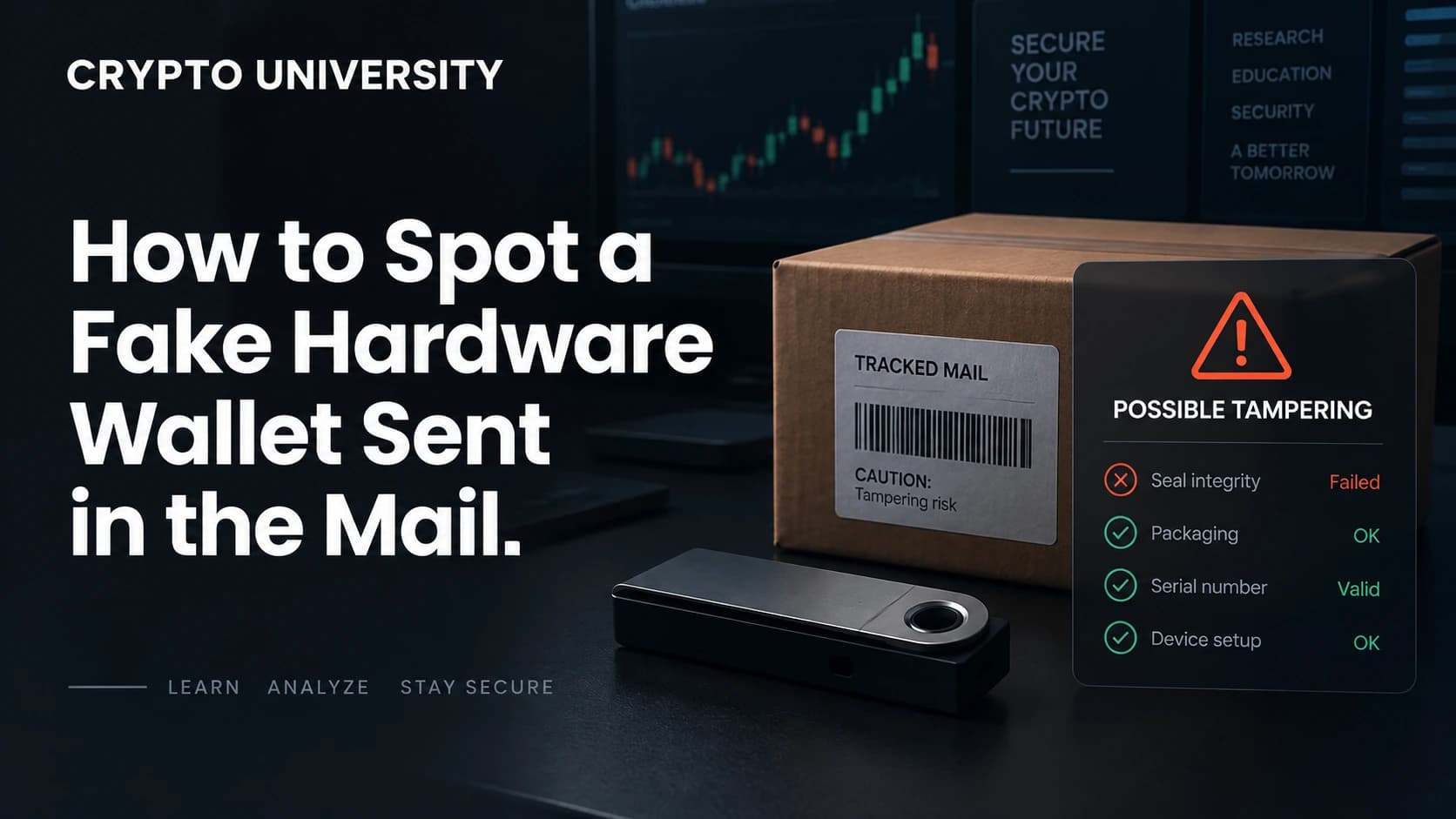
The best documented case appeared in 2021, when Ledger customers whose details were in the 2020 leak started receiving unordered Ledger Nano X devices. The packages were shrink wrapped, carried the correct branding, and included a sealed accessory bag.
Inside was a letter, presented as coming from the company's chief executive, explaining that the recipient needed to move to a new device because of the earlier breach. The enclosed manual told the user to plug the device into a computer and enter their 24 word recovery phrase into an application in order to initialize it. Security researchers who opened the devices found a flash drive soldered onto a circuit board that looked nothing like a genuine one. The phrase typed into that fake application went straight to the attacker.
The tactic has continued to evolve. In early 2026, Ledger and Trezor owners reported physical letters with company logos, reference numbers and QR codes, instructing them to complete a "critical security update" by entering their recovery phrase. In a separate case reported in 2026, a researcher bought a counterfeit device from an online marketplace and found a substituted microcontroller inside with the chip markings physically scraped off, paired with trojanized companion apps and servers set up to collect stolen phrases.
Warning Signs to Check Before You Touch Anything
| Red flag | Why it matters |
|---|---|
| You did not order it | Wallet companies do not ship devices to customers who have not paid for them |
| A letter references a breach or a security upgrade | Urgency and fear are the core of the script |
| Any instruction to enter your recovery phrase | No legitimate setup, update or support process ever requires this |
| A recovery card that already has words on it | The wallet is already controlled by someone else |
| A scratch-off panel hiding a "starter" phrase | A genuine device generates the phrase on its own screen, never on paper |
| A QR code linking to a setup site | Real setup happens in the official desktop or mobile app |
| Instructions to install software from a link or an included drive | Malware delivery |
| Spelling and grammar errors in the letter | Common in these campaigns, though not always present |
| A device that already has firmware installed | Several manufacturers ship with no firmware at all |
| Packaging that looks resealed or glued | Suggests tampering, although clean packaging proves nothing |
The last point deserves emphasis. Ledger has publicly stated that tamper-evident seals and holograms are weak security because they are cheap to clone and packages can be opened and closed without visible damage. Treat physical seals as a first filter, not as proof.
What a Genuine Setup Looks Like
| Step | Genuine device | Fake or tampered device |
|---|---|---|
| Source | Ordered by you from the manufacturer or an authorized reseller | Arrived unsolicited, or bought from a marketplace listing |
| Recovery phrase | Generated by the device and shown only on the device screen | Supplied to you on a card, a letter or a website |
| Backup cards | Blank, filled in by you | Pre-printed, pre-written or scratch-off |
| Firmware | Often absent on arrival and installed during setup through the official app | Already installed and ready to go |
| Authenticity check | A cryptographic check runs in the official app and confirms the device | Fails the check, or you are told to skip it |
The cryptographic check is the part that matters. Ledger devices carry a factory issued key and an attestation. When the device connects to Ledger Live, the company's secure server sends a random challenge, the device signs it, and the server verifies the signature against the attestation. A counterfeit device cannot produce a valid signature, so it fails and is blocked from the device manager. Trezor uses a comparable approach on its Secure Element models, where the chip and the main processor jointly prove the device is genuine when it first connects to Trezor Suite. Trezor devices also ship without firmware, and firmware signatures are verified by the bootloader on every connection.
What to Do If a Package Arrives
Work through these steps in order.
- Do not connect it to anything. Not your main computer, not a spare laptop, not a phone. Treat it as an unknown USB device.
- Do not scan any QR code or visit any URL printed in the package.
- Photograph everything before you handle it further. The outer packaging, the postage label, the letter, the manual and the device itself.
- Check your existing wallets from a device you trust. If you already own a hardware wallet, confirm your balances using your normal setup. Do not re-enter your phrase anywhere.
- Contact the manufacturer through their official website, typed by hand into your browser. Report the package and ask whether it matches a known campaign. Most wallet companies keep a public page listing active scams.
- Report it to the authorities. In the United States, mail based fraud can be reported to the US Postal Inspection Service at uspis.gov/report or on 1-877-876-2455, to the FTC at reportfraud.ftc.gov, and to the FBI's Internet Crime Complaint Center at ic3.gov. Other countries have equivalent consumer fraud and postal fraud bodies.
- Do not resell it or give it away. Passing a compromised device to someone else moves the risk rather than removing it.
If you have already entered your recovery phrase into anything connected to that package, treat the wallet as compromised. Move any remaining funds to a new wallet, generated on a device you know is genuine, as quickly as you safely can. There is no way to reverse a blockchain transaction and no support desk that can undo it.
How to Reduce Your Exposure
- Buy only from the manufacturer's own website or a reseller listed on that website. Avoid general marketplaces and discount sellers.
- Run the authenticity check in the official app on every new device, even one that arrived in perfect packaging.
- Never store your recovery phrase in a photo, a password manager, a cloud note or an email draft.
- Assume that your name, address and phone number are already in a leaked dataset somewhere, and treat unsolicited contact accordingly.
- Consider using a shipping address that is not your home, such as a parcel locker or a workplace, if that is practical where you live.
FAQ
Is it safe to plug in a suspicious hardware wallet just to look at it? No. The device may be a disguised USB drive carrying malware. Even connecting it to a computer you rarely use creates unnecessary risk.
Would a wallet company ever mail me a free replacement after a breach? No known manufacturer does this. Companies communicate through their official app, their website and the email address on your order. If a replacement is genuinely due, you would arrange it yourself through support.
The packaging looked perfect. Does that mean the device is real? Not necessarily. Ledger itself has said that seals and holograms are easy to clone. Packaging is a starting signal, not proof of authenticity.
What if a device fails the genuine check in the official app? Stop the setup, do not enter a recovery phrase, and contact the manufacturer's support through their official website. A failed check is a strong indicator that the device is counterfeit or modified.
Are these scams only aimed at Ledger owners? No. Ledger cases are the best documented because of the size and age of the 2020 leak, but similar letters and counterfeit devices have targeted owners of other brands, and vendor data breaches in 2026 affected several manufacturers.
Five Related Terms
- Recovery phrase (seed phrase): The list of words, usually 12 or 24, that can restore full control of a wallet on any compatible device.
- Supply chain attack: An attack that compromises a product or its software somewhere between the manufacturer and the end user.
- Tamper-evident seal: Packaging designed to show visible damage if opened. Useful as a signal, but not a security guarantee.
- Attestation: A cryptographic proof, signed by a manufacturer issued key, that a device is genuine.
- Cold storage: Holding private keys on a device that is not connected to the internet during normal use.
Sources
- Ledger, "A closer look into Ledger security: the root of trust." ledger.com
- BleepingComputer, "Ledger customers impacted by third-party Global-e data breach," 5 January 2026.
- CoinDesk, "Scammers Are Sending Ledger Users Fake Hardware Wallets," 17 June 2021.
- Cointelegraph, "Scammers mail out fake hardware wallets to victims of Ledger data breach," 17 June 2021.
- Trezor Knowledge Base, device authentication guides for Trezor Safe 3, Safe 5 and Model One. trezor.io
- CCN, "Ledger and Trezor Users Security Alert: Seed Phrase Phishing Attempts Sent by Mail," February 2026.
- US Postal Inspection Service, reporting guidance. uspis.gov
Three More Reading
- Beginners Guide to Hardware Wallets Ledger vs Trezor vs Coldcard (https://cryptouniversity.network/guides/beginners-guide-to-hardware-wallets-ledger-vs-trezor-vs-coldcard)
- The Crypto Anti-Phishing Checklist (https://cryptouniversity.network/guides/the-crypto-anti-phishing-checklist-12-habits-that-stop-wallet-drainers-in-2026)
Disclaimer: This article is educational and is not financial, legal or investment advice. Regulatory rules and register locations change, so verify details with the relevant authority before acting.
Not sure which problem you have?
Use the Fixing Crypto Mistakes hub to identify the transaction, wallet, network, or exchange issue before taking another action.
OPEN TROUBLESHOOTING HUB