Key Takeaways
Most wallet-drainer losses still come from preventable slip-ups: approving the wrong thing, trusting a fake support message, or signing in a hurry.
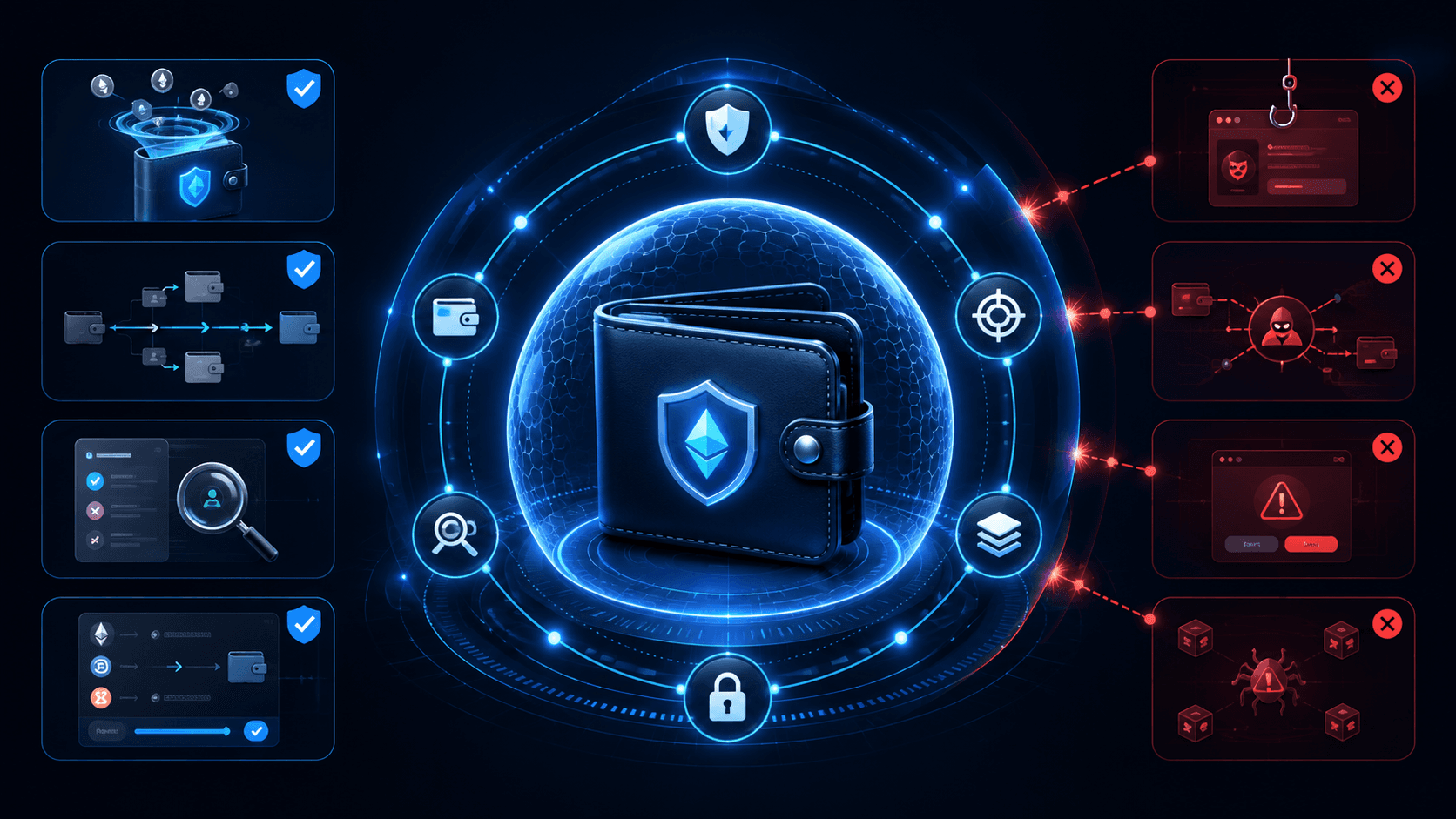
Good protection is not a single tool. It is a stack of small habits that cover how you browse, how you connect your wallet, and how you review what you sign.
The strongest move you can make is simply slowing down before you sign, especially when a site, message, or request feels urgent.
Why phishing protection needs to be practical
If you have spent any time in crypto, you have probably been told to watch out for scams. But phishing in 2026 does not look like the clumsy fake emails of a few years ago. Today's wallet drainer attacks are polished. They clone real websites, impersonate support staff, and slip malicious approvals into transactions that look completely normal until your funds vanish.
Here is the reassuring part: most people who lose money are not reckless. They simply have one bad moment in an otherwise ordinary routine. They click a sponsored search result, trust a friendly Telegram “admin,” approve a malicious Permit2 request, or copy an address that looks familiar.
This guide turns scam protection into something you can actually remember: a 12-point checklist of habits. No fear, no hype. Just the practical steps that stop the most common mistakes before they ever become losses.
Why wallet drainers still work
Wallet drainers are effective because they do not need to hack the blockchain at all. They only need you to sign something unsafe, or send your assets to the wrong place. That usually happens through one of a handful of routes: malicious token approvals, fake dApp connections, blind signing, fake support DMs, address poisoning, fake extension popups, or misleading signature requests.
The fix is not paranoia. It is a repeatable system. Here is how the most common attacks try to reach you:
Attack type | What it tries to get from you |
Fake site | A wallet connection and an approval |
Fake support DM | Your trust, a sense of urgency, and a link click |
Malicious approval | Permission to move your tokens |
Address poisoning | You to reuse a wrong destination address |
Signature scam | An off-chain or on-chain permission without clear context |
The 12 habits at a glance
Here is the full checklist in one view. Each habit is explained in detail below.
# | Habit |
1 | Bookmark the real sites you use |
2 | Be wary of anyone offering “support” in your DMs |
3 | Read the spender address before you approve any token |
4 | Treat Permit2 and signature requests as real risk |
5 | Do not blind sign unless you fully trust the context |
6 | Watch for address poisoning before sending funds |
7 | Review your browser extensions once a month |
8 | Use anti-phishing tools, but keep your own judgement |
9 | Keep your main wallet separate from your test wallet |
10 | Check every domain carefully, especially sponsored links |
11 | Revoke old approvals before they become a problem |
12 | Slow down whenever something feels urgent |
Habit 1: Bookmark the real sites you use
It sounds almost too simple, but bookmarking genuinely matters. Cloned domains and fake search ads are still one of the easiest ways to get drained. For every wallet app, exchange, DEX, bridge, or staking tool you use regularly, visit the real site once, confirm it is correct, and save it as a bookmark. From then on, open it from that bookmark instead of searching for it each time.
Why it works
You remove the single moment where a lookalike domain could sneak into your routine through a search result or a forwarded link.
Habit 2: Be wary of anyone offering “support” in your DMs
Genuine support teams almost never message you first. So if someone slides into your Telegram, Discord, or X messages right after you post a question in public, assume they are not who they claim to be until you have solid proof otherwise.
Fake support warning signs
They message you first.
They create a sense of urgency.
They ask you to “reconnect” or “validate” your wallet.
They send you a link instead of pointing you to the official site.
They ask for your seed phrase or private keys. No real team will ever do this.
Habit 3: Read the spender address before you approve any token
Many drainers work by getting you to approve a malicious “spender” contract, which is essentially handing a stranger permission to move your tokens. Before you tap approve, slow down for a few seconds and run through these checks:
Check | Why it matters |
Token name | Confirms this is the asset you actually mean to approve |
Spender address | Confirms exactly who is being given permission |
Approval size | Unlimited approvals create far bigger risk than limited ones |
Site context | Prevents a fake or confusing flow from slipping past you |
Habit 4: Treat Permit2 and signature requests as real risk
A common myth is that only token approvals can hurt you. That idea is out of date. Modern phishing often uses signature-based permissions, including Permit and Permit2-style flows, to authorize token movement without the traditional approve transaction you might expect to see.
A signature can be just as powerful as an on-chain approval, even when it is not labelled “transfer.” If you see a Permit2-style request, or any signature you do not fully understand, pause and find out exactly what it does before continuing.
Habit 5: Do not blind sign unless you fully trust the context
Blind signing means approving a transaction or message that you cannot actually read in plain language. It is one of the biggest avoidable risks in crypto, because you are agreeing to something you cannot see.
Situation | Why it is dangerous |
An unreadable prompt | You may have no idea what you are authorizing |
A cloned site | You may be trusting the brand, not the actual transaction |
Hardware confirmation on autopilot | You start clicking through without really reviewing |
If your wallet or hardware device can show you a human-readable version of what you are signing, use it. And if something can only be signed blindly, let that raise your caution rather than lower it.
Habit 6: Watch for address poisoning before sending funds
Address poisoning is a sneaky trick. Attackers send tiny transactions to your wallet from an address crafted to look almost identical to one you use often. Later, if you copy an address from your transaction history instead of checking it in full, you can send real funds straight to the attacker.
Safe sending rule
Never trust a partial address or your memory of one. Verify the entire address every time, or send only to an entry you have saved yourself in a trusted address book.
Habit 7: Review your browser extensions once a month
Browser extensions can quietly become part of your attack surface. Once a month, take a few minutes to check which extensions can read web pages or access your wallet, whether you still use them, whether they came from a publisher you trust, and whether they are up to date.
Extension hygiene checklist
Remove extensions you no longer use.
Avoid installing random “airdrop helper” tools.
Keep the number of wallet-related tools to a minimum.
Verify the publisher's identity carefully before installing.
Habit 8: Use anti-phishing tools, but keep your own judgement
Security tools genuinely help, but none of them replace a careful human. Think of them as a safety net, not as a reason to stop paying attention. A few that people commonly rely on:
Tool | Best use |
Review and revoke token approvals you no longer need | |
Pocket Universe | Preview what a risky transaction will actually do |
Scam Sniffer | Spot known phishing sites and receive alerts |
These tools can lower your risk, but they are not permission to stop thinking.
Habit 9: Keep your main wallet separate from your test wallet
Using one wallet for everything means a single bad click can cost you everything. A practical setup uses three wallets: one for long-term holdings you rarely touch, one for your active DeFi activity, and one small wallet for testing new or unfamiliar apps. If an interaction goes wrong, the damage stays contained to that one wallet.
For long-term storage, many people prefer hardware wallets such as Ledger, which keep signing isolated from your everyday browser.
Habit 10: Check every domain carefully, especially sponsored links
Search ads remain a favourite phishing channel. Attackers buy ads for wallet sites, DEX front-ends, bridge interfaces, staking dashboards, and airdrop claim pages, then sit and wait for a rushed click.
Domain check habits
Avoid clicking sponsored search results whenever you can.
Compare the full domain, not just the brand word in it.
Watch for swapped characters and unusual domain endings.
Use bookmarks for any destination you visit regularly.
Habit 11: Revoke old approvals before they become a problem
Stale approvals are one of the easiest ways for an old mistake to turn into a fresh loss. Make a habit of revoking permissions in these situations: when you no longer use an app, when a protocol has suffered an exploit, when you tested a tool once and moved on, or when you simply do not recognize a spender anymore. This is especially important after any interaction that felt off.
Habit 12: Slow down whenever something feels urgent
Urgency is the emotional engine behind almost every phishing attack. Watch out for pressure lines such as “claim now,” “your wallet is at risk,” “verify immediately,” “reconnect now,” or “your support ticket is expiring.” If a message or website is trying to shrink your thinking time, treat that pressure itself as the red flag.
A practical anti-phishing workflow
The checklist becomes easier to use when you tie it to three natural moments in your day.
Before connecting your wallet
Use a bookmark or a verified official link.
Check the domain carefully.
Confirm you genuinely intended to visit this app.
Avoid acting on anything that started in a DM.
Before approving or signing
Read the prompt fully.
Inspect the spender address or signature context.
Avoid blind signing when anything is unclear.
Check whether the request fits what you are trying to do.
After any suspicious interaction
Disconnect from the site.
Review your wallet approvals.
Move important funds if the risk is unclear.
Monitor your recent transactions.
Do not trust follow-up DMs offering “recovery” help.
Where EIP-7702 and newer signature patterns fit in
You may have heard about EIP-7702, a change introduced with Ethereum's Pectra upgrade in May 2025. It lets a normal wallet (an externally owned account) temporarily act like a smart contract, which enables conveniences such as batched transactions and gas sponsorship.
The catch is that this same flexibility has already been turned against users. Since the upgrade went live, security researchers have tracked phishing campaigns that abuse EIP-7702 “delegation” to drain wallets through a single signed message. Instead of asking you to approve tokens one by one, a malicious site can bundle everything into one click that looks routine.
The lesson is not that the technology is bad. It is that signing a delegation request deserves the same caution as handing over your private key. If any site or message asks you to “upgrade” your wallet or sign a delegation outside your wallet's own interface, treat it as a scam. New standards do not remove phishing. They make readable prompts and careful review more important than ever.
Why this checklist beats one-off advice
A single tip is easy to forget. A checklist works because it catches mistakes at several different stages, so a slip at one point can still be stopped at the next.
Stage | Risk reduced by the habit |
Before you visit a site | Fake or cloned domain risk |
Before you connect a wallet | Social engineering risk |
Before you sign | Malicious approval and drainer risk |
After a suspicious event | Containing the damage |
That is what a real wallet defense looks like: small checks, repeated consistently.
Final thought
Wallet drainers still work because too many people treat signing as a routine click instead of a financial decision. The best anti-phishing strategy in 2026 is not one magical tool. It is disciplined repetition.
Bookmark the real sites. Ignore unexpected support DMs. Check spender addresses. Be suspicious of urgency. Revoke old permissions. Keep your wallets separate. And above all, slow down before you sign. It is boring advice, but boring is exactly what keeps wallets safe.
Frequently asked questions
Question | Answer |
What is a wallet drainer? | A scam setup that tricks you into signing an approval or transaction that lets attackers move assets out of your wallet. |
What is address poisoning in crypto? | A tactic where attackers send tiny transactions from lookalike addresses, hoping you later copy the wrong one from your transaction history. |
Are Permit2-style requests dangerous? | They can be if you do not understand the permission you are granting. Signature-based approvals deserve the same caution as on-chain token approvals. |
Should I always revoke old approvals? | Review them regularly and revoke the ones you no longer need, especially after trying new apps or after a protocol incident. |
Are anti-phishing tools enough on their own? | No. Tools help, but your own review and slower decision-making still matter most. |
What is the best habit for a beginner? | Use bookmarks, distrust unexpected DMs, and never sign anything you do not understand. |
Disclaimer
This content is for educational and informational purposes only and is not financial advice. Nothing here is a recommendation to buy or sell any asset or use any platform. Do your own research and manage your risk.
DeFi Risk Management 101: How to Protect Your Portfolio From Protocol Failures
Cross-Chain Bridges: A Plain-English Guide to How They Work and When to Avoid Them
How to Read a Smart Contract Audit Report (Without Being a Developer)
The Complete Beginner's Guide to Self-Custody: How to Hold Your Own Crypto Safely
Need deeper training?
Join our structured modules with live examples and expert checklists for effective implementation.
JOIN THE ACADEMY