Key Takeaways
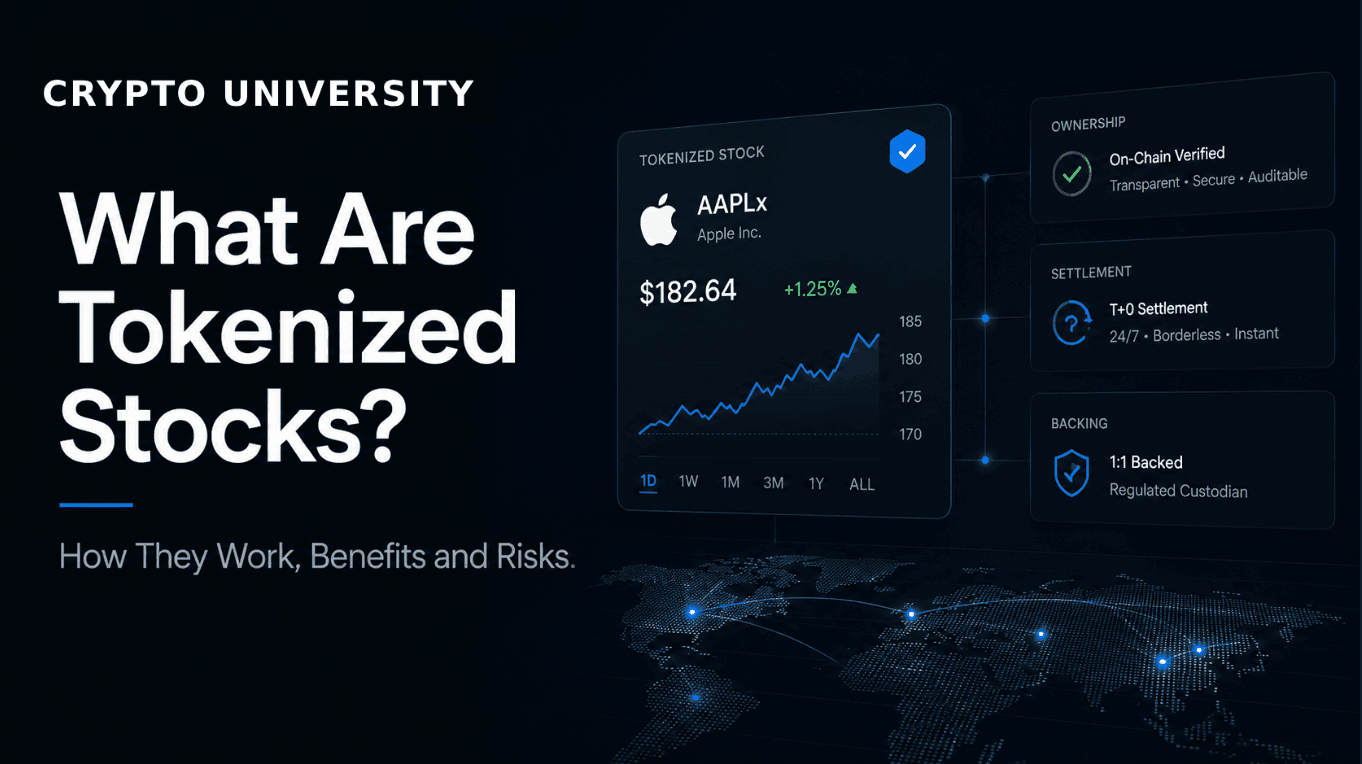
A tokenized stock is a crypto token that tracks the price of a real share or ETF. In most products you get the price exposure, but you don't actually own the share or get voting rights.
Before you buy, always check three things: who issued the token, whether it's backed by real shares, and how you can cash out. Backed and synthetic products carry very different risks.
Tokenized stocks are most useful if you live outside the US and struggle to access US brokers. Availability, legal protections, and rules still vary a lot from country to country.
What This Guide Covers
If you've ever held a stablecoin like USDT in a crypto wallet, you already understand the basic idea behind tokenized stocks. A stablecoin is simply a token that tracks a dollar sitting somewhere else. A tokenized stock does the same thing, except it tracks a share of a company like Tesla or Apple, or an ETF, that's being held somewhere else on your behalf.
The token itself trades on crypto platforms, while the real share sits safely with a custodian. What ties the two together is a legal arrangement, and that arrangement is where all the important details live.
In this guide, we'll walk through what tokenized stocks are, how they actually work behind the scenes, what you do and don't own when you buy one, and who they make sense for.
The Short Answer
A tokenized stock is a blockchain token designed to give you the same financial ups and downs as a listed share or ETF. When Tesla rises 5 percent, the token is built to rise 5 percent too. When Tesla pays a dividend, most tokenized products pass that value on to you in some form.
Here's the part people often miss: a tokenized stock usually is not direct ownership of the share. With most products available today, your name isn't on the company's shareholder register, you can't vote at shareholder meetings, and your legal claim is against the company that issued the token, not against Tesla itself. Whether that trade-off matters to you depends on why you're buying, which we'll come back to.
Want to compare live options? You can check current prices, backing, issuers, blockchains, and verified trading platforms in the Crypto University Tokenized Stocks Directory.
A Simple Example: Buying Tesla Exposure With a Token
Let's say Tesla trades at around 320 dollars on the Nasdaq. You'd like some exposure to it, but you don't have a US brokerage account, or your local broker charges heavy fees just to access US markets. Here's how the tokenized version works, step by step:
An issuer, such as Backed Assets (the company behind xStocks), buys real Tesla shares through a broker.
Those shares are held with a regulated custodian in a separate, ring-fenced account.
The issuer creates tokens, for example TSLAx, at a one-to-one ratio against the shares it holds.
The tokens get listed on crypto exchanges like Kraken or Bybit, or they trade directly on decentralised exchanges.
You buy TSLAx with USDT, USDC, or regular money, hold it on the exchange or move it to your own wallet, and sell whenever you want to exit.
At that point you have Tesla price exposure sitting inside a crypto account. What you don't have is a Tesla share in your name. What you hold is a token whose issuer owes you the financial value of one share.
Who's Involved: Issuer, Custodian and Platform
Three roles matter in every tokenized stock product, and mixing them up is what causes most of the confusion you'll see online. Here's who does what:
Role | What they do | Why it matters |
|---|---|---|
Issuer | Creates the token and defines your legal claim. Examples include Backed Assets for xStocks, an Ondo entity for Ondo Global Markets, and Robinhood's European arm for its EU stock tokens. | This is your counterparty. If anything goes wrong, your claim is against them. |
Custodian | Holds the actual shares. These are regulated brokers and custody providers. The better products keep the shares legally separated from the issuer's own money. | If the issuer fails, well-separated shares shouldn't be swept up in its bankruptcy. |
Platform | Where you actually trade: Kraken, Bybit, Gate, OKX, a decentralised exchange, or a wallet app. | A platform listing a token tells you nothing on its own about how well that token is backed. |
We break down each major issuer in The Companies Behind Tokenized Stocks Tokenized Stock Risks: Issuers, Custody, Liquidity and Tracking Error.
Backed vs Synthetic: Two Very Different Models
Not everything labelled a tokenized stock works the same way. There are really two models, and they carry different risks.
Feature | Fully backed (collateralised) | Synthetic |
|---|---|---|
How it works | Backed one-to-one by real shares held in custody. | Tracks the price without actually holding the share. |
Examples | xStocks, Ondo Global Markets tokens, Dinari dShares. | Equity perpetual futures and older derivative-style tokens. |
Where the price comes from | The issuer genuinely holds the underlying stock. | A price feed from an oracle or the platform itself. |
Main risks | Issuer failure and custody failure. | Counterparty solvency and funding costs. |
Both models can serve a purpose, but the golden rule is to always know which one you're buying. Our full backing guide How Tokenized Stocks Are Backed goes deeper.
How Issuance and Redemption Keep the Price Honest
Backed tokens stay close to the real share price because professional traders, known as authorised participants, can create and cash in tokens. If TSLAx drifts above the real Tesla price, they can buy shares, create new tokens, and sell them, which pushes the token price back down. If it drifts below, they can buy cheap tokens and redeem them for the value of the shares.
This is the same balancing act that keeps ETF prices near their true value. It works well when redemption is open, fast, and cheap, and less well when redemption is restricted or the stock market is closed. That's why tokens can drift away from the real price on weekends, sometimes sharply when there isn't much trading. We cover this in Can Tokenized Stocks Depeg From Real Shares?
Dividends, Votes and Corporate Actions
There are three things people naturally assume come with owning stock. Here's how tokens actually handle each one:
What you'd expect | How tokens handle it |
|---|---|
Dividends | Most backed products pass the value on, but not usually as cash. xStocks increases your token balance when a dividend is paid. Ondo reflects the value inside the token, after tax. Robinhood's EU tokens pass value through as in-app payments. Always check the specific product. |
Voting rights | Mainstream tokenized stocks don't give you voting rights, because you're not a registered shareholder. If voting matters to you, you'll need real shares through a broker. |
Splits and other actions | Handled automatically by the issuer, usually by adjusting your balance. You don't need to do anything, though a split can explain why a token's price suddenly looks different. |
There's more detail in Do Tokenized Stocks Pay Dividends? How xStocks and Stock Tokens Handle Payouts
Trading Hours: Better Than Markets, But Not Always 24/7
US stock exchanges are only open for about six and a half hours a day, five days a week. Tokenized stocks improve on that, but exactly how much depends on where you trade:
Venue | Trading hours |
|---|---|
Kraken (xStocks) | 24 hours a day, five days a week. |
Self-custody wallets on DEXs | 24/7, because no one can close a liquidity pool on a Sunday. |
Robinhood EU tokens | 24 hours a day, five days a week. |
Issuer minting and redemption | Usually follows US market hours or a 24/5 schedule. |
The catch is this: when the underlying stock market is closed, there's no live price to reference. Weekend prices are driven purely by token supply and demand, which can mean wider gaps between buying and selling prices, plus possible jumps when Monday's market opens. There's more detail in Can You Trade Tokenized Stocks 24/7? Market Hours and Weekend Pricing Explained
Why Tokenized Stocks Exist: The Access Problem
For decades, buying US stocks was easy if you were American with a brokerage account, and often painful if you weren't. Depending on where you lived, you might have faced brokers that don't accept your country, high minimum deposits, expensive international transfers, currency controls, and weeks of paperwork.
Yet the very same person locked out of a US broker can often buy USDT in minutes through a local exchange. Tokenized stocks connect those two worlds: if you can hold stablecoins, then where it's legally supported, you can hold Tesla or S&P 500 exposure through the same setup. The starting amounts are small too. Kraken lets you buy xStocks from just 1 dollar, which really matters in places where a single Microsoft share at around 380 dollars is a serious sum.
That's a real improvement, but it's not a revolution. Tokenized stocks aren't available in several major markets (including to US residents, and currently in the UK and Canada for xStocks), the legal treatment varies by country, and the protections you get differ from a regulated brokerage account. Access is broader, not universal.
The Main Risks
Here's a fair summary of what can go wrong:
Risk | What it means |
|---|---|
Issuer risk | Your claim is against the issuer. If it fails, recovery depends on how well the shares were separated and on the legal terms. |
Custody risk | The shares sit with custodians. Custody failure or fraud would weaken the backing. |
Liquidity risk | Trading pools are much thinner than real stock markets, so exiting a large position can move the price against you. |
Tracking risk | The token can trade above or below the real price, especially outside market hours. |
Platform and smart-contract risk | Exchange failures and code exploits can affect these tokens like any other crypto asset. |
Regulatory risk | Products can be pulled from your country, and the rules are changing fast. |
None of these makes tokenized stocks off-limits. They simply make them different from brokerage shares, and that difference should shape how much of your portfolio you put through them. There's a full breakdown in Tokenized Stock Risks: Issuers, Custody, Liquidity and Tracking Error.
Who Tokenized Stocks Are Useful For
A good fit if you... | Probably not a fit if you... |
|---|---|
Live outside the US with limited or expensive access to US brokers. | Already have cheap access to a good regulated broker. |
Are already comfortable using crypto exchanges and wallets. | Want voting rights and maximum investor protection. |
Want your equity and crypto exposure sitting in one place. | Are a US resident, since the main offshore products exclude you entirely. |
Want to hold equity exposure in self-custody or use it onchain. |
Quick Recap Before You Buy
A tokenized stock gives you price exposure through a token. In mainstream products your legal claim is against the issuer, not the company.
Always identify the issuer, the backing model, and the redemption terms first. Fully backed and synthetic products are different animals.
Dividends usually arrive as a bigger token balance or a value adjustment, not cash. Voting rights don't come at all.
Trading runs around the clock onchain, but weekend prices float without a live stock-market anchor.
Availability depends on where you live. Check whether the product legally serves your country before anything else.
You can compare live prices, issuers, backing, and verified venues for each asset in the Crypto University Tokenized Stocks Directory.
Frequently Asked Questions
What is a tokenized stock in simple terms?
It's a blockchain token built to track the price of a real share or ETF. The issuer holds or references the underlying asset, and the token gives you its financial performance without making you a registered shareholder.
Are tokenized stocks backed by real shares?
The major products today (xStocks, Ondo Global Markets, Dinari dShares) are backed one-to-one by real shares held with regulated custodians. Some other products are synthetic derivatives, so always check the documentation.
Do I own the actual stock when I buy a tokenized stock?
Generally no. You usually hold a debt instrument, certificate, or note issued against the shares. You get the financial exposure, not registered ownership or voting rights.
Can Americans buy tokenized stocks?
The main offshore products, including xStocks, aren't available to US residents. The SEC has confirmed tokenized securities still fall under securities laws and is working on an exemption framework, and Dinari holds US broker-dealer registration, so the picture is evolving.
Do tokenized stocks pay dividends?
Most backed products pass on dividend value, usually by increasing your token balance or adjusting the token's value rather than paying cash. Treatment varies by issuer.
Can I hold tokenized stocks in my own wallet?
Yes, for on-chain products. Kraken supports xStocks withdrawals to self-custody wallets, and tokens on Solana, Ethereum, and other chains can be held and traded like any other token where permitted.
Disclaimer: This content is for educational and informational purposes only and is not financial advice. Nothing here is a recommendation to buy or sell any asset or use any platform. Do your own research and manage your risk.
Explore The Crypto University Tokenized Stocks Directory.
Tokenized Stocks Explained: A Simple Guide for Beginner Traders
How to Buy Tokenized Stocks: A Step by Step Guide for Beginners
Best Platforms for Tokenized Stocks: Exchanges, Brokers and Onchain Apps
Need deeper training?
Join our structured modules with live examples and expert checklists for effective implementation.
JOIN THE ACADEMY