Key Takeaways
- Recovery depends on who controls the destination address, not on the blockchain. If a person, exchange, or token issuer controls the keys or the contract, a path exists. If nobody does, there is none.
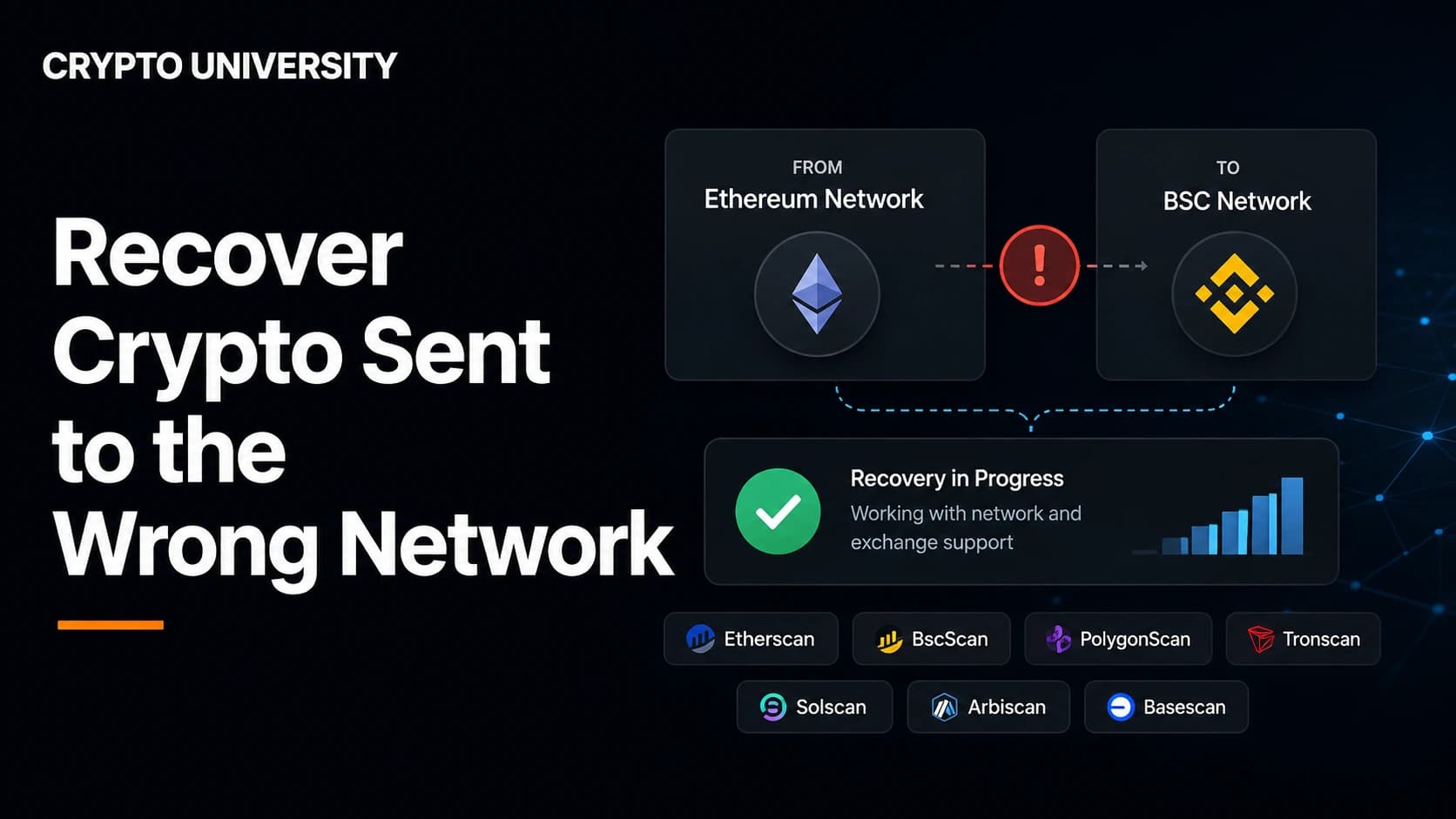
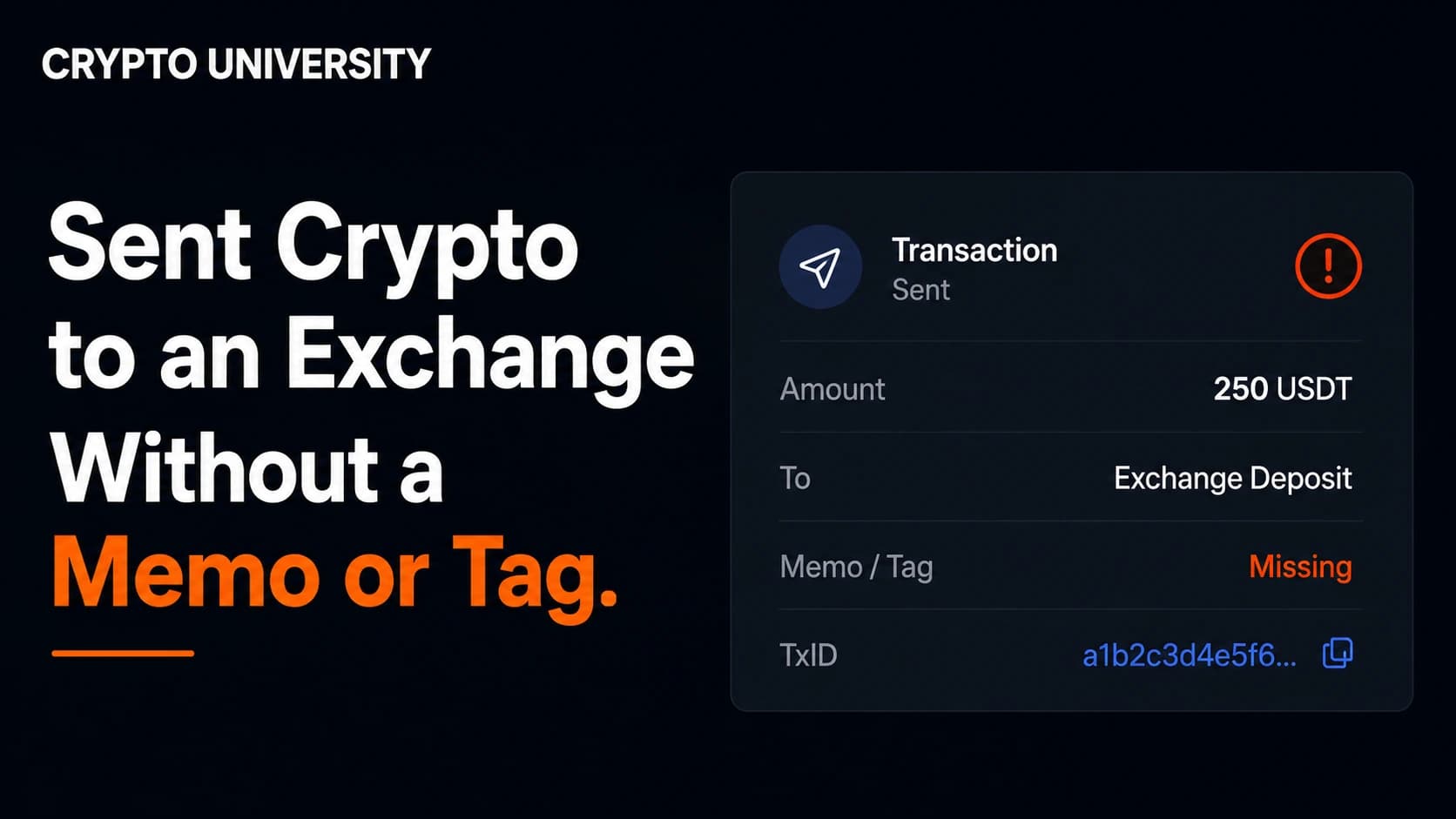
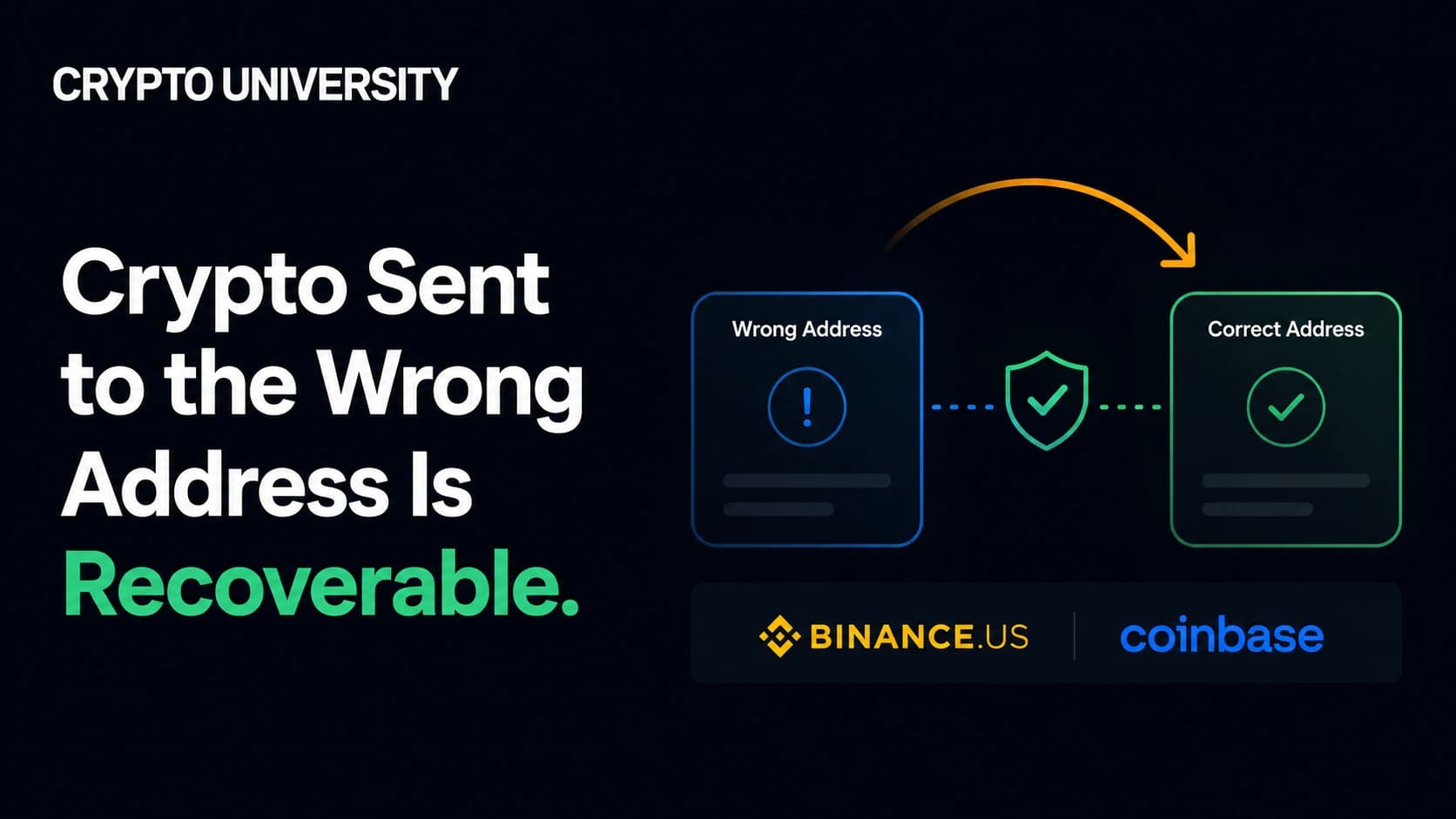
- Some common mistakes have a recovery path, but none is automatic. Wrong-network sends to an address you control and exchange deposits missing a memo or tag may be recoverable. The destination type and provider policy decide the outcome.
- Anyone who guarantees recovery for an upfront fee is very likely a scammer. Law enforcement agencies have issued repeated warnings about fake recovery services that target people who already lost money.
Why Crypto Transactions Cannot Be Reversed
Blockchains do not have a chargeback function. Once a transaction is confirmed, it is part of the permanent record and no support agent can undo it. Coinbase states this plainly in its help center: transactions are final and cannot be cancelled or reversed, and if you do not know who owns the receiving address, there is nothing you can do to retrieve the funds.
But "irreversible" is not the same as "unrecoverable." The transaction cannot be undone. The funds can still be sent back, voluntarily, by whoever controls the destination. So the useful question is never "can I reverse this?" It is: who or what sits at the other end of that address, and can they send it back?
Step 1: Collect the Facts Before You Do Anything
Gather these details from your wallet or exchange history first. Every recovery request asks for them, and entering them wrong is a common reason requests get rejected.
| What to collect | Where to find it | Why it matters |
|---|---|---|
| Transaction hash (TxID) | Wallet history or block explorer | Proves the transfer happened and where it went |
| Sending address | Your wallet | Confirms you are the sender |
| Destination address | The transaction record | Determines who controls the funds |
| Network used | Wallet network selector or explorer | Decides whether the send was cross-chain |
| Exact token and amount | Transaction record | Recovery forms often reject rounded numbers |
| Timestamp and confirmations | Block explorer | Establishes finality and timeline |
Then paste the destination address into a block explorer such as Etherscan, BscScan, Tronscan, Solscan, or mempool.space. The explorer answers the most important question: is the address a normal wallet, a smart contract, or an address with no history at all?
Step 2: Identify Which Type of Mistake You Made
Almost every case falls into one of eight categories.
| Scenario | Typical outcome | Who can help |
|---|---|---|
| Wrong network, same address format, self-custody wallet (for example ETH sent on Arbitrum to a Base address you control) | Usually recoverable by you | Nobody. Switch the network in your wallet |
| Wrong network deposit to an exchange address | Sometimes recoverable | The exchange, via a recovery ticket, for a fee |
| Deposit missing a memo or destination tag (XRP, XLM, ATOM, and similar) | Often recoverable | The receiving exchange |
| Unsupported token sent to a supported exchange address | Sometimes recoverable | The exchange, through an asset recovery tool |
| Sent to an address belonging to a person or business you can identify | Depends entirely on goodwill | The recipient |
| Sent to a token contract address (for example USDT sent to the USDT contract) | Occasionally recoverable | The token issuer, at its discretion |
| Sent to a random valid address with no known owner | Effectively unrecoverable | Nobody |
| Sent to a burn address or an unspendable address | Permanently gone | Nobody |
The Self-Custody Case Is the Good News Case
If the destination is your own externally owned account on a compatible EVM network, the same key normally controls that address across those networks. Confirm the transaction and address on the correct explorer, then use your wallet provider's official network instructions. You may need to switch networks or add the token contract and hold the destination network's native asset for gas. This does not automatically apply to exchange deposit addresses, smart-contract wallets, or incompatible address systems.
Step 3: If an Exchange Is Involved, Check Its Current Recovery Policy
Exchange deposit addresses are controlled by the exchange, not by you. Some exchanges provide a self-service recovery form for eligible deposits; others review cases manually or do not support recovery. Eligibility, supported networks, minimum amounts, fees, and processing times can change.
Use only the support link inside the exchange's official app or a URL you navigate to yourself. Collect the transaction hash, network, asset, exact amount, destination address, and account details before opening one complete request. If the problem is a missing memo or destination tag, follow the dedicated memo and tag recovery guide. If it is the wrong chain, use the wrong-network recovery guide.
Do not pay an unsolicited third party. A block explorer can prove where the assets went, but it cannot move assets held by an exchange.
Step 4: Token Issuer Recovery Is Exceptional
Some centrally issued tokens may have administrative controls, but that does not create a general consumer recovery right. An issuer may be technically unable, legally unwilling, or operationally unable to help. Never assume that freezing or reissuing assets is available for your token, network, destination, or jurisdiction.
If an issuer publishes an official recovery process, read the current eligibility rules directly on its verified domain and expect identity and ownership checks. Never share a seed phrase or private key. Treat anyone claiming to act for an issuer through direct messages as a scammer.
When Funds Are Genuinely Not Recoverable
Accepting a loss quickly is better than chasing a fantasy. Funds are effectively gone when:
- The destination is a valid address whose owner is unknown and unidentifiable
- The destination is a burn address or an address with no corresponding private key
- The tokens went into a smart contract with no withdrawal or rescue function, and the token is not centrally issued
- The receiving exchange states the network is unsupported and outside its recovery scope
- The amount is too small to clear the platform's minimum threshold
A note on typos: Bitcoin addresses carry a built-in checksum, so a mistyped address is normally rejected by your wallet before broadcast. Ethereum added a similar safeguard in EIP-55, which encodes a checksum in the capitalization of the address. It works well, but only if the wallet checks it, and an all-lowercase address bypasses the check in older software.
Beware of Recovery Scams
This is where people lose money a second time. The FBI has issued repeated public warnings about fraudulent crypto recovery services, including fake law firms, and states plainly that private sector recovery companies cannot issue seizure orders. The North American Securities Administrators Association has published its own advisory on "recovery room" schemes.
Warning signs to treat as disqualifying:
- They contacted you first. Legitimate investigators and lawyers do not cold-message loss victims on social media
- They guarantee recovery. Nobody can
- They want an upfront fee, especially in crypto or to a third-party company
- They ask for your seed phrase or private key. No legitimate service ever needs this
- They cannot show verifiable credentials, a real address, or a bar registration
For a large loss, the sensible step is a licensed lawyer in your jurisdiction or an established analytics firm you approached yourself, not a service that found you.
Prevention Checklist
- Send a small test transaction before any large or first-time transfer
- Verify the full address, not just the first and last four characters, because address-poisoning scams rely on matching endings
- Confirm the network on both the sending and receiving side
- Check whether the asset requires a memo or destination tag
- Use saved address book entries and allowlists instead of pasting each time
- Confirm the receiving platform supports both the token and the network
FAQ
Can a blockchain transaction be reversed if I act fast enough? No. Once confirmed, nobody can undo it. While a transaction is still pending, some wallets let you replace it with a higher fee transaction, but only before confirmation and only on networks that support it.
I sent tokens on the wrong network to my own wallet. Are they lost? Usually not. If both chains use the same address format and you hold the seed phrase, switch networks and the balance should appear. You may need to add the token contract manually and hold a little native coin for gas.
Will an exchange return crypto I withdrew to the wrong external address? No. Once the withdrawal leaves the exchange, the exchange has no control over it. You would need to contact whoever controls the receiving address.
How long does exchange or issuer recovery take? Timelines vary. Some exchange cases close within a few weeks, while issuer-level and complex cross-chain cases are widely reported to take months. No platform guarantees success.
Can law enforcement recover funds sent by mistake? An honest mistake is generally not a crime, so there is usually nothing to investigate. Law enforcement is relevant when theft or fraud is involved, and even then recovery rates are low.
5 Related Terms
- Blockchain finality
- the point at which a confirmed transaction can no longer be changed or removed.
- Self-custody
- holding your own private keys, meaning no third party can move or return your funds.
- Destination tag or memo
- an identifier some networks require so a shared exchange address can credit the right user.
- Smart contract address
- an on-chain program address; tokens sent there are stuck unless the code allows retrieval.
- Address poisoning
- a scam that plants a look-alike address in your transaction history hoping you copy it by mistake.
This article is educational information, not financial or legal advice. Platform fees, policies, and recovery tools change frequently. Always verify current terms directly with the relevant platform.
Sources
- Coinbase Help, "Crypto sent to the wrong address": https://help.coinbase.com/en/coinbase/trading-and-funding/sending-or-receiving-cryptocurrency/i-sent-funds-to-the-wrong-address-how-do-i-get-them-back
- Coinbase Help, "Deposit missing - Sent to wrong address": https://help.coinbase.com/en/exchange/crypto-transfers/sent-to-wrong-address
- Binance Support, "How to Retrieve a Deposit That Hasn't Arrived With Self-Service Recovery": https://www.binance.com/en/support/faq/how-to-retrieve-a-deposit-that-hasn-t-arrived-with-self-service-recovery-4d1347b4d6d44564ba44ea785703a4fd
- Binance Support, "How to Retrieve Crypto Deposit with Wrong or Missing Tag/Memo": https://www.binance.com/en/support/faq/how-to-retrieve-crypto-deposit-with-wrong-or-missing-tag-memo-40b87335db904481888ef406b105442b
- Binance.US Help Center, "How to use the deposit recovery tool": https://support.binance.us/en/articles/9842793-how-to-use-the-deposit-recovery-tool
- Blockchain.com Support, "Crypto Recovery for Unsupported or Incorrect Transfers": https://support.blockchain.com/hc/en-us/articles/8219099905436-Crypto-Recovery-for-Unsupported-or-Incorrect-Transfers
- Tether, "Tether Tokens Recovery": https://tether.to/en/tether-token-recoveries/
- BNB Chain Docs, "Recovering Tokens Sent to the Wrong Chain or Address": https://docs.bnbchain.org/bnb-smart-chain/faq/recovering-tokens-sent-to-wrong-chain-or-address/
- TechCrunch, "Coinbase launches asset recovery tool for unsupported Ethereum-based tokens": https://techcrunch.com/2022/12/15/coinbase-asset-recovery-tool
- FBI, "Building a Defense Against Cryptocurrency Recovery Scams": https://www.fbi.gov/contact-us/field-offices/elpaso/news/fbi-tech-tuesday-building-a-defense-against-cryptocurrency-recovery-scams
- FBI, "Fictitious Law Firms Targeting Cryptocurrency Scam Victims": https://www.fbi.gov/investigate/cyber/alerts/2025/fictitious-law-firms-targeting-cryptocurrency-scam-victims-combine-multiple-exploitation-tactics-while-offering-to-recover-funds
- NASAA, "Informed Investor Advisory: Crypto Recovery Room Scams": https://www.nasaa.org/78036/informed-investor-advisory-crypto-recovery-room-scams/
- Ethereum Improvement Proposals, "EIP-55: Mixed-case checksum address encoding": https://eips.ethereum.org/EIPS/eip-55
- The Block, "Tether has helped recover $87 million in USDT to date": https://www.theblock.co/post/131258/tether-recovered-87-million-usdt-wrong-addresses-since-launch
Not sure which problem you have?
Use the Fixing Crypto Mistakes hub to identify the transaction, wallet, network, or exchange issue before taking another action.
OPEN TROUBLESHOOTING HUB