Key Takeaways
- Funds sent on the wrong network may still exist at the destination address on that chain. Recovery depends on the address type, network compatibility, and who can authorize a transaction from that destination.
- Where the funds landed decides your options. If they arrived in a wallet you control, you can often recover them yourself for the cost of network fees. If they arrived at an exchange deposit address, only the exchange can move them, and most charge a fee.
- No legitimate recovery process needs your seed phrase. Anyone who asks for it, or who contacts you first offering to get your money back, is running a scam.
What "Wrong Network" Actually Means
Most people picture their coins floating somewhere in space. That is not what happens.
A token like USDT is not a single object. It is a separate contract deployed on each blockchain: one on Ethereum, one on Tron, one on BNB Chain, one on Solana. Your balance sits on exactly one of them.
Ethereum-compatible chains, usually called EVM chains, make this mistake easy. BNB Chain, Polygon, Arbitrum, Base and Avalanche C-Chain all build addresses from the same type of key pair as Ethereum, so an address starting with 0x is valid on every one of them. When you pick the wrong network on a withdrawal screen, the transaction does not fail. It succeeds, and it settles on a ledger you did not intend to use.
So the money is sitting at your address, on the wrong chain. Whether you get it back depends on who holds the key to that address.
Step 1: Gather the Facts Before You Do Anything
Do not send a second transaction, and do not type your seed phrase into any website or tool. Open a block explorer and record the following.
| What to record | Why it matters |
|---|---|
| Transaction ID (TxID or hash) | Every recovery form requires it |
| Transaction status | Recovery is only possible if it shows confirmed or success |
| Network it settled on | Determines which chain holds your funds |
| Receiving address | Shows whether it is your wallet or an exchange address |
| Token contract address | Separates the real token from a lookalike |
| Exact amount, including decimals | Mismatched amounts get claims rejected |
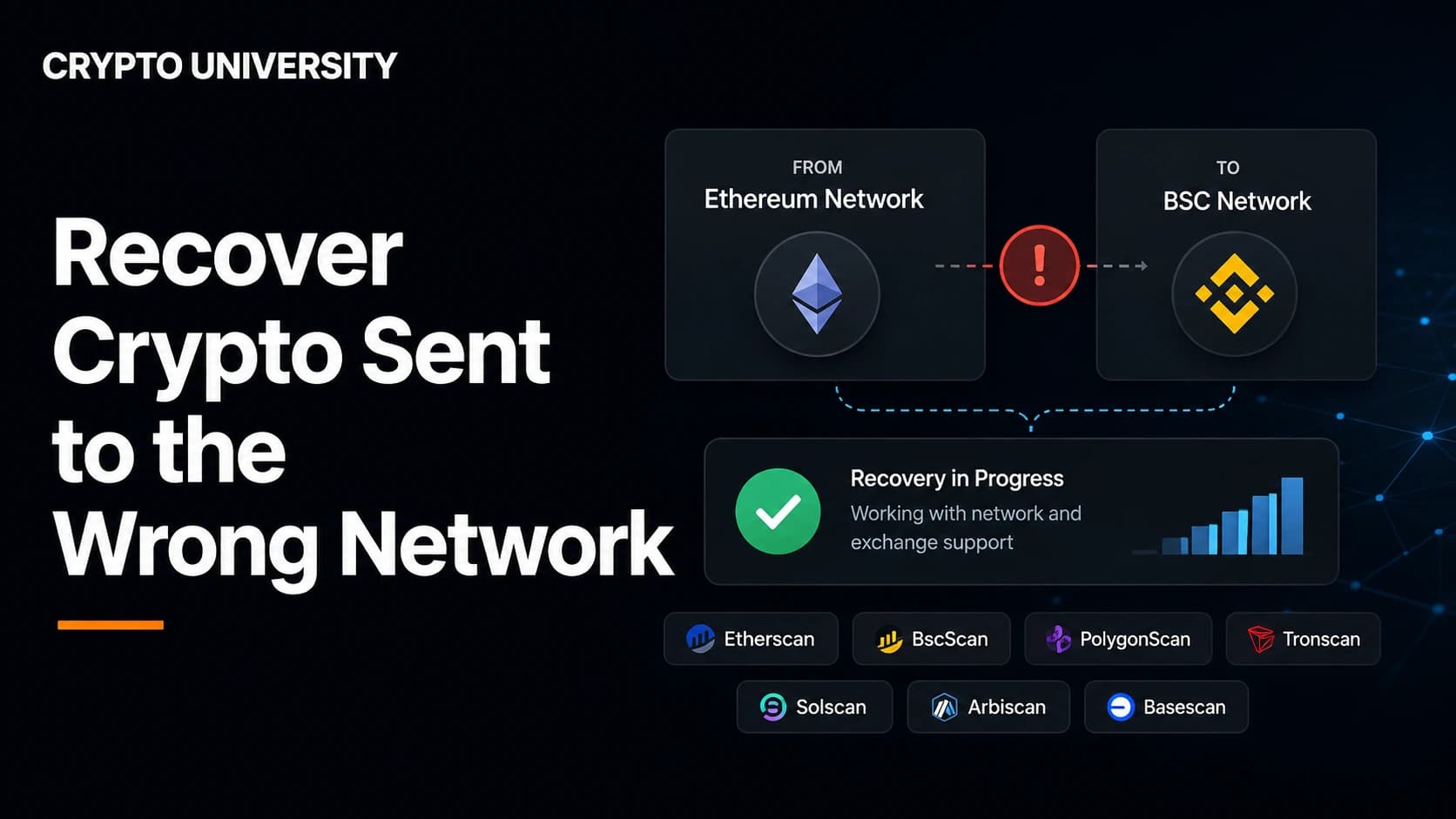
Useful explorers: Etherscan, BscScan, PolygonScan, Tronscan, Solscan, Arbiscan and Basescan.
Step 2: Identify Which Situation You Are In
| Where the funds landed | Who holds the key | Realistic outcome |
|---|---|---|
| Your own self-custody wallet (MetaMask, Trust Wallet, Ledger) | You | Usually recoverable by you, cost is gas only |
| An exchange deposit address | The exchange | Sometimes recoverable, usually for a fee, never guaranteed |
| An exchange hot wallet address | The exchange | Often recoverable, usually free or network fee only |
| A smart contract address | Nobody, unless it has a rescue function | Usually permanent loss |
| A wallet belonging to someone else | That person | Depends on their goodwill |
Case A: The Funds Are in a Wallet You Control
This is the best outcome, and the one most people do not realize applies to them. If the receiving address is your own EVM wallet, the tokens are already yours. Your wallet simply is not looking at that chain yet.
Steps to recover:
- Add the network to your wallet. In MetaMask, open the network selector and add the network manually, or use a network directory such as Chainlist. The network name, RPC URL and chain ID must be correct.
- Switch to that network. Your address stays identical. Only the ledger on display changes.
- Send a small amount of the gas token to that address. You cannot move anything without gas: BNB on BNB Chain, POL on Polygon, ETH on Arbitrum or Base, AVAX on Avalanche C-Chain. Buy a few dollars worth and withdraw it on the correct network.
- Add the token manually if it does not appear. Paste the token contract address from the block explorer into the "import token" field.
- Move the funds. Send them to an exchange that supports the chain you are on, or use a reputable bridge to return them to the chain you wanted.
Hardware wallets and unsupported networks. Do not type a hardware-wallet recovery phrase into ordinary wallet software just to test a recovery idea. First use the hardware-wallet vendor's verified documentation and supported integrations. If recovery would require exposing the phrase, stop and contact the vendor through its official support channel; exposing it can compromise every asset derived from that backup.
Solana note. SPL tokens sometimes do not display until the wallet creates the associated token account. Refreshing the wallet often reveals the balance.
Case B: The Funds Went to an Exchange Deposit Address
Here you have no direct power. The exchange holds the private key, and only it can sign a transaction to release the funds. Most major exchanges run a recovery process, but all state that success is not guaranteed.
Recovery policies change and are specific to the receiving platform, asset, and network. Do not rely on a fee or timeframe quoted by a third-party guide. Open the exchange's current deposit-recovery page from its verified app or help centre and check whether your exact asset/network combination is eligible.
A legitimate process may require identity verification, proof of the sending transaction, and a fee disclosed by the platform. It will never require your seed phrase or private key.
What to include in the request:
- The transaction hash exactly as the explorer shows it, not the explorer URL.
- The network, token, destination address, and exact amount.
- Proof from the sending wallet or platform if requested.
- One complete support request. Avoid duplicates unless support asks you to resubmit.
The platform may return the asset to the sending address or another eligible address rather than crediting the account. If a memo or destination tag was also missing, use the memo and tag recovery guide.
Case C: When Recovery Is Genuinely Not Possible
Being realistic here stops people throwing good money after bad.
| Situation | Why it is usually final |
|---|---|
| Sent to a smart contract address | Contracts cannot sign transactions, and most have no rescue function |
| Sent on a chain the platform does not operate on | It has no key infrastructure there and states it cannot recover |
| Sent to an address from a different key family | No private key exists for that address on the destination chain |
| Sent using privacy or obfuscation features | Kraken states these deposits will not be credited and may be lost |
| Withdrawn to a wrong external address | The funds have left, and blockchain transactions cannot be reversed |
The Second Trap: Recovery Scams
This is the part that turns a painful mistake into a much worse one.
The FBI has issued repeated public service announcements about companies that falsely claim they can recover lost cryptocurrency. The pattern is consistent: an advance fee is requested, then the service disappears or produces a worthless report and asks for more. North American securities regulators describe the same scheme, noting the use of fake websites, fake testimonials and AI-generated material.
Search results and comment sections for terms like "crypto recovery" and "exchange support number" are also heavily polluted with fake helplines. Always reach an exchange's help center from inside the official app or your own bookmark.
Red flags:
- Anyone who contacts you first, especially on social media or messaging apps
- A guarantee that funds will be recovered
- A request for your seed phrase, private key or wallet file, for any reason
- A request for payment in crypto before any work is done
- Claimed law enforcement ties. Private companies cannot issue seizure orders
How to Stop It Happening Again
- Send a test amount first. A few dollars on the intended network confirms the route before the real transfer.
- Read the network name, not the ticker. USDT on BNB Chain and USDT on Ethereum look identical in a token list and are not interchangeable.
- Check the platform's supported networks page before withdrawing, not after.
- Generate a fresh deposit address each time instead of reusing an old screenshot, because deposit addresses can be retired.
- Keep a small gas balance on every chain you use. It makes self-recovery immediate.
- Add the tag or memo where required, as with XRP, TON, XLM and ATOM. Missing memos are among the most common recoverable errors.
The pattern behind almost every one of these cases is the same. The interface will not stop you, so the check has to happen before you press send.
Frequently Asked Questions
Can a blockchain transaction be reversed? No. Once a transaction is confirmed, it is permanent. What people call "recovery" is not a reversal. It is a new transaction sent by whoever controls the private key at the receiving address.
I sent BEP20 tokens to an ERC20 address. Are they gone? Probably not. Both are EVM chains and share the same address format, so the tokens are sitting at that address on BNB Chain. If the address belongs to your own wallet, add BNB Chain to the wallet and move them. If it belongs to an exchange, use that exchange's recovery process.
How long does exchange recovery take? There is no reliable universal timeframe. The receiving platform's current policy and the technical complexity of the case determine the wait, and recovery is not guaranteed.
Why do exchanges charge so much for this? Recovery may require manual security, ownership, and engineering checks. A platform may charge a fee, deduct network costs, set a minimum recoverable amount, or decline the case. Check the current terms in the official app or help center.
Should I pay a company that offers to recover my crypto? Be extremely careful. Legitimate recovery for a wrong-network transfer happens either in your own wallet or through the official exchange support channel. Law enforcement agencies have repeatedly warned that most advertised recovery services are advance-fee scams, and some have had their websites seized.
Related Terms
- EVM chain: a blockchain that runs the Ethereum Virtual Machine and uses Ethereum-style addresses, such as BNB Chain, Polygon, Base or Arbitrum.
- Deposit address: the address an exchange assigns to you for incoming transfers, which is separate from the exchange's own hot wallet address.
- Token contract address: the unique identifier of a token on a specific chain, used to distinguish a real token from an imitation.
- Gas token: the native coin required to pay transaction fees on a given chain, such as BNB on BNB Chain or POL on Polygon.
- Memo or tag: an extra identifier required by chains such as XRP, TON and XLM so the receiving platform can match a deposit to the right account.
Sources
- Binance Support, "How to Retrieve a Deposit That Hasn't Arrived With Self-Service Recovery?", updated 29 May 2026.
- Coinbase Help, "Recover unsupported crypto" and "Unsupported crypto deposits".
- Kraken Support, "Crypto assets deposit recovery", updated 22 September 2025.
- Kraken Support, "Unsupported protocols / networks for Kraken deposits".
- Binance.US Help Center, "Unsupported asset recovery" and "How to use the deposit recovery tool".
- MEXC Support, "Common Cases and Solutions for Wrong Deposits".
- FBI Internet Crime Complaint Center, public service announcements on companies falsely claiming an ability to recover funds lost in cryptocurrency schemes.
- NASAA, "Informed Investor Advisory: Crypto Recovery Room Scams", November 2025.
This article is educational and is not financial, legal or investment advice. Exchange fees, processing times and supported networks change frequently. Always confirm current policy on the official help page of the platform you are using.
Not sure which problem you have?
Use the Fixing Crypto Mistakes hub to identify the transaction, wallet, network, or exchange issue before taking another action.
OPEN TROUBLESHOOTING HUB