Key Takeaways
# | Takeaway |
|---|---|
1 | “Backed 1:1” is only the starting point. Serious products like xStocks, Ondo and Dinari really do hold shares one-for-one with regulated custodians, but you usually own a claim that tracks the share (a certificate or a note), not the share itself. |
2 | Synthetic tokens are a different animal. They copy a stock’s price using mechanisms and collateral rather than real shares, which puts counterparty risk right at the center. If the docs can’t tell you where the shares are, treat the token as synthetic. |
3 | Your risk lives in three places, not one. The issuer, the custodian and the platform you trade on are separate points of failure. Check all three before you buy, and spread your exposure where you can. |
Every tokenized stock makes the same quiet promise: this token will move like the real share it tracks. Whether that promise holds up when markets get rough has almost nothing to do with the blockchain it runs on. It comes down to one simple question, what actually stands behind the token?
Sometimes the answer is real shares locked away with a custodian. Sometimes it’s a pool of collateral. And sometimes it’s little more than a company’s word. This guide walks you through how today’s biggest tokenized stocks are backed, how tokens stay tied to real share prices, and what would happen to your money if something broke. Think of it as the difference between owning a claim on real Tesla shares and owning a claim on a promise.
The 1:1 Backed Model
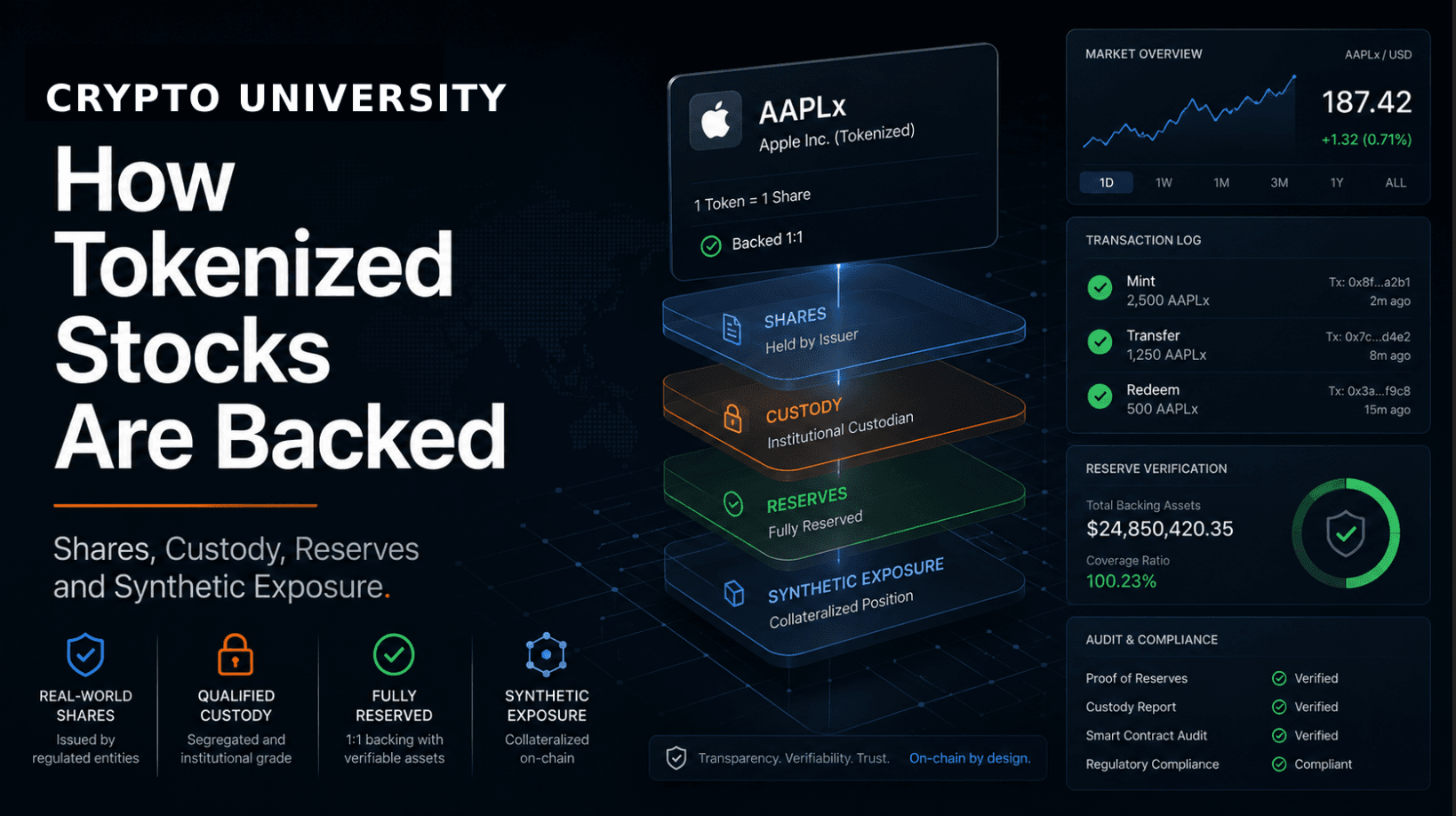
The most trusted products all work in a similar way. For every token in circulation, the issuer holds one matching share (or a slice of a shared pool of shares) with a regulated custodian. In other words, the tokens aren’t conjured out of thin air, they’re receipts for shares that genuinely exist.
xStocks is the clearest example to follow, since it’s the most widely distributed product out there, and it’s tracked in the Crypto University Tokenized Stocks Directory. Here’s how the cycle works:
Step | What Happens |
|---|---|
1. Buy the shares | The issuer, Backed Assets (JE) Limited, buys the real shares through brokers. |
2. Store them safely | Those shares sit with regulated custodians and brokers in separate collateral accounts. |
3. Mint the tokens | Tokens are created 1:1 against those shares on blockchains like Solana and Ethereum. |
4. Redeem and burn | When tokens are cashed in, the issuer sells or hands over the matching shares and destroys the tokens. |
Other products follow the same core idea with slightly different plumbing. Ondo Global Markets issues tokens that are notes backed by shares held at US broker-dealers, with an independent party reviewing the backing every single day and a security agent looking out for tokenholders. Dinari’s dShares are also backed one-for-one by shares sitting with regulated custodians.
The big advantage of full backing is this: the issuer doesn’t have to be a skilled trader for your token to hold its value. The shares in custody do the heavy lifting.
What You Actually Own: A Claim, Not the Share
Here’s a detail that trips up a lot of beginners. Full backing does not mean you personally own the share. What you own depends on the legal wrapper the product uses, and those wrappers differ more than the marketing suggests.
Product | Backing | What You Actually Hold |
|---|---|---|
xStocks | Real shares with regulated custodians | A tracker certificate (a bearer debt instrument). The issuer owes you the share’s economic performance. |
Ondo Global Markets | Shares at US broker-dealers, checked daily | A secured note structured as a total-return instrument. |
Dinari dShares | Real shares with regulated custodians | Tokenized shares under US broker-dealer registration, the closest to normal stock treatment, with dividends and corporate actions preserved. |
Robinhood EU Stock Tokens | May be hedged, but it’s a contract | A derivative referencing the price, an agreement with Robinhood’s European entity. |
So when someone asks, “are these real shares?”, the honest answer is: real shares usually do exist behind the scenes, but you’re holding an instrument that references them, not the share in your own name.
Compare tokenized stocks Want to see each token’s issuer, backing model and custody notes side by side? Explore the Crypto University Tokenized Stocks Directory. |
SPVs and “Bankruptcy Remoteness” in Plain English
You’ll notice xStocks is issued by a company called Backed Assets (JE) Limited. This is what’s known as a special purpose vehicle, or SPV. That’s a fancy term for a company built to do one job and one job only: issue and redeem these tokens. It doesn’t run a trading desk, it doesn’t lend money, and it doesn’t take on random debts that could drag the collateral down with it.
The whole point of this setup is something called bankruptcy remoteness. In plain terms: if the parent company or a partner goes bust, the accounts holding your collateral are legally separate and shouldn’t be grabbed by those creditors. Your claim is meant to be paid from that ring-fenced collateral first.
Two honest caveats, though. First, bankruptcy remoteness is a legal design, not a law of nature, and it hasn’t been heavily tested in court for tokenized stocks yet. Second, these structures often stretch across several countries at once (a Jersey issuer, a Swiss parent, a Liechtenstein-approved prospectus, custodians elsewhere), and cross-border insolvency is slow even when everything works as intended. “Designed to protect your collateral” and “instant payout if things fail” are two very different promises, and only the first one is really on offer.
Synthetic Exposure: Tracking a Price Without Owning It
Not every product that tracks a stock actually holds one. Synthetic products copy a stock’s price without owning any shares at all. Here are the main types you’ll run into:
Type | How It Tracks the Price | The Catch |
|---|---|---|
Equity perpetual futures | Follows the price through funding-rate mechanics; your margin is crypto or cash. | No shares exist at all behind it. |
Overcollateralized synthetics | Mints tracking tokens against crypto collateral worth more than the exposure (older DeFi projects like Mirror worked this way). | Only as safe as its collateral and price oracle. Mirror’s collapse with Terra in 2022 is the cautionary tale. |
CFDs and derivative tokens | A contract that pays out the price difference. | Depends entirely on the counterparty staying solvent. |
Synthetics aren’t automatically bad, perpetual futures in particular are handy trading tools. But they answer the question “what backs this?” with “a mechanism”, not “a share”. In a crisis, that difference is everything. A simple rule of thumb: if a product’s documentation can’t tell you where the actual shares are held, treat it as synthetic no matter what the marketing says.
How Backing Gets Verified: Proof of Reserves
Backing only matters if you can check it. Issuers prove their collateral in different ways, and some methods are far stronger than others. Here they are, ranked from weakest to strongest:
Verification Method | Strength | What It Means for You |
|---|---|---|
Self-reported dashboards | Weakest | Better than nothing, but you’re trusting the issuer’s word alone. |
Onchain proof-of-reserve feeds | Stronger | Backed uses Chainlink Proof of Reserve, so collateral can be checked against token supply automatically. |
Independent verification agents | Strong | A third party, like the one Ondo uses, reviews the backing regularly (daily, in Ondo’s case). |
Regulated custody + prospectus rules | Strong | EU-prospectus products (xStocks runs under a base prospectus approved by Liechtenstein’s FMA) carry legal disclosure duties with real consequences for lying. |
Full audits | Strongest | Regular attestations by accounting firms, though this is still uneven across the industry. |
A sensible standard for everyday holders: lean toward products that offer at least independent or onchain verification, and treat anything relying purely on self-reporting as a higher-risk bet.
Minting and Redemption: The Machinery That Keeps Prices Honest
Here’s the clever part that keeps token prices glued to real share prices. It’s a process called minting and redemption, powered by arbitrage. Don’t let the jargon scare you, the idea is simple.
Professional players (called authorized participants) can create new tokens by handing over cash or shares to the issuer, and they can redeem tokens for the value of the underlying share. If a token starts trading too expensively, they mint new ones and sell, nudging the price back down. If it trades too cheaply, they buy and redeem, nudging the price back up. This constant tug-of-war anchors the token to the real share price, the same way ETFs stay tied to the value of what they hold.
This is why redemption terms matter even if you never plan to redeem a single token yourself. Open, working redemption is what keeps the market price fair for everyone. When redemption gets paused or the underlying market closes, that anchor weakens and you start seeing tokens trade above or below their true value. That failure mode gets its own guide: Can Tokenized Stocks Depeg?
What Happens If Things Go Wrong
Let’s play it straight and walk through the ways things can break, and what each one would mean for you.
Failure Type | What It Means for You |
|---|---|
Issuer fails (backed model) | Tokens stop minting and redeeming, and trading likely continues messily at a discount. If the collateral is properly separated, you have a claim on identifiable shares, but recovery in a real insolvency would plausibly take months to years, not days. |
Custodian fails | Client assets at regulated custodians are usually kept separate from the custodian’s own balance sheet, so your collateral should survive, with delay and legal cost. Outright fraud (the assets weren’t really there) is the rarer, worse case. |
Synthetic counterparty fails | Your exposure can drop to zero with no collateral to claim. This is the scenario that separates the models. |
Platform (exchange) fails | The token itself is fine, but you become an unsecured creditor of the exchange. Self-custody removes this layer of risk. |
The lesson here: your risk isn’t in one place. The issuer, the custodian and the platform you trade on are three separate things that could fail, so it’s worth checking all three. If you’re weighing where to keep your tokens, see wallet vs exchange.
A Quick Checklist Before You Buy
Run through these five questions before putting money into any tokenized stock:
Ask Yourself | Why It Matters |
|---|---|
Where are the shares held, and who verifies them? | “Backed 1:1” is the start of your homework, not the end. |
What wrapper defines my claim? | A certificate, a note and a derivative give you very different rights. |
Is this backed by shares or by a mechanism? | Synthetics carry counterparty risk at their core, so treat them as a different product class. |
Does redemption actually work? | Working redemption keeps market prices honest, even for holders who never redeem. |
Am I spreading structural risk? | Issuer, custodian and platform are three separate failure points. |
Backing details for each tracked asset are listed in the Tokenized Stocks Directory.
Frequently Asked Questions
Are tokenized stocks really backed by real shares?
The major ones are. xStocks, Ondo tokens and Dinari dShares each hold underlying shares one-for-one with regulated custodians. Derivative-based tokens and perpetual futures are not backed by shares, so always check the specific product’s documentation.
What is a tracker certificate?
It’s a debt instrument whose repayment value tracks an underlying asset. xStocks are tracker certificates, which means you hold the issuer’s debt (collateralized by the shares) rather than the shares themselves.
What happens to my tokens if the issuer goes bankrupt?
In a collateralized SPV structure, the shares backing the tokens sit in segregated accounts meant to be outside the issuer’s bankruptcy estate, and you claim against that collateral. Expect a slow legal process rather than instant recovery, and always read the specific product’s terms.
What is proof of reserves for tokenized stocks?
It’s a way of proving that the token supply matches the collateral actually held. Examples include onchain feeds (like Chainlink Proof of Reserve for Backed), independent verification agents (like Ondo’s), and full audits. Stronger verification means less trust placed in the issuer’s word.
Is overcollateralization used for tokenized stocks?
Mostly in synthetic DeFi models, where crypto collateral worth more than 100% makes up for the absence of real shares. Share-backed products don’t need it, because they simply hold the asset itself.
Sources
xStocks Product & Legal Overview — https://docs.xstocks.fi/docs/product-legal-overview
Backed legal documentation (base prospectus, final terms) — https://assets.backed.fi/legal-documentation
Kraken xStocks risk disclosure — https://www.kraken.com/legal/xstocks
Ondo Global Markets documentation — https://docs.ondo.finance/ondo-global-markets
Chainlink Proof of Reserve — https://chain.link
Disclaimer: This content is for educational and informational purposes only and is not financial advice. Nothing here is a recommendation to buy or sell any asset or use any platform. Do your own research and manage your risk.
Explore the Crypto University Tokenized Stocks Directory.
Tokenized Stocks Explained: A Simple Guide for Beginner Traders
How to Buy Tokenized Stocks: A Step by Step Guide for Beginners
Can Tokenized Stocks Depeg From Real Shares? Premiums, Discounts and Tracking Error
How Tokenized Stocks Are Backed: Shares, Custody, Reserves and Synthetic Exposure
Need deeper training?
Join our structured modules with live examples and expert checklists for effective implementation.
JOIN THE ACADEMY