Key Takeaways
# | What to remember |
|---|---|
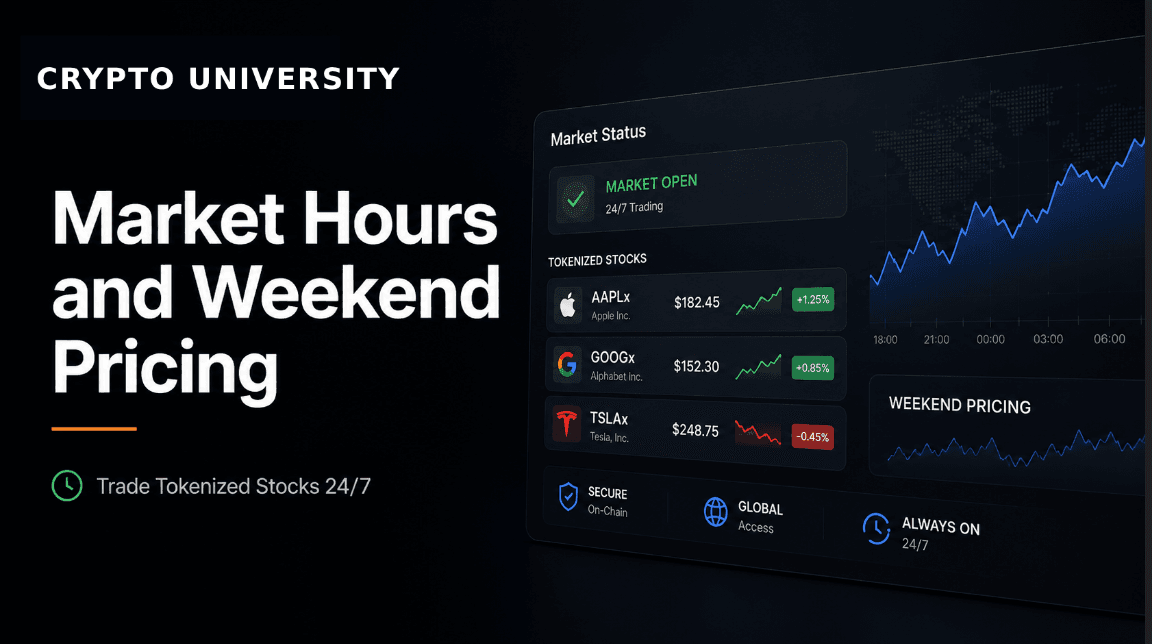
1 | Exchanges let you trade tokenized stocks 24 hours a day, 5 days a week. Onchain (in your own wallet) you can trade 24/7. The real stock itself only trades about 32.5 hours a week. |
2 | There are three trading windows: US market hours are the best time to trade, weeknights are okay for patient orders, and weekends are for reading forecasts, not chasing quick profits. |
3 | Trading outside market hours is a real advantage for reacting to big news, but it usually costs you more through wider spreads. Always check your platform's current hours before you rely on them. |
Trading Stocks Around the Clock: How True Is the Promise?
“Trade stocks 24/7” is the line you will see everywhere in the world of tokenized equities. The honest answer is that it is about three-quarters true. What really matters is not what you trade, but where you trade it.
Here is a simple example. The exact same TSLAx token pauses on Kraken over the weekend, yet it keeps swapping freely on a Solana exchange at 3 a.m. on a Sunday. Same token, very different rules, depending on the venue.
Below, you will find the actual schedules and, more importantly, what trading in each time window really gets you as a beginner.
When Can You Actually Trade? A Look by Venue
Different platforms open and close at different times. Here is a plain-English breakdown of the main venues and their hours.
Venue | Hours | What to know |
|---|---|---|
NYSE / Nasdaq (the real stock) | About 6.5 hours a day, Monday to Friday (roughly 14:30 to 21:00 UTC in summer), plus pre and post sessions | This is the only place the true reference price is created. |
Kraken (xStocks) | 24 hours a day, Monday to Friday (24/5) | Weekend trading was listed as “in development” when this was researched. |
Robinhood EU (stock tokens) | 24/5 | Based on Robinhood’s own product pages. |
OKX (tokenized stocks) | Follows the venue schedule | Check OKX’s product terms for the current hours. |
Ondo GM | Mint and redeem 24/5; token transfers 24/7 | There is a difference between the primary market and simply moving tokens. |
Decentralised exchanges (Jupiter and similar, in your own wallet) | 24/7/365 | Liquidity pools never close, but how deep they are changes a lot hour to hour. |
The pattern is easy to see. Centralised venues run 24/5, matching the days the underlying stock can be hedged. True round-the-clock trading lives onchain, in your own wallet, where nobody can shut a liquidity pool down.
So the accurate version of the slogan is this: tokenized stocks trade 24/5 on exchanges and 24/7 onchain, compared with only about 32.5 regular hours a week for the stock itself.
The Three Trading Windows, Explained Simply
Think of the trading week as three different windows. Each one behaves differently, so it helps to know which one you are in before you place an order.
Window | What it is | Best used for |
|---|---|---|
1. US market hours (the good window) | A live reference price, active arbitrage, the tightest spreads, and the deepest order books. Roughly 14:30 to 21:00 UTC on US weekdays (an hour later in winter). | Everything works as advertised. If you can choose when to trade, choose here. |
2. Weeknight overnights (the workable window) | Exchanges and onchain venues keep trading. The reference price is stale, but tomorrow’s open is close, and overnight index futures give a rough anchor. Spreads widen a little. | Fine for patient limit orders. Expensive if you use market orders. |
3. Weekends and US holidays (the float) | No reference price until Monday. Prices become forecasts driven by crypto sentiment and news. Spreads are widest and books are thinnest. | Reacting to genuinely big news early, or providing liquidity on purpose. Not for bored, casual market orders. |
A quick word on weekends. The convenience is real, but so is the cost. You pay for it through wider spreads and price premiums, billed at weekend rates. The two good reasons to trade then are reacting to major news before the rest of the world can, and knowingly providing liquidity. The one bad reason is placing a market order simply because it is Sunday and you are bored.
What Happens at the Edges
The trickiest moments are the transitions, when one window hands over to the next. Here is what tends to happen.
Moment | What tends to happen |
|---|---|
Friday close into the weekend | Token prices slowly drift away from Friday’s closing price as news piles up. |
Sunday night into Monday open | Tokens increasingly price in the expected open. The gap mostly “closes” by the stock opening near where tokens predicted, rather than tokens suddenly jumping. |
Earnings after the close | The headline event of overnight windows. Tokens reprice instantly on thin books while the stock waits for the open. |
US holidays | Nasdaq is closed and tokens keep floating. Treat these just like weekend windows. |
When the Market Is Closed or a Stock Is Halted
Sometimes the underlying stock is paused, either for a volatility halt or because news is pending. When that happens, tokens keep trading on whatever information exists. You get price discovery the stock is not allowed to have, along with all the accuracy risk that comes with it.
During longer closures, token prices become pure consensus guesses. So if you have ever wondered what happens during a stock-market closure, here is the answer: trading continues, anchored by nothing but opinion, and then reconverges once the real reference price returns.
A Simple Playbook for Beginners
If you remember nothing else, keep these five habits in mind.
Default to Window 1 (US market hours) for any entries and exits you truly care about.
Use limit orders only in Windows 2 and 3, never market orders.
Treat weekend prices as forecasts to read, not mistakes to arbitrage. Real weekend-versus-Monday arbitrage is a professional’s game with a hedging step you do not have.
Remember that dividends and rebases run on their own schedule, no matter which window you are trading in.
If a platform’s hours matter to your strategy, such as wanting weekend exits, check the current schedule on the platform itself, not in articles. Kraken’s weekend support was still in development at research time and may have launched since.
Frequently Asked Questions
Can I trade tokenized stocks on Saturday?
Yes, onchain in your own wallet on decentralised exchanges, trading runs 24/7. On Kraken and most centralised venues, trading is 24/5 with weekend support in development at research time. Always check your platform’s current schedule.
Why is the token price different from the stock price on Sunday?
The stock has no Sunday price at all, so the token trades on expectations of Monday’s open. The difference is a forecast plus a liquidity cost, not an error.
Do tokenized stocks trade on US holidays?
Token venues generally stay open, but the underlying stock does not. The dynamics are the same as weekends: floating prices until the next US session begins.
What time is best to trade tokenized stocks?
During US market hours, roughly 14:30 to 21:00 UTC on summer weekdays. That is when you get a live reference price, active arbitrage, and the tightest spreads.
What happens to my tokens when markets are closed?
Nothing. They sit safely in your account or wallet like any other asset. Only the quality of the pricing changes with the clock.
Disclaimer: This content is for educational and informational purposes only and is not financial advice. Nothing here is a recommendation to buy or sell any asset or use any platform. Do your own research and manage your risk.
Explore the Crypto University Tokenized Stocks Directory.
Tokenized Stocks Explained: A Simple Guide for Beginner Traders
How to Buy Tokenized Stocks: A Step by Step Guide for Beginners
Best Platforms for Tokenized Stocks: Exchanges, Brokers and Onchain Apps
Tokenized Stock Risks: Issuers, Custody, Liquidity and Tracking Error
Can You Buy Tokenized Stocks in the USA? Current Rules and Alternatives
Need deeper training?
Join our structured modules with live examples and expert checklists for effective implementation.
JOIN THE ACADEMY