Key Takeaways
1. A tokenized stock carries every risk of the normal stock, plus a stack of extra “wrapper” risks: issuer, custody, liquidity, tracking, technology, platform and regulation.
2. Liquidity and price tracking are the risks you will feel most often. Issuer and custody failures are rarer but more serious. Lost keys and failed platforms have caused the biggest real-world losses.
3. Almost every risk has a cheap fix, such as limit orders, trading in US hours, using withdrawal-friendly venues and spreading across issuers. Only regulatory change resists mitigation, so keep positions modest.
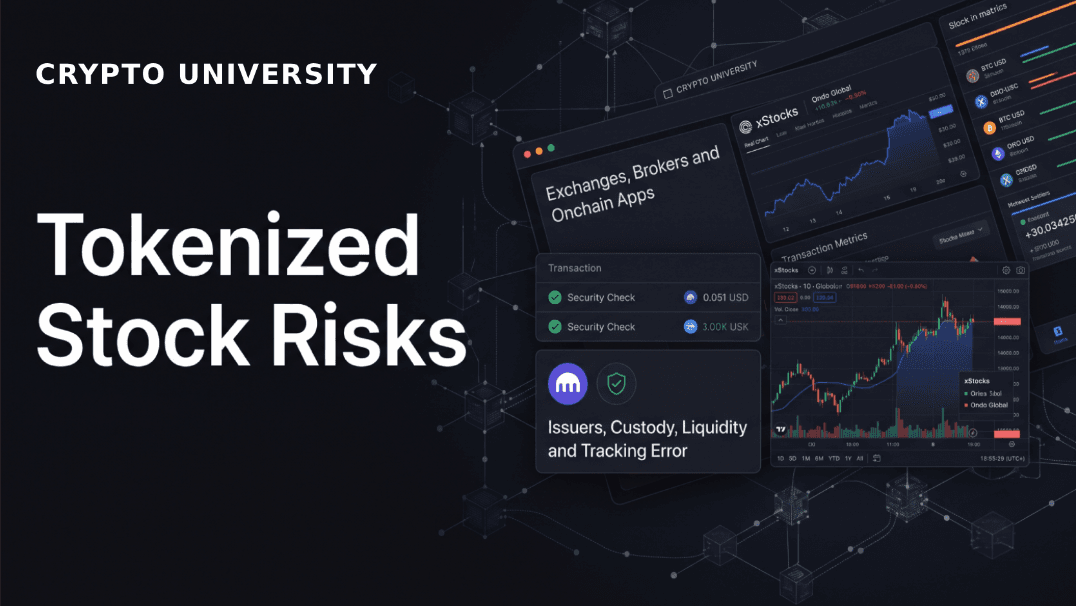
A tokenized stock carries every risk the real stock already has, and then it adds a few more that come from the digital wrapper around it. That is not a reason to run away. It is simply how these products are built. So the useful question is not “Are tokenized stocks risky?” It is “Which extra risks am I taking on, what could each one cost me, and how cheaply can I protect myself?” Let us walk through the whole stack in plain English, with no doom and no cheerleading.
The Risk Stack
It helps to picture your tokenized position as a set of layers stacked on top of one another. Each layer can break on its own, and each one behaves a little differently. Here they are, from the bottom up.
Layer | What it means for you |
|---|---|
Market risk | The stock itself can fall. This is exactly the same in any format, and it is usually the biggest risk of all. |
Issuer risk | The company that issued your token could fail or behave badly. |
Custody risk | The real shares backing your token could be missing or impaired. |
Liquidity risk | You might not be able to sell at a fair price when you want to. |
Tracking risk | The token's price can drift away from the real stock's price. |
Technology risk | Bugs in the code, blockchain outages, or losing your own keys. |
Platform risk | The exchange or app holding your tokens could fail. |
Regulatory and freeze risk | Rules can change, or the token itself can be restricted or frozen. |
The first layer, market risk, is nothing new. It is the same whether you own the stock through a broker or a token. Layers two through eight are the price you pay for the perks of the wrapper: easier access, trading outside normal hours, and the option to hold it yourself. Let us take them one at a time.
Issuer Risk
With most tokenized stocks, someone actually holds the real shares and issues you a token that represents them. Your legal claim is against that issuer, for example a special company (often called an SPV, or special purpose vehicle) set up in Jersey for xStocks, Ondo's issuing entity, or Robinhood's European business. Things can go wrong in small ways, such as a temporary pause on redemptions, or in serious ways, such as the issuer going bankrupt.
Good issuers design around this. They use bankruptcy-remote structures, which keep the SPV legally separate so its shares are not dragged into another company's failure. They keep the backing assets segregated, publish a prospectus, and hire independent agents to verify the backing.
What you can do: stick with issuers that publish clear documentation and get independently checked, spread your money across more than one issuer once positions get large, and simply avoid any product that will not tell you how it is structured.
One honest caveat: these structures are well designed, but they have not really been tested in court yet. No major tokenized-equity issuer has been through a bankruptcy, so how quickly you would get your money back is an educated guess, not a proven track record.
For more detail, see our guides How Tokenized Stocks Are Backed and the issuer guide.
Custody Risk
The real shares sit with regulated custodians and brokers. Segregation is meant to keep them safe even if the custodian itself fails. The scarier and rarer problem is fraud, where the shares are not actually there at all. That is exactly what proof-of-reserve reports and verification agents exist to catch. This layer is mostly invisible to you, and there is not much you can do about it directly beyond choosing products with stronger, independent verification. More on this in our guide, Where Are the Real Shares Held?
Liquidity Risk
This is the quiet one that trips people up most often. Tesla trades tens of billions of dollars a day on Nasdaq. Tokenized Tesla trades only a tiny slice of that, spread across different venues. In practice that means wider spreads (the gap between the buy and sell price), a bigger price impact when you trade larger amounts, and a real chance that buyers disappear during a stressful moment, exactly when you most want to sell. Weekends and off-hours make all of this worse, because that is when the fewest people are trading.
How to protect yourself: get in the habit of using limit orders, size your position to the depth actually available on the venue (check the order book or liquidity pool before you need it, not during a panic), trade during US market hours when things are busiest, and know your backup exit in advance, such as withdrawing to another venue or blockchain.
Want to compare tokenized stocks side by side? Crypto University Tokenized Stocks Directory shows live venue and market data for each asset.
Tracking Risk
Tokens stay close to their real stock price through arbitrage, which simply means traders profit from any gap and, in doing so, close it. But arbitrage only works when certain conditions hold: redemptions are open, the venues are running, and there is a real reference price to aim at. When the stock market closes for the weekend, or redemptions get paused, the token can start trading at a premium (above the real price) or a discount (below it). Usually this is a fraction of a percent. Occasionally it is several percent on thinly traded pairs. In rare one-off blowups on smaller venues, it has been much worse. The practical danger is this: if you buy at a premium and it snaps back, you can lose money even when the underlying stock has not moved at all. Full mechanics and history are in our guide, Can Tokenized Stocks Depeg?
Technology Risk
All the usual crypto risks apply here, unchanged. Smart-contract bugs are possible, and some tokens are more complex than others (rebasing tokens, which adjust their supply automatically, have more moving parts than a plain token). Blockchains can go down, and Solana's outage history matters for tokens issued on Solana. Bridges, which move tokens between chains, add their own risk for multichain versions. And the all-time champion of actual money lost is still the simplest one: people losing or mishandling their own keys. Holding your own tokens moves the risk from the platform to you, but it does not make the risk disappear. See our guide on wallet versus exchange.
Platform Risk
If your tokens sit on an exchange, they are exposed to whatever happens to that exchange: hacks, insolvency (FTX is the lesson nobody forgets), frozen withdrawals, or a delisting. A delisting is annoying rather than fatal, since the backing survives even if one venue drops the token. How to reduce it: use venues that actually let you withdraw, move long-term holdings into self-custody, and do not keep everything in one place.
Regulatory and Freeze Risk
This one comes in three flavors. First, rules can change. A product you can buy today might be pulled from your market tomorrow, often forcing you to sell within a short window at whatever price happens to be available. Second, you may never have been eligible in the first place. If you buy a product that was not offered to you and slip around the restrictions, your legal claim is weaker. Third, the token itself can be frozen. Issuers of compliant security tokens usually keep the power to freeze or block specific addresses when the law demands it, such as under sanctions or a court order. The fact that a token moves freely day to day does not mean it is immune to that kind of order. So if your big question is “Can it be frozen?”, the honest answer for regulated tokenized stocks is: under a legal process, generally yes.
Every Risk at a Glance
If you remember one section, make it this one. Here is each risk, what it could cost you, and the cheapest way to reduce it.
Risk | What it could cost you | Cheap way to reduce it |
|---|---|---|
Issuer failure | Delayed or lost recovery of your money | Choose documented, independently verified issuers; diversify at size |
Custody problems | Backing missing in a fraud scenario | Prefer products with strong proof-of-reserve and verification |
Thin liquidity | Wider spreads and bad fill prices | Use limit orders, trade in US hours, size to available depth |
Price tracking drift | Losing money even in a flat stock | Avoid buying at a premium; watch weekends and paused redemptions |
Technology and keys | Total loss from bugs or lost keys | Back up keys carefully; favor simpler, audited products |
Platform failure | Frozen or lost funds on an exchange | Use withdrawal-friendly venues; self-custody long-term holdings |
Regulatory change | Forced sale at a bad time | Keep positions modest; re-check product terms yearly |
How to Size It All: A Simple Frame
Here is a sensible personal approach, scaled to how confident you feel. Treat tokenized stocks as a satellite position, a small extra, rather than the core of your retirement savings. As your holdings grow, spread your risk across different issuers, platforms and custody methods. Favor products whose backing is actually verified. Trade in liquid conditions, using limit orders during market hours. Keep good records from day one. And re-read the product terms once a year, because this industry rewrites itself constantly. None of this is fancy. It is the same basic hygiene that careful stablecoin users already follow, applied to stocks.
FAQ
Are tokenized stocks safe?
They are only as safe as their weakest layer. Backed products from well-documented issuers on reputable venues have run smoothly at scale, but they still stack real risks (issuer, custody, liquidity, platform) on top of ordinary stock risk. “Safe” is not quite the right word. “Understood and sized sensibly” is.
What is the single biggest risk?
For most people day to day, it is the cost of getting out (liquidity and tracking) plus platform or key failures. In rare worst-case scenarios, it is the issuer going insolvent. And for volatile stocks, plain market risk still dwarfs everything else.
Can a tokenized stock go to zero even if the real stock does not?
In theory, yes, if the issuer and its collateral both fail in a fraud scenario. Synthetic products, ones with no real shares behind them, can also die along with their counterparty. That is exactly why the quality of the backing matters far more than how polished the app looks.
Can my tokens be frozen?
Under legal compulsion, such as sanctions or a court order, issuers of regulated tokenized stocks generally keep the power to intervene. Routine freezing of ordinary holders is not how these products normally work.
How do I reduce these risks cheaply?
Limit orders, trading during US hours, using venues that let you withdraw, self-custody for anything you hold long term, spreading across issuers once you are at size, and re-reading the product terms once a year. Most of the risk stack gives way to plain, boring discipline.
Sources
Source | Reference |
|---|---|
Kraken xStocks risk disclosure | kraken.com/legal/xstocks |
Backed base prospectus and final terms | assets.backed.fi/legal-documentation |
Ondo Global Markets documentation | docs.ondo.finance/ondo-global-markets |
xStocks product legal overview | docs.xstocks.fi/docs/product-legal-overview |
Disclaimer: This content is for educational and informational purposes only and is not financial advice. Nothing here is a recommendation to buy or sell any asset or use any platform. Do your own research and manage your risk.
Explore the Crypto University Tokenized Stocks Directory.
Can Tokenized Stocks Depeg From Real Shares? Premiums, Discounts and Tracking Error
How Tokenized Stocks Are Backed: Shares, Custody, Reserves and Synthetic Exposure
Need deeper training?
Join our structured modules with live examples and expert checklists for effective implementation.
JOIN THE ACADEMY