Key Takeaways
A DEX gives you 24/7 access and full control of your assets, but you take on the verification, slippage settings, and record-keeping yourself.
Always paste the issuer’s official contract address. Searching by ticker is one of the most common ways people get scammed.
Being able to trade onchain is not the same as being legally eligible, and every transaction is final, so move deliberately.
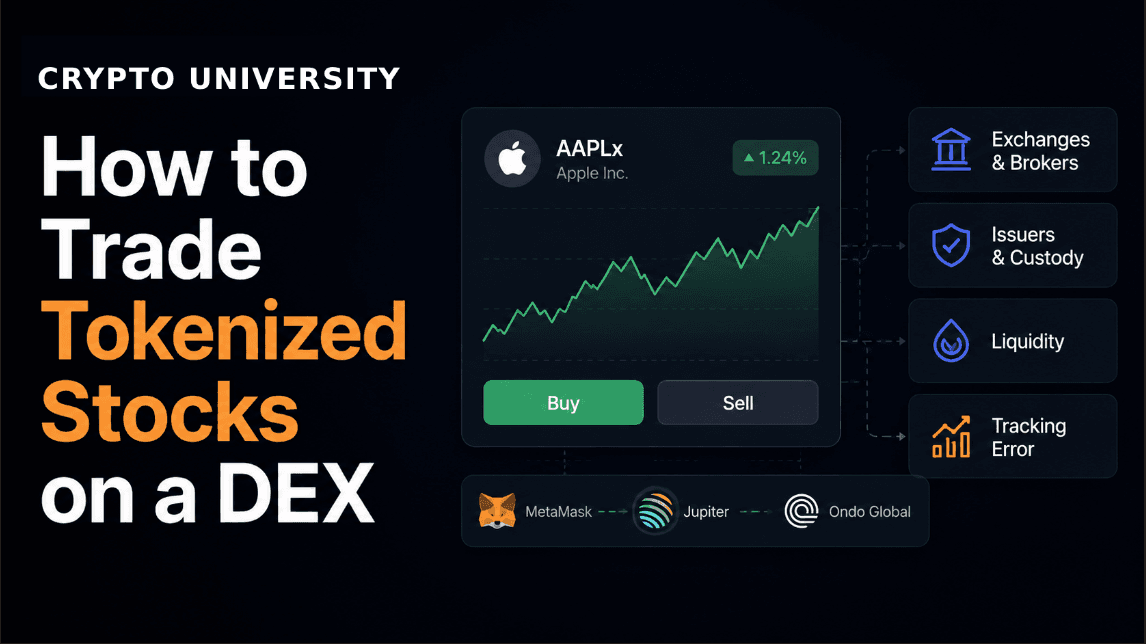
Trading tokenized stocks on a decentralized exchange (a DEX) is the purest version of the whole idea. You use your own wallet, the market never closes, and you swap equity exposure just like any other token. There is no account to open and no closing bell to wait for.
But here is the trade-off: the safety nets come off too. No support team can reverse a transaction if you send funds to the wrong address, nobody vetted the token you are about to buy, and the product’s legal rules still apply even though nothing on the blockchain forces you to follow them. This guide walks you through doing it the smart way.
When a DEX makes sense (and when it doesn’t)
A DEX is a great fit if you like holding your own assets, you want genuine around-the-clock access, you already use DeFi tools, or the only way to reach a particular token is onchain. It is probably not the right starting point if you are brand new, you want easy ways to move cash in and out, or you would rather let a platform handle the contract checks and record-keeping for you. Plenty of people happily do both: they buy on an exchange, move the tokens to their wallet, and trade onchain from there (see wallet vs exchange).
A DEX is a good fit if… | A DEX is less ideal if… |
You want to hold your own assets in your own wallet | You are brand new to crypto and wallets |
You value true 24/7 market access | You want simple ways to move cash in and out |
You already use DeFi tools | You would rather a platform verify contracts for you |
The only way to reach a token is onchain | You want someone else keeping your records |
Most tokenized-stock trading happens on Solana, where Jupiter pulls together the xStocks liquidity pools. Ondo’s tokens live on Ethereum and trade through MetaMask Swaps. The chain you choose drives your fees and decides which wallet you need, so it is worth checking first (see best blockchains).
Before your first swap
Run through these four checks in order, every single time. They take a couple of minutes and they are what separates a clean trade from an expensive mistake.
Check | What to do | Why it matters | |
1 | Verify the contract address | Copy the official address from the xStocks (or relevant issuer) docs and paste it straight into your DEX. | Anyone can mint a token called “TSLAx.” Only the issuer’s real address is legit. Searching a ticker and clicking the top result is exactly how people buy scams. |
2 | Check liquidity and price impact | Read the price-impact figure the DEX shows before you confirm. | A deep pool barely moves on your trade; a thin one can shift several percent. Big impact on a small order means the pool is too shallow for your size. |
3 | Set slippage on purpose | Start tight, around 0.5% for liquid pairs, then adjust to how the pair actually behaves. | Too tight and volatile off-hours trades fail. Too loose and you invite bad fills or sandwich attacks. Let the pair, not a default, set it. |
4 | Confirm you are eligible | Check the product’s terms for your region before you trade. | The contract is permissionless, but onchain access is not legal eligibility. Buying a token the issuer never offered you weakens any claim you would have later. |
For the legal side of things, see Are Tokenized Stocks Legal? We do not cover techniques for evading restrictions.
Compare tokenized stocks
Not sure which chain or venue a token trades on? Confirm it per asset in the Crypto University Tokenized Stocks Directory.
The swap, step by step
Fund your wallet with a stablecoin on the token’s chain (USDC on Solana for xStocks), plus a little native gas token (SOL). More on this in buying with stablecoins.
Open the DEX (Jupiter for Solana) and connect your wallet.
Paste the verified token address as the output, and set your stablecoin as the input.
Review the price impact and slippage. If the impact looks high, reduce your order size.
Confirm and sign in your wallet. The stock token shows up in your balance within seconds.
Record the trade: date, amounts, price, fees, and addresses for taxes. Onchain history is public, but piecing it together months later is a real chore (see tax guide).
Selling just reverses the process: swap the stock token back into a stablecoin, then cash out through an exchange whenever you want fiat.
Risks that are specific to trading onchain
On top of the usual tokenized stock risks, going onchain adds a few of its own. Here is what to watch for and how to protect yourself.
Risk | What it means | How to protect yourself |
Wrong-token risk | Copycat tokens use lookalike names and squatted tickers to fool you. | Only ever use the verified contract address. |
Wrapped or bridged versions | A token bridged to another chain adds bridge risk and can trade at different depth. | Prefer the token’s native issuance. |
Thin off-hours pools | Weekend liquidity can be a fraction of weekday depth — right when prices swing most. | Trade during deeper hours or size down (see trading hours). |
MEV and sandwich attacks | Bots can front-run larger trades to skim value from your fill. | Use sensible slippage and private-order routing where it is available. |
Irreversibility | There are no chargebacks onchain. | Double-check the address and network before signing. A wrong send is usually final. |
Where to double-check the details
When you need the official source of truth, especially for contract addresses and go straight to these, not to search results or links from chats.
Resource | What it is for | Link |
xStocks docs | Official contract addresses | |
Jupiter | Solana DEX aggregator | |
MetaMask RWA / Ondo Swaps | Trading Ondo tokens on Ethereum | |
Ondo Global Markets docs | Ondo token details |
Frequently asked questions
Where can I trade tokenized stocks on a DEX?
Mostly on Solana through Jupiter, which brings together the xStocks liquidity. Ondo tokens trade on Ethereum through MetaMask Swaps. Always confirm which chain a token lives on before you start.
Is DEX trading of tokenized stocks legal?
The swap itself is technically possible almost anywhere, but the products’ terms exclude certain regions and your local law still applies. Onchain access does not equal eligibility, and this guide does not cover getting around restrictions.
How do I avoid buying a fake stock token?
Only use the issuer’s official contract address from their documentation, pasted directly into the DEX. Never trust ticker search results or links someone sends you in a chat.
What slippage should I set?
Start around 0.5% for liquid pairs and adjust to how the pair behaves. Thin or volatile off-hours pools may need a bit more, but looser slippage invites worse fills, so where you can, size down instead of loosening it.
Can I lose money from low liquidity?
Yes. Thin pools create high price impact, so a large market swap can fill well away from the reference price. Check the impact figure and split or delay big orders.
Disclaimer: This content is for educational and informational purposes only and is not financial advice. Nothing here is a recommendation to buy or sell any asset or use any platform. Do your own research and manage your risk.
Explore the Crypto University Tokenized Stocks Directory.
Tokenized Stocks Explained: A Simple Guide for Beginner Traders
How to Buy Tokenized Stocks: A Step by Step Guide for Beginners
Best Platforms for Tokenized Stocks: Exchanges, Brokers and Onchain Apps
The Companies Behind Tokenized Stocks: xStocks, Ondo, Dinari, Robinhood and More
Need deeper training?
Join our structured modules with live examples and expert checklists for effective implementation.
JOIN THE ACADEMY