Key Takeaways
# | Key Takeaway |
|---|---|
1 | When you buy a tokenized stock, the company that actually owes you value is the issuer, not the exchange or app you bought it on. That is who you should research first. |
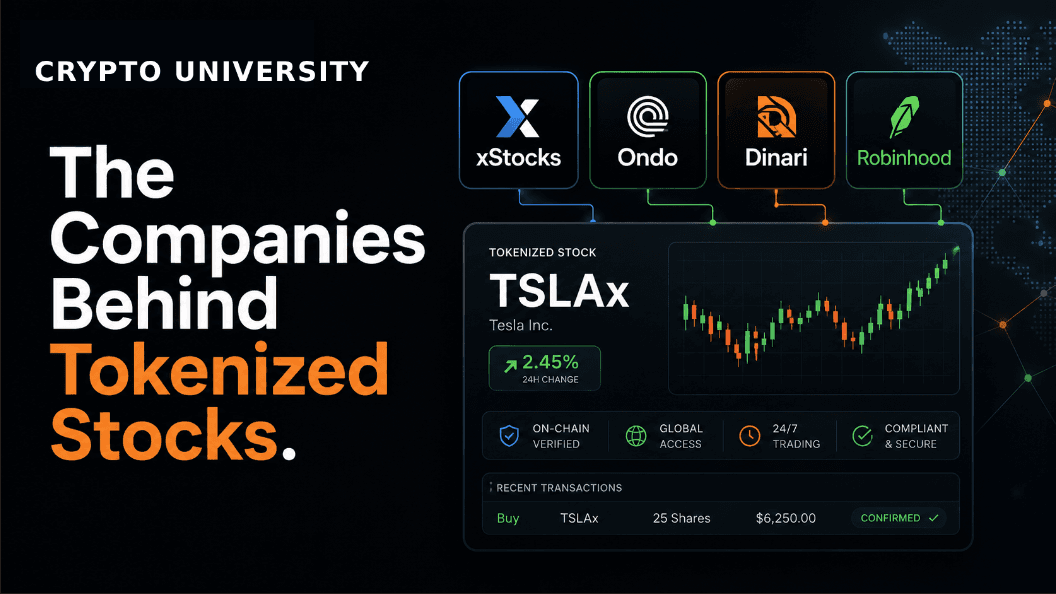
2 | Four issuers lead the space right now: Backed (xStocks) has the widest reach, Ondo holds the most assets, Dinari has US regulation, and Robinhood has the biggest app audience. |
3 | The same stock, such as Tesla, can exist as several different tokens from different issuers. Each one has its own structure, rules, and rules about who can buy it, so they are not interchangeable. |
Introduction
When you buy TSLAx on Kraken, Kraken is not the company standing behind your token. A Jersey based company called Backed Assets (JE) Limited is. When you buy a stock token on Gemini, the real engine behind it belongs to Dinari, a US registered broker dealer. Think of the exchange as the shop window. The issuer is the one who actually owes you the value of a Tesla share.
This matters more than it sounds. Most of the worries people have about tokenized stocks, like whether they are properly backed, how you get your money out, and what happens if something goes wrong, are questions about the issuer, not the exchange. So it is worth taking a few minutes to learn exactly who these companies are.
Issuer vs Exchange: The One Distinction That Explains Everything
The issuer is the company that creates the token, holds or arranges the shares behind it, defines your legal claim, handles things like dividends, and lets you redeem your token when you want out. The exchange or app is simply the place you trade. It gives you the order book, the interface, and the customer support, but it does not create the token.
One issuer can sell through many different venues. xStocks, for example, trades on Kraken, Bybit, Gate, Bitget, and OKX, plus several Solana based exchanges. At the same time, a single exchange can list products from several different issuers. The simple rule for beginners is this: look at the issuer first, and the venue second.
The Issuer does this | The Exchange or App does this |
|---|---|
Creates the token | Provides the order book |
Holds or arranges the real shares | Gives you the interface |
Defines your legal claim | Handles the customer relationship |
Processes dividends and corporate actions | Provides liquidity and marketing |
Handles redemption | Lists products from one or more issuers |
The Main Issuers at a Glance
Here is a quick side by side look at the four issuers that dominate the market today. Do not worry if some of the terms feel unfamiliar. The sections below explain each one in plain language.
Issuer | Product | What the token is | Main regulation | Where you can buy |
|---|---|---|---|---|
Backed (Backed Assets (JE) Ltd) | xStocks | A debt style tracker certificate, fully backed 1 to 1 by the real share | Jersey JFSC registration; EU prospectus approved in Liechtenstein | Kraken, Bybit, Gate, Bitget, OKX, Solana exchanges, Telegram Wallet |
Ondo (Ondo Global Markets) | Ondo tokenized stocks | Notes backed by shares held at US broker dealers, built to track total return | US broker dealer custody chain; sold outside the US | Ondo platform, MetaMask Swaps, partner venues |
Dinari | dShares | Tokens backed 1 to 1 by real shares, with dividends preserved | First US broker dealer registration for blockchain shares (June 2025) | Gemini in the EU, fintech and broker integrations |
Robinhood (EU entities) | Stock Tokens | Older tokens are derivatives; newer ones are debt securities on Robinhood Chain | EU regulated entities licensed in Lithuania | Robinhood EU app; wallet product in 120+ countries |
Backed and xStocks: The Distribution Leader
Backed is a Swiss founded tokenization company. The vehicle that actually issues the tokens is Backed Assets (JE) Limited, a special company set up in Jersey and registered with the Jersey Financial Services Commission. Each xStock is what is called a tracker certificate. In plain terms, it is a debt instrument that is fully backed by the real share, which is held with regulated custodians. In Europe, the tokens are sold under a prospectus approved by Liechtenstein, and Chainlink Proof of Reserve lets you check the backing on the blockchain.
The xStocks network is the most widely available tokenized stock product out there. It covers more than 100 stocks and ETFs, has reported over 25 billion dollars in total transaction volume, works across more than 50 platforms, and issues on several blockchains. Dividends are handled by increasing your token balance, and you can redeem directly with the issuer for a fee, though that is mostly used by professionals.
One thing to keep in mind: xStocks are not offered to people in the United States, and they are restricted in the UK, Canada, and Australia. Because it is a debt style product, everything depends on the backing structure working exactly as designed.
Ondo Global Markets: The Total Return Note Model
Ondo Finance started out with tokenized US Treasuries before moving into stocks. Its stock arm, Ondo Global Markets, launched in September 2025 and passed 1 billion dollars in total value locked by May 2026, with more than 200 tokenized US stocks and ETFs.
Its structure is a little different from the others. The tokens are notes backed by shares held at US registered broker dealers, and they are designed to track total return, which means dividends are effectively reinvested for you after tax is taken out. An independent agent checks the backing every day, and a separate security agent acts on behalf of token holders. You can mint and redeem five days a week, transfer tokens any time, and Ondo can even tokenize a company on its IPO day.
Ondo is not available in the US. It focuses on Asia Pacific, Europe, Africa, and Latin America. If you use a wallet, MetaMask Swaps is the easiest way in.
Dinari: The US Regulated Path
Dinari made the opposite bet to everyone else. Instead of avoiding US rules, it built its whole business inside them. Its subsidiary earned broker dealer registration in June 2025, the first US approval for blockchain based shares. Its tokens, called dShares, are backed 1 to 1 by real shares held with regulated custodians, and they preserve the normal shareholder perks like dividends and corporate actions. In July 2026, Dinari and tZERO announced a ready made platform for other broker dealers to handle issuing, trading, custody, and settlement.
Dinari usually reaches everyday users through partners rather than its own app. Gemini's European tokenized stocks, for example, run on Dinari. If tokenized stocks ever arrive for US retail investors in a big way, Dinari's rails are one of the most likely routes.
Robinhood: The Broker That Built Its Own Blockchain
Robinhood plays three roles at once. It issues tokens, it distributes them, and it now builds its own infrastructure too. Its original EU Classic Stock Tokens, launched in 2025, are derivatives that track more than 2,000 US stocks and ETPs. They are offered across 30 European countries with trading five days a week and dividends passed through to you.
In 2026, Robinhood went further and launched its own blockchain, called Robinhood Chain, along with a new generation of stock tokens structured as debt securities. This expanded access to eligible users in more than 120 countries.
Here is the important nuance for beginners. Robinhood's tokens are not the same as xStocks, which are fully backed tracker certificates. On top of that, Robinhood's two generations of tokens are not the same as each other. So calling everything a Robinhood tokenized share hides some real differences you should understand before buying.
The Supporting Cast
Custodians and brokers
These are the companies that actually hold the shares. For Ondo and Dinari, these are US broker dealers. For Backed, they are regulated custodians and brokers across different countries. The way they keep customer assets separate and safe is the foundation of every backed product.
Infrastructure providers
These sit one layer down. Chainlink provides proof of reserve and price data, Alpaca provides brokerage rails for minting and redemption, tZERO provides regulated trading infrastructure with Dinari, and then there are the blockchains themselves.
Exchanges
Exchanges are the distribution layer. They list, market, and provide liquidity, but they do not issue anything. If an exchange fails, it does not destroy a token's backing. If the issuer fails, that is the serious scenario.
How to Evaluate an Issuer
You do not need to be an expert to size up an issuer. These five questions cover most of what matters.
What exactly do I hold? Is it a certificate, a note, a derivative, or a broker held share? The legal document is the real product.
Where are the shares, and who checks? Named custodians plus independent or on chain verification beats a simple dashboard.
What is the regulatory anchor? A prospectus (Backed), a broker dealer registration (Dinari), or licensed entity derivatives (Robinhood) are all real anchors with different strengths. No anchor at all is a very different kind of product.
How do redemption and dividends work? Open redemption keeps the price honest, and clear rules on corporate actions prevent nasty surprises.
Am I even eligible? Every issuer restricts certain countries. It is the terms, not just whether you can access it, that decide if it is really for you.
Practical Takeaways
Your real counterparty is the issuer, not the exchange, so that is where your research should start.
Four issuers lead the market today: Backed has the widest reach, Ondo has the largest value locked and asset count, Dinari has US regulated rails, and Robinhood has the biggest app audience.
The same stock can exist as four different instruments from four issuers, so a Tesla token is not just one single thing.
Spreading your holdings across more than one issuer is possible and sensible once your positions get larger.
Frequently Asked Questions
Who issues xStocks?
Backed Assets (JE) Limited, a Jersey company registered with the JFSC and part of the Backed group. Exchanges like Kraken and Bybit only distribute the tokens; they do not issue them.
Is Robinhood's stock token the same as an xStock?
No. Robinhood's Classic EU tokens are derivatives, its newer tokens are debt securities on Robinhood Chain, and xStocks are fully backed tracker certificates from a completely separate issuer.
Which tokenized stock issuer is regulated in the US?
Dinari, whose subsidiary holds US broker dealer registration, the first for blockchain based shares. xStocks, Ondo, and Robinhood's tokens are all offered outside the US only.
Can the same stock have multiple tokens?
Yes. Tesla exposure exists as TSLAx from Backed, an Ondo token, a Dinari dShare, and a Robinhood token. Each one has a different structure, venue, and eligibility, so check which one your platform actually lists.
What happens if an exchange delists a tokenized stock?
The token and its backing still exist. You would withdraw where supported and either trade elsewhere or redeem under the issuer's terms. A delisting is inconvenient but not fatal. Issuer failure is the serious scenario.
Disclaimer: This content is for educational and informational purposes only and is not financial advice. Nothing here is a recommendation to buy or sell any asset or use any platform. Do your own research and manage your risk.
Explore the Crypto University Tokenized Stocks Directory.
Can Tokenized Stocks Depeg From Real Shares? Premiums, Discounts and Tracking Error
How Tokenized Stocks Are Backed: Shares, Custody, Reserves and Synthetic Exposure
Best Platforms for Tokenized Stocks: Exchanges, Brokers and Onchain Apps
Need deeper training?
Join our structured modules with live examples and expert checklists for effective implementation.
JOIN THE ACADEMY