Key Takeaways
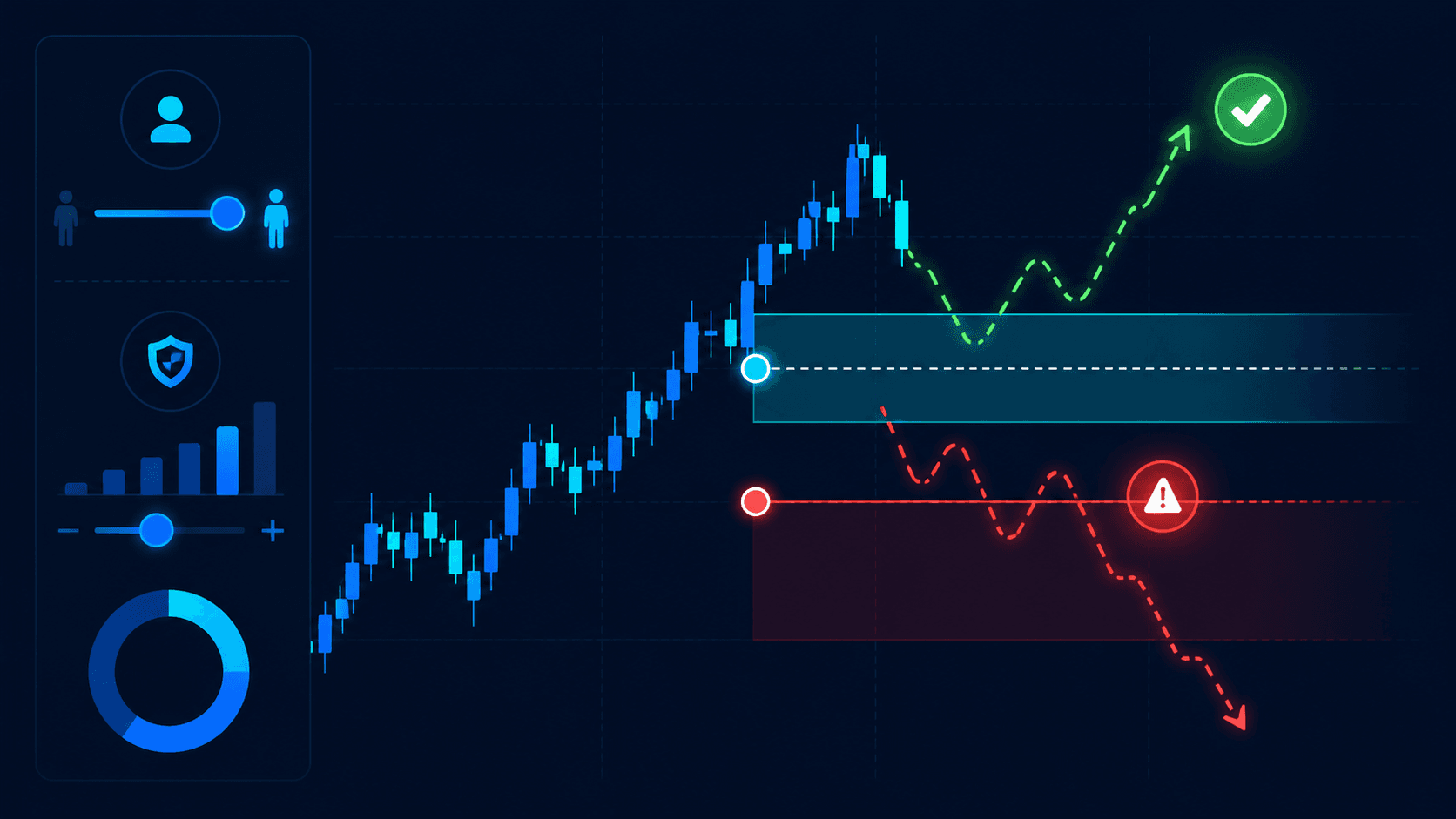
A stop-loss order can protect your capital, but it is not an automatic safety net that works in every market condition.
The gap between a stop-market order and a stop-limit order is huge, especially in thin or fast-moving crypto markets, so picking the right one matters.
Strong risk management often depends more on your position size and trade structure than on the stop-loss order itself.
Stop-loss orders get talked about constantly in crypto trading, and they are also one of the most misunderstood tools out there.
If you have spent any time around trading advice, you have probably heard the rule: always use a stop loss. It sounds smart, and it is well intentioned, but on its own it is incomplete. A stop loss can absolutely save you from turning a manageable loss into a painful one. It can also get triggered by ordinary market noise, fail to execute in a thin market, or hand you a false sense of safety when the real problem is simply that your position is too big.
The honest takeaway is this: a stop loss is one part of a bigger risk-management system, not a magic button you press to stay safe.
In this guide we will walk through it together, the difference between market stops and stop-limit orders, when stop losses genuinely help, when they work against you, how exchange-based and on-chain stops differ, why weekend and gap risk still matter in a 24/7 market, and when adjusting your position size is the smarter move.
What Is a Stop-Loss Order?
A stop-loss order is simply an instruction to reduce or close a position once the price reaches a level you have chosen in advance.
The idea is easy to grasp: you are capping your downside in case the trade goes the wrong way. In plain language, you are telling the market that if the price drops to a certain point, you do not want to keep holding your full position.
That is a useful intention. But here is the catch, what actually happens when your stop triggers depends entirely on the type of order you used.
Stop-Market vs Stop-Limit: Why the Difference Matters
This is the first thing every new trader needs to get straight, because the two order types behave very differently once they are triggered.
Stop-Market Orders
A stop-market order turns into a market order the moment your trigger price is hit. Its biggest strength is that it prioritizes getting you out, so execution is almost always guaranteed. The trade-off is that in a fast-moving market the price you actually receive can be noticeably worse than the price you expected.
Stop-Limit Orders
A stop-limit order turns into a limit order once the trigger price is reached. Its biggest strength is price control, since you decide the worst price you are willing to accept. The downside is real though: if the price moves too quickly through your limit, the order may never fill at all.
That last point, non-execution risk, is one of the biggest and most painful mistakes beginners make in crypto.
Quick Comparison
Order type | Best for | Main weakness |
Stop-market | Traders who want exit certainty | Slippage in fast-moving markets |
Stop-limit | Traders who want price control | The order may not fill at all |
Why Stop-Limit Gaps Are Dangerous in Thin Markets
Crypto markets are not equally liquid. Some assets trade with deep order books around the clock, while others barely have buyers and sellers at certain hours.
If you place a stop-limit on a thinly traded altcoin and the price gaps straight past both your stop and your limit, your order can trigger but never get filled. The result is that you are still fully exposed to the falling market while believing you were protected.
A Thin-Market Example
Step | What happens |
You buy in | You buy a low-liquidity token at $1.00 |
You set a stop | Your stop trigger is $0.90 |
You set a limit | Your limit price is $0.89 |
Bad news hits | The price instantly trades down to $0.82 |
The result | Your order may not fill because no buyers exist at your limit level |
What you had was not really an exit. It was a conditional hope.
When Stop Losses Help
Stop losses work best when they genuinely fit the structure of your trade. They tend to help when:
there is a clear level that would prove your trade idea wrong
the market is reasonably liquid
the position is short-term or tactical
you cannot watch the trade around the clock
your trade thesis falls apart if the price breaks a specific level
Good Use Cases
Scenario | Why a stop helps |
Breakout trade | Limits the damage if the breakout fails |
Leveraged position | Helps you manage liquidation risk |
Swing trade with defined support | Creates a disciplined, pre-planned exit |
High-volatility event trade | Stops a small thesis failure from becoming a large loss |
A stop is most powerful when it reflects a real failure of your trade idea, not just a moment of emotional discomfort.
When Stop Losses Hurt
Used poorly, a stop loss can quietly work against you. That tends to happen when:
the asset is highly volatile and noisy
your stop sits at an obvious level that the whole crowd can see
the market is illiquid
you are using a stop instead of simply trading a smaller size
the position was meant to be a long-term hold, not a quick trade
Common Bad Use Cases
Scenario | Why the stop may hurt |
Very thin altcoin | Gaps and slippage can be severe |
Highly obvious support level | Stop hunts and liquidity sweeps are common there |
Long-term investment position | Normal volatility may trigger a premature exit |
Oversized position | The stop becomes a bandage for poor sizing |
This is exactly why always use a stop is too simple a rule to follow blindly.
Exchange-Side Stops vs On-Chain Stops
Not every stop loss works the same way under the hood.
Exchange-Side Stops
These are handled by centralized exchanges and usually trigger based on what is happening in that exchange's order book. They are easy to place, integrated directly with spot and derivatives trading, and often well suited to active traders. The trade-offs are that they depend on the exchange's systems, can trigger on price action specific to that single venue, and do not carry over to self-custody setups.
On-Chain Stops
These rely on smart contracts, bots, or third-party automation to mimic stop-loss behavior. They make risk control possible in self-custody and DeFi-native strategies. But they come with extra layers of risk: execution can depend on bots or keepers doing their job, gas spikes and latency can interfere, slippage can be severe in thin liquidity pools, and smart contract risk is always present.
Side-by-Side Comparison
Stop type | Main advantage | Main risk |
Exchange-side | Easier and often faster for active trading | You depend on a single venue |
On-chain | Works in DeFi or self-custody setups | Automation, slippage, and contract risk |
Weekend Gap Risk in Crypto
Traditional markets close on weekends. Crypto never does. It is tempting to assume that means gap risk simply does not exist in crypto, but it does not disappear, it just changes shape.
Big price moves can still happen during low-liquidity stretches such as weekends, regional off-hours, or overnight news windows. If your stop triggers during one of these quieter periods, you may get a worse fill than you would expect.
A few reasons weekend conditions can catch traders off guard:
order books are thinner in some pairs
market makers provide less depth
macro or regulatory headlines can land at any time
chain-specific incidents or liquidation cascades can spread fast
A stop order does not remove these risks. It simply interacts with them.
Should You Use a Stop Loss? A Simple Decision Guide
Here is a quick way to think it through before you place a stop.
A Stop Loss Probably Makes Sense If:
the trade is short-term or tactical
you have a clear level that would prove the idea wrong
the market is liquid enough to fill your order reliably
you cannot keep a close eye on the position
It May Be Better to Rethink or Resize If:
the asset is highly illiquid
you intend to hold the position through volatility
your stop level is driven by fear rather than trade structure
the position is simply too large for your account
Decision Table
Question | If yes | If no |
Is this a short-term trade? | A stop may fit well | Position sizing may matter more |
Is there a clear invalidation level? | Build the stop around your thesis | Do not force a random stop |
Is liquidity strong? | Execution should be reliable | Be cautious with stop-limit orders |
Is the position too large? | Reduce the size first | Then think about stop structure |
Three Real Examples
Example 1: Stop-Market on a Liquid BTC Trade
Entry | BTC at $92,000 |
Thesis | A breakout above resistance should hold |
Invalidation | A move back below $89,500 |
Tool used | Stop-market at $89,400 |
Why this works: BTC is relatively liquid, the trade has a clear point where the idea is proven wrong, and the trader's priority is simply getting out. A stop-market fits that perfectly.
Example 2: Stop-Limit on a Thin Altcoin
Entry | A low-cap altcoin at $2.50 |
Stop | $2.20 |
Limit | $2.18 |
What happens | A sudden drop sends the token straight to $2.00 |
Why this fails: The stop triggers, but the limit order may just sit there unfilled. The trader still owns the position while the price keeps sliding.
Example 3: Using Position Size Instead of a Tight Stop
A trader wants exposure to a volatile, narrative-driven coin. Instead of using a very tight stop that is likely to get tagged by normal noise, they cut their position size dramatically. Risk is now controlled through a smaller capital allocation rather than a fragile order sitting in the order book.
Why this can be smarter: In a noisy market, a smaller position can ride out ordinary volatility far better than a poorly placed stop ever could.
When Not to Use a Stop Loss
Knowing when to skip a stop loss matters just as much as knowing when to use one.
You might choose not to use a stop if:
you are slowly building a long-term investment position
the asset is so illiquid that stop execution is unreliable
your position is already small and intentionally risk-capped
your thesis is built on a multi-month horizon, not short-term price swings
This does not mean abandoning risk control. It just means the protection comes from somewhere else, such as:
smaller position sizes
staged entries
diversification
lower leverage, or no leverage at all
Position Sizing: The Underrated Risk Tool
A lot of traders try to fix a sizing problem with a stop-loss order. More often than not, that backfires.
If your position is too big, even a well-placed stop can push you into emotional decisions, messy exits, panic, and jumping back in at the wrong time. A smaller position simply gives you more room to think clearly.
Stop Loss vs Position Sizing
Tool | Best role |
Stop loss | Tactical exit control for a specific trade |
Position sizing | Core risk control for your whole portfolio |
The strongest setups usually use both together.
Tools and Execution Context
If you actively trade on platforms like Bybit, OKX, or BTCC, exchange stop features are probably already part of your routine. For mapping out your chart and invalidation levels before you place a stop, many traders lean on TradingView.
One reminder though: do not place a stop just because a platform makes it quick and easy. Place it because it genuinely fits the structure of your trade.
Final Thoughts
Stop-loss orders are genuinely useful, but they are not a one-size-fits-all solution. In crypto, liquidity gaps, slippage, crowded levels, and fast-moving conditions can make a stop behave very differently from what a beginner expects.
The best approach is refreshingly simple: understand the difference between stop-market and stop-limit, place your stops where your trade idea actually fails, respect the realities of thin markets, and never treat a stop as a replacement for proper position sizing.
A good stop is part of a plan. A bad stop is just a surprise you have scheduled for later.
Frequently Asked Questions
What is the difference between a stop-market and a stop-limit order?
A stop-market turns into a market order when triggered, so it prioritizes getting you out. A stop-limit turns into a limit order and may not fill at all if the price moves too quickly through your limit.
Are stop losses always a good idea in crypto?
No. They can help in liquid, tactical setups, but they can also fail or cause poor exits in thin or highly volatile markets.
Why do stop-limit orders fail sometimes?
Because the price can gap straight past your limit level, leaving the order triggered but unfilled.
Should long-term investors use stop losses?
Not always. For longer-term positions, smaller sizing and staged entries are often more useful than tight stop placement.
What is weekend gap risk in crypto if the market never closes?
Crypto trades continuously, but liquidity can still thin out during certain periods, which can lead to worse stop execution during sharp moves.
What is more important, stop losses or position sizing?
Position sizing is usually the more important foundation. Stop losses work best when layered on top of sensible sizing.
Disclaimer
This content is for educational and informational purposes only and is not financial advice. Nothing here is a recommendation to buy or sell any asset or use any platform. Do your own research and manage your risk.
On-Chain Analytics for Beginners: How to Use Nansen, Arkham Intelligence, and Token Terminal
How to Research a New Crypto Project: A 10-Point Due Diligence Framework
SEC Project Crypto Explained: Atkins’ Token Taxonomy and the Innovation Exemption
KelpDAO Aftermath: Why DeFi's $292M Hack Is Forcing the Industry to Grow Up
Need deeper training?
Join our structured modules with live examples and expert checklists for effective implementation.
JOIN THE ACADEMY