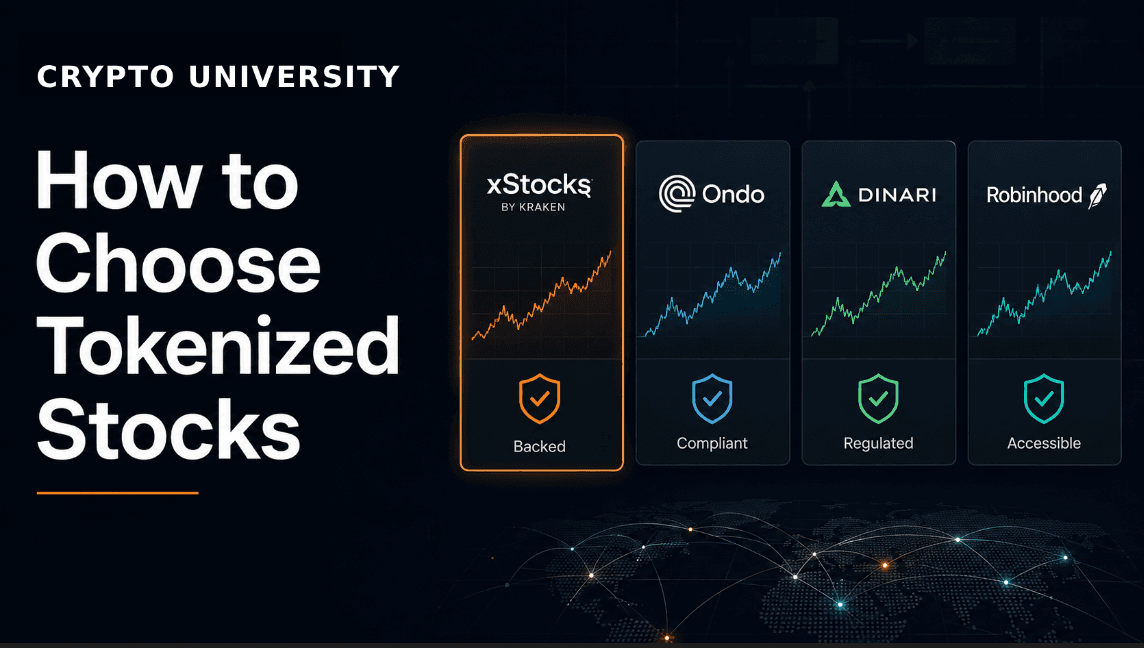
If you want to own US stocks using crypto rails, four names come up again and again: xStocks, Ondo, Dinari, and Robinhood. They all try to answer the same question, but each one does it with a completely different legal setup underneath. The good news is that choosing between them usually comes down to just three personal facts: where you live, whether you want to hold the tokens yourself and use DeFi, and how much you care about the structure behind them. Let's walk through it together.
Key Takeaways
|
A quick jargon-buster
Before the comparison, here are a few terms that show up in the tables, explained in plain language.
Term | In plain English |
|---|---|
Self-custody | You keep the tokens in your own wallet, and only you control them. |
DeFi composability | How easily the token can plug into other crypto apps, like lending or trading pools. |
Mint and redeem | Creating a new token by locking up backing (mint), or cashing it back out for its value (redeem). |
Proof of reserves | A public, checkable way to confirm the real shares backing the tokens actually exist. |
Broker-dealer | A licensed, regulated firm allowed to buy and sell shares on your behalf. |
Derivative | A contract whose value tracks a stock, rather than a direct ownership stake in it. |
The basics: what each product actually is
Even though they all track real stocks, the thing you are actually holding is different in each case. This table shows the core difference.
Feature | xStocks (Backed) | Ondo Global Markets | Dinari dShares | Robinhood Stock Tokens |
|---|---|---|---|---|
What it really is | A certificate backed 1-for-1 by real shares | A note secured by real shares | A real tokenized share on broker-dealer rails | A derivative or debt claim on Robinhood |
Are real shares held for you? | Yes, with regulated custodians, plus public proof of reserves | Yes, with US brokers, checked daily | Yes, with regulated custodians | No direct claim; Robinhood hedges at the firm level |
Who regulates it | Jersey company under an EU prospectus | Offshore offer on a US custody chain | US broker-dealer (a first for on-chain shares) | EU-licensed entities under MiFID |
What you can buy, and where
Next, here is how they compare on selection, blockchains, where to buy them, and who is allowed to use them.
Feature | xStocks (Backed) | Ondo Global Markets | Dinari dShares | Robinhood Stock Tokens |
|---|---|---|---|---|
How many stocks | 100+ stocks and ETFs | 200+ stocks and ETFs | A growing list via partners | 2,000+ (Classic); 200+ (newer retail rollout) |
Which blockchains | Solana, Ethereum, Mantle, TON, Ink and more | Ethereum, Solana and more | Ethereum, Arbitrum, Base, Plume | Robinhood Chain (an Arbitrum-based network) |
Where to buy | Kraken, Bybit, Gate, Bitget, OKX and DEXs | Ondo platform, MetaMask Swaps, partners | Gemini (EU) and partner apps | The Robinhood app |
Who can use it | Outside the US; restricted in UK, Canada, Australia | Outside the US (Asia, EU, Africa, Latin America) | Depends on the partner; live in the EU | 30 EU/EEA countries; newer product in 120+ countries |
Your rights and control
Finally, this is what you can actually do with each token once you hold it, from dividends to cashing out.
Feature | xStocks (Backed) | Ondo Global Markets | Dinari dShares | Robinhood Stock Tokens |
|---|---|---|---|---|
Dividends | Added automatically to your balance | Build up inside the token's value | Paid the traditional way | Passed through in the app |
Voting rights | No | No | No (for retail) | No |
Hold it in your own wallet? | Yes | Yes | Depends on the partner | Starting to arrive via Robinhood Chain |
Use it in DeFi apps | Strongest (Solana ecosystem) | Strong (Ethereum) | Limited | Very little today |
Can you cash out directly? | Yes, via the issuer (fee; pro users) | Yes, mint and redeem almost 24/5 | Yes, via regulated rails | No; you just close the position in the app |
Want live, per-asset detail? You can check current issuer and venue data for each individual stock in the Crypto University Tokenized Stocks Directory.
How they really differ, in plain English
xStocks (Backed): built for access and DeFi
xStocks is the one you will find in the most places. It is listed on more exchanges than any of the others, shows up across decentralized exchanges, lets you hold the tokens in your own wallet from day one, and has already handled more than 25 billion dollars in trading. Behind the scenes, each token is a certificate issued by a company in Jersey, backed one-for-one by real shares held with regulated custodians, and you can independently verify that the shares are really there. The trade-off is that it is the most crypto-native of the four, so your claim sits offshore and everything rests on that backing being maintained. Pick it if you want the widest availability, self-custody, DeFi, and plenty of exchange choice.
Ondo Global Markets: built for easy minting and a big menu
Ondo's standout features are practical ones. You can create and cash out tokens almost around the clock, an outside party checks the backing every single day, and it offers the largest list of properly backed tokens, more than 200, including the ability to tokenize a stock the same day it goes public. Its legal setup is broadly similar to xStocks, an offshore note backed by US-held shares, but with more built-in verification. Pick it if you want the biggest selection, easy minting and cashing out, and you prefer holding on Ethereum.
Dinari dShares: built to sit inside the rules
Dinari is the only one built inside US broker-dealer regulation, and it keeps dividends and corporate actions working the traditional way. Right now that usually means you reach it through a partner, such as Gemini in the EU, and it is less flexible for DeFi. But if US regulators eventually open the door to tokenized stocks for American investors, Dinari's setup looks well placed to be the road they arrive on. Pick it if you want the most conservative, rules-first structure, or you are betting on US-regulated rails.
Robinhood Stock Tokens: built for a smooth app experience
Robinhood offers the most names by far, over 2,000 in its Classic lineup, along with the simplest app, dividends paid straight into your account, and availability in more than 120 countries through its own blockchain. The catch is that these tokens are derivatives or debt claims on Robinhood itself, not a direct claim on real shares set aside for you, so there is no collateral to claim, no way to redeem them, and very little on-chain life today. Pick it if you want EU convenience and a huge list of names, and you are comfortable that this is the least token-like of the tokenized stocks.
The short version: who each one suits
Product | Best for |
|---|---|
xStocks | The widest availability, holding tokens yourself, and using DeFi. |
Ondo | The biggest menu of stocks and easy minting and cashing out. |
Dinari | The most cautious, regulation-first setup, or a bet on US-regulated rails. |
Robinhood | The simplest app experience and the largest list of stock names. |
Which one is right for you? Three simple questions
Work through these in order and the answer usually appears on its own.
Ask yourself | What it means for you |
|---|---|
Where do you live? | US: none of these are open to you yet. UK, Canada, or Australia: xStocks is restricted, so check the others. EU: all four are available. Asia, Middle East, Africa, or Latin America: usually a choice between xStocks (through exchanges) and Ondo. |
Do you want to hold the tokens yourself and use DeFi? | Yes: go with xStocks (on Solana) or Ondo (on Ethereum). No: Robinhood's app or Dinari through Gemini are simpler. |
How much do you care about the legal structure? | Verified backing plus deep liquidity: xStocks. Daily checks plus easy minting: Ondo. Maximum caution and regulation: Dinari. Pure app simplicity: Robinhood. |
A smart tip: it is fine to spread your bets
If you are putting in a meaningful amount of money, using more than one issuer is sensible rather than indecisive. Holding the same stock through two different structures roughly halves how exposed you are to any single company's legal setup. Think of it as basic hygiene for a larger position, not a sign that you cannot make up your mind. Not sure which chain or venue a token trades on? Confirm it per asset in the Crypto University Tokenized Stocks Directory.
Frequently asked questions
Which tokenized stock product is the safest?
There is no single safest option, because each one is safe in a different way. Dinari is the most tightly regulated, Ondo verifies its backing every day, xStocks has a long track record plus public proof of reserves, and Robinhood offers app-based custody under conduct rules. None of them match the protections of a normal home-country brokerage, but all of them are safer than undocumented synthetic copies.
Which one has the most stocks?
Robinhood, with more than 2,000 names in its Classic lineup, followed by Ondo with 200-plus backed tokens, then xStocks with 100-plus, then Dinari's growing partner list.
Can I hold the same stock from more than one issuer?
Yes. You could get Tesla exposure in all four ecosystems, for example. Just remember that each version is a completely separate product. They do not swap, merge, or bridge into one another.
Which one is cheapest?
It depends more on where you buy than on the issuer itself, so compare the spreads and fees on the platforms available to you. Robinhood advertises zero spreads on the surface, but your true cost also includes currency conversion and the token's structure.
Do any of them give voting rights?
No. All four leave out shareholder voting.
Sources
xStocks documentation and ecosystem: docs.xstocks.fi and xstocks.fi
Ondo Global Markets documentation: docs.ondo.finance/ondo-global-markets
Dinari announcements on broker-dealer registration, Gemini, and tZERO
Robinhood newsroom on Classic tokens and Robinhood Chain expansion
Disclaimer: This content is for educational and informational purposes only and is not financial advice. Nothing here is a recommendation to buy or sell any asset or use any platform. Do your own research and manage your risk.
Explore the Crypto University Tokenized Stocks Directory.
Tokenized Stocks Explained: A Simple Guide for Beginner Traders
How to Buy Tokenized Stocks: A Step by Step Guide for Beginners
Best Platforms for Tokenized Stocks: Exchanges, Brokers and Onchain Apps
Tokenized Stock Risks: Issuers, Custody, Liquidity and Tracking Error
Can You Buy Tokenized Stocks in the USA? Current Rules and Alternatives
Need deeper training?
Join our structured modules with live examples and expert checklists for effective implementation.
JOIN THE ACADEMY