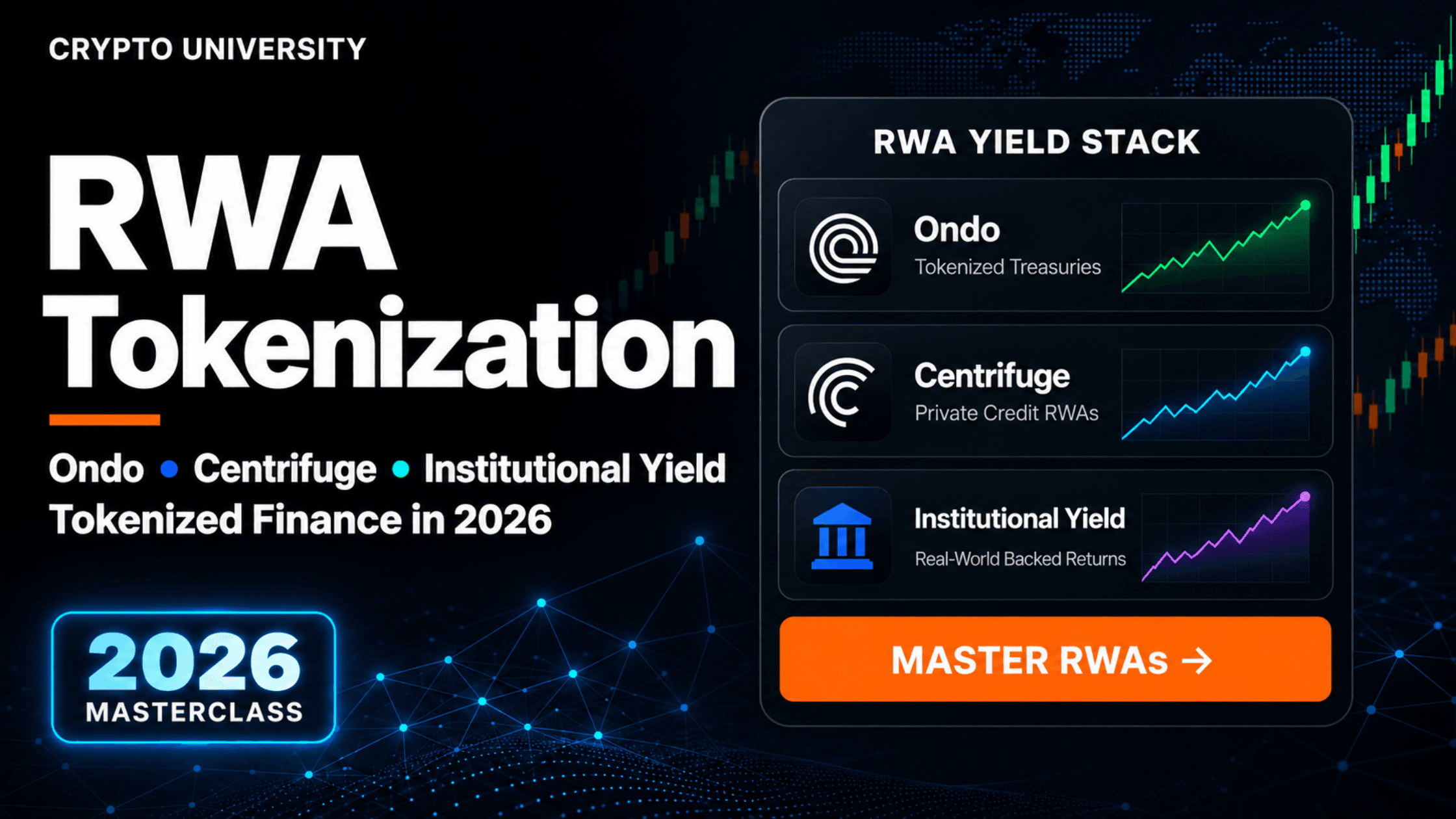
Mastering Real-World Asset (RWA) Tokenization: Ondo, Centrifuge, and Institutional Yield in 2026
The cryptocurrency market has officially crossed the Rubicon from speculative digital experiments to foundational global financial infrastructure. By 2026, the Real-World Asset (RWA) Tokenization sector has evolved from a niche DeFi narrative into a multi-trillion-dollar asset class. Major traditional finance (TradFi) institutions now routinely tokenize U.S. Treasuries, private credit, real estate, and commodities, bridging the gap between blockchain efficiency and regulated, yield-bearing assets.
For High-Net-Worth Individuals (HNWIs), family offices, and sophisticated retail investors, RWA tokenization is no longer optional; it is the cornerstone of a modern, inflation-resistant portfolio. It offers the "holy grail" of crypto investing: sustainable, "Real Yield" derived from actual global economic activity, completely decoupled from the volatile, inflationary token emissions of early DeFi.
This comprehensive guide breaks down the core mechanics of modern RWA tokenization, the top-tier platforms for accessing these assets in 2026, and the strict operational and regulatory frameworks required to build a resilient, yield-generating RWA portfolio safely.
The 3 Pillars of Modern RWA Tokenization in 2026
To effectively allocate capital to tokenized real-world assets, investors must understand the legal and technological infrastructure that makes them viable.
Tokenized U.S. Treasuries and Money Market Funds:
This is the baseline "risk-free" rate of the crypto ecosystem. Protocols and regulated issuers now tokenize short-term U.S. Treasuries and money market funds (e.g., yielding 4-5% APY). These tokens represent legal claims on underlying TradFi assets held in bankruptcy-remote Special Purpose Vehicles (SPVs). The yield is passed directly to the token holder, providing a stable, inflation-hedged return that serves as the ultimate safe haven during crypto bear markets.
Decentralized Private Credit and Institutional Debt:
Beyond government bonds, decentralized protocols facilitate direct lending to real-world businesses (e.g., emerging market fintechs, real estate developers, or trade finance operations). Borrowers provide real-world collateral or undergo rigorous off-chain underwriting, and the resulting debt is tokenized on-chain. This allows retail and institutional investors to access high-yield private credit markets previously gated exclusively for billionaire family offices.
Legal Wrappers and Regulatory Compliance (The "How"):
A token is only as valuable as the legal right it confers. In 2026, mature RWA projects utilize robust legal wrappers (like Delaware LLCs or Swiss foundations) that explicitly map on-chain token ownership to off-chain legal rights. Furthermore, to comply with global securities laws (like the EU’s MiCA or U.S. SEC regulations), top-tier RWA platforms implement permissioned pools, requiring investors to pass strict KYC/AML and accredited investor checks before interacting with the smart contracts.
Top Platforms for RWA Tokenization and Yield in 2026
Accessing the RWA market requires platforms that balance deep liquidity, rigorous regulatory compliance, and transparent asset backing.
1. Binance: Best for Accessible RWA Token Trading and Launchpools
For investors seeking broad exposure to the RWA narrative without navigating complex, permissioned DeFi protocols, Binance offers the most liquid and user-friendly gateway.
Core Features: Binance frequently lists the governance tokens of leading RWA protocols (e.g., ONDO, CFG, MKR) and offers "Launchpool" events where users can stake established assets to farm new RWA token emissions before they hit the open market.
Regulatory Vetting: Binance conducts exhaustive due diligence before listing any RWA-related asset, ensuring that the underlying projects have legitimate legal structures and audited reserve proofs, significantly reducing the risk of investing in "vaporware" RWA scams.
Why Investors Choose It: It provides immediate, deep liquidity for RWA narrative tokens, allowing investors to easily scale into or out of positions while capturing the macro growth of the tokenization sector.
👉 Access Top-Tier RWA Token Listings and Launchpools on Binance (Use referral code: CPA_00SXKU7IO9)
2. Kraken: Best for Regulated, Institutional-Grade RWA Yield
For HNWIs and family offices who prioritize regulatory compliance, transparency, and institutional custody over speculative token trading, Kraken is the gold standard.
Core Features: Kraken’s "Simple Earn" and institutional products increasingly feature direct access to regulated, RWA-backed yield products. Investors can earn returns derived from tokenized government securities or highly vetted private credit funds, all while maintaining the liquidity and security of a major, publicly audited exchange.
Proof of Reserves & Segregation: Client assets are held in segregated, cold storage environments, backed by frequent, attested Proof of Reserves. This ensures that the RWA yield is generated transparently and is protected from corporate insolvency.
Why Investors Choose It: It eliminates smart contract risk and DeFi complexity. Investors get the yield benefits of RWA tokenization, wrapped in the regulatory compliance and institutional security of a top-tier global financial institution.
👉 Earn Regulated, Transparent RWA Yield with Kraken (Use referral code: QjZ0L3)
3. Bybit: Best for RWA Narrative Trading and Structured Yield Products
For active traders who want to capitalize on the volatility of RWA governance tokens or earn yield on their holdings, Bybit provides a highly versatile, institutional-grade environment.
Core Features: Bybit offers deep perpetual futures markets for major RWA tokens, allowing sophisticated traders to hedge their spot RWA portfolios or speculate on the sector's growth with capital efficiency. Additionally, Bybit’s "Dual Investment" and structured products often feature RWA tokens, allowing users to earn enhanced yield on their holdings.
Unified Risk Management: Funds deployed in Bybit’s earning products can often be used simultaneously as cross-margin collateral, maximizing capital efficiency without locking up assets.
Why Investors Choose It: It bridges the gap between passive RWA yield generation and active, derivatives-based portfolio management, offering the flexibility to pivot strategies as macroeconomic conditions change.
👉 Trade RWA Narrative Tokens and Structured Yield Products on Bybit (Use referral code: 46164)
Top Tools for Supporting Your RWA Portfolio
A professional RWA investment strategy requires a technology stack that ensures security, analytical depth, and regulatory compliance.
4. TradingView: Best for Tracking RWA Token Metrics vs. TradFi Yields
Successful RWA investing requires correlating crypto token performance with traditional macroeconomic indicators. TradingView is the essential command center for this analysis.
Core Features: Advanced investors use TradingView to chart RWA governance tokens alongside traditional benchmarks, such as the iBoxx USD Liquid High Yield Index or the US 2-Year Treasury Yield (TVC:US02Y). Custom indicators can track the Total Value Locked (TVL) of major RWA protocols to gauge institutional adoption and liquidity health.
Why Investors Choose It: It provides the quantitative visibility needed to determine if an RWA token’s price action is fundamentally justified by its underlying real-world yield, or if it is purely speculative.
👉 Analyze RWA Token Metrics and Macro Yield Curves with TradingView
5. Ledger: Best for Securing Permissioned RWA Wallets
Interacting with decentralized RWA protocols often requires interacting with complex, permissioned smart contracts that verify your KYC status via Zero-Knowledge proofs or Soulbound Tokens (SBTs).
Core Features: Ledger hardware wallets provide FIPS 140-2 Level 3 certified Secure Element protection. When you interact with an RWA protocol to deposit capital or claim yield, Ledger ensures every signature is physically verified on the device’s secure screen.
Clear Signing: Ledger’s ecosystem parses these complex, permissioned transactions, displaying human-readable details to prevent "blind signing" attacks where malicious contracts disguise token drains as routine yield claims.
Why Investors Choose It: It provides the ultimate physical circuit breaker, ensuring that your legally binding, yield-bearing RWA tokens cannot be stolen or manipulated by remote digital attacks.
👉 Secure Your RWA Token Holdings with a Ledger Hardware Wallet
6. Koinly: Best for Tracking the Complex Tax Implications of RWA Yield
The tax treatment of RWA tokenization is highly nuanced. Receiving yield from a tokenized Treasury fund may be classified differently than yield from a decentralized private credit pool, and trading the governance tokens triggers capital gains events.
Core Features: Koinly seamlessly integrates with major exchanges and self-custody wallets. Its advanced heuristic engine accurately categorizes RWA yield distributions (e.g., distinguishing between ordinary interest income and capital gains) and tracks the cost basis of RWA governance tokens with precision.
Why Investors Choose It: It transforms the opaque, multi-jurisdictional cash flows of RWA investing into a clean, audit-ready tax report, ensuring compliance with strict global tax authority requirements.
👉 Automate Your Complex RWA Yield Tax Tracking with Koinly
Step-by-Step: How to Build a Resilient RWA Portfolio
Deploying capital into real-world assets requires a disciplined, compliance-first workflow. Follow this exact blueprint:
Step 1: Define Your RWA Allocation and Risk Tranche
Determine your goal. For capital preservation, allocate the majority of your RWA sleeve to tokenized U.S. Treasuries or money market funds (via regulated platforms like Kraken). For yield enhancement, allocate a smaller portion to decentralized private credit or RWA governance tokens (via Binance or Bybit).
Step 2: Vet the Legal Wrapper and Reserve Proofs
Before investing in any RWA protocol, verify its legal structure. Does it use a bankruptcy-remote SPV? Are the underlying assets audited by a reputable, independent third party (e.g., a Big Four accounting firm)? Avoid projects that cannot provide transparent, real-time proof of their off-chain reserves.
Step 3: Execute with Hardware Security
If interacting with a decentralized RWA protocol, connect your Ledger hardware wallet. Verify the smart contract address against the protocol’s official documentation. When approving the token spend limit, approve only the exact amount you are depositing, never "unlimited."
Step 4: Monitor Macroeconomic Shifts and Rebalance
RWA yields are directly tied to traditional interest rates. Monitor central bank policies (e.g., Federal Reserve rate decisions). If traditional rates drop, RWA yields will compress, and capital may rotate back into higher-risk crypto assets. Rebalance your portfolio accordingly to maintain your target risk profile.
Risk Management: The Hidden Dangers of RWA Tokenization
While RWA tokenization offers sustainable yield, it introduces unique, hybrid risks that must be actively managed:
Regulatory Reclassification Risk: The SEC and other global regulators are actively scrutinizing RWA tokens. If a tokenized asset is deemed an unregistered security, the protocol could be forced to halt operations or restrict access, freezing investor funds. Mitigation: Favor protocols that proactively implement strict KYC/AML gateways and operate in crypto-friendly legal jurisdictions (e.g., Switzerland, UAE, or specific U.S. states).
Liquidity Fragmentation and Redemption Delays: Unlike pure crypto assets, RWA tokens are backed by illiquid or slow-moving real-world assets. In a market panic, you may not be able to instantly redeem your token for fiat at a 1:1 ratio if the underlying SPV faces a liquidity crunch. Mitigation: Maintain a robust buffer of highly liquid, native crypto assets (like BTC, ETH, or USDC) outside of your RWA sleeve.
Smart Contract and Oracle Risk: The bridge between off-chain legal rights and on-chain tokens relies on smart contracts and oracles. A bug in the contract or a manipulated oracle feed could disrupt yield distribution or token minting/burning. Mitigation: Only use battle-tested RWA protocols with significant TVL, multiple top-tier audits, and active bug bounty programs.
Frequently Asked Questions (FAQ)
Q: Are RWA tokens considered securities?
A: In many jurisdictions, yes. Tokens that represent a direct claim on the profits or cash flows of a real-world asset (like a tokenized bond or real estate share) are highly likely to be classified as securities. This is why top-tier RWA platforms restrict access to verified, accredited investors through strict permissioned pools.
Q: How is yield from tokenized U.S. Treasuries taxed?
A: Tax treatment varies by jurisdiction, but generally, yield generated from tokenized Treasuries or money market funds is treated as ordinary interest income, taxed at your marginal income tax rate. Trading the RWA governance token itself triggers a separate capital gains or losses event. Automated tracking via Koinly is essential to navigate this complexity.
Q: What happens to my RWA tokens if the issuing company goes bankrupt?
A: This is why the legal wrapper is critical. Mature RWA projects hold the underlying assets in a "bankruptcy-remote" Special Purpose Vehicle (SPV). This legal structure ensures that the assets are segregated from the issuer’s corporate balance sheet, protecting token holders in the event of the issuer's insolvency. Always verify this structure before investing.
Q: Can I use RWA tokens as collateral for DeFi loans?
A: Increasingly, yes. Leading DeFi lending protocols (like Aave or Morpho) have begun integrating permissioned RWA tokens as eligible collateral. However, this usually requires the borrower to pass the same KYC/AML checks as the RWA issuer, maintaining the regulatory compliance of the underlying asset.
Risk Warning: Investing in Real-World Asset (RWA) tokenization carries unique risks, including regulatory reclassification, liquidity fragmentation, smart contract vulnerabilities, and the potential insolvency of off-chain legal entities. Unlike pure crypto assets, RWA redemption may be subject to traditional banking delays.
Not Financial Advice: The information provided in this article is for educational and informational purposes only. It does not constitute financial, investment, legal, or tax advice. RWA regulations vary significantly by jurisdiction. Always conduct your own rigorous research (DYOR) and consult with a qualified, licensed legal and financial professional before investing in tokenized real-world assets.
Affiliate Disclaimer: This article contains affiliate links. If you click on these links and sign up for a service or make a purchase, we may earn a commission at no additional cost to you. We only recommend platforms, tools, and services that we have thoroughly vetted and believe provide genuine value, security, and utility to our readers.
Recommended reading:
Need deeper training?
Join our structured modules with live examples and expert checklists for effective implementation.
JOIN THE ACADEMY