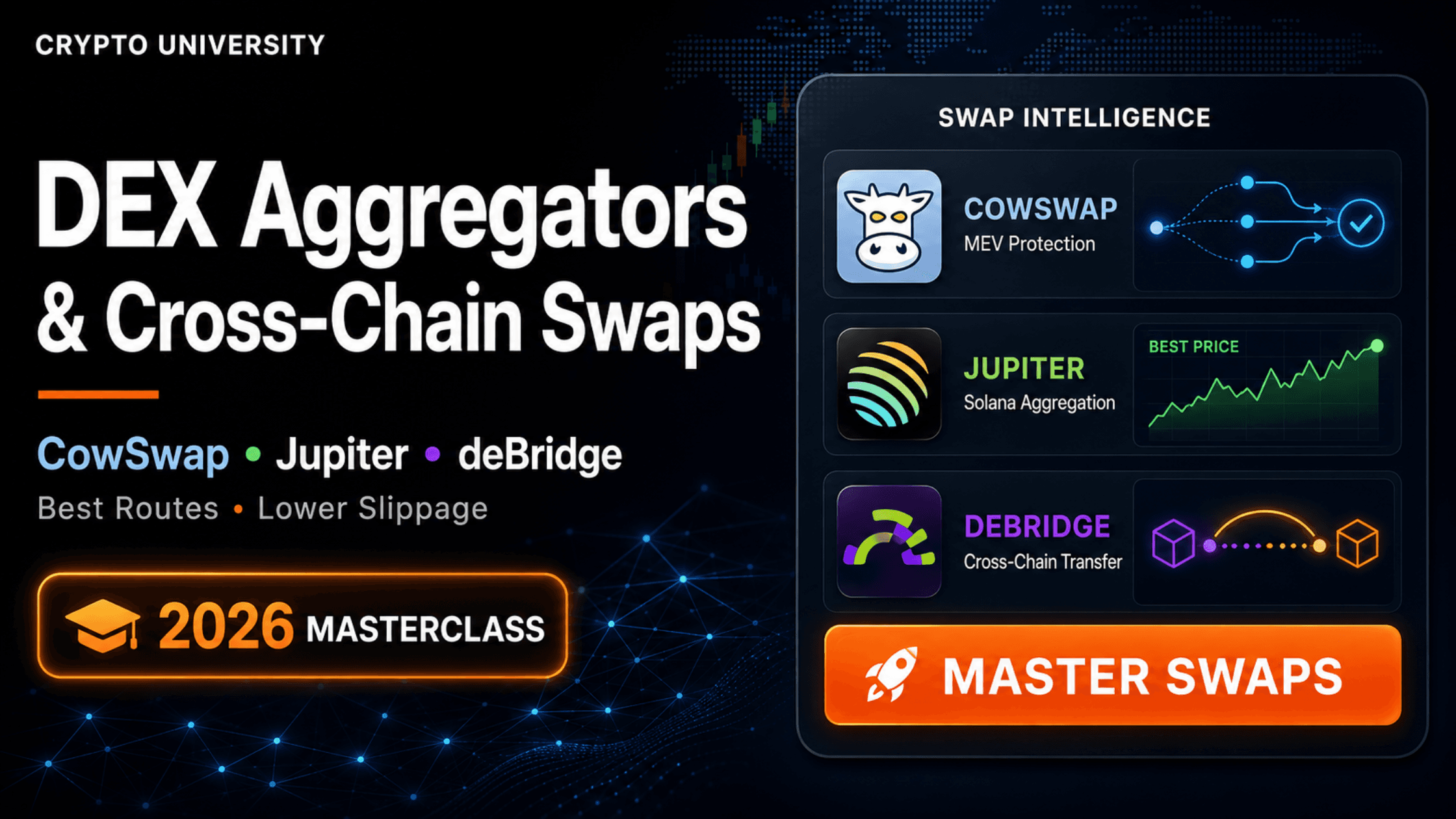
Mastering DEX Aggregators and Cross-Chain Swaps: CowSwap, Jupiter, and deBridge in 2026
The decentralized finance (DeFi) landscape of the early 2020s was notoriously fragmented. Traders were forced to manually navigate isolated liquidity pools across a dozen different blockchains, suffering from massive slippage, exorbitant gas fees, and relentless Maximal Extractable Value (MEV) sandwich attacks.
By 2026, this friction has been entirely eliminated by the rise of Advanced DEX Aggregators and Trustless Cross-Chain Bridges. These next-generation protocols no longer just scrape prices from a few decentralized exchanges (DEXs). They utilize intent-based routing, sophisticated MEV protection, and cryptographically secure interoperability layers to find the absolute best execution price across the entire multi-chain ecosystem, all in a single, seamless transaction.
For sophisticated retail traders, quantitative desks, and multi-chain DeFi natives, mastering these aggregation tools is no longer optional; it is the baseline requirement for capital efficiency. This comprehensive guide breaks down the mechanics of modern DEX aggregation, the top-tier platforms dominating the space in 2026, and the strict operational security frameworks required to execute cross-chain swaps safely.
The 3 Pillars of Modern DEX Aggregation in 2026
To maximize execution quality, you must understand the technological shifts that separate modern aggregators from legacy routers.
Intent-Based Routing and MEV Protection: Instead of forcing users to specify the exact path of a trade, modern aggregators (like CowSwap) allow users to sign an "intent" (e.g., "I want to swap 1 ETH for at least 3,000 USDC"). Off-chain "solvers" then compete to fulfill this intent. Because the trade is matched in a batch auction and settled at a guaranteed price, traditional public mempool sandwich attacks are mathematically neutralized, often resulting in "gasless" swaps for the end user.
High-Throughput Native Aggregation: On high-speed networks like Solana, aggregators (like Jupiter) have evolved into comprehensive DeFi hubs. They do not just route swaps; they integrate limit orders, Dollar-Cost Averaging (DCA), perpetuals, and yield strategies into a single interface, leveraging the network's sub-second finality and fraction-of-a-cent transaction fees to provide a Centralized Exchange (CEX)-like experience with self-custody.
Trustless Cross-Chain Interoperability: The era of risky "lock-and-mint" wrapped assets is ending. Modern cross-chain infrastructure (like deBridge) uses decentralized validator networks and cryptographic proofs to transfer native assets directly between chains (e.g., native ETH on Ethereum to native ETH on Arbitrum) without relying on a centralized bridge operator or creating vulnerable synthetic tokens.
Top Platforms for DEX Aggregation and Cross-Chain Swaps in 2026
Executing multi-chain trades requires platforms with deep liquidity integration, robust security, and intuitive user experiences.
1. CowSwap: Best for MEV-Protected, Gasless EVM Swaps
CowSwap (built on the CoW Protocol) has redefined how trading occurs on Ethereum and its Layer 2 networks by prioritizing user protection over raw speed.
Core Features: CowSwap uses a unique "Coincidence of Wants" (CoW) matching engine. If two users want to swap opposite assets (e.g., User A wants ETH for USDC, User B wants USDC for ETH), the protocol matches them directly peer-to-peer. If no direct match is found, professional solvers route the trade through underlying DEXs (like Uniswap or Curve), guaranteeing the user a better or equal price than the market, with zero slippage and often zero gas fees.
Surplus Capture: If a solver executes the trade at a better price than the user's limit, the "surplus" is returned to the user, not captured by the protocol or the solver.
Why Traders Choose It: It is the ultimate shield against MEV. Large trades that would be ruthlessly sandwiched on traditional DEXs are executed safely and efficiently on CowSwap.
👉 Execute MEV-Protected, Gasless Swaps on CowSwap (Use referral code: DECENTRALISED)
2. Jupiter: Best for High-Speed, Deep Liquidity Solana Aggregation
As the Solana ecosystem has matured into a dominant force for retail and institutional DeFi activity, Jupiter has cemented its position as the undisputed liquidity hub of the network.
Core Features: Jupiter aggregates liquidity from every major Solana DEX (Orca, Raydium, Meteora, etc.) to guarantee the best possible price. Beyond simple swaps, it offers advanced features like native Limit Orders, DCA bots, and a perpetuals trading interface, all unified under one sleek, highly responsive dashboard.
Jupiter LFG & Launchpad: Jupiter also serves as a primary gateway for new, vetted Solana ecosystem token launches, providing users with early, fair access to high-potential projects.
Why Traders Choose It: It combines the speed and low cost of the Solana network with the deepest liquidity aggregation in DeFi, making it the default starting point for any Solana-based trading strategy.
👉 Access Deep Liquidity and Advanced Tools on Jupiter
3. deBridge: Best for Trustless, High-Speed Cross-Chain Bridging
Moving assets between disparate blockchains is the most dangerous operation in DeFi. deBridge provides a robust, decentralized infrastructure designed to eliminate the systemic risks of traditional bridges.
Core Features: deBridge enables the transfer of arbitrary data and liquidity across blockchains with sub-minute finality. Instead of creating wrapped, synthetic versions of assets, deBridge facilitates the transfer of native assets by utilizing a decentralized network of independent validators who cryptographically verify the transaction on the source chain before releasing funds on the destination chain.
Deep DEX Integration: deBridge’s liquidity protocol is natively integrated into major aggregators (like 1inch and Jupiter), meaning users can often execute a cross-chain swap in a single click without ever manually interacting with a standalone bridge interface.
Why Traders Choose It: It offers the security of decentralized validation combined with the speed and capital efficiency required for professional, multi-chain portfolio management.
👉 Bridge Native Assets Securely Across Chains with deBridge
4. OKX Web3: Best for Unified Multi-Chain Wallet and Aggregated Swaps
For users who want the power of cross-chain aggregation without managing a dozen different browser extensions and RPC settings, OKX Web3 offers a seamless, all-in-one solution.
Core Features: The OKX Web3 wallet features a built-in, cross-chain DEX aggregator that automatically scans multiple networks and bridges to find the absolute cheapest and fastest route for any swap. It supports dozens of chains natively, eliminating the need for manual network switching.
MPC Security: The wallet utilizes Multi-Party Computation (MPC) technology, meaning there is no single seed phrase to lose. The private key is sharded and secured across multiple devices, providing institutional-grade security with a user-friendly recovery process.
Why Traders Choose It: It abstracts away the intense complexity of multi-chain DeFi, providing a CEX-like ease of use while maintaining the self-custody and aggregation benefits of Web3.
👉 Experience Seamless Multi-Chain Swaps with OKX Web3 (Use referral code: DECENTRALISED)
Top Tools for Supporting Your Aggregation Workflow
A professional multi-chain trading setup requires a secure, analytical, and compliant technology stack.
5. TradingView: Best for Tracking Cross-Chain Liquidity and Price Action
Before executing a cross-chain swap, verifying the price and liquidity depth on both the source and destination chains is critical. TradingView is the essential tool for this analysis.
Core Features: Advanced traders use TradingView to compare the price of an asset across different networks (e.g., ETH on Ethereum vs. ETH on Arbitrum) to identify arbitrage opportunities or bridge premiums. Custom indicators can also track the Total Value Locked (TVL) of major cross-chain bridges to gauge network security and liquidity health.
Why Traders Choose It: It provides the macro and micro-level visibility needed to ensure you are not swapping into an illiquid market or paying an exorbitant, temporary bridge premium.
👉 Analyze Cross-Chain Liquidity and Token Metrics with TradingView
6. Ledger: Best for Securing Source and Destination Wallets
Cross-chain swaps require signing complex, multi-step smart contract transactions (e.g., approve, lock, bridge, mint, swap). This makes them a prime target for sophisticated phishing and "address poisoning" attacks.
Core Features: Ledger hardware wallets ensure that every step of a cross-chain transaction is physically verified on the device’s secure, tamper-proof screen.
Clear Signing: Ledger’s integration with major Web3 wallets and dApps allows it to parse and display human-readable transaction details, preventing "blind signing" attacks where malicious contracts disguise token drains as routine bridge approvals.
Why Traders Choose It: It provides the ultimate physical circuit breaker. Even if a fake bridge website perfectly mimics the real one, the attacker cannot drain your funds without your explicit physical consent on the Ledger device.
👉 Secure Your Cross-Chain Operations with a Ledger Hardware Wallet
7. Koinly: Best for Tracking Complex Cross-Chain Tax Events
From a tax perspective, a cross-chain swap is not a simple transfer; it is a taxable disposal of the source asset and an acquisition of the destination asset, triggering a capital gains or losses calculation.
Core Features: Koinly seamlessly ingests data from your self-custody wallets across multiple chains. Its advanced heuristic engine is specifically trained to decode complex cross-chain bridge transactions, accurately linking the outgoing transfer on Chain A with the incoming receipt on Chain B to calculate the correct cost basis and capital gain/loss.
Why Traders Choose It: It transforms the chaotic, multi-chain nature of DeFi aggregation into a clean, compliant, and easily auditable ledger, ensuring you don't overpay or underreport your tax liabilities.
👉 Automate Your Complex Cross-Chain Tax Tracking with Koinly
Step-by-Step: How to Execute a Secure Cross-Chain Swap
Moving capital between networks requires a deliberate, security-first workflow to avoid costly mistakes. Follow this exact blueprint:
Step 1: Define the Route and Verify Liquidity
Determine the source asset, destination asset, and target network. Use an aggregator like Jupiter (for Solana) or OKX Web3 (for multi-chain) to preview the quote. Check the estimated gas fees, bridge fees, and the final amount you will receive.
Step 2: Connect via Hardware Wallet
Navigate to the official aggregator or bridge interface. Connect your Ledger-secured Web3 wallet. Crucial: Always verify the URL via a trusted bookmark to avoid phishing sites.
Step 3: Review and Approve with Caution
When prompted to approve the token spend limit, approve only the exact amount you are swapping, never "unlimited." When the final transaction signature is requested, carefully read the details on your Ledger’s physical screen. Verify the destination address, the network, and the contract name.
Step 4: Monitor Settlement
Once signed, the transaction will be processed. Cross-chain swaps may take anywhere from a few seconds (on high-speed L2s) to a few minutes (for deep cryptographic finality). Monitor the transaction hash on a block explorer. Once confirmed, verify the receipt of funds in your destination wallet.
Step 5: Log the Transaction for Tax Purposes
Ensure your portfolio tracker (like Koinly) has successfully synced the transaction. Verify that it has correctly categorized the event as a swap/trade rather than a simple, non-taxable transfer.
Risk Management: The Hidden Dangers of Cross-Chain Aggregation
While modern aggregators are highly advanced, the multi-chain environment carries unique risks that must be actively managed:
Bridge Smart Contract Risk: Even decentralized bridges like deBridge rely on complex smart contracts and validator networks. A zero-day exploit in the bridge's code or a compromise of the validator network could result in the loss of locked funds. Mitigation: Only use battle-tested, heavily audited bridges with a long track record of secure operation and active bug bounty programs.
Slippage and Liquidity Fragmentation: On smaller, less liquid chains, the "best" route provided by an aggregator might still suffer from high slippage if the trade size is large relative to the pool depth. Mitigation: Always use limit orders or strict slippage tolerance settings (e.g., 0.5% or less) for large trades, and break massive swaps into smaller chunks if necessary.
Phishing and Fake Token Approvals: The DeFi aggregation space is rife with fake websites and malicious tokens designed to trick users into signing unlimited approval transactions. Mitigation: Never click on aggregator links from Twitter or Discord. Always type the URL manually or use a verified bookmark, and mandate Ledger hardware verification for every single transaction.
Frequently Asked Questions (FAQ)
Q: What is the difference between a DEX and a DEX aggregator?
A: A DEX (like Uniswap or Orca) is a specific protocol that holds its own liquidity pools and facilitates trades directly between users and those pools. A DEX aggregator (like CowSwap or Jupiter) does not hold its own liquidity; instead, it scans dozens of different DEXs simultaneously to find the cheapest, most efficient route for your trade, often splitting the order across multiple pools to minimize slippage.
Q: Are cross-chain swaps considered taxable events?
A: Yes. In most major jurisdictions, swapping a token on Chain A for a token on Chain B is treated as a disposal of the first asset and an acquisition of the second. This triggers a capital gains or losses calculation based on the fair market value of the assets at the time of the swap. Using automated software like Koinly is essential to track these multi-chain events accurately.
Q: How do intent-based solvers protect against MEV?
A: Traditional DEX trades are broadcast to the public mempool, where bots can see them, front-run them, and manipulate the price. Intent-based protocols keep the trade details hidden from the public mempool. Solvers commit to fulfilling the trade at a guaranteed price before it is settled on-chain. If they cannot meet that guarantee, the trade simply does not execute, protecting the user from slippage and sandwich attacks.
Q: Is it safe to use a software wallet for cross-chain swaps?
A: It is highly discouraged for significant capital. Cross-chain transactions are complex and are the #1 target for sophisticated drainers. Always use a Ledger hardware wallet to physically verify the smart contract address, network, and transaction details before signing, ensuring your funds cannot be intercepted or redirected.
Risk Warning: Cryptocurrency trading and cross-chain operations carry inherent risks, including smart contract vulnerabilities, bridge exploits, extreme market volatility, and irreversible user error. While aggregators improve execution, they do not eliminate the underlying risks of decentralized finance. You could sustain a partial or total loss of your initial investment.
Not Financial Advice: The information provided in this article is for educational and informational purposes only. It does not constitute financial, investment, legal, or tax advice. Always conduct your own research (DYOR) and consult with a qualified, licensed professional before executing complex multi-chain transactions or making any financial decisions.
Affiliate Disclaimer: This article contains affiliate links. If you click on these links and sign up for a service or make a purchase, we may earn a commission at no additional cost to you. We only recommend platforms, tools, and services that we have thoroughly vetted and believe provide genuine value, security, and utility to our readers.
Need deeper training?
Join our structured modules with live examples and expert checklists for effective implementation.
JOIN THE ACADEMY