Key Takeaways
- A ticker symbol is not an identity. A token is defined by its contract address plus the network it runs on, and nothing stops someone from deploying a copy with the same name and logo.
- Several versions of the same asset can all be legitimate. Native, bridged, wrapped and post-migration tokens often trade under similar names but carry different backing, different risks and different redemption rights.
- Verification is a short repeatable routine. Check the issuer's official address list, then the exchange asset or deposit page, then the block explorer, and confirm all three agree before you trade or deposit.
Why One Ticker Can Point to Several Different Tokens
A ticker symbol is a label, not an identifier. Anyone can deploy a token contract named USDC, WBTC or ARB, give it a matching logo, and list it on a decentralized exchange within minutes. The blockchain does not stop this, because symbols are simply text stored inside the contract.
What actually identifies a token is a pair of values:
- The contract address, called the mint address on Solana
- The network the contract lives on, such as Ethereum, Base, BNB Chain or Solana
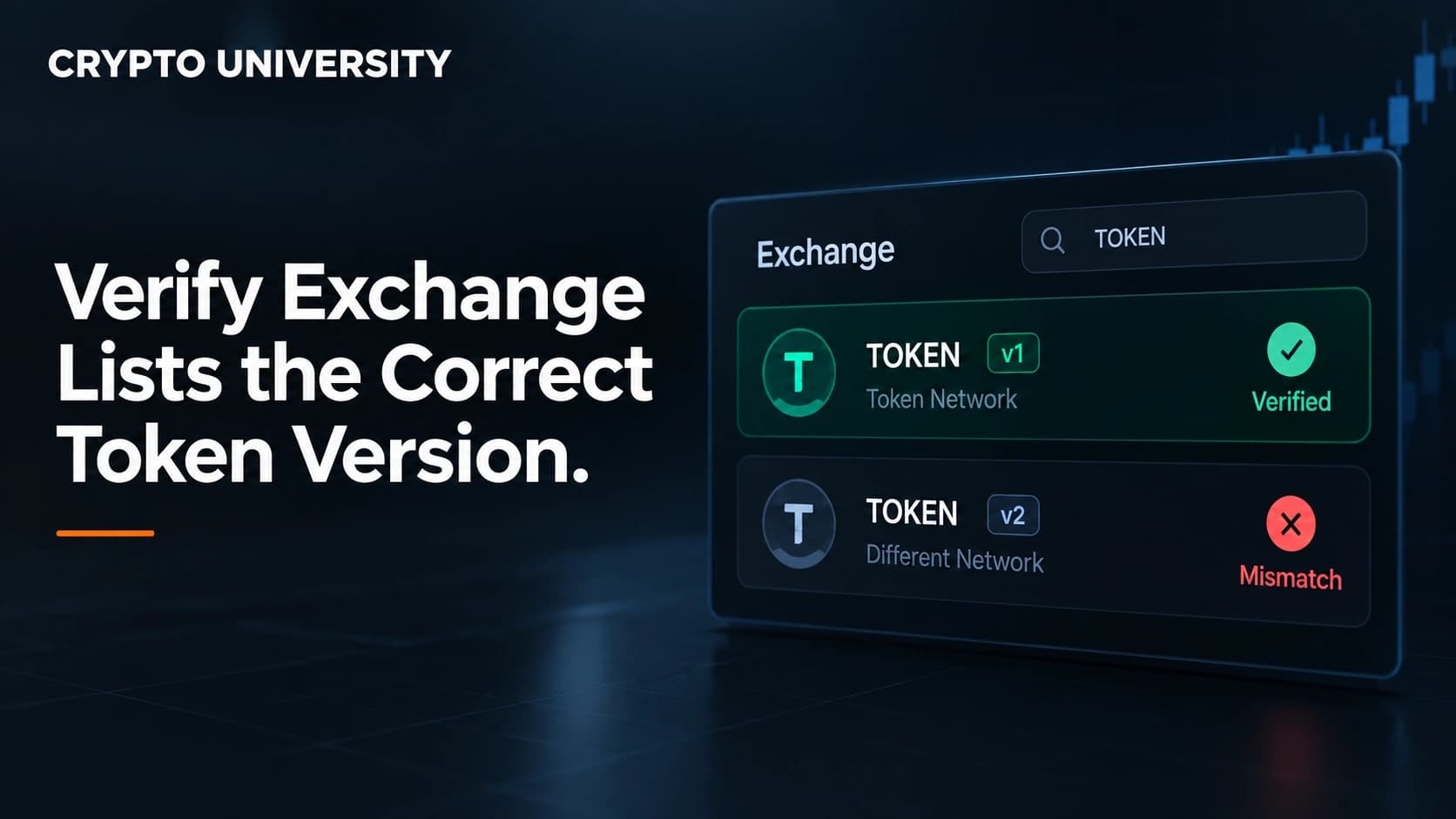
This matters on exchanges for three separate reasons. Centralized exchanges support one specific contract per network and their systems cannot credit anything else. Decentralized exchanges let anyone create a trading pair for any contract, including a near perfect copy. And some alternative versions of a token are entirely legitimate but still not the same asset, with different issuers standing behind them.
The Token Versions You Are Most Likely to Meet
| Version type | What it is | Why it matters |
|---|---|---|
| Native issue | Issued directly by the project or issuer on that chain | The reference version, usually the one exchanges list |
| Multi-chain deployment | Same issuer, same asset, different chain and usually a different address | Cannot be moved between chains without a bridge or a native transfer protocol |
| Bridged version | Locked on a source chain, minted on a destination chain by a bridge | Adds the bridge as a dependency and often cannot be redeemed with the original issuer |
| Wrapped version | A representation of an asset from another chain, such as BTC on Ethereum | Backing depends on a custodian or a protocol, not on the original network |
| Post-migration version | A new contract created after an upgrade, rebrand or merger | The old contract usually still exists and can still be traded by mistake |
| Legacy version | The deprecated contract left behind after a migration | Thin liquidity, often no support, sometimes no value |
| Copycat contract | An unrelated contract reusing a known name and symbol | No backing, and in some cases impossible to sell |
The stablecoin market is the clearest example. Circle issues native USDC on the chains it supports, while USDC.e is a bridged version created by moving USDC across a bridge, most commonly seen on Avalanche, Polygon, Arbitrum, Optimism and Linea. They trade at similar prices because of deep swap pools, but they are not the same asset, and bridged USDC is not directly redeemable with Circle.
Wrapped Bitcoin shows the same pattern. WBTC, cbBTC, tBTC and BTCB are all tokens that represent bitcoin on other chains, and each one has a different issuer, custody model and redemption process. An exchange that lists cbBTC has not listed WBTC, and the two are not interchangeable.
Step by Step: Verifying a Listing on a Centralized Exchange
1. Start with the issuer, not the exchange
Go to the project's own website or documentation and find the published contract address for the chain you care about. Serious issuers maintain an address page. Circle publishes native USDC addresses per chain, and Tether publishes its contract addresses per network. Reach the site through a bookmark or a known link rather than an advertisement or a reply on social media, because fake sites publish fake addresses with total confidence.
2. Open the exchange asset or deposit page
On most centralized exchanges the deposit screen shows the network selector and a contract information field. Open it and copy the address the exchange expects.
3. Compare the full address
Match every character. Do not rely on the first four and last four characters, because vanity address generators can produce addresses with a chosen prefix or suffix. Paste both addresses into a plain text editor and compare them side by side.
4. Confirm the network
The same symbol can exist on several chains at once. Sending a token on the wrong network is one of the most common ways people lose funds, because the receiving exchange is not watching that chain for that contract.
5. Check the block explorer
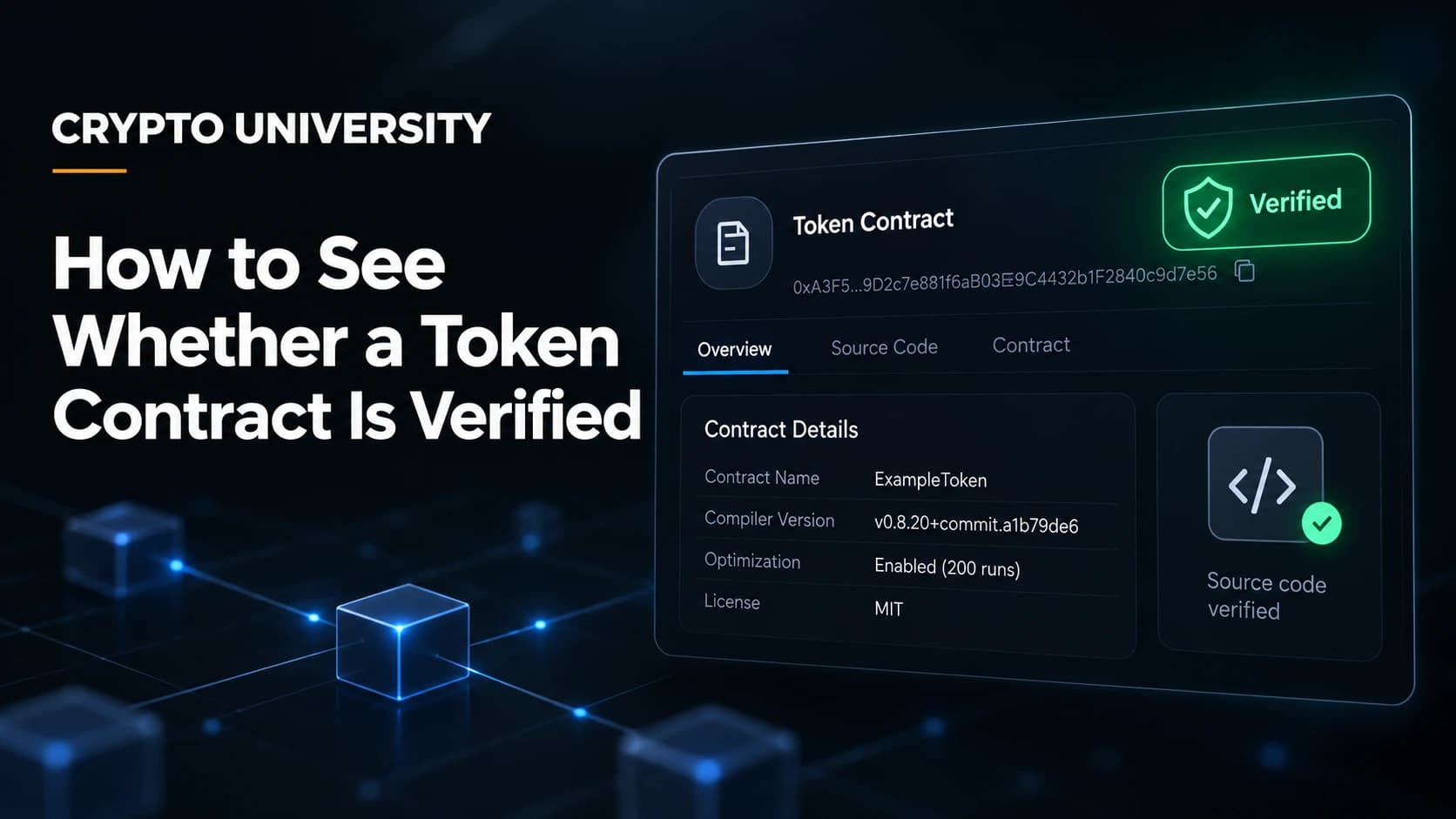
Open the address on the explorer for that chain, such as Etherscan for Ethereum or Solscan for Solana. Look at the token page rather than the market data. A contract marked as verified means the published source code matches the deployed bytecode. That is useful, but it is a transparency signal, not a safety guarantee.
6. Read the listing announcement
Exchanges publish listing announcements, migration notices and deposit or withdrawal status pages. If a project claims a listing and the exchange has not announced it, the claim is unverified. Announcements are also where exchanges state which contract version they support after a migration.
7. Test with a small amount
For a first deposit to a new asset or a new network, send a small test transfer, wait for it to be credited, then send the rest.
Verifying on a Decentralized Exchange
A decentralized exchange has no listing committee. Any contract can be paired with any other contract, so the burden of identification sits entirely with you.
| Check | Centralized exchange | Decentralized exchange |
|---|---|---|
| Who chose the contract | The exchange listing team | Whoever created the pool |
| Where to find the address | Deposit page or asset details | Token selector, pool page or explorer |
| Main failure mode | Wrong network or unsupported version on deposit | Buying a copycat contract |
| Useful supporting tool | Exchange announcement page | Token security scanners and pool analytics |
| Recovery if wrong | Sometimes possible, never guaranteed | Effectively none |
On a decentralized exchange, search by contract address rather than by symbol. Then look at the pool itself. Very low liquidity, a single large holder, and a token that was created hours ago are all signals worth pausing on. Contract scanners can flag common problems such as unlocked liquidity, mint permissions or transfer restrictions that prevent selling.
Special Case: Token Migrations and Mergers
Migrations are where careful people still make mistakes, because both contracts are real and both can be traded.
Common migration types include contract upgrades from version one to version two, rebrands with a new symbol, redenominations that change the number of units, chain migrations, and mergers where several tokens consolidate into one. The Artificial Superintelligence Alliance merger is a widely covered example: AGIX and OCEAN holders were converted into FET during 2024 under a published set of ratios, with a further ticker change to ASI announced for a later phase. Reporting on the current state of that final step differs across sources, which is exactly why the exchange announcement page is the source to trust for what a venue lists today.
When a migration is in progress, check these four things:
- Whether the exchange handles the swap automatically for balances held on the platform
- Whether deposits of the old token are still accepted, and until when
- The new contract address published by the project
- Whether your self-custody balance needs a manual claim or swap
Deprecated does not mean deleted. Old contracts keep emitting transfers forever, and thin liquidity pools for legacy tokens often stay open long after everyone has moved on.
Red Flags Worth Slowing Down For
| Signal | What it may indicate |
|---|---|
| Address matches only at the start and end | A vanity address built to look familiar |
| Very large total supply with almost no holders | A copy contract with no real distribution |
| Token appeared in your wallet unexpectedly | An unsolicited airdrop used as scam bait |
| Contract source code not verified on the explorer | Reduced transparency and higher unknown risk |
| Listing announced by the project but not by the exchange | Unconfirmed listing claim |
| The symbol carries a suffix such as .e, b or a bridge name | A bridged or wrapped variant, not the native asset |
Where Money Actually Gets Lost
Most losses in this area are not dramatic hacks. They are deposits that were correct in every way except one. The four recurring cases are sending a bridged variant to an address that expects the native token, choosing the wrong network in the withdrawal screen, omitting a required memo or destination tag on chains that use them, and depositing a token the platform does not support at all.
Exchanges can only credit assets their systems can identify and process, so an unsupported contract or an unsupported chain may simply not register. Recovery is sometimes possible for large amounts on major platforms, often involves a fee, and is never something to count on in advance.
A Reusable Checklist
- Get the contract address from the issuer's official channel
- Confirm the chain you intend to use
- Match the exchange address to the issuer address character by character
- Open the explorer page and check the token is the established one
- Read the exchange announcement for migrations or version notes
- Send a small test transfer first
FAQ
Does a verified contract mean the token is safe? No. Verification on a block explorer only means the published source code matches the deployed bytecode. Verified contracts can still contain owner functions that pause trading, change fees, block addresses or mint new supply.
What is the difference between native and bridged USDC? Native USDC is issued by Circle directly on that chain. Bridged USDC, often labelled USDC.e, was minted by a bridge against USDC locked elsewhere. They usually trade close to each other, but the bridged version adds bridge risk and cannot be redeemed with Circle.
Can I deposit a bridged token to an exchange that lists the native one? Usually not. If the deposit page shows the symbol without a bridge suffix, assume the bridged version is unsupported. Swap it to the native version first, or confirm with the exchange help centre.
How do I know if a token has migrated to a new contract? Check the project's official announcements, then check whether the exchange has published a migration notice. Block explorers also update both the old and new token pages when a migration is registered with them.
Do exchanges ever list the wrong version? Established exchanges rarely list an outright fake, but they do list bridged or legacy variants alongside native ones, and they may lag behind a migration by days or weeks. Smaller venues and decentralized exchanges carry far more identification risk.
Five Related Terms
- Contract address the unique on-chain identifier of a token, called the mint address on Solana.
- Bridged token a token minted on one chain to represent an asset locked on another.
- Wrapped token a token that represents an asset from a different network or standard, backed by a custodian or protocol.
- Token migration the process of replacing an old token contract with a new one, usually with a fixed conversion ratio.
- Deposit network the specific blockchain an exchange expects for a given asset, selected before sending funds.
Sources
- Circle, "What is the difference between USDC and USDC.e", https://www.usdc.com/learn/whats-the-difference-between-usdc-and-usdce
- Binance Support, "How to Identify the Correct Token/Ticker Symbol", https://www.binance.com/en/support/faq/how-to-identify-the-correct-token-ticker-symbol-b5dcf3f29baa48cea3ee6eb4d6326257
- Etherscan Information Center, "Token Migration", https://info.etherscan.com/token-migration/
- Phantom Help Center, "How to verify a token contract address", https://help.phantom.com/hc/en-us/articles/40156023225235-How-to-verify-a-token-contract-address
- Bitso Help Center, "Fake tokens: how to spot them and verify the official smart contract", https://support.bitso.com/hc/en-us/articles/43995041552404-Fake-tokens-How-to-spot-them-and-verify-the-official-smart-contract-of-stablecoins-like-USDC-and-USDT
- Artificial Superintelligence Alliance, "Update on ASI Token Merger", https://www.fetch.ai/blog/artificial_superintelligence_alliance_update_ASI_token_merger
Three More Reading
- Coin Bureau, "What Is Wrapped Bitcoin (WBTC)? How It Works, Alternatives and Risks", https://coinbureau.com/education/what-is-wrapped-bitcoin
- Matcha Blog, "Native and bridged USDC: differences and uses", https://blog.matcha.xyz/article/native-and-bridged-usdc-differences
- DEXTools, "What Is a Wrapped Token: Complete Crypto Guide", https://www.usdc.com/learn/whats-the-difference-between-usdc-and-usdce
Disclaimer: This article is educational and is not financial, legal or investment advice. Regulatory rules and register locations change, so verify details with the relevant authority before acting.
Not sure which problem you have?
Use the Fixing Crypto Mistakes hub to identify the transaction, wallet, network, or exchange issue before taking another action.
OPEN TROUBLESHOOTING HUB