Key Takeaways
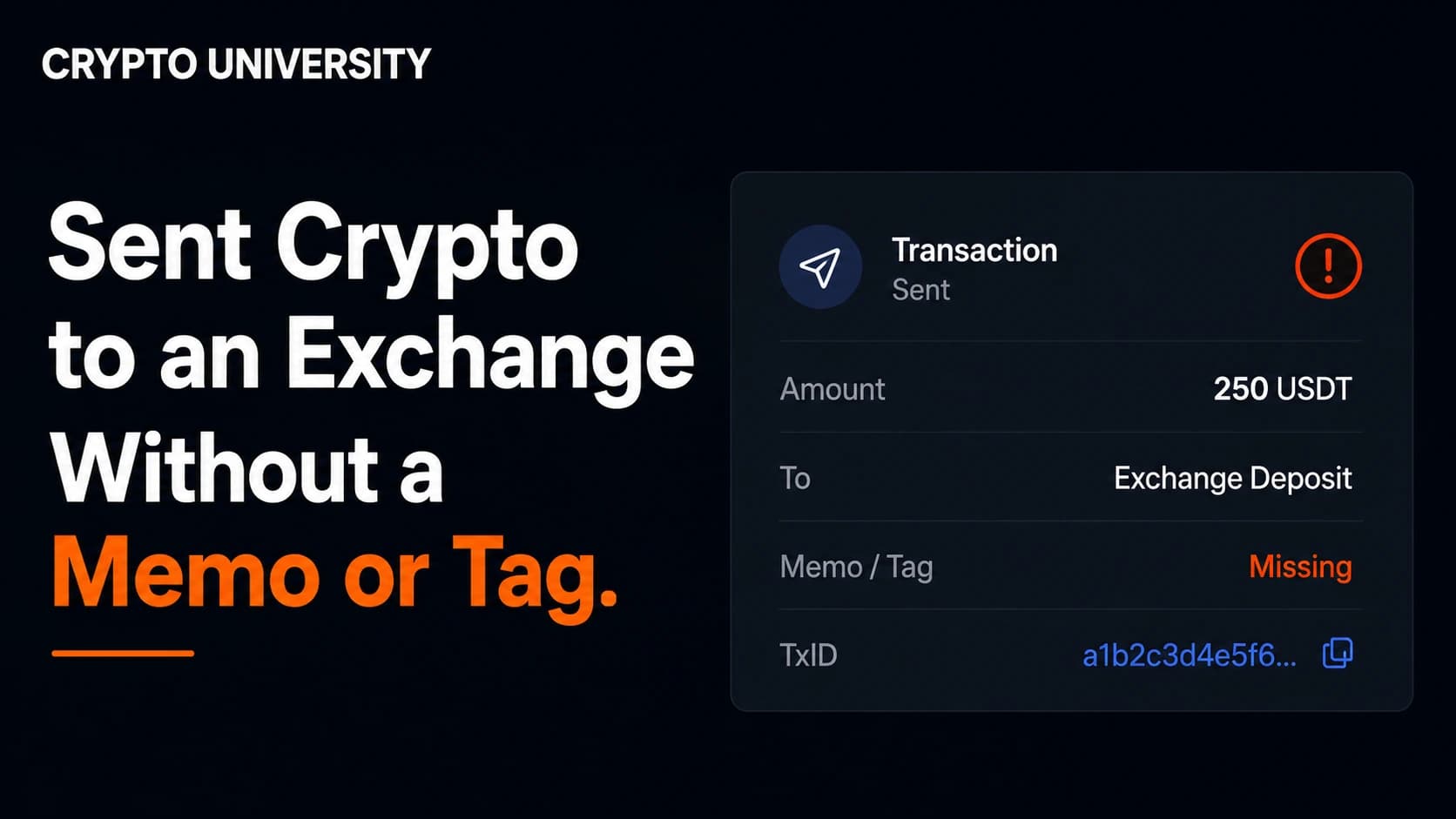
- The transfer may have reached the exchange without being credited. A missing or incorrect memo can prevent the platform from matching a shared deposit address to your account. Recovery depends on the receiving exchange's policy and the exact transaction.
- Only the receiving exchange can fix it. No wallet provider, block explorer, sending platform, or third party service can reassign the deposit for you. Most large exchanges have a dedicated recovery form for exactly this problem.
- Recovery costs time and usually money. Expect a fee, a wait of days to weeks, and a real chance of refusal if the token is unsupported or the amount is too small to cover the fee.
What a Memo or Destination Tag Actually Does
On most blockchains, every user has a unique address, so the address alone tells the network where funds should land. A handful of networks work differently. On those chains, a large exchange holds one single deposit address that is shared by every customer on the platform, and it separates users with a second field attached to the transaction.
That second field has different names depending on the chain. It may be called a memo, a destination tag, a message, a payment ID, or a comment. The function is identical in all cases.
A simple way to picture it: the address is the apartment building, and the memo is the apartment number. Deliver a package to the right building with no apartment number and it sits in the lobby. It is not stolen and not destroyed. It is just unassigned.
Coinbase describes this directly, noting that the extra field allows exchanges to route deposits from one shared address to the correct customer account.
Which Networks Use This Field
| Asset or Network | Field Name | Typical Format |
|---|---|---|
| XRP | Destination Tag | Numeric |
| Stellar (XLM) | Memo | Alphanumeric |
| Cosmos (ATOM) | Memo | Alphanumeric |
| Hedera (HBAR) | Memo | Numeric |
| EOS | Memo | Numeric |
| Stacks (STX) | Memo | Numeric |
| Celestia (TIA), dYdX, Osmosis, Kava, Akash, Axelar, SEI, ZetaChain | Memo | Numeric |
| TON | Comment or Memo | Varies |
| BNB Beacon Chain, XEM, BAND | Memo | Varies |
This list reflects what major exchanges currently document. Requirements change as platforms add networks or migrate to new address formats, so always read the deposit screen rather than relying on a list.
Important: a memo is generally only needed when sending to an exchange or another custodial service. Sending to a self custody wallet that you control usually does not require one, because that address belongs to you alone.
What Actually Happened to Your Funds
Three things are true at the same time, and understanding all three removes most of the panic.
The transaction succeeded. On the blockchain, the transfer confirmed normally. You can look it up on a block explorer and see it settled.
The exchange received the money. It sits in the pooled wallet that holds deposits for all customers on that network.
The exchange's internal ledger has no idea it is yours. Their system matched the incoming transfer against a list of memos, found nothing, and left it unattributed.
This is why recovery is an accounting task, not a blockchain task. Nobody can reverse the transaction on chain. Someone at the exchange has to manually match your deposit to your account and move it. That is also why hardware wallet companies say plainly that they cannot help. The funds are no longer in a place your keys control.
Step by Step: What to Do First
1. Pause before sending again. A second transfer with the correct memo does not repair the first one. Confirm the original transaction and open the receiving exchange's official recovery process before taking another action.
2. Confirm the deposit on a block explorer. Search the transaction and check that it shows as confirmed, that the destination address matches the exchange's deposit address, and that the memo field is genuinely empty or wrong. If the network itself was incorrect, use the wrong-network recovery guide instead.
3. Gather your evidence before opening a ticket. Incomplete submissions are the most common reason recovery requests get rejected.
| Information Needed | Where to Find It |
|---|---|
| Transaction hash (TxID) | Block explorer or your sending wallet history |
| Exact amount sent | Block explorer, entered without separators |
| Sending address | Your wallet or the sending platform |
| Receiving address | The exchange's deposit address |
| Date and time of transfer | Block explorer timestamp |
| Correct memo or tag | Your exchange deposit page |
| Network used | Deposit screen or explorer |
4. Use the exchange's specific recovery form, not general chat. Most large platforms have a dedicated workflow. A generic ticket often gets bounced back or routed slowly.
5. Submit once, then wait. Duplicate applications can invalidate the original. Binance explicitly lists a previously submitted application as a reason a new one will fail.
6. Ignore anyone who contacts you offering help. More on this below, because it matters enormously.
How Exchanges Handle Missing-Memo Deposits
The receiving exchange controls the shared deposit wallet, so it is the only party that can investigate or assign the deposit. Some platforms offer a dedicated self-service form; others handle requests case by case or decline unsupported assets and networks.
Policies, minimum amounts, fees, return destinations, and processing times change. Open the current recovery page from inside the official app or from a verified bookmark. Submit the transaction hash, exact amount, sending and receiving addresses, network, timestamp, and the correct memo or tag. Do not submit duplicate tickets unless support asks you to.
A block explorer, wallet provider, or third-party “recovery expert” cannot reassign an exchange deposit. If the destination address itself was wrong, see how to assess wrong-address recoverability.
The Harder Case: You Sent From Another Exchange
If the funds left one exchange and arrived at another without a memo, you are dealing with two companies at once.
The sending exchange usually cannot help. Coinbase states plainly that it cannot retrieve funds once they have been sent out, and directs users to the receiving platform. Binance says the same about withdrawals sent to third party platforms.
So the receiving exchange is your only route. If that exchange returns the funds to the sender address, you then need the sending exchange to credit the returned amount, since it will arrive at their hot wallet rather than your account. Expect a second ticket and additional waiting.
When Recovery May Not Be Possible
- The token or network is not supported by the receiving exchange.
- The amount left after fees is below the minimum withdrawal threshold.
- The memo you entered by accident matched a genuine memo belonging to another real customer. Binance states it cannot assist in this case.
- The deposit went to an expired or retired deposit address.
- The chain or asset falls outside what the platform can technically move.
Recovery is generally offered as a courtesy service, not a contractual right. Most terms of service make this explicit.
A Serious Warning About Recovery Scams
This is the part of the process where people lose money for real.
Search results and social media for phrases like "sent XRP without destination tag" are heavily polluted with fake support pages carrying fake hotline numbers, often published on unrelated forums and developer sites. They are designed to appear during exactly this moment of stress.
The FBI has repeatedly warned about this pattern, including a 2026 public service announcement about criminals impersonating its own Internet Crime Complaint Center. The agency notes that nearly all complainants reported scammers claiming to have recovered their lost funds or offering to help recover them, and that IC3 will never ask for payment to recover lost funds or refer anyone to a company that charges for recovery.
Apply a few fixed rules:
- Start from the exchange's official website or app. Never from a search advertisement, forum post, or social media reply.
- No legitimate exchange asks for your seed phrase, private keys, password, or two factor codes.
- No legitimate recovery process requires you to send more crypto first to "unlock" a balance.
- Never install remote access software at the request of support.
- Anyone who contacts you unprompted about a deposit you have not publicly discussed is a scammer.
How to Prevent This Next Time
- Send a small test amount first when using a new exchange, then send the rest once it credits.
- Copy and paste both fields separately. Never type either by hand.
- Take a screenshot of the deposit page showing the address and the memo together.
- Check QR codes carefully. Kraken warns that when scanning a QR code for assets requiring a tag, users must confirm the memo is actually included.
- Use combined address formats where available. XRP supports X addresses that encode the tag inside the address itself. Stellar based assets support muxed addresses beginning with M, which remove the separate memo requirement on platforms that accept them.
- Recheck the memo before every deposit, even to an exchange you have used before, since platforms occasionally migrate wallet infrastructure.
Frequently Asked Questions
Are my funds permanently lost if I forgot the memo? Usually not. The transaction confirmed and the assets are in the exchange's wallet. Whether you get them back depends on that exchange's recovery policy, the asset involved, and the amount. It is not guaranteed.
How long does recovery take? It varies widely by platform and asset. Some exchanges review applications within a couple of business days, while more complex cases can take weeks. Published estimates are targets, not commitments.
Will I be charged a fee? Usually yes. Fees range from a simple network withdrawal charge to a percentage of the transaction with a fixed minimum. Check the exchange's published policy before you assume the cost.
Can I recover it myself using a block explorer? No. A block explorer only lets you view and prove the transaction. The funds sit in an address controlled by the exchange, so only the exchange can move them.
What if I sent to the right address but the wrong memo? Report it immediately. If the memo happened to match another customer's account, the deposit may have been credited to that person, and most exchanges state they cannot reverse this.
Related Terms
- Destination Tag: a numeric identifier used on XRP to route a deposit to the correct account within a shared address.
- Memo: the equivalent field on chains such as Stellar, Cosmos, Hedera, and EOS.
- Omnibus Wallet: a single wallet holding pooled customer funds, with ownership tracked in the exchange's internal database.
- Transaction Hash (TxID): the unique identifier of a confirmed blockchain transaction, used as proof in recovery requests.
- Muxed Address: a Stellar address format starting with M that embeds the memo within the address itself.
Sources
- Coinbase Help, "Destination tags and memos"
- Binance Support, "How to Retrieve Crypto Deposit with Wrong or Missing Tag/Memo?"
- Kraken Support, "Destination Tag for XRP deposits" and "Crypto assets deposit recovery"
- CEX.IO Help Centre, "Recovering incorrect crypto deposits"
- MEXC Support, "Applying to Recover a Deposit Due to an Unfilled/Incorrectly Filled Memo/Tag" and "What is the Uncredited Deposit Return Application?"
- FBI Internet Crime Complaint Center, Public Service Announcement, "FBI Warns of Scammers Impersonating the IC3" (2026)
- FBI, "Cryptocurrency Investment Fraud" victim resources
This article is educational and is not financial, legal, or investment advice. Exchange policies and fees change frequently. Always confirm current procedures on the official support pages of the platform involved.
Not sure which problem you have?
Use the Fixing Crypto Mistakes hub to identify the transaction, wallet, network, or exchange issue before taking another action.
OPEN TROUBLESHOOTING HUB