Key Takeaways
- A zero balance after a restore is almost always a path problem, not a lost funds problem. The coins usually sit on a different branch of the same seed phrase.
- The fastest way to identify the correct path is to work backwards from an old receiving address, because the address format tells you which purpose number the original wallet used.
- Automatic account discovery should be your first move and manual path entry your last. Most modern wallets can scan the standard paths for you before you start typing anything by hand.
What a Derivation Path Actually Is
Modern crypto wallets are hierarchical deterministic wallets, usually shortened to HD wallets. The standard behind them is BIP32. It allows one seed phrase to produce an unlimited tree of private keys and addresses. You back up twelve or twenty four words once, and every key you will ever need can be regenerated from those words.
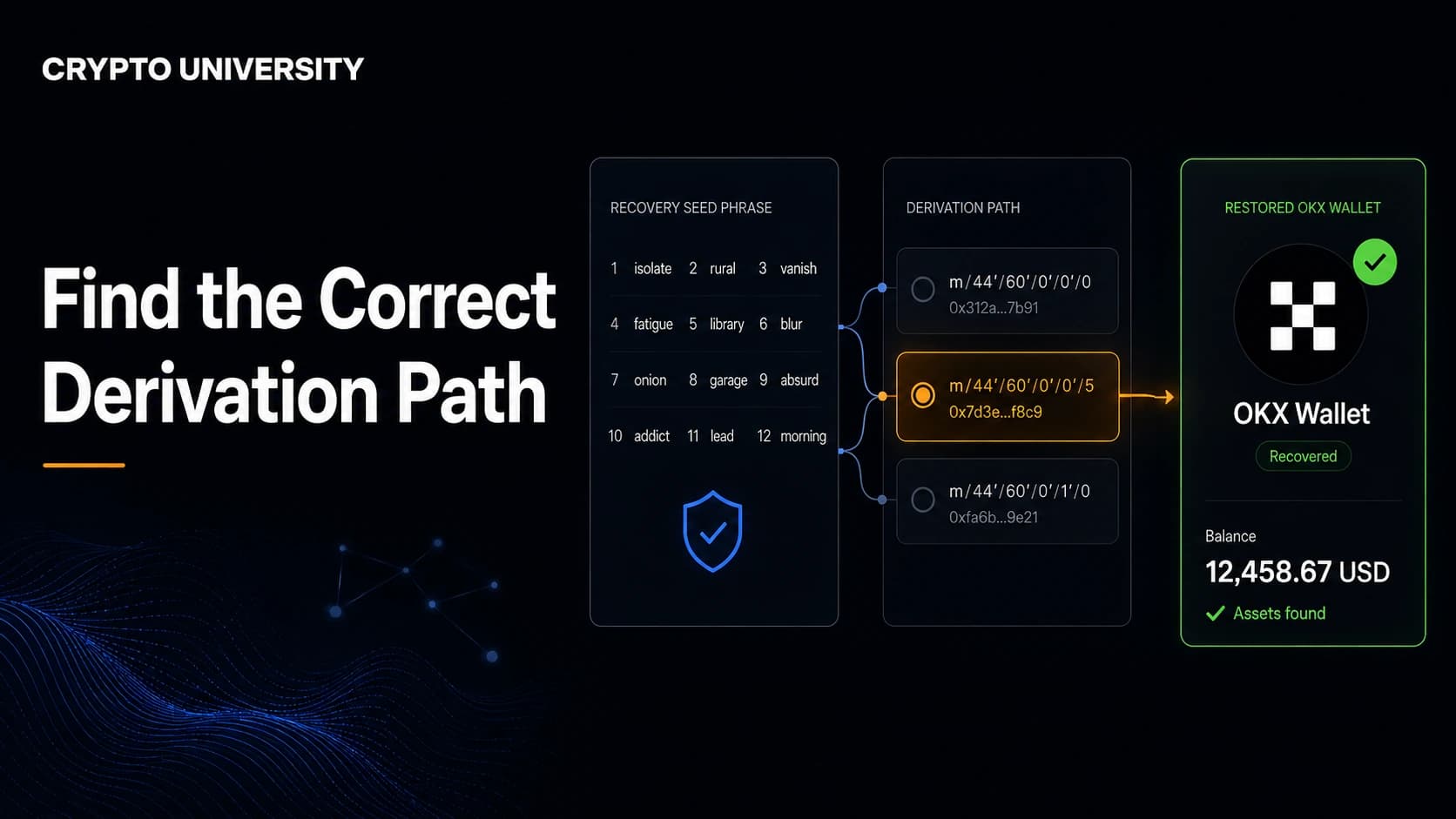
A derivation path is the route through that tree. It tells the wallet exactly which branch to walk down to reach a specific key. BIP44 defined the five level structure that almost every wallet now follows:
m / purpose' / coin_type' / account' / change / address_indexEach level has a job:
| Level | Example value | What it controls |
|---|---|---|
| purpose | 44', 49', 84', 86' | The address type, or script type, the wallet produces |
| coin_type | 0' for Bitcoin, 60' for Ethereum, 501' for Solana | Which coin the branch belongs to, taken from the SLIP-44 registry |
| account | 0', 1', 2' | Separate logical accounts inside one seed |
| change | 0 or 1 | 0 for receiving addresses, 1 for internal change addresses |
| address_index | 0, 1, 2 and upward | The individual address in the sequence |
The apostrophe marks a hardened level. Some wallets and tools write it as the letter h instead, so m/84'/0'/0' and m/84h/0h/0h mean the same thing.
Why the Wrong Path Shows an Empty Wallet
Every path is valid. That is the part that surprises people. If you back up a wallet that used m/84'/0'/0' and then restore it in software that defaults to m/44'/0'/0', the new wallet derives a completely different set of addresses from the same words. It looks in the wrong place, finds no history, and reports a balance of zero.
Nothing has been lost. Your coins are still recorded on the blockchain against the original addresses. You only need to point a wallet at the correct branch. This is why the first rule of derivation path recovery is simple: do not re-enter your seed phrase into random websites in a panic. The seed is fine. The configuration is wrong.
Step 1: Confirm the Seed Format Before You Touch Paths
Before assuming a path issue, check that your recovery phrase is the format the new wallet expects. A path setting cannot fix a format mismatch.
- BIP39 phrases are the industry standard and work in most wallets, including Ledger, Trezor and MetaMask.
- Electrum native seeds are not BIP39. Electrum stretches the words with a different salt, so the same words produce a different master key. These seeds should be restored in Electrum.
- SLIP-39 shares are split backups. A single share is not a complete seed and will always fail on its own.
- Monero phrases of twenty five words follow their own scheme entirely.
Also ask yourself whether you ever set a passphrase, sometimes called a thirteenth word or a seed extension. A passphrase creates a totally separate wallet from the same words. Restoring without it, or with a typo in it, produces an empty wallet that looks identical to a path error.
Step 2: Read Your Old Address Format
If you have any old receiving address, an old transaction, or a screenshot, you can narrow the path in seconds. On Bitcoin, the address prefix maps directly to a purpose number.
| Address starts with | Script type | Standard | Typical first address path |
|---|---|---|---|
| 1 | Legacy P2PKH | BIP44 | m/44'/0'/0'/0/0 |
| 3 | Wrapped SegWit P2SH-P2WPKH | BIP49 | m/49'/0'/0'/0/0 |
| bc1q | Native SegWit P2WPKH | BIP84 | m/84'/0'/0'/0/0 |
| bc1p | Taproot P2TR | BIP86 | m/86'/0'/0'/0/0 |
Native SegWit is the current default for most Bitcoin wallets, so m/84'/0'/0' is the sensible first guess when you have no other information. Wrapped SegWit is mainly seen in wallets set up between roughly 2017 and 2021.
Ethereum and other account based chains do not encode the script type in the address, so this shortcut only helps on Bitcoin and similar UTXO chains.
Step 3: Match the Wallet That Created the Seed
The wallet brand that generated the phrase is the strongest clue you have. Defaults differ, and a few well known ones cause most of the confusion.
| Wallet or chain | Common default path | Note |
|---|---|---|
| Most modern Bitcoin wallets | m/84'/0'/0' | Native SegWit, bc1q addresses |
| Older Bitcoin wallets and exchanges | m/44'/0'/0' or m/49'/0'/0' | Legacy or wrapped SegWit |
| MetaMask and most EVM software wallets | m/44'/60'/0'/0/x | Extra accounts increase the last number |
| Ledger Live for Ethereum | m/44'/60'/x'/0/0 | Extra accounts increase the account level instead |
| Phantom and most Solana wallets | m/44'/501'/0'/0' | Some wallets use the shorter m/44'/501'/0' |
| Ethereum Classic | m/44'/61'/0'/0/x | A separate SLIP-44 coin type |
The Ledger Live versus MetaMask difference is the single most reported Ethereum recovery issue. Both are valid readings of the same standard, but they walk different branches, so an account that is visible in one app may appear to be missing in the other.
For anything not listed above, the community maintained site walletsrecovery.org documents the default paths used by a large number of wallets and is the standard reference for this problem.
Step 4: Let the Wallet Scan Before You Type Anything
Manual path entry invites typos. Use built in account discovery first.
- Electrum offers a Detect Existing Accounts option during BIP39 restore, which checks common paths for transaction history.
- Sparrow Wallet can scan the standard script types when importing a seed or an extended public key.
- Trezor Suite and Ledger Live handle their own defaults automatically for supported coins.
- Phantom discovers accounts across several path groupings when you import a phrase or connect a hardware device.
If discovery finds nothing, only then move to manual entry, and change one variable at a time.
Step 5: Work Through Account Index and Gap Limit
If the purpose number is right but the balance is still zero, two settings are usually responsible.
Account index. Wallets that support multiple accounts increment the third level. Try m/84'/0'/1', then m/84'/0'/2', and so on. In Electrum, each account needs its own wallet file.
Gap limit. Wallets stop scanning after a run of unused addresses, commonly twenty in a row. If you once received funds at a high address index, the scan may stop before reaching it. Raising the gap limit tells the wallet to keep looking.
Step 6: Verify Without Exposing Your Seed
You can test a path without typing your seed into anything connected to the internet.
- Restore into a reputable wallet on a device you control and compare the first derived address with an address you recognise.
- Use a watch-only wallet built from your extended public key, the xpub or zpub, to check balances without touching private keys.
- If you use an offline derivation tool, run it on an air gapped machine and destroy the environment afterwards.
Never enter a seed phrase into a website, a support chat, a spreadsheet, or a "wallet recovery service" that contacts you first. Anyone with your words has your coins. There is no legitimate service that needs them.
Quick Troubleshooting Checklist
| Symptom | Most likely cause | First thing to try |
|---|---|---|
| Wallet rejects the phrase | Wrong seed format or a mistyped word | Check the word list and the original wallet software |
| Phrase accepted, balance zero | Wrong purpose number | Try 84', then 44', then 49', then 86' |
| One account visible, others missing | Account index difference | Increase the account level |
| Old addresses missing from history | Gap limit reached | Raise the gap limit and rescan |
| Correct path but still empty | Missing passphrase | Restore again with the passphrase |
FAQ
Can the wrong derivation path make me lose my coins? No. The path only changes which addresses a wallet looks at. Your funds stay on the blockchain at the original addresses and become visible again once the correct path is used.
Which derivation path should I try first for Bitcoin?
Start with m/84'/0'/0' if your old addresses began with bc1q, m/44'/0'/0' if they began with 1, and m/49'/0'/0' if they began with 3. Taproot addresses beginning with bc1p use m/86'/0'/0'.
Why do my Ledger and MetaMask Ethereum addresses differ? Ledger Live creates extra Ethereum accounts by increasing the account level, while MetaMask increases the final address index. Both are derived from the same seed, so switching the path setting reveals the missing accounts.
Is it safe to use an online derivation tool? Entering a live seed phrase into any online tool is a serious risk. If you need to test derivations, use an offline machine and treat any seed that has been typed into a browser as compromised.
How many paths should I test before assuming something else is wrong? Test the four standard Bitcoin purposes and the first few account indexes. If all of them are empty, the problem is more likely a passphrase, a seed format mismatch, or a transcription error in the words.
Related Terms
- HD wallet
- A wallet that derives all its keys from a single seed using the BIP32 tree structure.
- BIP39 passphrase
- An optional extra word that produces an entirely separate wallet from the same seed phrase.
- xpub
- An extended public key that can generate receiving addresses and monitor balances without private keys.
- Gap limit
- The number of consecutive unused addresses a wallet checks before it stops scanning.
- SLIP-44 coin type
- The registry of coin numbers used at the second level of a derivation path.
Sources
- BIP32, Hierarchical Deterministic Wallets. https://github.com/bitcoin/bips/blob/master/bip-0032.mediawiki
- BIP44, Multi-Account Hierarchy for Deterministic Wallets. https://github.com/bitcoin/bips/blob/master/bip-0044.mediawiki
- BIP84, Derivation scheme for P2WPKH based accounts. https://github.com/bitcoin/bips/blob/master/bip-0084.mediawiki
- SLIP-0044 registered coin types. https://github.com/satoshilabs/slips/blob/master/slip-0044.md
- Trezor firmware documentation, coin BIP44 paths. https://github.com/trezor/trezor-firmware/blob/master/docs/misc/coins-bip44-paths.md
- MetaMask Help Center, importing a seed phrase from another wallet. https://support.metamask.io/configure/wallet/importing-a-seed-phrase-from-another-wallet-software-derivation-path/
- Phantom Help Center, supported derivation paths. https://help.phantom.com/hc/en-us/articles/12988493966227-Supported-derivation-paths-in-Phantom
More Reading
- Coldcard Learn, HD wallets and Bitcoin derivation paths. https://coldcard.com/learn/how-bitcoin-works/bitcoin-derivation-paths
- Wallets Recovery, default derivation paths by wallet. https://walletsrecovery.org
- BIP86, Key derivation for single key P2TR outputs. https://github.com/bitcoin/bips/blob/master/bip-0086.mediawiki
This article is educational content. It is not financial, legal, or security advice. Always verify wallet procedures against official documentation from the wallet provider.
Not sure which problem you have?
Use the Fixing Crypto Mistakes hub to identify the transaction, wallet, network, or exchange issue before taking another action.
OPEN TROUBLESHOOTING HUB