Key Takeaways
- Start with a block explorer. Explorers such as Etherscan attach public name tags and labels like "Exchange" to many known exchange addresses, which is the fastest first check.
- Confirm with a second source. Analytics platforms, official exchange disclosures, and on-chain behavior patterns help you verify a label, because labels can be incomplete or wrong.
- A missing label proves nothing. Exchanges control huge numbers of addresses, and most individual deposit addresses are never publicly tagged. Treat every result as evidence, not certainty.
Why This Question Matters
A blockchain address is just a string of characters. Nothing in it says "this is Binance" or "this is a private person," yet knowing who controls it is often useful.
Here are the most common reasons people check:
| Situation | Why the answer helps |
|---|---|
| Sending funds to a friend or business | You can spot if the "personal" address is really an exchange deposit address |
| Reading large transfers in the news | You can tell whether coins moved into an exchange, out of one, or between an exchange's own wallets |
| Researching a token | You can see how much supply sits in exchange wallets versus private wallets |
| Security and scam checks | You can confirm that an address claiming to be an exchange is actually linked to it |
| Tax or record keeping | You can match your own transfers to the platforms you used |
The Different Types of Exchange Addresses
A centralized exchange does not use one address. It runs a whole system of them.
| Address type | What it does | How easy it is to identify |
|---|---|---|
| Deposit address | A unique address given to each user for incoming funds | Hard. Usually unlabeled individually |
| Hot wallet | An online wallet used to process withdrawals and daily flows | Easy. Often labeled on explorers |
| Cold wallet | Offline storage for most customer reserves | Moderate to easy. Often published in reserve disclosures |
| Sweep or consolidation address | Collects funds from many deposit addresses | Moderate. Detected through patterns |
Deposit addresses are the tricky part. Research on wallet clustering notes that each user on a large exchange typically receives at least one unique deposit address per blockchain, so one exchange may control an enormous number of addresses. Only a small share of those will ever carry a public label.
Method 1: Check Block Explorer Labels
This is the quickest method and the right place to start.
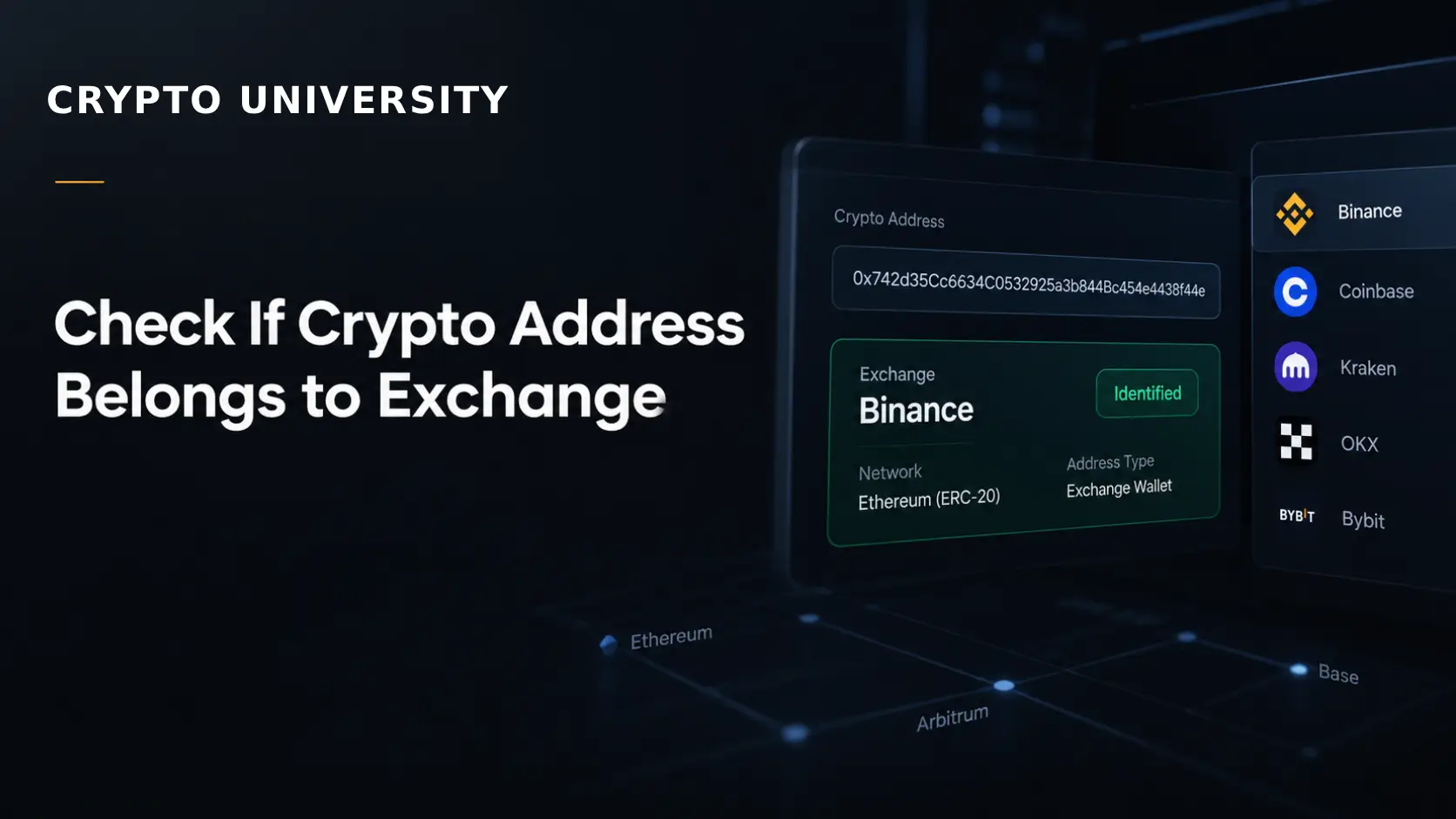
What labels are. Etherscan uses public name tags to show the owner or purpose of an address, and labels to show the category it belongs to, such as "Exchange." Its curators decide whether to tag an address based on whether the owner wants it shown publicly or whether it is of public interest. In practice, tags usually appear on addresses tied to major exchanges, projects, and well known figures.
Step by step on Etherscan (Ethereum and similar chains)
- Copy the full address from a trusted source.
- Paste it into the search bar on the explorer for that network (for example, Etherscan for Ethereum or BaseScan for Base).
- Look near the top of the address page for a name tag such as "Coinbase 10" or "Binance 14."
- Check the labels area for categories such as "Exchange."
- Click the label to see other addresses in the same category. Etherscan keeps a browsable list of exchange accounts and a Label Word Cloud page for exploring categories.
What about Bitcoin?
Many Bitcoin explorers show raw transaction data with fewer entity labels, so analysts often rely on clustering and analytics platforms (Method 2).
Limitation: Explorer labels are curated but not complete. Many exchange addresses have no tag at all, and tags can be updated or removed over time.
Method 2: Use a Blockchain Analytics Platform
Analytics platforms go a step further than explorers. Instead of labeling single addresses, they group many addresses into entities.
Arkham explains its system with three layers. An entity is a group of addresses belonging to one organization, a label names one specific address (for example, "Binance Hot Wallet #3"), and tags describe what an address has done in the past. Its Binance entity, for example, is meant to cover known hot wallets, cold wallets, and deposit addresses across many networks.
| Tool type | Examples | Best for | Cost |
|---|---|---|---|
| Block explorers | Etherscan, BaseScan, Arbiscan | Quick single address checks | Free |
| Entity analytics | Arkham, Nansen | Seeing which organization an address may belong to | Free tiers plus paid features |
| Data platforms | Dune | Querying exchange flows with SQL | Free tier plus paid plans |
| Compliance tools | Chainalysis, Elliptic, TRM Labs | Professional risk screening | Enterprise pricing |
Dune's documentation offers a useful look at how this works in practice. Its curated exchange address table is built from manually maintained lists, while a separate table detects deposit addresses by finding addresses that receive tokens from outside wallets and then move them into known exchange hot wallets.
Important: Entity clustering is an estimate. A dashboard label is a strong clue, but it is not a legal or official confirmation.
Method 3: Check the Exchange's Official Disclosures
Some exchanges publish their own wallet addresses. This is the most direct source, because the exchange itself is making the claim.
Much of this started after the FTX collapse in November 2022. On November 10, 2022, Binance published details of its hot and cold wallet addresses as a first step toward a fuller proof of reserves system. Many other exchanges have since released reserve reports.
How to use these disclosures
- Go to the exchange's official website directly. Do not use links from social media messages or ads.
- Find the proof of reserves or transparency page.
- Look for a list of wallet addresses by asset.
- Compare the address you are checking against that list, character by character.
Limitation: These lists usually cover reserve wallets, not every deposit address. Binance also notes that most of its corporate holdings sit in wallets that are not part of its proof of reserves figures. So an address missing from the list may still belong to the exchange.
Method 4: Read the On-Chain Behavior
When no label exists, the address's transaction history can still offer clues. This takes more skill, so treat the signals below as hints, not proof.
| Signal | What it may suggest |
|---|---|
| Receives funds from many unrelated senders, then forwards everything to one address | Likely an exchange deposit address sweeping to a hot wallet |
| Sends to thousands of different addresses, often in batches | Possibly an exchange hot wallet processing withdrawals |
| Holds very large balances and moves rarely | Possibly cold storage, but also a large private holder |
| Very high transaction count over many years | Often a service, not an individual |
| Funds flow into an address that is already labeled as an exchange | The sending address may be a deposit address for that exchange |
The Bitcoin clustering rule
On Bitcoin, analysts rely heavily on the common input ownership heuristic. When several addresses are used as inputs in one transaction, they are usually controlled by the same entity, because spending them requires the private keys for all of them. If one address in that group is known to be an exchange, the others are likely linked too.
This rule has known weak spots. A CoinJoin transaction deliberately combines inputs from different people, which breaks the assumption. Analysts therefore combine it with other methods such as change address detection.
A Simple Checklist You Can Follow
- Search the address on the correct block explorer for its network.
- Note any name tag or label. Write down the exact wording.
- Search the address on an analytics platform such as Arkham to see if it belongs to a known entity.
- Compare with official exchange disclosures if the address claims to be a reserve wallet.
- Review the transaction pattern for deposit, sweep, or batch withdrawal behavior.
- Look for agreement. Two or more independent sources pointing to the same exchange gives you much higher confidence.
- Record your sources if you plan to share your findings publicly.
Common Mistakes to Avoid
| Mistake | Better approach |
|---|---|
| Treating one label as final truth | Confirm with at least one more source |
| Assuming "no label" means "private person" | Remember most deposit addresses are unlabeled |
| Checking the wrong network | Match the explorer to the chain the address is on |
| Comparing only the first and last few characters | Compare the full address |
| Making public accusations from a dashboard | Support serious claims with transaction hashes and official statements |
A Security Warning: Lookalike Addresses
Knowing how exchange addresses work also helps you avoid a common scam called address poisoning. Attackers generate an address that starts and ends with the same characters as one you use, such as your exchange deposit address. They then send a tiny or zero value transfer so the fake address appears in your history. If you later copy the address from your history, your funds go to the attacker.
Security firm Blockaid reported flagging more than 65 million address poisoning transactions since January 2025. To stay safe:
- Always copy your exchange deposit address fresh from inside the exchange app or website.
- Never copy a destination from your transaction history.
- Check the full address, not just the beginning and end.
- Ignore unexpected tiny transfers from unknown addresses.
Conclusion
Checking whether an address belongs to an exchange is about gathering evidence. Start with explorer labels, confirm with analytics platforms or official disclosures, and use transaction patterns when labels are missing. Combining two or three methods gives you a well supported answer.
Frequently Asked Questions
Can I tell from the address itself whether it belongs to an exchange?
No. Addresses do not contain owner information. You need outside sources such as explorer labels, analytics platforms, or the exchange's own disclosures.
Is my exchange deposit address labeled publicly?
Usually not. Most individual deposit addresses have no public name tag, although analytics tools may link them to an exchange by watching where the funds are swept.
Are Etherscan and Arkham labels always accurate?
No. Both are useful and widely used, but labels can be incomplete, outdated, or occasionally wrong. Treat them as strong clues and verify important findings with another source.
Why do exchanges publish their wallet addresses?
Mainly for transparency. Publishing reserve wallet addresses lets the public check on-chain balances as part of proof of reserves reporting.
Is it legal to look up who owns a blockchain address?
Blockchain data on public networks is openly visible, and looking up labels is a normal research activity. How you use or share that information may be subject to local laws, so avoid making public claims about individuals without strong evidence.
Related Terms
- Hot Wallet: A crypto wallet connected to the internet, used by exchanges to process deposits and withdrawals quickly.
- Cold Wallet: A wallet kept offline to store funds more securely, often holding most of an exchange's reserves.
- Block Explorer: A website that lets anyone search and view transactions, addresses, and blocks on a blockchain.
- Proof of Reserves: A process in which an exchange shows evidence that it holds enough assets to cover customer balances.
- Address Poisoning: A scam where attackers plant a lookalike address in your transaction history so you send funds to them by mistake.
Sources
- Etherscan Information Center, "Public Name Tags, Labels and Public Notes"
- Etherscan Information Center, "Explore a Contract Address on Etherscan"
- Etherscan, "Exchange Accounts" label page
- Arkham Research, "A Guide to Arkham Intel's Tagging System"
- Dune Docs, "CEX Flows" methodology
- Binance Blog, "Our Commitment to Transparency"
- Binance, "Proof of Reserves"
- AMLBot Blog, "Wallet Clustering and Entity Identification in Blockchain Analysis"
- CryptoQuant, "Introduction to Bitcoin Heuristics"
- Blockaid Blog, "Address Poisoning: The Growing Threat"
- Tsuchiya et al., "Blockchain Address Poisoning," USENIX Security 2025 This article is educational and factual. It is not financial advice and contains no price predictions. Figures cited from third party tools are point in time estimates that change continuously.
Not sure which problem you have?
Use the Fixing Crypto Mistakes hub to identify the transaction, wallet, network, or exchange issue before taking another action.
OPEN TROUBLESHOOTING HUB