Key Takeaways
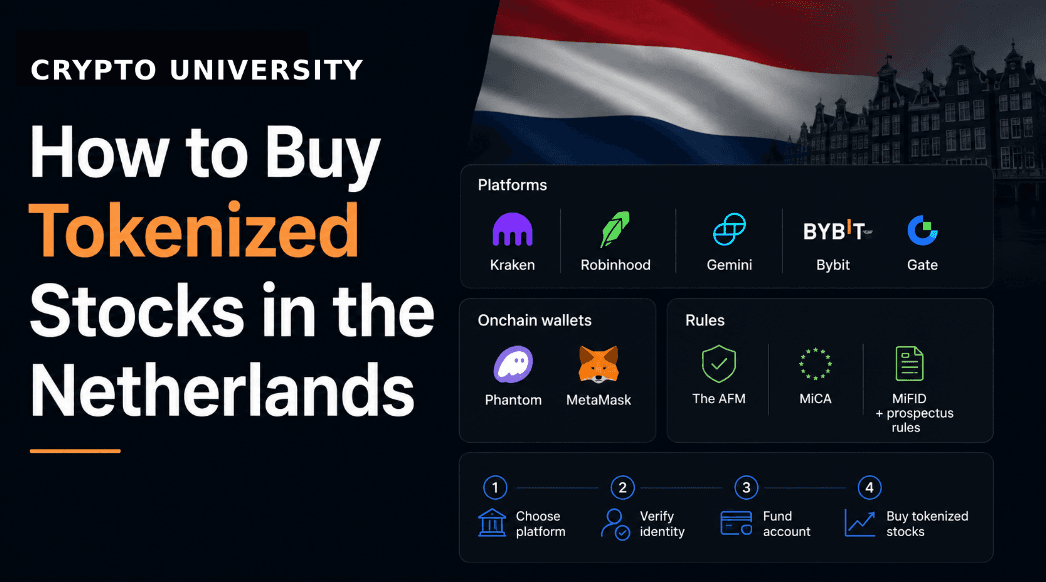
If you live in the Netherlands, you can legally buy tokenized stocks through EU-regulated platforms such as Kraken, Robinhood and Gemini.
These products follow MiFID and prospectus rules rather than MiCA, and the Dutch regulator (the AFM) watches investor protection closely.
The two Dutch-specific things to plan for are the Box 3 wealth tax and the currency conversion cost when you buy US-dollar tokens.
What This Guide Covers
Tokenized stocks are simply shares of real companies, like Tesla or Apple, turned into digital tokens you can trade on crypto-style platforms. If you live in the Netherlands, the short answer to “can I buy them?” is yes. You sit inside the European Union, which has a fairly open and clear set of rules for these products.
What makes the Netherlands worth its own guide is two things: a watchful regulator called the AFM, and a unique wealth tax known as Box 3 that can shape your final result more than which platform you pick. Below, everything is explained in plain language so you know what to expect before you start.
The Rules That Apply to You
Two layers of rules govern your access. Here is what each one means for you as a beginner.
The AFM (Autoriteit Financiële Markten)
The AFM is the Dutch financial watchdog. It takes an active line on protecting investors in crypto-related products, including tokenized shares. As the EU’s crypto rules matured through 2026, the AFM stepped up its monitoring. In practice, this is good news for you: Dutch users usually see clear risk warnings and deal with platforms that take the rules seriously.
MiCA vs MiFID (the important distinction)
This sounds technical, but the idea is simple. A tokenized stock is treated as a financial instrument (like a normal share), so it falls under the older MiFID and prospectus rules, not under MiCA (the newer EU crypto law, which does not cover financial instruments). So even when a platform holds a MiCA crypto license, its tokenized-stock service runs through a separate investment-services license. Here is the difference at a glance.
Rulebook | What it covers | Applies to your tokenized stocks? |
|---|---|---|
MiCA | General crypto assets and stablecoins | No, it excludes financial instruments |
MiFID + prospectus rules | Shares, securities and investment products | Yes, this is the rulebook that governs them |
This is why the tokens reach you through regulated routes, not a grey market. For example, xStocks reach Dutch users under Backed’s EU prospectus through Kraken’s Cyprus MiFID entity, Robinhood offers its tokens as derivatives through its EU-licensed business, and Gemini distributes Dinari dShares to European users.
Platforms Dutch Residents Can Use
Here are the main options today. Always confirm inside the app that the product is switched on for the Netherlands before you commit.
Platform | What you can buy | Good to know |
|---|---|---|
100+ xStocks | Via its Cyprus MiFID entity; supports Solana self-custody withdrawals | |
2,000+ classic tokens (derivatives) and newer chain tokens | Available across the EU/EEA including the Netherlands; trades 24/5 with low FX fees | |
Dinari dShares | Rolling out across the EU with a growing list | |
Bybit / Gate | Selected xStocks | Check whether the Netherlands is enabled on each venue |
Onchain (Phantom, MetaMask) | xStocks on Solana; Ondo on Ethereum | Self-custody; eligibility terms apply |
Step by Step for a Dutch Resident
Follow these five steps to make your first purchase with confidence.
Step | What to do |
|---|---|
1. Pick the structure, then the platform | A certificate (Kraken), a dShare (Gemini) and a derivative (Robinhood) are not the same thing legally, so choose the type first, then the venue. |
2. Complete KYC | Verify your identity with a Dutch ID. This is usually quick for EU residents. |
3. Add money | SEPA transfers in euros are the cheapest option. You can also deposit USDT or USDC if you already hold crypto. Note that US-dollar tokens involve a currency conversion somewhere, so compare rates carefully. |
4. Buy with a limit order | Place your order during US market hours for the tightest price tracking. |
5. Decide on custody | Keep the token in your exchange account, or withdraw it to your own self-custody wallet. |
The Box 3 Wealth Tax (General Information, Not Advice)
The Netherlands taxes personal wealth in an unusual way. Instead of taxing the profit you make when you sell, the Dutch “Box 3” system has historically taxed what you hold, using an assumed return that has faced legal challenges and reforms through the mid-2020s.
For a tokenized-stock holder, that raises a few Dutch-specific questions: how are these tokens valued and categorised for Box 3, are they treated like normal securities or like crypto, and how do the ongoing Box 3 reforms apply to them?
This area is genuinely complex and still changing. The general principle worth remembering is that Dutch wealth tax may apply to your holdings even if you never sold them. Treat that as a reason to speak to a Dutch tax professional rather than something you calculate from an article. Keep complete records: what you held on the reference dates, every transaction, and values in euros. This guide is not tax advice.
What Dutch Buyers Should Watch
Keep these four points in mind so there are no surprises later.
Watch out for | Why it matters |
|---|---|
The structure behind the token | The same Tesla exposure can arrive as a certificate, a dShare or a derivative. Same price chart, different legal claim. |
Limits on protection | MiFID conduct rules apply through the firm selling you the product, but there is no compensation scheme that makes tokenized products whole the way insured bank deposits are. |
The currency layer | As a euro-based investor you carry US-dollar exposure inside every US stock token, on top of the normal share risk. |
AFM updates | The Dutch regulator updates its guidance on crypto and tokenized products from time to time, so check in if you hold a meaningful amount. |
Frequently Asked Questions
Are tokenized stocks legal in the Netherlands?
Yes, when they are offered by properly licensed EU firms. Examples include xStocks under Backed’s prospectus through Kraken’s Cyprus MiFID entity, Robinhood’s derivative tokens, and Dinari dShares through Gemini. These are all regulated routes.
Which platforms serve Dutch users?
Kraken (xStocks), Robinhood (tokens across the EU/EEA), Gemini (dShares) and a few others. You can also access some tokens onchain through Phantom or MetaMask if you are eligible. Always confirm availability in the app.
How are tokenized stocks taxed in the Netherlands?
They likely fall under the Box 3 wealth-tax system, which taxes what you hold rather than only the gains you realise, and which is being reformed. The treatment of tokenized securities specifically is nuanced, so consult a Dutch tax adviser. This guide is not tax advice.
Do I need euros or stablecoins to buy?
Either works. SEPA transfers in euros are cheapest, while USDT or USDC are handy if you already hold crypto. US-dollar tokens will involve a currency conversion step for euro funders.
Does MiCA cover tokenized stocks in the Netherlands?
No. Tokenized stocks are financial instruments and sit outside MiCA’s scope. They are governed by MiFID and prospectus rules, so a platform’s MiCA license does not authorise its stock-token business.
External Sources
AFM role on crypto and tokenized securities; Dutch MiCA implementation (2026)
xStocks EU legal structure (Backed prospectus, PEDSL-CY MiFID entity): docs.xstocks.fi
Kraken xStocks: kraken.com/xstocks
Robinhood EU tokens: robinhood.com/eu
Dutch Box 3 wealth-tax reform materials (Belastingdienst / Dutch government); consult a local adviser
Disclaimer: This content is for educational and informational purposes only and is not financial advice. Nothing here is a recommendation to buy or sell any asset or use any platform. Do your own research and manage your risk. Crypto rules are changing quickly, so check the latest guidance before acting.
Explore the Crypto University Tokenized Stocks Directory and EU MiCA License Tracker.
Tokenized Stocks Explained: A Simple Guide for Beginner Traders
How to Buy Tokenized Stocks: A Step by Step Guide for Beginners
Best Platforms for Tokenized Stocks: Exchanges, Brokers and Onchain Apps
Tokenized Stock Risks: Issuers, Custody, Liquidity and Tracking Error
How to Cash Out Crypto in the UK in 2026: A Step-by-Step Guide
Need deeper training?
Join our structured modules with live examples and expert checklists for effective implementation.
JOIN THE ACADEMY