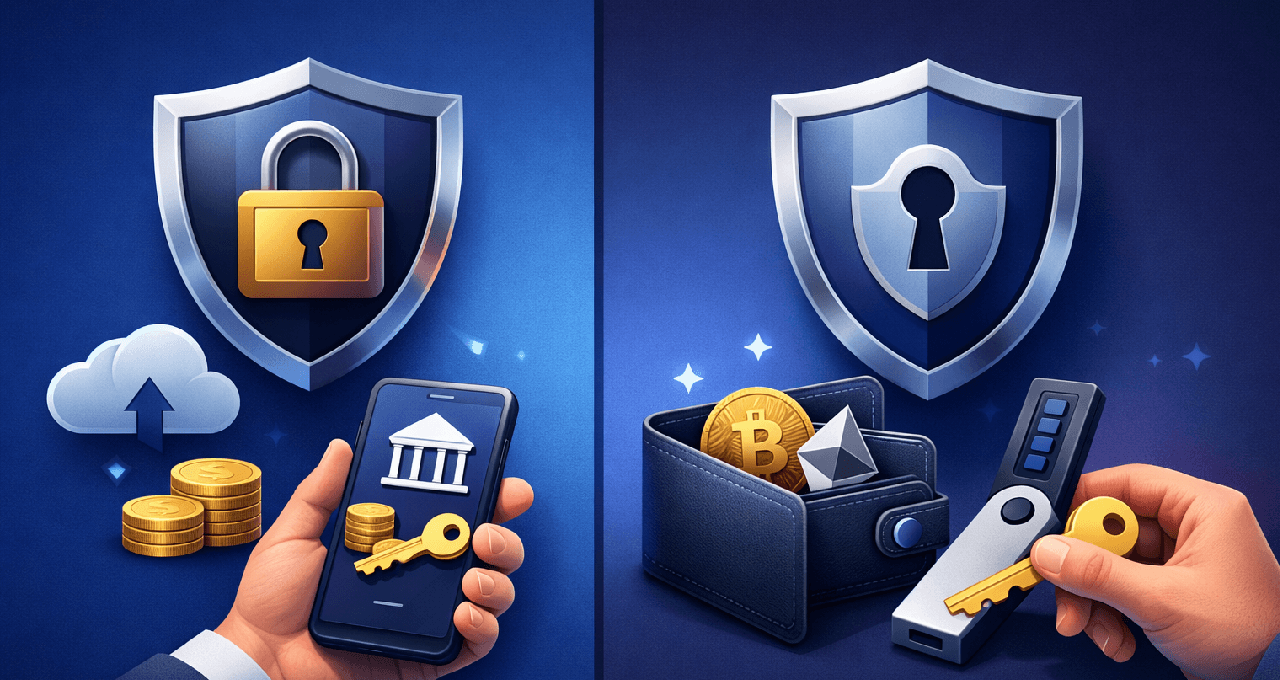
A cryptocurrency wallet stores the keys that let you access your digital assets. The main difference between custodial and non-custodial wallets is who controls those keys. This guide explains both types in detail, with comparison tables, step-by-step instructions, security checklists, and clear risk disclosures.
What Is a Crypto Wallet?
A wallet does not store coins like a physical bank vault. It stores private keys that prove ownership on the blockchain. The coins themselves live on the public ledger. Losing your keys means losing access to your assets permanently.
There are two main categories: custodial (third party holds the keys) and non-custodial (you hold the keys).
Custodial Wallets Explained
In a custodial wallet, a company (the exchange or wallet provider) holds your private keys. You log in with email and password, similar to online banking.
Common Examples (widely used in 2026):
Coinbase Wallet (custodial mode)
How Custodial Wallets Work (Step-by-Step)
Create an account with email and complete identity verification (KYC).
Deposit funds via bank transfer, card, or another crypto address.
The platform credits your balance internally.
To send crypto, you request a withdrawal; the company signs the transaction.
The company manages security, backups, and recovery.
Advantages and Risks Table for Custodial Wallets
Aspect | Advantage | Risk / Limitation |
Ease of use | Simple login, no seed phrases | You do not control the keys |
Recovery | Password reset or support team | Company can freeze or limit access |
Security | Company handles hacking protection | Single point of failure if company is hacked |
Insurance | Some platforms offer partial insurance | Not all assets covered; limits apply |
Fees | Often lower for basic trades | Withdrawal fees set by the company |
Non-Custodial Wallets Explained
In a non-custodial wallet, you alone control the private keys. No company can access your funds. This follows the principle “not your keys, not your coins.”
Common Examples (widely used in 2026):
Software: MetaMask, Trust Wallet, Exodus
Hardware: Ledger Nano S Plus, Ledger Stax, Trezor Model T
Mobile: Phantom (Solana), Rainbow (Ethereum)
How Non-Custodial Wallets Work (Step-by-Step)
Download the app or buy a hardware device.
Create a new wallet; the app generates a 12- or 24-word seed phrase.
Write down the seed phrase on paper and store it offline (never photograph or store digitally).
Verify the seed phrase by re-entering selected words.
Receive your public address to deposit funds.
To send crypto, the wallet uses your private key to sign the transaction locally.
Direct Comparison: Custodial vs Non-Custodial
Comprehensive Feature Comparison Table
Feature | Custodial Wallet | Non-Custodial Wallet |
Key control | Company controls keys | You control keys |
Ease for absolute beginners | Very easy (email + password) | Requires learning seed phrases |
Security responsibility | Company handles it | 100% your responsibility |
Recovery if you lose access | Company can help with KYC | Seed phrase only; permanent loss if forgotten |
Hacking risk | Centralized target for attackers | Decentralized; only your device at risk |
Regulatory compliance | Full KYC required on most platforms | Usually no KYC for basic use |
Transaction speed | Instant internal transfers | On-chain speed (depends on blockchain) |
Asset support | Thousands of coins on one platform | Varies; some support only specific chains |
Staking / DeFi access | Limited or none | Full access to decentralized protocols |
Cost | Trading fees + withdrawal fees | Usually only network gas fees |
Security Risks and Real-World Considerations
Custodial risks (widely reported incidents):
Large centralized platforms have been targets of hacks in the past. When this happens, customer funds can be affected. Some platforms offer insurance programs, but coverage is often limited and subject to terms.
Non-custodial risks:
The biggest risk is user error. Losing or exposing your seed phrase means permanent loss of funds. Hardware wallets protect against online hacks but can still be lost or damaged.
Smart Contract Risk (non-custodial only):
When you connect a non-custodial wallet to decentralized applications, you approve spending limits. Malicious contracts can drain funds if you approve without checking.
Step-by-Step Security Checklist for Non-Custodial Wallets
Buy hardware wallets directly from the manufacturer’s official website.
Set up the device in a private location and never enter your seed phrase on any computer or phone.
Store the seed phrase on metal backup plates or in a fireproof safe.
Enable all available security features (PIN, passphrase, biometric).
Test small withdrawals before moving large amounts.
Never share your seed phrase or private keys.
Use separate wallets for large holdings and daily spending.
Update firmware and software only from official sources.
Hybrid Approaches and Advanced Options
Some platforms now offer “self-custody with assistance” features such as multi-party computation (MPC) wallets. These split the key so no single party holds the full private key. They aim to combine convenience with improved security. Research each option carefully before use.
Institutional investors often use specialized custodial services with multi-signature requirements and insurance policies. Retail users usually choose between standard custodial exchanges for small amounts and hardware non-custodial wallets for larger holdings.
Regulatory and Tax Considerations (Informational Only)
Custodial platforms must follow know-your-customer (KYC) and anti-money-laundering rules in most countries. They report transactions to tax authorities where required. Non-custodial wallets do not automatically report activity, but you remain responsible for accurate tax reporting on any gains. Rules vary by country and change over time.
When to Use Each Type
Use a custodial wallet when:
You are brand new to crypto.
You want the simplest possible experience.
You are holding very small amounts for daily use.
You value customer support and password recovery.
Use a non-custodial wallet when:
You want full control of your assets.
You plan to use decentralized finance (DeFi) or staking.
You are holding larger amounts long-term.
You are comfortable managing your own security.
Many experienced users keep a small custodial balance for quick trades and the majority of their holdings in non-custodial hardware wallets.
Common Beginner Mistakes to Avoid
Storing large amounts on exchanges long-term.
Taking photos of seed phrases or storing them in cloud notes.
Clicking links in unsolicited messages (phishing).
Approving unlimited spending on DeFi sites.
Forgetting to test small transfers first.
Best Practices Summary Table
Practice | Custodial Users | Non-Custodial Users |
Daily spending | Use app balance | Use mobile software wallet |
Long-term storage | Withdraw to personal wallet | Hardware wallet + offline seed backup |
Backup method | Rely on platform support | Written seed phrase + metal backup |
Two-factor authentication | Enable everywhere | Enable on connected accounts |
Regular review | Check account statements | Verify balances on blockchain explorer |
Conclusion
Custodial wallets offer convenience and simplicity at the cost of control. Non-custodial wallets give you full ownership and DeFi access at the cost of greater personal responsibility. Most users benefit from understanding both and using each for its intended purpose. Start small, practice the steps above, and always prioritize security over convenience when amounts grow.
This knowledge applies whether you hold Bitcoin, Ethereum, stablecoins, or other digital assets. Review your setup regularly and stay informed about new security standards as the industry evolves.
FAQ
What does “not your keys, not your coins” mean?
It means that if you do not control the private keys, the custodian technically owns the assets even though your balance appears in the app.
Can I lose my crypto in a non-custodial wallet?
Yes, permanently, if you lose your seed phrase. There is no customer support to recover it.
Are hardware wallets necessary for beginners?
Not immediately. Start with a software non-custodial wallet for small amounts while you learn.
Do all exchanges offer custodial wallets?
Yes. Any time you hold crypto on an exchange without withdrawing to your own address, it is custodial.
Read More
Need deeper training?
Join our structured modules with live examples and expert checklists for effective implementation.
JOIN THE ACADEMY