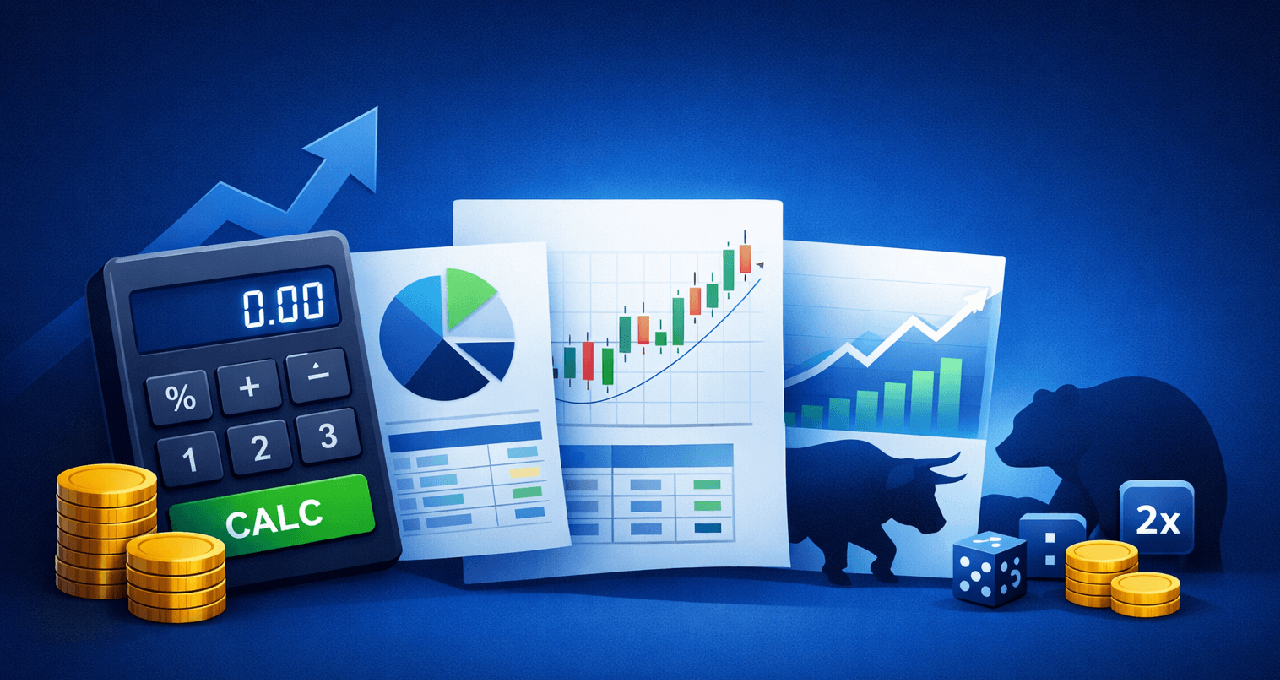
Position sizing answers one question: “How many coins or contracts should I buy or sell on this trade?” Getting the answer right is one of the biggest differences between traders who survive long term and those who do not. This guide provides every formula, table, and step needed to calculate position size safely and consistently.
Why Position Sizing Is the Foundation of Risk Management
Even with perfect entries and stop-loss orders, incorrect position size can wipe out an account after a few losing trades. Proper sizing ensures that any single loss stays within a predetermined, affordable percentage of total capital.
Core Concepts Before Calculating
Account balance: Total equity available for trading.
Risk per trade: The maximum percentage or dollar amount you are willing to lose on any one position (most beginners start at 0.5–1%).
Stop-loss distance: The percentage or dollar difference between entry price and stop-loss price.
Leverage (if using futures or margin): Multiplies both gains and losses.
The Basic Position-Sizing Formula
Position size (in base currency) = (Account balance × Risk %) ÷ Stop-loss distance (%)
Example Table: $10,000 Account at 1% Risk
Asset | Entry Price | Stop Distance | Stop Price | Max Loss ($) | Position Size | Value of Position ($) |
BTC/USDT | $60,000 | 3% | $58,200 | $100 | 0.0556 BTC | $3,333 |
ETH/USDT | $2,800 | 4% | $2,688 | $100 | 0.8929 ETH | $2,500 |
SOL/USDT | $140 | 6% | $131.60 | $100 | 11.90 SOL | $1,667 |
The table shows how more volatile assets (SOL) receive smaller dollar exposure for the same risk.
Three Main Position-Sizing Methods Compared
Method | Formula | Best For | Pros | Cons | Typical Risk Setting |
Fixed Percentage | (Balance × Risk %) ÷ Stop distance | Beginners, consistent risk | Simple, easy to scale | Ignores volatility changes | 0.5–2% per trade |
Fixed Dollar | Fixed $ risk ÷ Stop distance | Small accounts | Keeps loss amount constant | Does not grow with account | $50–$200 per trade |
Volatility-Based (ATR) | (Balance × Risk %) ÷ (ATR × Multiplier) | Experienced traders | Adjusts automatically to market | Requires ATR calculation | 1–2× ATR stop |
Kelly Criterion (full) | Edge / Odds (advanced statistical) | Quantitative traders | Mathematically optimal | Can lead to large drawdowns | Not recommended for beginners |
Volatility-Based Example Table (Using 14-day ATR)
Asset | Current ATR | Chosen Stop (1.5× ATR) | Account $10k | Risk 1% | Position Size |
BTC | $1,800 | $2,700 (4.5%) | $10,000 | $100 | 0.0370 BTC |
ETH | $120 | $180 (6.4%) | $10,000 | $100 | 0.9259 ETH |
Step-by-Step Calculator Walkthrough (Manual Method)
Write down current account balance.
Choose risk percentage (example: 1%).
Calculate maximum dollar risk = balance × 0.01.
Decide stop-loss price or percentage distance.
Divide dollar risk by stop distance in dollars or convert percentage.
Divide result by entry price to get coin quantity.
Round down to the nearest tradable unit on your exchange.
Verify total position value does not exceed any exchange limits.
Ready-to-Use Blank Calculator Table (Copy for Personal Use)
Step | Input / Calculation | Your Numbers |
1 | Account balance | |
2 | Risk % per trade | |
3 | Max $ risk (step 1 × step 2) | |
4 | Entry price | |
5 | Stop-loss price | |
6 | Stop distance in $ (entry – stop) | |
7 | Position size in coins (max $ risk ÷ step 6) | |
8 | Position value $ (coins × entry) |
Position Sizing with Leverage (Futures)
Leverage multiplies the effect of the stop distance.
Effective risk % = (Stop distance % × Leverage)
Leverage Adjustment Table
Leverage | Stop Distance | Effective Account Risk at 1% Sizing |
1× (spot) | 3% | 3% |
5× | 3% | 15% (dangerous) |
10× | 3% | 30% (account-threatening) |
20× | 1% | 20% |
Traders using 10× leverage must reduce the base position size dramatically or widen stops.
Scaling Position Size as Account Grows
Many traders increase position size only after the account grows by a set amount (example: every additional $5,000). This keeps risk percentage constant while allowing compounding.
Account Growth Scaling Table
Account Balance | Risk % | Max $ Risk per Trade | Example Position (BTC, 3% stop) |
$5,000 | 1% | $50 | 0.0278 BTC |
$10,000 | 1% | $100 | 0.0556 BTC |
$25,000 | 1% | $250 | 0.1389 BTC |
$50,000 | 0.75% | $375 | 0.2083 BTC |
Common Position-Sizing Mistakes
Using the same coin quantity on every trade regardless of price or volatility.
Ignoring exchange minimum order sizes and rounding incorrectly.
Increasing size after a winning streak (revenge sizing).
Forgetting to recalculate after deposits or withdrawals.
Mixing spot and leveraged positions without adjusting total risk.
Practical Examples Across Trading Styles
Day Trading Example (5-minute chart)
Account $8,000, risk 0.5%, BTC entry $61,500, stop $61,000 (0.81% distance) → position 0.0634 BTC.
Swing Trading Example (daily chart)
Account $15,000, risk 1%, ETH entry $2,650, stop $2,450 (7.5% distance) → position 0.7895 ETH.
Altcoin Low-Liquidity Example
Account $12,000, risk 0.75%, smaller altcoin with 8% stop → smaller dollar exposure to avoid slippage.
Tools and Resources for Faster Calculation
TradingView has a built-in position-size widget in the trading panel.
Most exchanges display required margin and liquidation price once you enter quantity.
Spreadsheet templates (Google Sheets or Excel) allow automatic recalculation when you change any variable.
Free online calculators on major exchange education pages update in real time.
Summary Table: Choosing the Right Method for Your Stage
Trader Experience | Recommended Method | Update Frequency | Complexity |
Absolute beginner | Fixed percentage | Every trade | Low |
Intermediate | Fixed percentage + ATR | Weekly | Medium |
Advanced | Volatility-based | Daily | High |
FAQ
What is the safest risk percentage for beginners?Most educational sources suggest 0.5–1% of total account per trade until consistent profitability is proven over many months.
Does position sizing change when using 100× leverage?
Yes. The stop distance must be divided by the leverage multiplier or the position size reduced proportionally.
How often should I recalculate my position size
After every deposit, withdrawal, or significant account change (greater than 5–10%).
Can I use the same sizing formula for spot and futures?
The formula stays the same, but futures require an extra leverage adjustment step.
Read More
Need deeper training?
Join our structured modules with live examples and expert checklists for effective implementation.
JOIN THE ACADEMY