Key Takeaways
Tokens cannot pay their own fees on most networks. Moving USDT, USDC, or any other token needs a small balance of the network's native coin, such as ETH, BNB, POL, SOL, or TRX.
The gas token must be on the same network as the token you want to move. ETH on Ethereum does not pay fees on Arbitrum or Base, and a bridged "ETH" token on BNB Chain does not pay fees at all.
Keep a buffer and send the native coin last. If you do run out, you can usually recover by depositing a small amount of the right coin or by using a wallet that lets you pay fees in another token.
The Problem in One Sentence
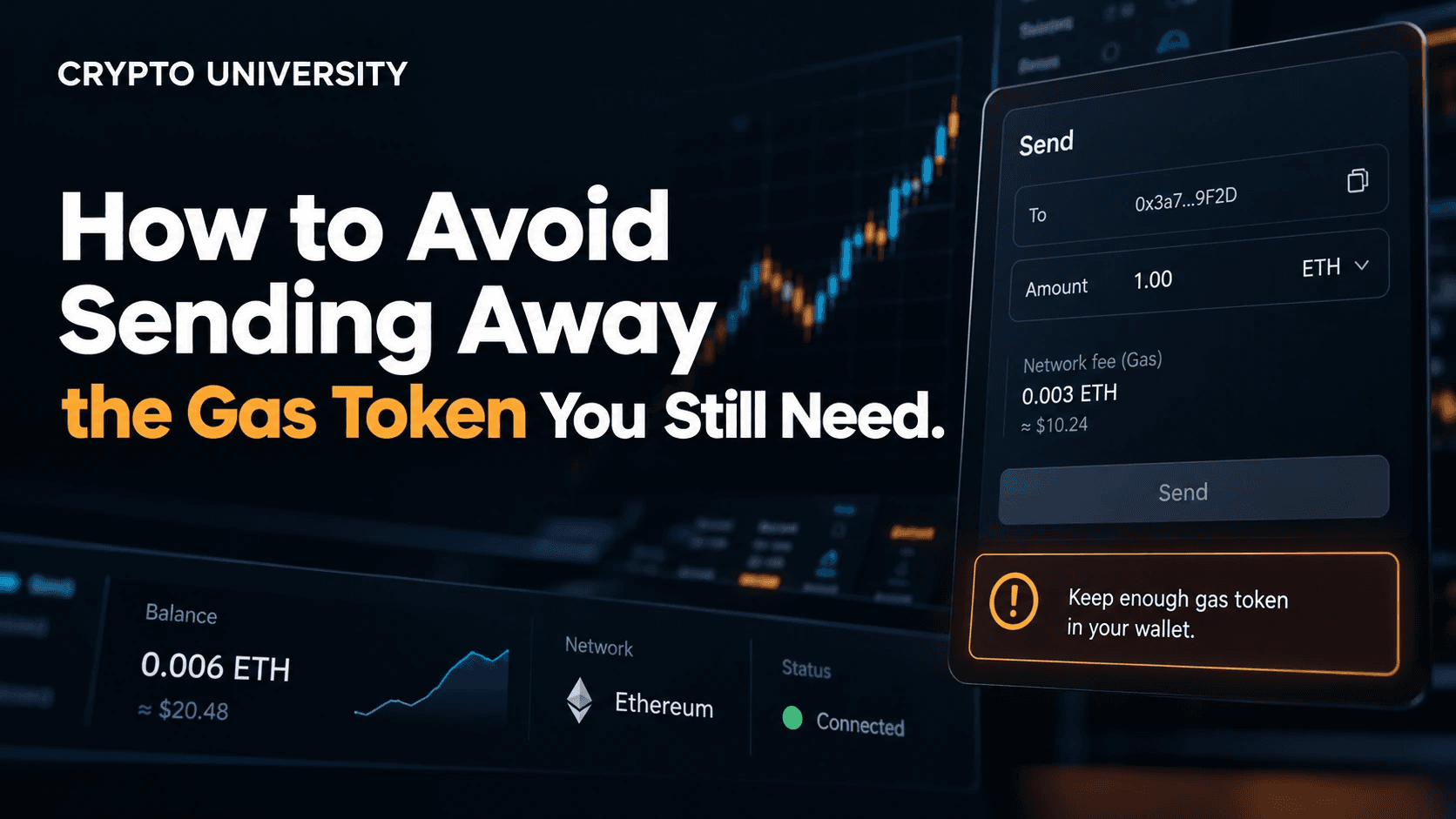
You send all of your ETH (or BNB, SOL, TRX) elsewhere, and the tokens left behind cannot move because nothing remains to pay the network fee. Nothing is lost, but the tokens stay stuck until you add a little of the right coin back.
Why Tokens Need a Separate Gas Coin
Every blockchain has a native coin that is built into the protocol. It is the only asset the network accepts as payment for processing transactions. On Ethereum, fees are measured in gas and paid in ETH, and the fee is charged whether the transaction succeeds or fails.
Tokens such as USDT or USDC are records kept by smart contracts running on the network. Sending one means asking the network to run that contract, and the fee is due in the native coin. That is why a wallet can show $500 in USDT and still refuse to send it, with an error like "insufficient funds for gas" or "not enough ETH to cover the network fee."
Which Coin Pays Fees on Each Network
Network | Gas token | Example tokens that need it |
Ethereum | ETH | USDT, USDC, DAI (ERC-20) |
Arbitrum, Optimism, Base, Linea | ETH (held on that network) | USDC, ARB, OP |
BNB Smart Chain | BNB | USDT, USDC (BEP-20) |
Polygon PoS | POL (formerly MATIC) | USDT, USDC |
Solana | SOL | USDC, USDT (SPL tokens) |
TRON | TRX (or Energy and Bandwidth) | USDT (TRC-20) |
Avalanche C-Chain | AVAX | USDC, USDT |
Since September 2024, Polygon PoS has used POL as its native gas token. Older guides that say MATIC describe the same role.
The "Same Network" Trap
This is the mistake that catches even careful users. Holding the right coin is not enough. It has to be on the same network as the token.
You hold | You want to move | Will it work? | Why |
ETH on Ethereum | USDC on Arbitrum | No | Arbitrum fees must be paid with ETH that is on Arbitrum |
ETH on Base | USDC on Base | Yes | Same network, native gas token |
"ETH" (BEP-20) on BNB Chain | USDT on BNB Chain | No | That ETH is a token on BNB Chain. Fees there need BNB |
WETH on Ethereum | USDT on Ethereum | No (in a standard wallet) | WETH is an ERC-20 token, not native ETH |
SOL on Solana | USDC on Solana | Yes | Same network, native gas token |
Rule of thumb: look at which network the stuck token is on, then make sure you hold that network's own native coin, on that network, in that exact address.
How Much Gas Token Should You Keep?
There is no single right number, because fees change with network demand. Instead of chasing an exact figure, keep enough for several transactions, not just one. Here is why one is rarely enough:
Token transfers cost more than coin transfers. A plain ETH transfer uses 21,000 gas. A token transfer runs contract code and uses more.
Approvals cost extra. Swapping or depositing a token into an app often needs an approval transaction first, then the main transaction.
Failed transactions still cost money. On Ethereum, a transaction that runs out of gas during execution is reverted, but the gas is still consumed.
Fees can jump. A buffer that covers one transfer on a quiet day may not cover it on a busy one.
Network-Specific Notes
Solana. The base fee is 5,000 lamports per signature (1 SOL is 1 billion lamports), plus any optional priority fee. Accounts must also keep a minimum rent balance, and sending a token to a new holder may require creating a token account, which costs extra SOL.
TRON. Every transaction uses Bandwidth, and contract calls such as USDT transfers also use Energy. Accounts get 600 free Bandwidth per day but no free Energy, so TRX is burned to cover any shortfall. A USDT transfer to an address that already holds USDT uses roughly 65,000 Energy, and roughly 131,000 to a new address. One widely cited estimate puts the burn cost at about 6.85 TRX and 13.45 TRX respectively. These figures can change, so check your wallet's estimate before sending.
Step by Step: How to Avoid Draining Your Gas Token
Check what else is in the wallet. Look for tokens on the address, using a block explorer if your wallet hides small balances.
Decide whether you are emptying the wallet. If you will keep using it, do not press Max on the native coin. Type an amount that leaves a buffer.
If you are emptying it, send tokens first and the native coin last.
Read the confirmation screen. Check the network name, the fee, and the balance that will remain.
Watch exchange withdrawals. The exchange pays the fee when you withdraw USDT, but moving it again from your wallet needs gas. Withdraw a little native coin on the same network too.
What to Do If You Already Sent It Away
Your tokens are not gone. You have a few ways to get them moving again.
Option | How it works | Things to watch |
Send in a small amount of the native coin | Withdraw or transfer a little ETH, BNB, SOL, or TRX to the same address, on the same network | Double check the network. Exchange minimum withdrawals may be higher than you need |
Pay fees in another token | Some wallets can take the fee in a token such as USDC | Support is limited to certain networks and tokens, and a small service fee may apply |
Gasless or sponsored transactions | An app or wallet covers the fee for you through a paymaster | Depends entirely on the app. Only use well known providers |
Rent or receive Energy (TRON) | Energy can be staked, delegated, or rented from a market | Use reputable services only. Never share private keys |
Paying Fees With Another Token
Some wallets let you pay the fee in a token you already hold. MetaMask's Gas Station feature, for example, lets users choose a supported token such as USDT or USDC next to the network fee on the confirmation screen. It covers networks including Ethereum, BNB Smart Chain, Arbitrum, Polygon, Linea, and Base, and includes a small MetaMask fee. Availability can change, so check your wallet's help pages.
How Gas Sponsorship Works
Under the ERC-4337 standard, a smart contract called a paymaster can pay gas for a user. It either sponsors the fee or collects a token like USDC from the user and pays the network in the native coin. EIP-7702 lets ordinary wallets use these smart account features. Either way, someone still pays the gas in the native coin.
A Safety Warning
Stuck balances attract scammers. Be wary of strangers offering to "send you gas," and of "free gas" or "unlock your tokens" websites that ask you to connect a wallet and sign transactions. No legitimate service needs your recovery phrase to send you gas.
Common Mistakes and How to Avoid Them
Mistake | Result | Better approach |
Pressing Max on the native coin | Tokens left behind with no fee money | Send tokens first, or type an amount that leaves a buffer |
Holding ETH on the wrong network | Fees cannot be paid on the network you need | Match the gas coin to the token's network |
Treating WETH or bridged ETH as gas | Transaction fails | Hold the network's native coin |
Withdrawing only USDT to a fresh wallet | Cannot move it again | Withdraw a little native coin on the same network |
FAQ
Are my tokens lost if I have no ETH or BNB left?
No. They remain at your address. You only need a small amount of the native coin on the same network to move them again.
Why can't I use WETH to pay gas on Ethereum?
WETH is an ERC-20 token that represents ETH. The network itself only accepts native ETH for fees, so you would need to unwrap WETH first, and unwrapping also needs gas.
Can I pay gas fees with USDT or USDC?
On standard wallets, no. Some wallets and apps support paying fees in stablecoins through features like MetaMask Gas Station or paymasters, but support depends on the network and the provider.
Why does sending USDT on TRON burn TRX?
USDT transfers on TRON use Energy and Bandwidth. If your account does not have enough of these resources, the network burns TRX to cover the cost.
Do layer 2 networks use their own token for gas?
Many popular layer 2 networks, such as Arbitrum, Optimism, and Base, use ETH for gas. The ETH must be held on that layer 2 network, not on Ethereum mainnet.
Related Terms
Gas Fee: The fee paid in a network's native coin to process a transaction or run a smart contract.
Native Token: The built-in coin of a blockchain, such as ETH or SOL, used to pay network fees.
Paymaster: A smart contract that pays gas fees for a user, either for free or in exchange for another token.
Disclaimer
This article is for educational purposes only and is not financial, legal, or tax advice. Crypto transfers are usually irreversible, and wallet and exchange rules change over time, so always check the current requirements of the platforms you use before sending funds.
Sources
More Reading From Crypto University
Need deeper training?
Join our structured modules with live examples and expert checklists for effective implementation.
JOIN THE ACADEMY