Key Takeaways
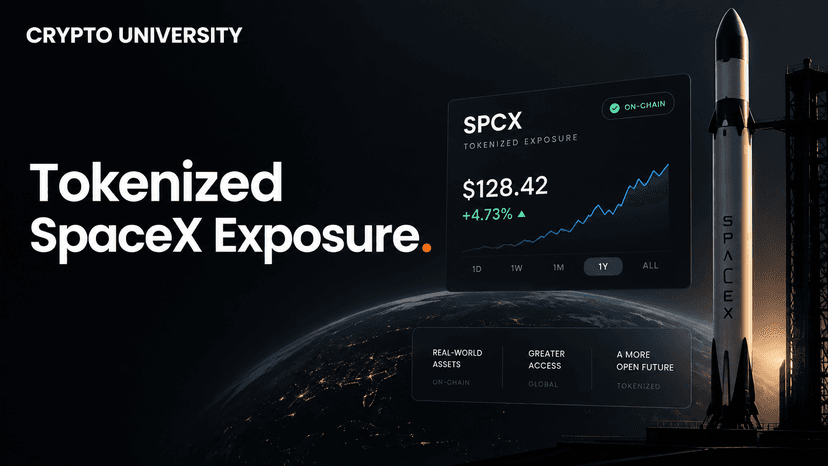
1. SpaceX is now public. Since June 12, 2026 it trades on the Nasdaq as SPCX, so “tokenized SpaceX” no longer automatically means private-market exposure.
2. There are three different kinds of SpaceX token. Know whether you are holding a legacy pre-IPO instrument, a backed tracker, or a derivative before you buy, because they are not the same thing.
3. The IPO created a real price. That price revealed which older products were overpriced. Your product’s terms and your entry price matter far more than the hype around the name.
A Quick Introduction
For a long time, “tokenized SpaceX” worked very differently from something like tokenized Tesla. Tesla was already a public company with a live Nasdaq price, so a Tesla token had a clear number to track. SpaceX, on the other hand, was private. That meant every SpaceX token was really a claim on a hard-to-sell private asset, with no official market price behind it.
That changed on June 12, 2026, when SpaceX listed on the Nasdaq under the ticker SPCX. The company priced its IPO at $135 a share, raised roughly $75 billion, and debuted at a valuation near $1.7 trillion, making it the largest IPO ever recorded.
If you are searching for tokenized SpaceX today, you have landed in the aftermath of that change, and it left the token landscape more confusing than you might expect. Here is a simple map to help you find your way.
The Pre-IPO Era: What Those Tokens Actually Were
Before the IPO, you could not simply buy “SpaceX shares on a blockchain.” Exposure came through a few different structures, and it helps to understand what each one really was.
Structure | What it was | Key detail |
|---|---|---|
SPV-backed tokens | Platforms like Jarsy bought real SpaceX shares in private markets and locked them inside special purpose vehicles (Delaware LLCs), then issued tokens (JSPAX) representing the economic rights. | Minimums could be as low as $10. |
Mirror / structured tokens | Republic’s product (first called preSPAX, later renamed PRESPCX after a 5-for-1 adjustment in May 2026) was built to mirror SpaceX’s private valuation. | It did not give you actual share ownership. |
Synthetic perpetuals | Venues like Ventuals and Trade.xyz offered perps that tracked estimated SpaceX valuations. | No shares at all, purely a derivative. |
Regulation S warrants | Warrant structures that offered a pathway to convert into real shares once the company listed. | Backing quality varied a great deal. |
These products were very different in how well they were backed, and their prices were only estimates rather than real market prices. Premiums above the eventual IPO price were common, and some buyers paid private-market prices well above where SPCX later traded. As one CoinDesk analysis of the IPO scramble put it, tokenizing a stock is the easy part. The hard part is securing the actual underlying asset with a clean legal claim.
What the IPO Changed
The IPO changed three big things at once.
Change | What it means for you |
|---|---|
A real price now exists | SPCX trades on the Nasdaq. It priced at $135, opened at $150, and traded around $120 to $125 in late July 2026. Every SpaceX-linked token now has a public price to compare against, which revealed exactly which older products were overpriced. |
Pre-IPO structures wind down or convert | SPV and warrant structures usually have rules for a “liquidity event”: handing out shares, cashing out at the listing price, or converting into a new instrument. If you hold JSPAX, PRESPCX or similar, your rights come from the product documents, not from the SPCX ticker. Check your platform’s announcements. |
Standard tokenization is now possible | As a public stock, SpaceX can be tokenized the same way as Tesla or Nvidia, with 1:1 backed tracker products. June 2026 set a record $3.86 billion in onchain tokenized-equity volume, driven heavily by SpaceX interest. Always confirm on your venue whether a specific SPCX token is actually live. |
The Landscape Today: Three Kinds of “SpaceX Token”
Today, when someone says “SpaceX token,” they could mean one of three very different things. Knowing which one you are looking at is the most important step before you buy.
Type | What it is | What to watch |
|---|---|---|
Legacy pre-IPO instruments (JSPAX, PRESPCX and similar) | Older products that are now in transition. | Their value depends on conversion and distribution terms, not just the SPCX price. Spreads can be wide while wind-downs process. |
Post-IPO backed tokens | Where offered, these work like any tokenized public stock: 1:1 collateralized trackers. | Standard rules apply. The major issuers exclude US persons, and your local rules still matter. |
Derivatives and perps | Price exposure only, with no backing. | Counterparty risk, as always. |
If you are buying today, decide which of these three you actually want. For most beginners who simply want straightforward exposure, a backed tracker on a reputable venue (once you confirm it is listed) is the cleanest choice.
Risks That Survived the IPO
Going public solved some problems, but it did not remove the risk. Here are the main ones to keep in mind.
Risk | Why it matters |
|---|---|
Post-IPO volatility | SPCX fell from its $150 open to the low $120s within six weeks. That is normal price discovery for a huge IPO, but it hurt anyone who bought pre-IPO tokens at higher valuations. Lockup expirations, usually around six months after listing, are a known future supply event. |
Legacy-product limbo | Until an older instrument fully converts or pays out, you carry documentation risk on top of market risk. Read your product’s liquidity-event clause carefully. |
Concentration and narrative risk | SpaceX is a story stock with a high-profile CEO, heavy reliance on government contracts, and a valuation that assumes decades of Starlink and launch dominance. Easy token access does not make the underlying bet any safer. |
Before You Buy: A Quick Checklist
If you are… | Focus on… |
|---|---|
A brand-new buyer | Confirming the issuer and backing of any SPCX token on your venue before buying. Popular names attract low-quality products. |
Holding a legacy pre-IPO token | Your product’s conversion terms, which are now the most important document you own. |
Wanting simple exposure | A 1:1 backed tracker on a reputable platform, or buying SPCX directly through a broker. |
Frequently Asked Questions
Can I buy tokenized SpaceX stock now?
SpaceX trades publicly as SPCX, so tokenized versions can exist just like they do for any public stock. Check your platform to see which SPCX product it lists and who issues it. Availability depends on the venue and has been changing quickly since the IPO.
What happened to pre-IPO SpaceX tokens after the IPO?
It depends on the structure. SPV tokens and warrants follow their liquidity-event terms, which might mean receiving shares, a cash payout, or conversion into a new product. Mirror tokens follow their issuer’s wind-down rules. Always check your specific product’s announcements.
Did pre-IPO token holders make money from the IPO?
It was mixed. People who bought earlier at lower private valuations generally did well. Those who bought at peak premiums above the $135 IPO price often faced losses as SPCX settled into the $120s. Your entry price and product terms decided the outcome.
Is tokenized SPCX available to US users?
The major offshore tokenized products exclude US persons, the same as they do for Tesla or Apple tokens. US users can simply buy SPCX directly through any broker.
Is SPCX the same as investing in Starlink?
SPCX represents all of SpaceX, which includes Starlink. Any separately marketed “Starlink token” would be a different product, and without a Starlink listing it would be a private-market bet. Apply the same caution described earlier for pre-IPO products.
This article is for general educational purposes only and is not financial, investment, or legal advice. Tokenized stocks and pre-IPO products carry significant risk. Always do your own research and consider speaking with a licensed professional before investing.
More Reading
Explore the Crypto University Tokenized Stocks Directory.
Tokenized Stocks vs Traditional Stocks: Which Is Better for Investors?
Best Platforms for Tokenized Stocks: Exchanges, Brokers and Onchain Apps
The Companies Behind Tokenized Stocks: xStocks, Ondo, Dinari, Robinhood and More
Tokenized Stock Risks: Issuers, Custody, Liquidity and Tracking Error