Key Takeaways
Kuwait has no licensed local crypto exchanges. Since July 2023, Kuwaiti regulators have prohibited virtual asset services inside the country, so every cash-out route relies on platforms licensed elsewhere or on peer-to-peer deals.
BitOasis and Rain are the two main regional platforms that list KWD support, but their status differs. Rain lists KWD bank withdrawals with a fixed KWD 5 bank charge. BitOasis supports KWD, but its support centre currently reports KWD withdrawals as temporarily disabled.
P2P trading is the most flexible route and also the riskiest. It carries fraud, payment reversal and bank account review risks that do not exist in the same way on a regulated platform.
Introduction
"How do I turn my crypto back into Kuwaiti dinars?" is one of the most common questions from crypto holders in Kuwait. The answer is less simple than in neighbouring countries such as Bahrain or the UAE, because Kuwait does not license any crypto exchanges.
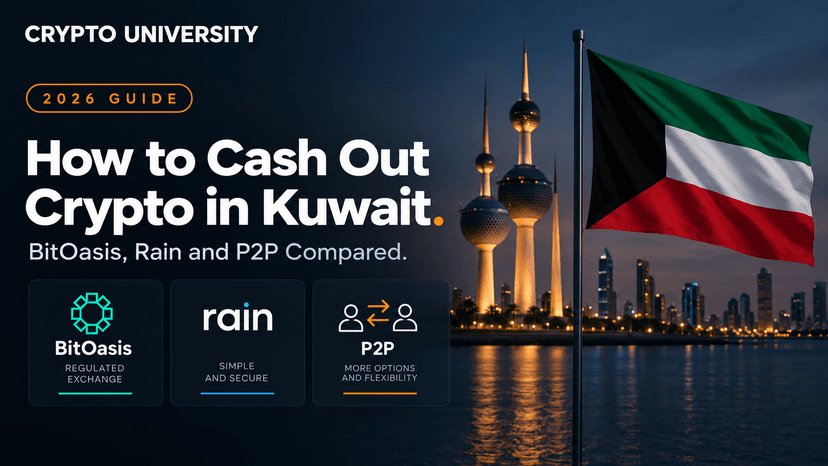
This guide explains the legal background, then compares the three routes people most often use: BitOasis, Rain and peer-to-peer (P2P) trading. It covers how each one works, what verification is needed, known fees, and the risks to understand before moving any money.
This article is for education only. It is not legal, tax or financial advice. Rules and platform features change often, so always confirm details directly with the platform and a qualified professional in Kuwait.
The Legal Context in Kuwait
Before comparing platforms, it is important to understand the regulatory picture.
In July 2023, several Kuwaiti authorities issued coordinated circulars placing what they called an "absolute prohibition" on virtual asset activity. According to reporting on the circulars, the ban covers using crypto for payments and investment, bans crypto mining, and states that no licences will be issued to provide virtual asset services in Kuwait. The authorities said the measures follow Financial Action Task Force (FATF) recommendations on anti-money laundering.
Authority | Role in the 2023 Prohibition |
|---|---|
Central Bank of Kuwait (CBK) | Circular to local banks, finance companies and exchange companies |
Capital Markets Authority (CMA) | Circular No. 10 of 2023 covering virtual asset services |
Ministry of Commerce and Industry | Ministerial Circular No. 1 of 2023 and consumer warnings |
Insurance Regulatory Unit | Circular No. 6 of 2023 for the insurance sector |
What this means in practice:
There is no Kuwaiti regulator protecting you if something goes wrong with a crypto platform.
Platforms that serve Kuwait residents are licensed in other countries, such as Bahrain or the UAE.
Kuwaiti banks operate under central bank instructions not to deal in or facilitate crypto, so transfers linked to crypto platforms may face questions, delays or returns.
Regulators also warn that crypto has no legal status in Kuwait and is highly speculative. If you are unsure how the rules apply to your situation, speak with a Kuwaiti legal professional before acting.
What "Cashing Out" Actually Means
Cashing out, also called using an off-ramp, is the process of converting crypto into government-issued money and moving it into a bank account. It usually involves four steps:
Verify your identity on a platform through KYC (Know Your Customer) checks.
Transfer your crypto from your wallet to the platform.
Sell the crypto for a fiat currency such as KWD or USD.
Withdraw the funds to a bank account in your own name.
Each step has its own costs, delays and risks. The route you choose decides how smooth or difficult these steps are.
Quick Comparison: Three Cash-Out Routes
Feature | BitOasis | Rain | P2P Trading |
|---|---|---|---|
Type | Regional broker and exchange | Regional broker and exchange | Direct trade between users |
Main licences | Dubai VARA (full VASP licence), Bahrain | Central Bank of Bahrain, ADGM FSRA (Abu Dhabi) | Depends on the marketplace used |
KWD support | Listed as supported | Listed as supported | Depends on local buyers |
KWD bank withdrawal | Temporarily disabled per support notice | Available, KWD 5 bank charge | Buyer pays you by bank transfer |
KYC required | Yes, tiered | Yes | Usually yes on major P2P marketplaces |
Main risk | Service interruptions with banking partners | Cross-border transfer delays and bank charges | Fraud, reversed payments, account freezes |
Best suited to | Existing users watching for KWD withdrawals to resume | Users wanting a regulated route with KWD withdrawals | Experienced users who understand scam risks |
Status and fees reflect platform pages checked in September 2026. Always confirm on the platform before transacting.
Route 1: BitOasis
What It Is
BitOasis is one of the longest-running crypto platforms in the Middle East and North Africa. It was founded in 2016 and is headquartered in Dubai. In July 2024, Indian exchange CoinDCX acquired BitOasis, and in December 2024 BitOasis received a full Virtual Asset Service Provider (VASP) licence from Dubai's Virtual Assets Regulatory Authority (VARA). It has also reported holding a licence in Bahrain.
BitOasis lists Kuwait as a supported country and the Kuwaiti dinar as a supported fiat currency.
How Cashing Out Works
On BitOasis, the general process is to sell crypto into a fiat balance and then request a bank withdrawal to a personal account in your name.
Detail | What BitOasis States |
|---|---|
Verification | Three KYC tiers, with higher tiers unlocking higher limits |
Processing time | Withdrawals usually processed in 1 to 2 days |
Bank credit time | Up to 3 days, or 3 to 7 days for international transfers |
Bank account rule | Funds go to a personal account in the user's own name |
Important Status Notice
As of September 2026, BitOasis's own support article on fiat withdrawals shows a service notice (last updated in May 2026) stating that withdrawals in SAR, QAR, KWD, OMR and USD are temporarily disabled because of issues with a banking partner.
This means that, at the time of writing, Kuwait-based users may not be able to withdraw KWD directly to a bank account from BitOasis. Check the BitOasis support centre or contact its support team for the latest status before selling any crypto on the platform expecting a KWD withdrawal.
Points to Consider
Strength: Long regional track record and a full VARA licence in Dubai.
Limitation: The KWD withdrawal pause, plus occasional reports from users of slow verification reviews.
Tip: Do not sell crypto into a fiat balance you cannot currently withdraw unless you are comfortable holding that balance on the platform.
Route 2: Rain
What It Is
Rain was founded in 2017 and is headquartered in Bahrain. In 2019 it became one of the first crypto companies in the Middle East to receive a licence, granted by the Central Bank of Bahrain (CBB). It is also regulated by the Financial Services Regulatory Authority (FSRA) at Abu Dhabi Global Market, and has reportedly received in-principle approval from Dubai's VARA.
Rain lists the Kuwaiti dinar among its supported currencies. It is important to be precise here: Rain is licensed in Bahrain and Abu Dhabi, not by any Kuwaiti authority, since Kuwait does not issue crypto licences.
How Cashing Out Works
Complete Rain's identity verification.
Add a personal bank account in your own name.
Send crypto to your Rain wallet and sell it for KWD.
Request a KWD withdrawal to your Kuwaiti bank account.
Fees and Limits
Item | Details from Rain's Help Centre |
|---|---|
Deposits | No Rain fee, though your bank may charge |
KWD withdrawal | Fixed KWD 5 charge to cover correspondent bank fees |
Local free withdrawals | Only where Rain holds a local bank account, such as Bahrain and the UAE |
Withdrawal limits | Weekly limits based on your account tier |
Name matching | Account name must match your bank account name |
Because Rain does not hold a local bank account in Kuwait, a KWD withdrawal is treated as an international transfer. The final amount you receive may also be reduced by intermediary bank fees.
Points to Consider
Strength: Multiple GCC licences, KWD withdrawals listed as available, and a clear fee schedule.
Limitation: Cross-border transfers can be slower, and Rain disclosed a wallet breach of roughly USD 14.8 million in 2024, which it reportedly covered from company funds with no customer losses.
Tip: Withdraw in the same currency as your receiving bank account to avoid extra conversion costs.
Route 3: P2P Trading
What It Is
Peer-to-peer trading means selling crypto directly to another person, who pays you in local currency, usually by bank transfer. Large global exchanges such as Binance, Bybit and OKX run P2P marketplaces where buyers and sellers post offers.
On most major marketplaces, the platform holds the seller's crypto in escrow. The crypto is released to the buyer only after the seller confirms the money has arrived.
How It Works
Choose a P2P marketplace and complete its KYC checks.
Post or accept an offer to sell a stablecoin or Bitcoin for KWD.
The buyer sends KWD to your bank account.
You confirm the payment has fully cleared in your account.
You release the crypto from escrow.
Key Risks
Risk | What Can Happen |
|---|---|
Fake payment proof | A buyer sends an edited screenshot instead of real money |
Third-party payments | Money arrives from someone other than the buyer, which can be linked to fraud |
Payment reversal | A buyer disputes the transfer with their bank after receiving your crypto |
Bank account review | Unusual incoming transfers may lead a bank to ask questions or restrict an account |
Legal uncertainty | P2P trades inside Kuwait sit within the scope of the 2023 prohibition |
Points to Consider
Strength: Flexible, fast when it works, and does not depend on one platform's banking partner.
Limitation: The highest risk of fraud, and the least protection if something goes wrong.
Tip: Never release crypto based on a screenshot. Only release after checking your actual bank balance.
How to Choose a Route
Ask yourself these questions before cashing out:
Is KWD withdrawal currently working on this platform? Check the support centre, not just the app store listing.
Where is the platform licensed? Know which regulator oversees it and what that protects.
What is the total cost? Add the trading spread, platform fee and bank charges together.
How long can I wait? International transfers can take several business days.
Do I understand the legal position in Kuwait? If not, seek local legal advice first.
Safety Checklist Before You Cash Out
Use only official apps and websites, and type the address yourself.
Turn on two-factor authentication.
Send a small test transaction first.
Keep records of every trade, deposit and withdrawal.
Use bank accounts only in your own name.
Be cautious of anyone offering "guaranteed" rates or asking you to move the chat off the platform.
Frequently Asked Questions
Is it legal to cash out crypto in Kuwait?
Kuwait's 2023 circulars place a broad prohibition on virtual asset activity, including investment and payments, and no local licences are issued. The rules are primarily directed at regulated entities and service providers, but the legal position for individuals is not fully clear. Consult a Kuwaiti legal professional for advice on your situation.
Can I withdraw KWD from BitOasis right now?
As of September 2026, BitOasis's support centre states that KWD withdrawals are temporarily disabled due to banking partner issues. Check its official support pages for updates, as this may change.
How much does Rain charge for KWD withdrawals?
Rain's help centre lists a fixed charge of KWD 5 per KWD withdrawal to cover correspondent bank fees. Intermediary banks may deduct additional amounts.
Is P2P trading safe in Kuwait?
P2P trading can work, but it carries more risk than a regulated platform. Common problems include fake payment proofs, reversed transfers and bank account reviews. Beginners should understand these risks fully before using it.
Do I need KYC to cash out crypto?
Yes, in almost all cases. BitOasis, Rain and major P2P marketplaces all require identity verification before you can withdraw to a bank account.
Related Terms
Off-ramp: A service that converts crypto into fiat money.
Off-ramp: A service or process that converts crypto into traditional money.
P2P trading: Buying or selling crypto directly with another person, usually through a marketplace with escrow.
KYC (Know Your Customer): Identity checks that regulated platforms require before you trade.
Escrow: A system where a platform holds crypto until both sides of a trade complete their obligations.
Correspondent bank: An intermediary bank that helps process international transfers and may charge fees.
Sources
Capital Markets Authority of Kuwait, Resolutions and Circulars on virtual assets: https://www.cma.gov.kw/en/web/cma/cma-board-releases/resolutions-and-regulations/-/cmaboardreleases/detail/1384960
Library of Congress, In Custodia Legis, "Regulation of Cryptocurrencies in the GCC Countries, Part Two" (January 2025): https://blogs.loc.gov/law/2025/01/regulation-of-cryptocurrencies-in-the-gulf-cooperation-council-gcc-countries-part-two/
Gulf Business, "Kuwait bans cryptocurrency" (July 2023): https://gulfbusiness.com/kuwait-bans-cryptocurrency/
BitOasis Support, Fiat Withdrawal Processing Information: https://support.bitoasis.net/en/support/solutions/articles/29000035891-fiat-withdrawal-processing-information
BitOasis, Fiat Fees page: https://bitoasis.net/en/page/fees/fiat
BitOasis Blog, CoinDCX acquisition announcement (July 2024): https://blog.bitoasis.net/coindcx-and-bitoasis-join-forces-in-a-first-of-its-kind-deal-in-mena-region/
Cointelegraph, "CoinDCX's BitOasis receives full crypto license in Dubai" (December 2024): https://cointelegraph.com/news/bitoasis-coindcx-crypto-vasp-license-dubai
Rain Help Centre, Withdrawal bank charges: https://www.rain.com/en/support/articles/10757111-withdrawal-bank-charges
Rain Help Centre, Our fees: https://www.rain.com/en/support/articles/10749004-our-fees
Datawallet, Rain Review 2026 (July 2026): https://www.datawallet.com/crypto/rain-review