Key Takeaways
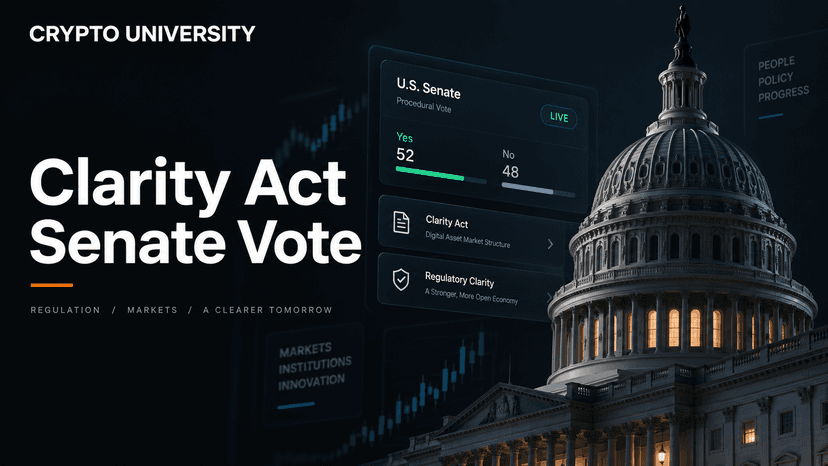
The Senate did not advance the Clarity Act. On September 15, 2026, a cloture vote on the motion to proceed to H.R. 3633 received a reported 50 votes in favor and 49 against, short of the 60 votes needed.
The final draft changed a lot before the vote. It added stricter ethics rules for federal officials, a Treasury "circuit breaker" for stablecoin rewards, narrower developer protections, and tighter conflict rules for exchanges.
The bill is stalled, not formally dead. A motion to reconsider keeps a procedural path open, but the calendar before the November 2026 midterms is very tight, and US crypto rules will keep coming mainly from agencies and courts for now.
What Happened in the Clarity Act Senate Vote
The Digital Asset Market Clarity Act, also called the Clarity Act or H.R. 3633, faced its first full Senate floor test on Tuesday, September 15, 2026.
The vote was not on whether the bill should become law. It was a cloture vote on the motion to proceed. In simple terms, it asked whether the Senate should end debate on starting formal consideration of the bill. Cloture needs three fifths of the Senate, which means 60 votes when all seats are filled.
The motion received a reported 50 yes votes and 49 no votes. Reports named four Republicans, Jerry Moran, Rand Paul, Josh Hawley, and Thom Tillis, as voting no alongside Democrats. Tillis's no vote was described as a procedural move that allows the vote to be reconsidered later.
Vote Detail | What Was Reported |
|---|---|
Date | September 15, 2026 |
Type of vote | Cloture on the motion to proceed to H.R. 3633 |
Votes needed | 60 |
Reported result | 50 yes, 49 no |
Outcome | Motion rejected |
Follow-up step | A motion to reconsider was entered |
What Is the Digital Asset Market Clarity Act?
The Clarity Act is a crypto market structure bill. Its main goal is to answer a question that has shaped US crypto policy for years: when is a digital asset regulated by the Securities and Exchange Commission (SEC), and when is it regulated by the Commodity Futures Trading Commission (CFTC)?
Without a clear law, those lines have mostly been drawn through agency actions, enforcement cases, and court rulings. The Clarity Act tries to replace that with written rules for tokens, exchanges, brokers, and developers.
It is separate from the GENIUS Act, which set rules for payment stablecoin issuers in 2025. The Clarity Act focuses on markets and trading, not on issuing stablecoins.
How the Bill Reached the Senate Floor
Date | Milestone |
|---|---|
May 29, 2025 | H.R. 3633 introduced in the House |
July 17, 2025 | House passes the bill 294 to 134, with 78 Democrats voting yes |
January 2026 | Senate Agriculture Committee advances its market structure text |
May 14, 2026 | Senate Banking Committee advances its version 15 to 9 |
July 22, 2026 | Senator Cynthia Lummis releases a merged Senate text |
August 8, 2026 | Majority Leader John Thune files cloture before the August recess |
September 14, 2026 | Republicans release a "last, best and final" substitute text |
September 15, 2026 | Cloture vote fails |
The CFTC vs SEC Split Explained
The core of the Clarity Act is a division of oversight. The general idea is that assets tied to decentralized blockchain networks go to the CFTC, while fundraising and investment contract activity stays with the SEC.
Area | Main Regulator Under the Bill | What It Covers |
|---|---|---|
Digital commodities | CFTC | Spot trading of assets linked to a blockchain whose value comes from the network's use |
Exchanges, brokers, dealers | CFTC | Registration, custody, capital, and customer protection rules for digital commodity intermediaries |
Token fundraising | SEC | Disclosure rules and exemptions for projects raising money |
Securities and fraud | SEC | Existing anti-fraud and market manipulation authority is preserved |
Payment stablecoins | Handled mainly by the GENIUS Act | The Clarity Act adds rules on rewards and marketing |
The terms changed between versions. The House bill used "mature blockchain system" and "investment contract assets." Later Senate drafts leaned on "network tokens" and "ancillary assets," meaning tokens whose value may still depend on the work of a founding team. Many details would still need joint SEC and CFTC rulemaking before they applied to any specific token.
What the Final Draft Changed
Senators Cynthia Lummis, Tim Scott, and John Boozman released the final draft on September 14. Republicans said it included 126 changes requested by Democrats during more than a year of talks. The last round focused on four open disputes.
1. Ethics Rules for Federal Officials
Ethics was one of the hardest issues, largely because of reported crypto business interests connected to President Trump and his family. The final text reportedly reflected most of a proposal backed by Senators Tillis (R) and Ruben Gallego (D), and Republicans said the President agreed to it.
Key points in the final ethics language:
Covered officials and their spouses would have to divest significant crypto-related interests or place them in a qualified blind trust
Rules would reach officials who issue or sponsor digital assets
State attorneys general would gain a role in enforcement
Civil penalties could reach 20 percent of the value of a prohibited deal or $500,000, whichever is greater
Reports said the rules would have no sunset date
2. Stablecoin Yield and the Circuit Breaker
Banks argued that stablecoin rewards could pull deposits away from community banks. The bill already barred crypto platforms from paying interest or yield just for holding payment stablecoins. Rewards tied to activity or transactions could remain, subject to rules.
The final draft added a circuit breaker. If the Treasury Secretary finds in writing that substantial deposit flight from community banks is happening, Treasury would be directed to write rules restricting stablecoin rewards. That power would expire 18 months after the law takes effect. Some analysts noted this could put exchange rewards programs at risk.
3. Narrower Developer Protections
The bill includes parts of the Blockchain Regulatory Certainty Act, which protects people who write software from being treated like money transmitters. The final draft:
Kept protections under the Bank Secrecy Act for simply developing software
Removed references to the federal criminal statute on unlicensed money transmitting
Extended coverage to miners and validators
Kept derivatives law outside the developer shield
4. Exchange Conflicts and Consumer Safeguards
The final text tightened rules for trading platforms and added new protections.
Change | What It Means |
|---|---|
Affiliate trading limits | The CFTC would write rules on conflicts inside vertically integrated firms |
Proprietary trading rule | Exceptions narrowed to what is "necessary" |
Fundraising cap | Annual limit cut from $75 million to $50 million, with a $200 million lifetime cap |
Audited financials | Required for projects raising more than $25 million |
Crypto kiosks | Registration, fraud warnings, and a 72 hour hold for some new customer transactions |
Anti-money laundering | Brokers, dealers, and exchanges brought into Bank Secrecy Act and sanctions compliance |
State laws | State consumer protection laws preserved |
Why the Vote Failed
Both parties gave different explanations after the vote.
Supporters, led by Senator Lummis, said Democrats walked away from a text that already reflected many of their demands. They argued that failing to pass the bill leaves consumers without federal protections.
Opponents and skeptics said the vote was forced too early. Senator Angela Alsobrooks said the bill is not going to die but argued disputes over presidential ethics provisions were still unresolved. Some Democrats reportedly wanted officials to sell existing crypto holdings, not only avoid new ones. Senator Elizabeth Warren has long argued the bill does not protect investors or national security well enough.
Talks also broke down in the final hours. Democrats sent a counterproposal on Monday night, and Republican negotiators rejected it on Tuesday morning, according to reports.
What Happens Next
The failed vote does not repeal the House-passed bill. It means the Senate did not open formal debate.
Possible Path | What It Would Involve |
|---|---|
Revote | The motion to reconsider allows another cloture attempt if enough senators change positions |
Senate passage | Would still require amendments and a separate final vote |
House action | Senate changes would need House approval, reportedly not possible until after the November elections |
2027 restart | A new Congress could require starting negotiations again |
Agency rules | The SEC and CFTC keep shaping crypto policy through rules and guidance |
Some supporters pointed out that stablecoin legislation also failed an early procedural vote in 2025 before later becoming law. Others, including at least one Republican Senate aide quoted by The Block, said they believe the bill is effectively dead for this year.
What Crypto Users Should Watch
This section is informational and not financial or legal advice.
Any new cloture vote or public statement from Senate leaders on reconsideration
Ethics negotiations, since this was the most visible sticking point
Stablecoin rewards policy, especially on exchanges offering rewards on USD stablecoins
SEC and CFTC actions, which fill the gap while Congress is stalled
The November 2026 midterm results, which could change who writes the next version
FAQ
Did the Clarity Act fail in the Senate?
The Senate rejected a cloture motion on September 15, 2026, by a reported 50 to 49 vote. This blocked formal debate, but it was not a final vote on the bill, and a motion to reconsider keeps a path open.
What does the Clarity Act do?
It would divide crypto oversight between the SEC and CFTC, create registration rules for exchanges and brokers, set disclosure rules for token fundraising, and add consumer and anti-money laundering protections.
What is the stablecoin circuit breaker?
It is a provision in the final draft that would let Treasury restrict stablecoin rewards if it finds substantial deposit flight from community banks. The authority would expire after 18 months.
Is the Clarity Act the same as the GENIUS Act?
No. The GENIUS Act, passed in 2025, covers payment stablecoin issuers. The Clarity Act covers wider crypto market structure, including which agency regulates which assets.
Does the failed vote change how my crypto is regulated today?
No new rules took effect. US crypto oversight continues under existing laws, agency guidance, and court decisions.
Related Terms
Stablecoin:A cryptocurrency designed to maintain a stable value, usually pegged 1:1 to fiat like USD (e.g., USDT, USDC).
Decentralization: Decentralization is the distribution of control, decision-making, infrastructure, or data across multiple independent participants rather than concentrating authority in a single company, server, or administrator.
Sources
CryptoSlate, "Here's what's new in the final CLARITY Act before Tuesday's Senate vote" (September 14, 2026): https://cryptoslate.com/heres-whats-new-in-the-final-clarity-act-before-tuesdays-senate-vote/
The Block, "Clarity Act fails procedural Senate vote" (September 15, 2026): https://www.theblock.co/news/regulation/2026-09-15-this-one-stings-clarity-act-fails-senate-is-cryptos-biggest-regulatory-push-dead-415135
The Crypto Times, "CLARITY Act Senate Vote Live" (September 15, 2026): https://www.cryptotimes.io/2026/09/15/clarity-act-senate-vote-live-will-crypto-bill-move-forward/
TheStreet, "CLARITY Act fails Senate cloture vote" (September 15, 2026): https://www.thestreet.com/crypto/policy/live-clarity-act-faces-senate-cloture-vote-in-today
CoinDesk, "Senate opens first stage of crypto Clarity Act voting" (August 8, 2026): https://www.coindesk.com/policy/2026/08/08/u-s-senate-opens-first-stage-of-crypto-clarity-act-voting-to-give-bill-a-chance-next-month
Decrypt, "Why Trump Backed Tougher Ethics Rules in Clarity Act" (September 2026): https://decrypt.co/378125/clarity-act-crypto-ethics-trump-key-vote
BeInCrypto, "Republicans Release Final Clarity Act Text" (September 2026): https://beincrypto.com/clarity-act-final-text-ethics-changes/
Sumsub, "What Is the CLARITY Act?" (July 2026): https://sumsub.com/blog/clarity-act-guide/
Disclaimer: This content is for educational and informational purposes only and is not financial, investment, legal, or tax advice. Nothing here is a recommendation to buy or sell any asset or use any platform. Do your own research and manage your risk.
More Reading
H.R. 3633, Digital Asset Market Clarity Act, on Congress.gov
Senator Lummis, Boozman, and Scott release final Clarity Act text
Troutman Pepper: Senate adjourns without Clarity Act vote, September vote set
What Is Entropy in a Crypto Wallet? Why Seed Randomness Matters
Can You Buy Tokenized Stocks in the UK? Platforms, FCA Rules and Access