Key Takeaways
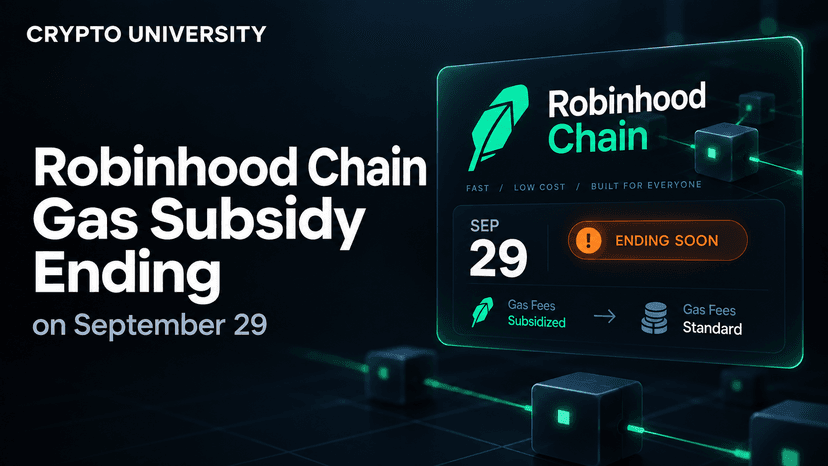
Robinhood’s 90-day gas subsidy for eligible Robinhood Wallet swaps on Robinhood Chain ends on September 29, 2026. After that date, users should expect to pay network fees in ETH for their own transactions.
The subsidy only ever covered the Robinhood Wallet. People using MetaMask, Rabby, or other third-party wallets on Robinhood Chain have been paying normal gas fees since launch.
Much of the chain’s early activity was recorded while gas was free. Analysts widely describe the end of the subsidy as the first real test of how much user demand is organic.
What Is Robinhood Chain?
Robinhood Chain is a blockchain network launched by the brokerage Robinhood. It went live on mainnet on July 1, 2026.
In simple terms, it is an Ethereum Layer 2. That means it processes transactions on its own network, then settles data back to Ethereum for security. It is built with Arbitrum Orbit, a toolkit that lets companies launch their own Arbitrum-based chains.
According to Robinhood’s developer documentation and partner guides, Robinhood Chain is designed for tokenized real-world assets such as stocks and ETFs, is fully compatible with Ethereum tools, and uses ETH as its native gas token. The chain does not have its own token.
Feature | Robinhood Chain |
|---|---|
Network type | Ethereum Layer 2 |
Technology stack | Arbitrum Orbit |
Mainnet launch | July 1, 2026 |
Gas token | ETH |
Native chain token | None |
Mainnet chain ID | 4663 |
Main stated use case | Tokenized stocks, ETFs, and other real-world assets |
What Was the Robinhood Chain Gas Subsidy?
When the mainnet launched, Robinhood started a 90-day gas subsidy. Under this promotion, Robinhood paid the network fees for eligible swaps made inside the Robinhood Wallet on Robinhood Chain.
This practice is often called gas sponsorship. The user signs the transaction, but a third party pays the gas. Companies use it to remove friction for new users who do not yet hold ETH.
How eligibility worked
Reports describe the subsidy in slightly different ways, so it is worth being precise:
It applied to Robinhood Wallet users only, not to third-party wallets.
It was tied to swaps that met a minimum threshold. That threshold was reported at $5 at launch.
In early August 2026, Robinhood announced on X that it had lowered the threshold from $5 to $0.50, so more swaps qualified. The offer was still set to end on September 29.
Robinhood has reportedly recorded the cost of the subsidy as a marketing expense, not as chain revenue.
In practice, most swaps in the Robinhood Wallet during this period cost users nothing in gas. Users should check the Robinhood Wallet app for the exact terms that applied to their own account.
What Changes After September 29?
The core change is simple: the free ride ends for Robinhood Wallet users. Transactions on the chain will require a network fee paid in ETH, the same way they already do for everyone using other wallets.
Area | During the subsidy (July 1 to September 29) | After September 29 |
|---|---|---|
Robinhood Wallet swaps | Eligible swaps had gas covered by Robinhood | Users expected to pay gas in ETH |
Third-party wallets (MetaMask, Rabby, others) | Users paid normal gas | No change, users still pay gas |
Need to hold ETH on the chain | Often not needed for eligible swaps | Needed to cover network fees |
Cost of frequent small trades | Close to zero in gas | Gas adds up with every transaction |
Tokenized stock access | Unchanged by the subsidy | Unchanged by the subsidy |
Application fees (DEX, launchpad, bots) | Still charged by the apps | Still charged by the apps |
Gas fees and app fees are different
This is a common point of confusion. The subsidy covered network gas. It did not remove fees charged by the applications themselves.
Crypto.news explained that the large revenue numbers reported for Robinhood Chain on data sites such as DefiLlama mostly came from application-layer fees, such as launchpad spreads, trading bot commissions, and decentralized exchange swap fees. Those fees exist with or without the subsidy.
Why the Subsidy Matters: The Numbers So Far
Robinhood Chain grew quickly in its first months. However, nearly all of these figures were recorded while gas was free for many users, which makes clean comparisons difficult.
Metric | Reported figure | Source and date |
|---|---|---|
Total DEX volume (first two months) | About $34.6 billion | Robinhood two-month update, September 2 |
Total transactions (first two months) | About 576 million | Robinhood two-month update, September 2 |
Total addresses (first two months) | About 12.3 million | Robinhood two-month update, September 2 |
Stock Tokens live | 190+ | Robinhood two-month update, September 2 |
Peak daily chain revenue | About $4.01 million | DefiLlama data, September 2 |
Daily chain revenue after the drop | About $1.06 million | Reported September 11 |
Value locked (TVL) | About $929 million | DefiLlama, September 17 |
30-day DEX volume | About $39.1 billion | DefiLlama, September 17 |
These are widely reported figures from third-party data dashboards and company updates. Data providers can measure revenue and volume in different ways, so treat them as estimates.
Most activity came from memecoins, not stocks
Robinhood built the chain for tokenized real-world assets. Yet multiple outlets reported that most of the fee-generating activity came from memecoin trading, especially through the launchpad Pons and the trading bot GMGN. Crypto.news estimated that tokenized stocks made up roughly 3 percent of DEX trading activity in its analysis.
This matters because memecoin traders often make many small, fast trades. That type of activity is the most sensitive to gas costs.
Gas prices already moved during the subsidy
PANews, citing The Defiant, reported that users paid about $4.45 million in gas fees on September 2. It said base fees had risen about 23 times over the prior 11 days as activity surged. This shows that Robinhood Chain gas is not always tiny. When demand spikes, fees can rise quickly, even on a Layer 2.
Who Is Most Affected?
Not every user will feel the change in the same way.
User type | Likely impact | Why |
|---|---|---|
Occasional Robinhood Wallet user | Low to moderate | A few transactions per month means limited total gas cost |
High-frequency memecoin trader | High | Many small trades multiply gas costs |
Users of automated trading bots | High | Bots can submit large numbers of transactions |
MetaMask or Rabby users | Little to none | They were already paying gas |
Long-term holder who rarely moves assets | Low | Gas is only paid when you transact |
Developers building apps on the chain | Varies | Apps can choose to sponsor gas for their own users |
What developers can still do
The end of Robinhood’s promotion does not mean gasless apps disappear entirely. Robinhood’s documentation says the chain supports account abstraction standards ERC-4337 and EIP-7702, with tools from providers such as Alchemy and ZeroDev that let apps sponsor gas for their users. Some swap tools also offer modes where a third party covers on-chain gas. For example, 1inch says its Fusion mode uses resolvers who pay the gas for the swap.
Whether individual apps choose to pay gas for users is a business decision for each app.
How to Prepare: A Practical Checklist
This section is educational and is not financial advice. It explains general steps that help users avoid failed or surprise transactions.
Step 1: Check whether you hold ETH on Robinhood Chain
After the subsidy ends, a transaction can fail if your wallet has no ETH on Robinhood Chain to pay gas. ETH on Ethereum mainnet or another network does not count. It must be on Robinhood Chain itself.
Step 2: Understand what bridging costs
If you move ETH onto Robinhood Chain from another network, the bridge transaction has its own fees. Use official or well-known bridges and double-check the destination network before confirming.
Step 3: Review the fee before every confirmation
Your wallet shows an estimated network fee before you sign. Get into the habit of reading it, especially during busy periods when base fees can rise.
Step 4: Remember that approvals cost gas too
Many first-time swaps require a token approval, which is a separate transaction. That means some actions involve two gas payments, not one.
Step 5: Watch out for scams
Deadlines attract scammers. Be cautious of messages promising a “subsidy extension,” free gas claims, or airdrops tied to the change. Robinhood announcements should be verified through Robinhood’s official website, app, or verified social accounts. Never share your recovery phrase.
What to Watch After the Deadline
Several analysts, including Datawallet, have pointed out that October data will be the first view of Robinhood Chain without the promotion. Useful indicators include:
Daily transactions and active addresses compared with September levels
DEX volume and value locked on public dashboards like DefiLlama
Average gas fees paid per transaction
Share of activity from tokenized stocks versus memecoins
Robinhood’s third-quarter earnings, expected in late October, which should be the first report covering a full quarter of mainnet activity
None of these outcomes can be predicted with confidence. A drop in activity would not automatically mean failure, and steady activity would not automatically mean long-term success. The data simply becomes easier to compare with other networks, such as Base, where users have always paid their own gas.
FAQ
When does the Robinhood Chain gas subsidy end?
The 90-day subsidy began with the mainnet launch on July 1, 2026, and is scheduled to end on September 29, 2026, based on Robinhood’s announcements and widely reported coverage.
Did the subsidy apply to MetaMask and other wallets?
No. The subsidy applied only to eligible swaps made in the Robinhood Wallet. Users of MetaMask, Rabby, and other third-party wallets already paid normal gas fees.
What token do I need to pay gas on Robinhood Chain?
You need ETH on Robinhood Chain. The network uses ETH as its gas token and does not have a separate chain token.
Will app fees also start after September 29?
App fees were never removed. Decentralized exchanges, launchpads, and trading bots charge their own fees regardless of the gas subsidy.
Can apps on Robinhood Chain still offer gasless transactions?
Yes, they can. The chain supports account abstraction tools that let developers sponsor gas for their users. Whether a specific app does so depends on that app.
Related Terms
Gas Fee: A gas fee is the cost paid to a blockchain network to process and record a transaction.
Layer 2: A Layer 2 is a network built on top of a base blockchain like Ethereum that processes transactions more cheaply while relying on the base chain for security.
Gas Sponsorship: Gas sponsorship is an arrangement where an app, wallet, or company pays network fees on behalf of the user.
Account Abstraction: Account abstraction lets crypto wallets work like programmable smart contracts, enabling features such as batched transactions and sponsored gas.
Tokenized Stocks: Tokenized stocks are blockchain tokens designed to track the price of traditional company shares.
Sources
Crypto.news, “Robinhood Chain flips Solana in revenue as gas subsidy ends,” September 2026. https://crypto.news/robinhood-chain-flipped-solana-revenue-gas-subsidy-expires/
KuCoin News (citing Odaily), “Robinhood lowers the gas fee subsidy threshold to $0.5 on Robinhood Chain,” August 8, 2026. https://www.kucoin.com/news/flash/robinhood-lowers-gas-fee-subsidy-threshold-to-0-5-on-robinhood-chain
KuCoin News, “Robinhood Chain Revenue Drops 83% Despite Record Trading Volume,” September 2026. https://www.kucoin.com/news/flash/robinhood-chain-revenue-drops-83-despite-record-trading-volume
PANews (citing The Defiant), “Robinhood Chain single-day gas fees surge, up 82x in 11 days,” September 4, 2026. https://panews.io/articles/01a069f1-4d2a-7101-931c-f031c4a00838
51 Insights, “Robinhood built a bigger business that makes less money,” September 2026. https://51insights.substack.com/p/robinhoods-chain-346b-traded-about
Datawallet, “Robinhood Chain Statistics and Trends for 2026.” https://www.datawallet.com/crypto/robinhood-chain-statistics
CryptoTicker, “Robinhood Chain: Free Gas Ends, Stress Test for Memecoins,” September 17, 2026. https://cryptoticker.io/en/robinhood-chain-gas-subsidy-ends-memecoins/
Robinhood Chain Docs, “Account Abstraction.” https://docs.robinhood.com/chain/account-abstraction
1inch Help Center, “How to use 1inch on Robinhood Chain.” https://help.1inch.com/en/articles/15781744-how-to-use-1inch-on-robinhood-chain
Disclaimer: This article is for educational purposes only and is not financial, legal, or investment advice. Bridge routes, supported assets, and availability can change. Always verify details on official sources before moving funds.
More Reading
Best Robinhood Chain Trading Platforms in 2026: FOMO, GMGN, Uniswap and OpenSea Compared
MiCA Explained: What the End of the EU Crypto Transition Period Means
How to Verify a Stablecoin's Reserves Yourself (Before the Rules Change)
Is Robinhood Chain Safe? Custody, Sequencer Risk, and Ethereum Settlement
How to Buy Robinhood Tokenized Stock: HOOD Tokens and Available Platforms