Key Takeaways
Tokenized stocks are not one product. They come in at least four forms, certificates, secured notes, broker-issued tokens and app-based derivatives, and each one carries different rights, risks and protections.
You are never the legal shareholder. You get the price exposure of the stock, but not voting rights, and there is always at least one extra company standing between you and the real share.
Where you live usually decides it. If you have a cheap, reliable broker and no need for crypto features, traditional shares are the safer default. If brokerage access is hard, tokenized stocks can be the practical way in.
Tokenized or traditional? First, know what you are comparing
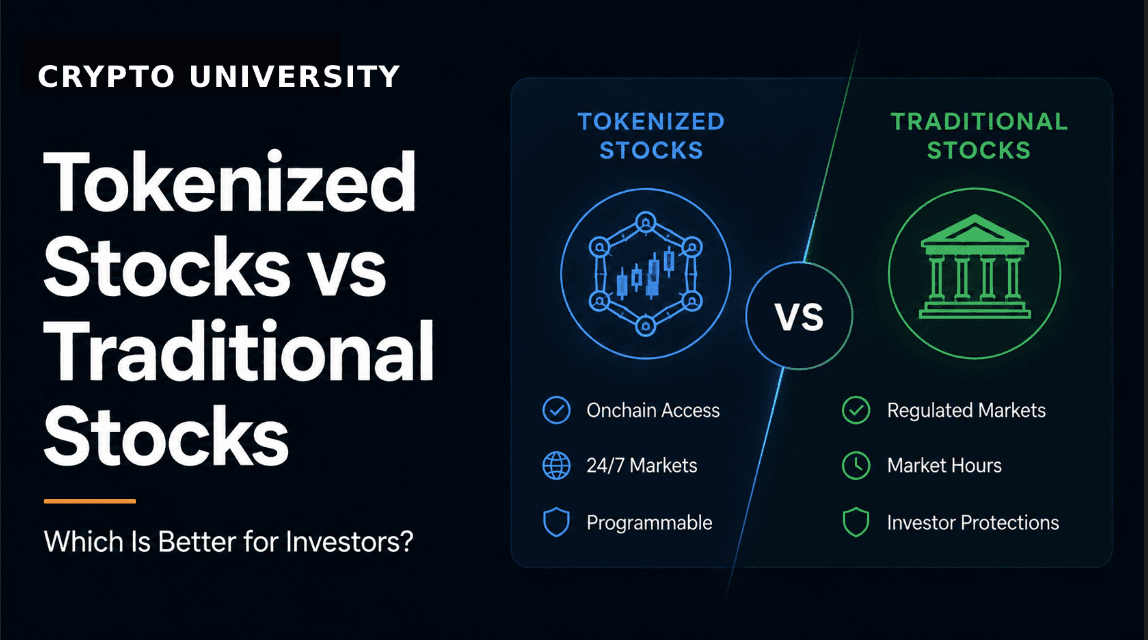
People often ask whether they should buy tokenized stocks or traditional stocks, as if tokenized stocks were a single thing. They are not. There are at least four different types, and each one works quite differently.
Those four types are:
Collateralised certificates, for example xStocks.
Secured notes, for example Ondo.
Broker-issued tokenized shares, for example Dinari dShares.
App-issued derivatives, for example Robinhood's EU tokens.
Some of them behave almost like a crypto asset. Others behave almost like a normal brokerage share. So comparing tokenized stocks to real shares without saying which type you mean is how people end up talking past each other.
Let us do it properly. First we will look at what all tokenized stocks have in common, then compare the different types side by side.
What all tokenized stocks have in common
Compared with a normal brokerage share, every tokenized version gives you some mix of helpful features: longer or round-the-clock trading hours, near-instant settlement, very small minimum amounts, the ability to fund with stablecoins, and, for the on-chain versions, the option to hold the asset in your own wallet and use it in DeFi.
They also share the same big limitation. You are not the official shareholder. None of the mainstream tokenized products currently give you voting rights, and every one adds at least one extra company between you and the real business whose stock you are tracking.
There is one more thing they have in common. None of the major tokenized products are available to everyday investors in the United States right now. Meanwhile, traditional brokerage accounts are easy for Americans to open, and hardest to open for exactly the emerging-market investors that tokenization is trying to help. That mismatch drives most of the sensible decisions between the two.
The four structures, compared
This table lines up a normal brokerage share against the four tokenized types so you can see exactly where they differ.
What to look at | Brokerage share | xStocks (certificate) | Ondo GM (secured note) | Dinari dShares | Robinhood EU tokens |
|---|---|---|---|---|---|
What you actually hold | The share itself, in street name | A debt claim, backed 1:1 by collateral | A note secured by shares held at US broker-dealers | A tokenized share, backed 1:1 on broker-dealer rails | A derivative contract with Robinhood's EU entity |
Are real shares held? | Yes, you own them | Yes | Yes | Yes | Hedged at firm level; the instrument itself is a contract |
Dividends | Paid in cash | Reflected as a balance rebase | Reflected in the token, after withholding | Preserved in the usual way | Passed through in the app |
Voting rights | Yes | No | No | No | No |
Self-custody | No | Yes, e.g. on Solana | Yes, e.g. on Ethereum | Chain-dependent, via partners | Evolving via Robinhood Chain |
DeFi use | No | Yes | Yes, where supported | Limited | Not currently |
Regulatory anchor | Domestic brokerage rules | EU prospectus plus Jersey SPV | Offshore notes on a US custody chain | US broker-dealer registration | EU MiFID firm |
Who can buy | Depends on country, easiest in the US | Non-US, excluding UK, Canada, Australia | Non-US | Through partners, EU via Gemini | 30 EU and EEA countries; newer product in 120+ countries |
The pattern in plain English: Dinari sits closest to a traditional security, Robinhood's tokens feel closest to a familiar app with the least crypto flavour, and xStocks and Ondo sit in the crypto-native middle where self-custody and DeFi access are strongest.
Where traditional stocks are simply better
It helps to be clear-eyed about this side. A normal brokerage share still wins in several important ways.
Strength | Why it matters |
|---|---|
Legal directness | You own the share itself, with no issuer sitting in between you and the asset. |
Investor protection | Long-established rules, insurance schemes and decades of legal precedent stand behind you. |
Liquidity | The real stock market is far deeper than any token venue, so buying and selling is easier. |
Corporate rights | You get voting rights, class-action rights and proper company records. |
Admin maturity | Tax, inheritance and account recovery are all well understood and handled smoothly. |
If you live in the US or Western Europe, you can open a low-cost broker, and you do not specifically need self-custody or 24/7 trading, then a normal brokerage account is still the boring, correct choice for your main stock holdings.
Where tokenized stocks are better
Strength | What it means for you |
|---|---|
Access where brokers fail | If your country is rejected by brokers, or you face currency controls, tokenized stocks let you get US stock exposure through crypto rails from just a few dollars. |
Custody you control | Only tokenized products let you hold stock exposure in your own wallet, move it in minutes, and stay outside any single platform's problems. |
Trading hours and DeFi | Continuous trading, instant settlement, and, for on-chain versions, the option to use your holdings as DeFi collateral. |
For someone funding through M-Pesa or peer-to-peer USDT, the real comparison is not token versus share. It is token versus nothing, or token versus a slow, expensive offshore account. Just remember that these features come with their own risks.
The risk comparison people skip
Market risk is the same on both sides. If Tesla drops 20 percent, it drops 20 percent for everyone. The differences sit on top of that basic risk.
Type of risk | Traditional share | Tokenized stock |
|---|---|---|
Market risk (the stock price) | Same | Same |
Issuer risk | None extra | Added |
Liquidity | Deep and easy | Thinner |
Tracking drift (premiums and discounts) | Minimal | Possible |
Smart-contract and platform risk | None | Added |
Legal recovery if things go wrong | Well tested | Less tested |
Single point of failure | The broker, but regulated and insured | The issuer and the platform |
Tokenized products give you more flexibility but also more layers of risk. Anyone telling you they are completely safe, or completely reckless, is selling you an oversimplification.
So which one is better for you?
There is no single winner. The better question is which one fits your situation. Use this simple guide.
Your situation | What to do |
|---|---|
You are a US person | Tokenized retail products are not open to you today, so use a broker. Some, like Kraken Securities, offer ordinary stocks. Keep an eye on the SEC's exemption work. |
You have a good, cheap broker and no crypto-specific needs | Use a brokerage for your core holdings. Add tokenized only for the hours, custody or DeFi features you will actually use. |
Broker access is poor but crypto rails are good | Tokenized stocks are the practical route. Pick the type on purpose: certificates or notes for self-custody and DeFi, dShares through partners for the most traditional protections, or app derivatives for simplicity if you are in the EU. |
Whichever you pick | Size your position to the structure's risk, not just the stock's. |
Frequently Asked Questions
Is a tokenized stock the same as owning shares?
No, not in any current mainstream structure. You hold a certificate, a note, a tokenized-share claim or a derivative. The money side, meaning your exposure to the price, is the same by design. The legal ownership and rights are not.
Which tokenized stock structure is safest?
It depends on what you are worried about. For regulatory directness, Dinari's broker-dealer rails lead. For verifiable collateral plus self-custody, xStocks or Ondo. For simple app-based investing under EU conduct rules, Robinhood's tokens. All of them still rank below a domestic brokerage account on legal protection.
Are tokenized stocks good for long-term investing?
They can hold long-term exposure, but issuer and platform risks build up over time in a way that owning real shares does not. Many people treat tokenized positions as a smaller, satellite holding rather than the core of a retirement portfolio.
Do tokenized stocks cost more than brokers?
Sometimes less, thanks to no account fees, one-dollar minimums and cheap stablecoin funding. Sometimes more, thanks to wider spreads, thin order books and network fees. For small international investors, tokenized is often cheaper overall. For large domestic investors, brokers usually win.
Can I switch from tokenized exposure to real shares later?
In practice you sell the tokens and buy the shares through a broker. Direct token-to-share conversion is not a everyday retail feature yet.
Disclaimer: This content is for educational and informational purposes only and is not financial advice. Nothing here is a recommendation to buy or sell any asset or use any platform. Do your own research and manage your risk.
Explore the Crypto University Tokenized Stocks Directory.
Tokenized Stocks Explained: A Simple Guide for Beginner Traders
How to Buy Tokenized Stocks: A Step by Step Guide for Beginners
Best Platforms for Tokenized Stocks: Exchanges, Brokers and Onchain Apps
Need deeper training?
Join our structured modules with live examples and expert checklists for effective implementation.
JOIN THE ACADEMY