Key Takeaways
July 2026 is an unusually dense regulatory month. The MiCA transition period in the European Union closed on 1 July, California’s licensing regime started the same day, Japan’s parliament passed a law reclassifying crypto assets on 15 July, and United States regulators faced a statutory deadline of 18 July to finalise stablecoin rules under the GENIUS Act.
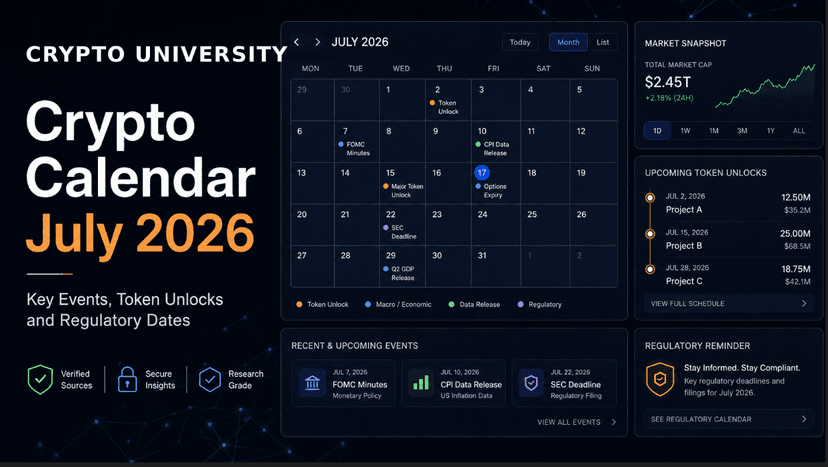
Token unlocks are scheduled supply events, not predictions. Roughly 145 projects had unlocks scheduled in July 2026, with aggregate estimates commonly reported near 376 million US dollars for the month. Estimates differ widely between data providers because they use different methods.
A crypto calendar is a research tool, not a trading signal. Its value is in helping you know what is coming, read primary sources, and avoid being surprised. It does not tell you what any asset will do.
What a Crypto Calendar Actually Is
A crypto calendar is a dated list of scheduled or expected events that can affect how crypto markets, products and companies operate. Good calendars track things that are already on the public record: legal deadlines written into statutes, vesting schedules written into smart contracts, central bank meeting dates published a year in advance, and conference dates announced by organisers.
That last point is the important one for beginners. A calendar is useful precisely because it deals in known dates, not guesses. If an entry cannot be traced back to a law, a contract, an official schedule or an organiser announcement, it belongs in the speculation pile rather than the calendar.
The Four Categories Worth Tracking
Most useful crypto calendars sort entries into four buckets. Learning the categories is more valuable than memorising any single month.
Category | What it covers | Where the date comes from |
|---|---|---|
Regulatory and legal | Licensing deadlines, rulemaking cutoffs, court dates, legislative votes | Statutes, regulator notices, parliamentary schedules |
Token unlocks | Previously locked tokens becoming transferable | Vesting schedules, often enforced on-chain |
Macroeconomic | Central bank decisions, inflation and jobs data | Published central bank and statistics agency calendars |
Network and industry | Protocol upgrades, conferences, product launches | Developer roadmaps, organiser announcements |
Regulatory Dates in July 2026
July 2026 saw several long-scheduled compliance deadlines land in the same few weeks.
Date | Jurisdiction | Event |
|---|---|---|
1 July 2026 | European Union | End of the MiCA transitional period. Crypto-asset service providers without full authorisation from a national regulator can no longer serve EU clients. |
1 July 2026 | California, United States | The Digital Financial Assets Law took effect, requiring a state licence to do crypto business with California residents. |
14 July 2026 | South Korea | Policymakers announced plans for a National Asset Basic Act that would treat virtual assets as a recognised national asset class. |
15 July 2026 | Japan | The National Diet passed an amendment moving crypto assets from the Payment Services Act into the Financial Instruments and Exchange Act. |
18 July 2026 | United States | Statutory one-year deadline for federal regulators to finalise rules implementing the GENIUS Act stablecoin framework. |
Before the August recess | United States | Window for a Senate floor vote on the CLARITY Act, the market structure bill that would divide oversight between the SEC and the CFTC. |
MiCA. The Markets in Crypto-Assets Regulation applied from 2024, but member states were allowed to let existing firms keep operating under national rules for a transition period. Reporting before the deadline suggested that a large share of previously registered national entities had not obtained full MiCA authorisation, which is why the date was widely described as a consolidation moment for European exchanges and custodians.
Japan. The 15 July law reclassifies Bitcoin and roughly one hundred other crypto assets as financial instruments, introducing insider trading rules and disclosure obligations. Two points are often blurred in coverage. The reclassification is targeted to take effect in fiscal 2027, and the separate proposal for a flat tax rate near 20 percent sits in a tax reform outline projected for 2028. Passage is not the same as entry into force.
The GENIUS Act. The United States stablecoin law was enacted in July 2025 and gave regulators one year to publish final rules. The statute says the framework takes effect on the earlier of 120 days after final rules or 18 January 2027. In other words, the July rulemaking deadline changes when compliance starts, not whether it starts.
The CLARITY Act. The bill passed the House in 2025 and cleared the Senate Banking Committee in May 2026. As of mid-July it had not received a full Senate floor vote. Legislative timing is genuinely uncertain, so treat any calendar entry for it as a window rather than a fixed date.
Token Unlocks in July 2026
A token unlock happens when tokens allocated to a team, early investor, treasury or ecosystem fund pass their vesting date and become transferable. Unlocks are written into the token’s design in advance, which is why they can be calendared months ahead.
Aggregate estimates for July 2026 sat around 376 million US dollars across roughly 145 projects, a figure attributed to unlock tracker Tokenomist and repeated across crypto media. Some outlets reported far higher weekly totals. The gap is usually a methodology difference: some counts include only cliff unlocks, others add continuous daily vesting, and all of them move with token prices.
Notable individual events reported for the month included the following.
Approximate date | Token | What was scheduled |
|---|---|---|
Early July | RedStone (RED) | Allocation split across early backers, contributors, ecosystem and protocol development |
12 July | Aptos (APT) | Around 11.3 million APT, a small share of circulating supply |
Second week | Pump.fun (PUMP) | The month’s largest single unlock, widely reported at roughly 82.5 billion tokens |
15 July | Connex (CONX) | Ecosystem and community treasury allocations |
16 July | Arbitrum (ARB) | Recurring monthly release to team and investors |
17 July | deBridge (DBR) | Cliff unlock to ecosystem and core contributors |
Across the month | STRK, ZK, SEI, EIGEN, ZRO, HYPE and others | Scheduled linear or cliff releases |
How to read unlock data without overreacting
Check the percentage, not the dollar figure. An unlock worth 100 million dollars on a 50 billion dollar token is minor. An unlock worth 10 million dollars on a 60 million dollar token is not.
Distinguish cliff from linear. A cliff releases a block at once. Linear vesting drips daily and is usually already reflected in market expectations.
Look at who receives the tokens. Treasury and ecosystem allocations often stay unsold for long periods. Investor allocations behave differently.
Remember the market already sees the schedule. Unlocks are public information, so the idea that any given date guarantees a price move does not hold up.
Macroeconomic Dates in July 2026
Crypto markets remain sensitive to United States monetary policy, so the Federal Reserve calendar shows up on almost every crypto calendar.
Date | Event |
|---|---|
8 July 2026 | Minutes of the June FOMC meeting released |
14 July 2026 | Consumer Price Index report for June |
15 July 2026 | Federal Reserve Beige Book |
28 to 29 July 2026 | FOMC meeting, with the rate decision announced at 2:00 pm Eastern on the second day |
Going into the July meeting, the federal funds target range stood at 3.50 to 3.75 percent, unchanged since December 2025. No Summary of Economic Projections is published at the July meeting, since those accompany the March, June, September and December meetings.
Network Upgrades and Industry Events
Date | Event |
|---|---|
20 to 24 July 2026 | Canada Crypto Week, Toronto |
21 to 22 July 2026 | Blockchain Futurist Conference, Toronto |
22 July 2026 | ETHToronto |
23 to 24 July 2026 | Wiki Finance Expo, Hong Kong |
27 to 29 July 2026 | Science of Blockchain Conference, Stanford |
On the protocol side, Ethereum’s Glamsterdam upgrade did not ship in July. The Ethereum Foundation confirmed it now targets the third quarter of 2026 after originally aiming for June, and set a post-upgrade gas limit target of 200 million, up from roughly 60 million. Glamsterdam’s headline changes are enshrined proposer-builder separation and block-level access lists. Hard fork dates routinely slip because client testing takes priority over schedules, so treat all upgrade dates as provisional until a specific block or epoch is announced.
How to Build Your Own Crypto Calendar
Pick your primary sources. Central bank calendars, regulator websites, official project blogs and developer call notes.
Add unlock tracking. Public unlock dashboards cover most large tokens. Cross-check at least two.
Separate confirmed from expected. Mark legislative votes, court dates and hard forks as provisional.
Record the source link next to every entry. This is what makes a calendar auditable later.
Review weekly, not hourly. Most calendar entries are known weeks in advance and do not need constant monitoring.
Common Mistakes to Avoid
Treating a passed law as an active law. Entry into force is a separate date.
Copying unlock figures from social media without checking the percentage of supply.
Assuming a deadline creates a deadline effect. Many compliance dates pass quietly.
Ignoring time zones. A 2:00 pm Eastern Fed announcement is early morning in most of Asia.
Frequently Asked Questions
What is a crypto calendar used for? It is a research and planning tool. It helps you see which regulatory deadlines, token unlocks, macro releases and protocol upgrades are scheduled, so you can read the underlying documents in advance rather than reacting to headlines.
What was the biggest crypto regulatory date in July 2026? Two stand out. The MiCA transition period ended on 1 July across the European Union, and Japan’s parliament passed its Financial Instruments and Exchange Act amendment on 15 July. The 18 July GENIUS Act rulemaking deadline in the United States was also significant for stablecoin issuers.
Do token unlocks always push prices down? No. Unlock schedules are public, sizes vary enormously relative to circulating supply, and recipients do not necessarily sell. Some unlocks pass with no visible effect. This article does not make price predictions.
Where can I check token unlock dates myself? Unlock trackers such as Tokenomist publish schedules, and most projects document vesting in their own tokenomics pages or documentation. Cross-checking more than one source is sensible because reported totals differ by methodology.
Did the MiCA deadline get extended? Public guidance from EU regulators before the date described 1 July 2026 as a hard cutoff with no further grandfathering. Individual member states had already shortened their own transition windows in some cases.
When is the next Federal Reserve decision after July 2026? The FOMC holds eight scheduled meetings a year. The July meeting ran on 28 and 29 July 2026, and the Federal Reserve publishes the full calendar, including the following year on a tentative basis, on its website.
Is Ethereum’s Glamsterdam upgrade happening in 2026? It is targeted for the second half of 2026, with the Ethereum Foundation pointing to the third quarter after an earlier June target slipped. Upgrade timing depends on testnet results and is not fixed until developers announce a mainnet activation point.
Disclaimer: This content is for educational and informational purposes only and is not financial advice. Nothing here is a recommendation to buy or sell any asset or use any platform. Do your own research and manage your risk.
Top 5 Charting Tools and Platforms for Crypto Beginners
Top 5 Crypto Portfolio Trackers and Management Tools
Top 5 Paper Trading Platforms to Practice Crypto Trading Risk-Free
How to Cash Out Crypto in Dubai in 2026
How to Get Started on Robinhood Chain: A Complete Beginner's Guide