Key Takeaways
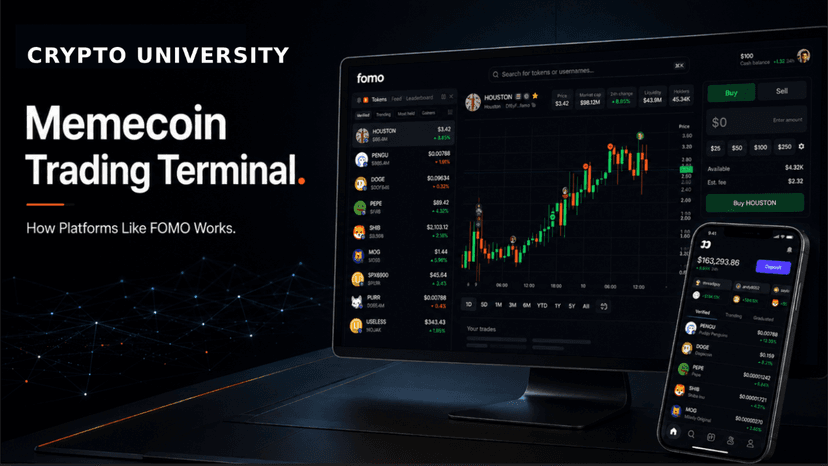
1. A memecoin trading terminal is a fast, all-in-one dashboard or app for finding and swapping newly launched tokens directly on the blockchain, rather than on a mainstream exchange like Coinbase.
2. Platforms differ in three ways that matter most: which blockchains they support, whether they hold your keys (custody), and how much control you get over routing, fees, and slippage. FOMO's angle is a USDC balance, sponsored gas, and a social copy-trading feed.
3. These tools lower the friction of trading but not the risk. Speed, leaderboard profit displays, custody trade-offs, and built-in referral incentives all deserve scrutiny before you use any of them.
If you have spent any time around memecoins, you have probably seen screenshots of fast-moving trading dashboards with token feeds, charts, and one-click buy buttons. These are called trading terminals, and a wave of consumer apps, including FOMO, has made them easier to use than ever. This guide explains what a memecoin trading terminal is, how these platforms actually work, how FOMO fits into the landscape, and the risks to understand first. It is written to inform, not to promote any platform or trading style.
What Is a Memecoin Trading Terminal?
A memecoin trading terminal is a tool that lets you discover and swap newly launched tokens directly on a blockchain, from a single interface. Instead of visiting a decentralised exchange, copying addresses by hand, and managing fees yourself, a terminal bundles discovery, charts, execution, and portfolio tracking together and optimises for speed.
Terminals exist because most memecoins never reach a large, regulated exchange. New tokens first trade only on decentralised exchanges, so anyone who wants to trade them early has to interact with the blockchain directly. Terminals are the layer that makes that faster and less technical.
Why People Use Terminals Instead of Coinbase or Binance
Mainstream exchanges list a limited, vetted set of assets and add new ones slowly. Most brand-new memecoins do not meet their criteria, or arrive long after the early price action. Terminals trade whatever exists on-chain, within seconds of a token appearing. That access is the entire appeal, and also the source of most of the risk, because "whatever exists on-chain" includes a very high share of scams and failures.
How a Trading Terminal Works
Under the surface, a terminal is a friendly front-end for on-chain swaps. A few core concepts appear in almost every one, and they are worth knowing even if you never trade.
Concept | What it means in a terminal |
|---|---|
Contract address (CA) | The unique on-chain ID of a token. You paste it in to load the correct token, because names are not unique and scammers clone them. |
Routing | The terminal sends your order through decentralised exchanges and aggregators (such as Raydium or Jupiter on Solana) to fill it. |
Gas fee | A network fee for each transaction. Some apps sponsor or bundle this so you do not hold the chain's native token. |
Slippage | The gap between the price you expect and the price you get. It grows on low-liquidity tokens and fast markets. |
Copy trading / leaderboard | Feeds that show or mirror other users' trades. Useful for signal, but they highlight winners more than losers. |
Knowing these five terms lets you read almost any terminal, whether it is a mobile app or a browser dashboard.
The Two Main Designs
Terminals generally fall into two camps. Browser terminals (such as Axiom, Photon, and GMGN) run as web dashboards with rich charts and discovery tools. Telegram bots (such as Trojan and BullX) run inside a chat app and are built for sniping launches within seconds. The key difference is custody: many bots hold a signing key on your behalf so they can trade instantly, which is convenient but means the tool controls your funds. Newer consumer apps like FOMO aim for a middle path, with an app-like experience and self-custody.
Where FOMO Fits In
FOMO is a social-first, mobile and web trading app launched in May 2025 by Paul Erlanger and Se Yong Park. It is one of several recent platforms trying to make on-chain trading feel like a mainstream consumer app rather than a technical tool. It has drawn notable venture backing, including a reported $75 million funding round in 2026 led by well-known crypto and tech investors, and reported more than 120,000 users in its first six months.
Its design choices explain why people talk about it. Several are genuinely user-friendly, and each has a trade-off worth understanding.
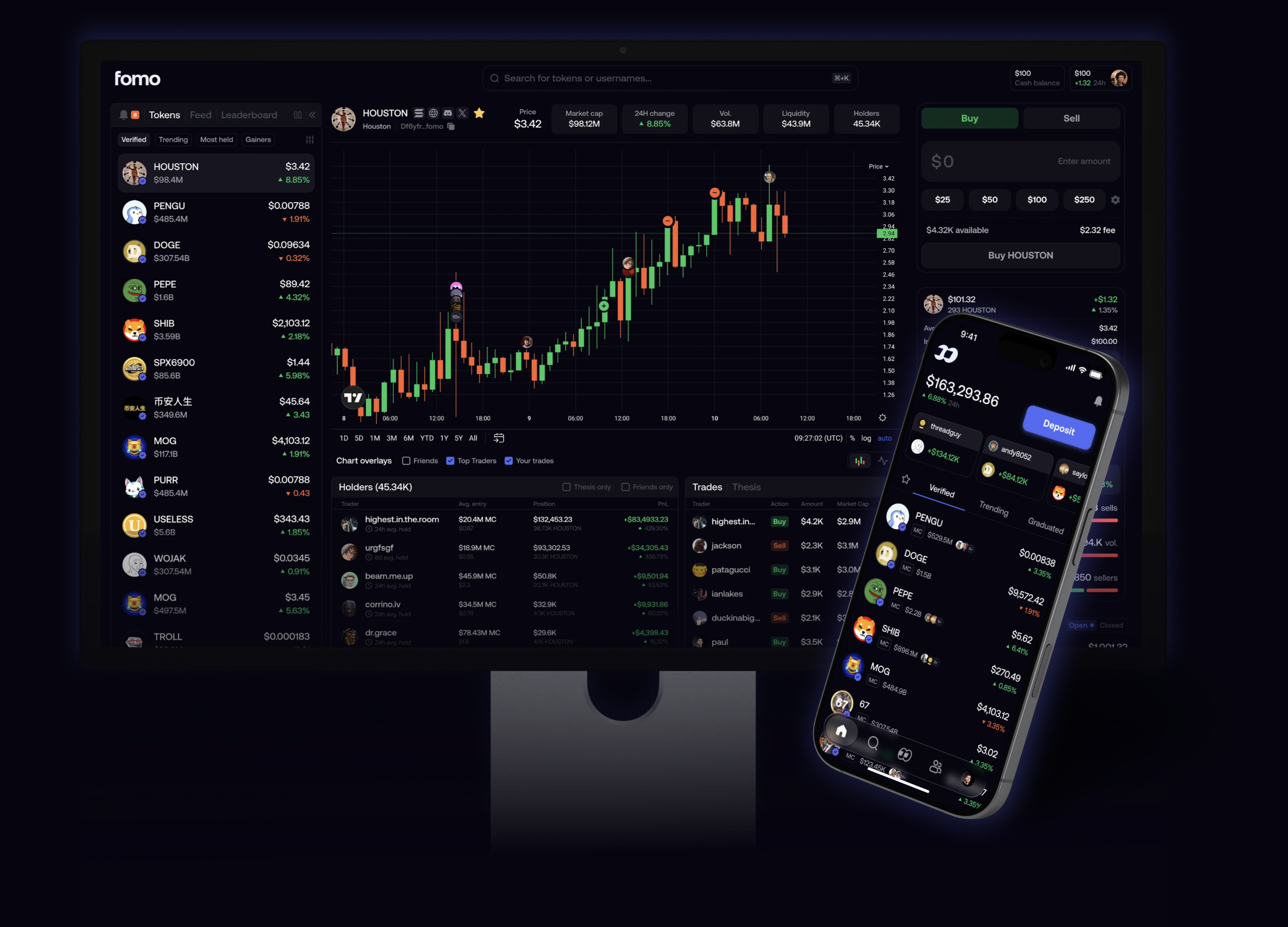
USDC as your balance. You hold and think in dollars rather than juggling SOL or ETH. This does not remove stablecoin, depeg, or smart-contract risk, and it does not remove costs created during routing.
Sponsored gas and no bridging. FOMO absorbs or bundles network fees and lets you trade across chains from one balance. The cost is shifted into the platform's model, not erased, and you get less granular control over routing and slippage than a direct exchange would give.
Self-custody. FOMO is noncustodial, using embedded wallets so users keep control of their keys. That is a meaningful contrast with custodial Telegram bots.
A social, copy-trading feed. FOMO makes real trades publicly visible and lets you follow or mirror other users. Its own pitch is that verified on-chain trades are harder to fake than influencer screenshots. That is fair, but choosing who to copy is still exposed to survivorship bias, and copying a trade does not copy the risk the other person can absorb.
Easy funding and referrals. Funding works via Apple Pay, card, or crypto deposit, with a reported flat transaction fee, and a referral program pays users a share of the fees generated by people they invite. That referral incentive is exactly why so many "how to use FOMO" videos exist, and why they are not neutral sources.
How FOMO Compares to Other Terminals
No terminal is "best" in the abstract. The right lens is what each one optimises for. The table below compares widely used platforms on the factors that actually differ. Details change often, so treat this as a snapshot.
Platform | Type | Chains | Custody | Known for |
|---|---|---|---|---|
Mobile + web app | Multi-chain | Self-custody | USDC balance, sponsored gas, social copy feed. | |
Axiom | Browser terminal | Solana focus | Embedded wallet | Fast execution and token discovery tools. |
Photon | Browser terminal | Solana only | Connected wallet | Speed and real-time charts for launches. |
BullX | Web + Telegram | Multi-chain | Bot key | Launch categorisation and multi-chain reach. |
Trojan | Telegram bot | Solana | Bot key | Fast sniping from within a chat app. |
GMGN | Browser terminal | Multi-chain | Mixed | Discovery and copy-trading features. |
"Bot key" means the tool holds a signing key that can move your funds; treat that as custodial risk.
Join Internet Capital Markets Telegram community
Features to Weigh Before Using Any Terminal
Whichever platform you look at, the same handful of questions tell you most of what you need to know.
Custody: does the tool hold a key that can move your funds, or do you keep control?
Fees: what is the transaction fee, and are network fees included or added on top?
Routing and slippage: how much control do you have, and what happens on a thin market?
Chains: does it cover the networks you care about without manual bridging?
Transparency: are fees, risks, and referral incentives clearly disclosed?
Risks Specific to Trading Terminals
Terminals reduce friction, and less friction can mean faster mistakes. These are the risks that come from the tools themselves, on top of the well-documented risks of memecoins as an asset, where widely cited research suggests roughly 97% of tokens have failed.
Risk | Why terminals make it easy to overlook |
|---|---|
Custodial key risk | Bots that hold your signing key can be compromised or fail, taking funds with them. |
Survivorship bias | Leaderboards and copy feeds show winners prominently; the larger group who lost is not surfaced. |
Referral incentives | Many guides earn a cut when you sign up, which can shape the advice you are given. |
Speed-driven errors | One-click buying and launch sniping make impulsive, oversized trades effortless. |
Exposure to scam tokens | Terminals list anything on-chain, including honeypots and rug pulls, with no vetting. |
Hidden cost shifting | Sponsored gas and simplified routing can obscure the true cost of a trade. |
Disclaimer: Crypto University does not give financial advice and does not suggest that anyone should trade memecoins. If you explore these tools to learn, verify contract addresses from official sources, understand the custody model, assume you can lose everything you put in, and treat any profit-focused "guide" with a referral link as marketing rather than education.
FAQ
Is a trading terminal the same as an exchange?
Not quite. A centralised exchange like Coinbase holds your funds and lists a vetted set of assets. A terminal is usually a front-end for trading directly on the blockchain, giving access to far more tokens with far less vetting.
Is FOMO safe to use?
FOMO is a venture-backed, noncustodial app, which reduces some risks compared with custodial bots. But no tool makes the underlying memecoins safe. The main risk is what you trade, not only where you trade it.
What does noncustodial mean?
It means you control the private keys to your wallet, rather than the platform holding them. If a platform is custodial, it can move your funds, which is convenient but adds a point of failure.
Why is USDC used as the balance?
Holding a stablecoin lets you think in dollar terms and avoids needing the native token of each chain just to transact. It does not remove market risk or stablecoin-specific risks.
Do I need a terminal to buy memecoins?
For very new tokens, usually yes, because they only trade on-chain at first. Established memecoins are often available on mainstream exchanges, which are simpler for beginners.
5 Related Terms to Know
Trading terminal: An all-in-one interface for discovering and swapping on-chain tokens quickly, often with charts and portfolio tools.
Custody: Who holds the private keys to your funds. Self-custody means you do; custodial means the platform or bot does.
Routing: How a terminal sends your order through decentralised exchanges and aggregators to complete the trade.
Slippage: The difference between the expected and actual trade price, usually larger on low-liquidity tokens.
Copy trading: Automatically mirroring another user's trades, subject to survivorship bias in who appears worth copying.
Sources
Details in this article are drawn from the following public sources. Platform features, fees, and funding figures change quickly and should be treated as reported at the time of writing.
FOMO Labs, via QuickNode Builders Guide and fomo.family - product description, multi-chain and USDC-denominated design.
Wikipedia, "Fomo (platform)" - founders, launch date, funding rounds, and reported user and volume figures.
Insights4VC (2026) - analysis of FOMO's noncustodial model, gas sponsorship, USDC balance, and routing trade-offs.
Bankless (Oct 2025) - overview of FOMO's social and copy-trading approach.
Coin Bureau and Pump Parade (2026) - reviews of Axiom, Photon, and BullX terminals and their custody and chain differences.
Sacra and Definitive (2025-2026) - how terminals route orders through decentralised exchanges and aggregators.
CoinLaw / Chainalysis and CoinGecko (2026) - context on memecoin failure and rug-pull rates.
The Companies Behind Tokenized Stocks: xStocks, Ondo, Dinari, Robinhood and More
Best Crypto Off-Ramps in the UAE: OKX, BitOasis and Fasset Compared