What Role Do AI Tools Play in Crypto Research?
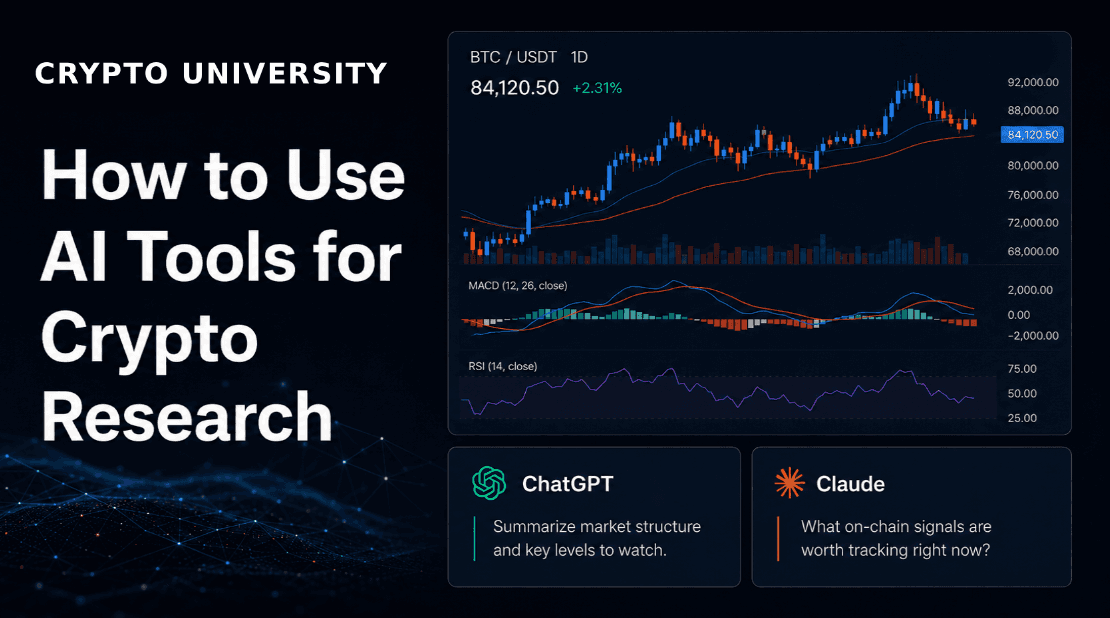
In 2026, large language models (LLMs) like ChatGPT (from OpenAI) and Claude (from Anthropic) have become commonly used research assistants among crypto traders and analysts. They are used to summarize whitepapers, explain technical concepts, parse tokenomics documents, draft research frameworks, and answer questions about how specific blockchain mechanisms work.
This is a meaningful development. Crypto is a field with dense technical documentation, rapidly evolving terminology, and a learning curve that frustrates many beginners. AI tools can compress that learning curve significantly when used correctly.
However, AI tools come with well-documented limitations that anyone using them for financial research needs to understand clearly before relying on their outputs.
What AI Tools Are Good For in Crypto Research
Explaining concepts and terminology
AI models are trained on enormous amounts of text, including crypto documentation, academic papers, and technical explainers. If you need to understand what a liquidity pool is, how proof-of-stake consensus works, what a smart contract does, or what the MVRV ratio measures, an AI assistant can explain it clearly and adjust the level of complexity to match your background.
Summarizing long documents
Whitepapers and tokenomics documents are often lengthy and written in technical language. AI tools can read a pasted document and produce a structured summary that highlights the key points. This is faster than reading 40 pages to find the relevant sections.
Research frameworks and checklists
AI tools can help you build a structured approach to evaluating a project. You can ask for a checklist of questions to ask before investing in a new DeFi protocol, a framework for comparing two Layer 2 networks, or a summary of the risks associated with a particular token type.
Explaining code and smart contracts
Pasting smart contract code into an AI assistant and asking it to explain what the code does is a practical way for non-developers to understand whether a contract has concerning functions, such as mint capabilities or owner-controlled withdrawal permissions.
Drafting research notes
AI can help you organize and articulate your research findings into structured notes, reports, or summaries that are easier to review and share.
What AI Tools Are Not Good For in Crypto Research
Price prediction
AI tools cannot predict cryptocurrency prices. Any model that claims to do so is either hallucinating, oversimplifying, or deliberately misleading. Price prediction requires knowing future events that no model has access to.
Real-time data
AI language models have a training data cutoff. They do not have access to live price feeds, current on-chain data, or recent news unless they are connected to a live search tool. For current market data, use dedicated platforms like CoinMarketCap, CoinGecko, Glassnode, or CryptoQuant.
Auditing smart contracts
While AI can explain what contract code appears to do, it is not a substitute for a professional smart contract audit. Sophisticated exploits often involve subtle vulnerabilities that require specialized security expertise to identify.
Providing financial advice
AI tools are not licensed financial advisors. Asking an AI whether you should buy or sell a specific token is not a reliable basis for making that decision. The AI may produce a confident-sounding response that reflects pattern-matching from training data, not genuine analysis of your specific situation.
Replacing primary sources
AI models can occasionally produce inaccurate information presented confidently, a behavior commonly called "hallucination." For anything factual and consequential, verify outputs against primary sources such as official documentation, blockchain data, or reputable publications.
A Practical Workflow: Using AI Alongside Dedicated Tools
The most effective approach treats AI as a research layer on top of dedicated crypto tools rather than as a replacement for them.
Example workflow for evaluating a new token:
Find the token on DEXTools or DexScreener to check liquidity, holder distribution, and trading activity.
Run the contract address through Bubblemaps to visualize wallet concentration.
Paste the project's whitepaper or tokenomics document into ChatGPT or Claude and ask for a structured summary covering: what the project does, how the token is used, vesting schedules, and inflation rate.
Ask the AI to generate a list of due diligence questions specific to the project's claimed use case.
Use Glassnode or CryptoQuant to understand the broader market context before making any decision.
Cross-check any factual claims the AI makes against the original documentation or blockchain explorers.
This workflow uses each tool for what it is genuinely good at and avoids relying on any single source for the complete picture.
Prompt Examples for Crypto Research
Here are practical examples of prompts that get useful results from AI tools.
For understanding a concept: "Explain what a liquidity pool is and how impermanent loss works. Assume I have no prior DeFi knowledge."
For summarizing documentation: "Here is a project's tokenomics section. Summarize the key points including total supply, allocation breakdown, vesting schedules, and any inflation mechanisms." (Then paste the text.)
For building a research checklist: "What are the most important questions to ask when evaluating a new DeFi lending protocol from a risk and legitimacy standpoint?"
For explaining contract code: "Here is a Solidity smart contract function. In plain language, explain what this function does and whether there are any features here that could pose a risk to token holders." (Then paste the code.)
For comparing protocols: "Compare Uniswap V3 and Curve Finance as decentralized exchanges. What are they each designed for and what are the tradeoffs?"
Pros and Cons
ChatGPT: Free tier available. ChatGPT Plus at $20/month. ChatGPT Pro at $200/month.

Pros:
The most widely used AI assistant globally, with a large training set that includes substantial crypto and blockchain documentation
Available in a free tier and integrates with browsing capabilities in paid plans, allowing it to access current information when connected to a search tool
Strong at structured output tasks such as building tables, summaries, checklists, and comparative analysis
Cons:
The free tier has a knowledge cutoff and does not access live data without the browsing feature enabled on a paid plan
Can produce confident-sounding responses that are factually incorrect, particularly for highly specific or recent topics
Responses can be verbose and benefit from follow-up prompting to get concise, usable output
Claude: Free tier available. Claude Pro at $20/month. Claude Max and Team plans at higher price points.
Pros:
Generally strong at handling long documents including multi-page whitepapers and tokenomics PDFs without losing context
Tends toward cautious, well-qualified responses that clearly flag uncertainty, which is useful for research contexts where accuracy matters
Also available in a free tier with a paid plan for extended usage and priority access
Cons:
Like all AI tools, has a knowledge cutoff and requires live search capability for current information
Not a replacement for human judgment on consequential financial decisions
The quality of output is directly dependent on the quality of the prompts provided; vague questions produce vague answers
FAQ
Can AI tools tell me what crypto to buy?
No. AI tools are research assistants, not financial advisors. They can help you understand a project or market concept, but they cannot reliably tell you which assets will increase in value. That is not something any tool can do.
Are AI research outputs accurate?
Often yes, for well-established concepts. For recent or highly specific information, accuracy varies and should be verified. Always cross-check consequential claims against primary sources.
Do AI tools have access to live crypto prices?
Not by default. Some paid plans include live browsing capabilities, but the base AI models have a training cutoff date. Use dedicated price and analytics platforms for current market data.
Is using AI for crypto research becoming normal?
Yes. As of 2026, AI research tools are widely used across the crypto industry by both retail and institutional participants. The tools have improved significantly and are now considered part of a standard research toolkit for many traders and analysts.
Which AI tool is better for crypto research, ChatGPT or Claude?
Both are capable tools. ChatGPT tends to be better known and has a larger user base in crypto communities. Claude is often noted for handling very long documents well. The practical difference for most users is small. Testing both on your specific research tasks is the most reliable way to decide.
Related Terms
Disclaimer: This content is for educational and informational purposes only and is not financial advice. Nothing here is a recommendation to buy or sell any asset or use any platform. Do your own research and manage your risk.
Bubblemaps Review: How to Read Token Holder Bubble Maps
DEX Screener Explained: How to Track DEX Pairs, Liquidity & Prices
What is Glassnode? A Beginner's Guide to On-Chain Analytics
What is DEXTools? How Crypto Traders Use It
Rugcheck Explained: How to Spot Scam Tokens on Solana in 2 Minutes