Key Takeaways
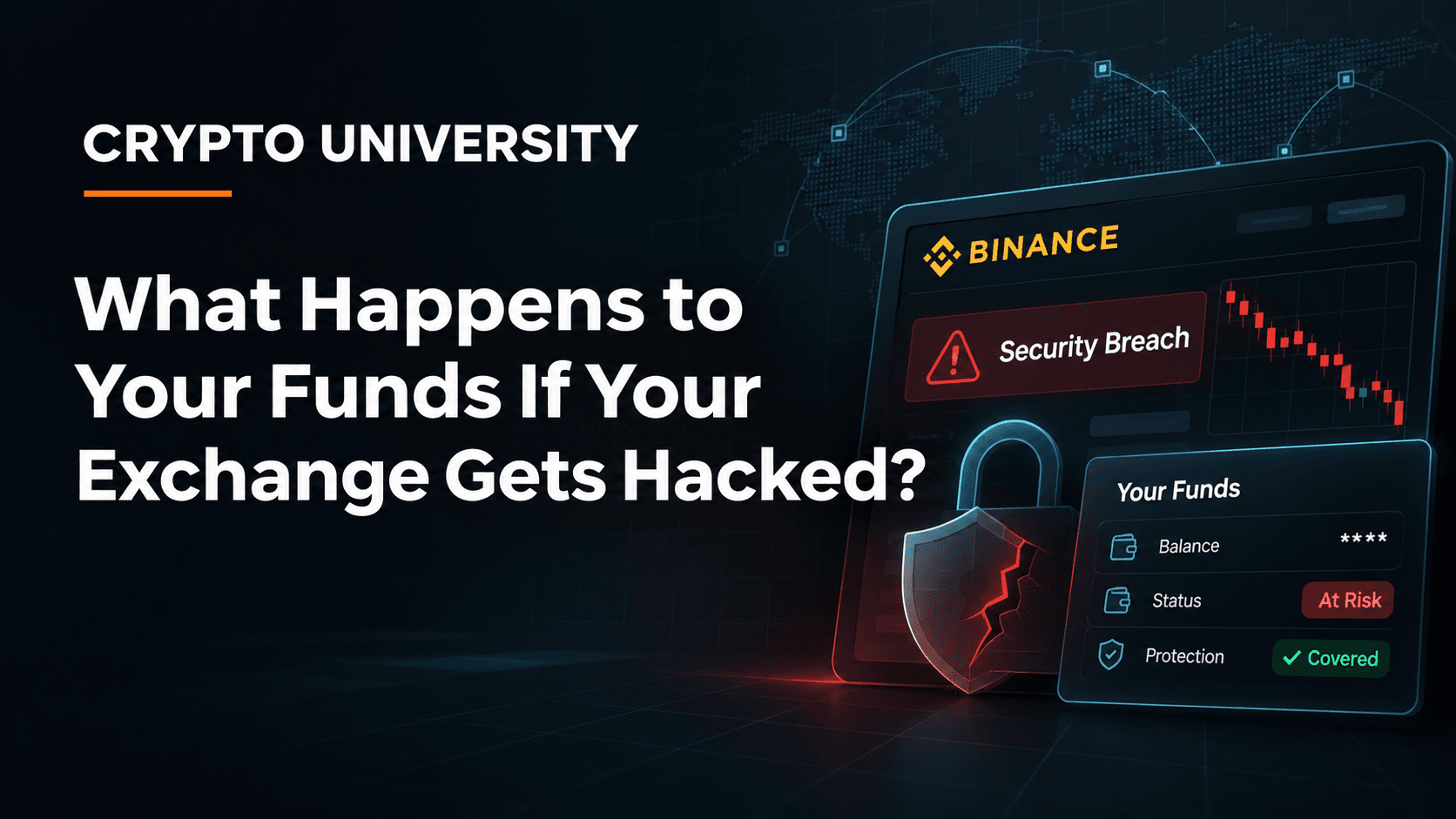
Your outcome depends on the exchange, not the blockchain. When you keep crypto on an exchange, you hold a claim against that company. Whether you are repaid depends on its reserves, its legal structure, and the rules where it operates.
There are four common outcomes. The exchange absorbs the loss, losses are shared across users, the exchange is sold or merged, or it goes into bankruptcy. The first is the most common for large exchanges, but it is not guaranteed.
There is no government insurance for exchange-held crypto. In the US, FDIC and SIPC coverage do not apply to crypto held on an exchange. Any protection comes from the exchange's own funds or private insurance.
First, Understand What You Own on an Exchange
When you buy crypto on a centralized exchange, the coins usually do not sit in a wallet that you control. The exchange holds them in large shared wallets, and your account shows a balance on its internal ledger.
In practice, your balance is a promise from the exchange to give you that crypto when you ask for it. This is why the phrase "not your keys, not your coins" exists. If the company cannot keep that promise, your balance is only as good as the company behind it.
Exchanges split their holdings into two types of storage:
Storage type | How it works | Hack risk |
|---|---|---|
Hot wallet | Connected to the internet to process withdrawals quickly | Higher, because it is online |
Warm wallet | Partly automated, used to refill hot wallets | Medium |
Cold wallet | Keys kept offline, used for most reserves | Lower, but not zero |
Most hacks hit hot or warm wallets. However, the February 2025 Bybit theft began during a routine transfer from an Ethereum cold wallet, which shows that offline storage only helps if the signing process around it is secure.
What Happens in the First Hours and Days
Most exchange hacks follow a similar pattern. Knowing it helps you stay calm and avoid scams.
Stage | What usually happens |
|---|---|
Detection | Blockchain analysts or the exchange spot large unusual outflows |
Freeze | Withdrawals are paused on some or all networks. Deposits often stay open |
Disclosure | The exchange posts a statement with an estimated loss and a cause, if known |
Tracing | Security firms track stolen funds. Stablecoin issuers may freeze some tokens |
Recovery plan | The exchange says how it will cover the gap, or that it cannot |
Reopening | Withdrawals return in phases, often one asset at a time |
Bank run risk | Many users withdraw at once, which tests whether reserves are real |
The bank run stage matters. After the Bybit hack, CoinDesk reported that customers withdrew around $4 billion within hours. An exchange that survives this rush has shown it holds real reserves. One that cannot pay withdrawals is in serious trouble.
The Four Possible Outcomes for Your Funds
1. The exchange absorbs the loss
The company covers the gap from its own treasury, a dedicated protection fund, or loans. Customers keep their full balances.
Binance (2019): About 7,000 BTC was stolen from a hot wallet. Binance covered it from its Secure Asset Fund for Users (SAFU).
Bybit (February 2025): Roughly 401,000 ETH, worth about $1.4 to $1.5 billion at the time, was stolen. Bybit kept withdrawals open, secured bridge loans for about 80% of the missing ETH, and later said it had restored 1:1 backing.
Bitget (September 2026): About $388 million was taken from hot and warm wallets. Bitget said its Protection Fund absorbed the loss and reopened withdrawals in phases between September 28 and October 2.
Binance (October 2026): Binance estimated the impact at about $6.3 billion, the largest crypto theft on record. It said it would cover all losses using SAFU, part of its futures insurance fund, and company funds, and it resumed withdrawals in phases in early November.
2. Losses are shared across all users
When the exchange cannot cover the gap, the loss may be spread across every customer, not just those whose coins were in the hacked wallet. This is called socialized losses.
Bitfinex (2016): After roughly 120,000 BTC was stolen, Bitfinex cut every account balance by about 36%. Users received "BFX" tokens representing the loss, which the exchange bought back in full by April 2017.
WazirX (July 2024): India's WazirX lost about $235 million, reported as roughly 45% of its reserves. It used a Singapore court-supervised restructuring. Creditors approved a revised plan, and in October 2025 the court approved it. Reports said users could recover about 55% of their balances in an initial distribution, with the rest tied to future recovery efforts.
3. The exchange is sold or merged
Sometimes the exchange makes users whole but cannot continue as a business.
DMM Bitcoin (May 2024): The Japanese exchange lost about 4,502 BTC, then valued at around $300 million. Its parent group raised funds to back customer balances. The exchange later shut down and transferred customer accounts to SBI VC Trade.
4. The exchange enters bankruptcy
This is the worst outcome for customers. Funds can be locked for years and repaid only in part.
Mt. Gox (2014): The Tokyo exchange collapsed after reporting that around 850,000 BTC was missing. More than a decade later, repayments are still not fully complete. The trustee said over 19,500 creditors had been repaid by March 2025. In October 2026, the deadline was extended again, to October 31, 2027.
Quick comparison
Outcome | Example | What customers got | Time to access |
|---|---|---|---|
Exchange absorbs loss | Bybit 2025, Bitget 2026 | Full balances | Hours to days |
Socialized losses | Bitfinex 2016, WazirX 2024 | Partial at first | Months to over a year |
Sold or merged | DMM Bitcoin 2024 | Full balances, new platform | Months |
Bankruptcy | Mt. Gox 2014 | Partial, after a long process | Over a decade |
What Decides Whether You Get Paid Back
The exchange's reserves and size
Large exchanges with deep treasuries can often absorb even very large losses. Smaller platforms may not survive a hack of a similar size. This is why the same type of attack can mean a short delay at one exchange and years of waiting at another.
Protection funds
Some exchanges hold a dedicated reserve for emergencies. Binance has SAFU, and Bitget has its Protection Fund. These are company funds, not public guarantees. They can be smaller than a hack. For example, Binance has described SAFU as worth about $1 billion, far below the $6.3 billion estimated in its 2026 hack, so company funds were also needed. Bitget's published terms also say that being eligible to claim does not guarantee reimbursement.
The legal status of your assets
If an exchange fails, a key question is whether your crypto is still your property or has become property of the company. In the US Celsius case in January 2023, a bankruptcy court ruled that about $4.2 billion in "Earn" account assets belonged to the company's estate, because the terms of use transferred ownership. Customers in that program became unsecured creditors. Reading your exchange's terms, especially for yield or lending products, tells you which side of that line you are on.
Local rules
Rules differ by country, and they are changing. For example:
Japan requires registered exchanges to keep most customer crypto in cold storage, rules that were tightened after the 2018 Coincheck hack.
The European Union's MiCA regulation requires crypto service providers to keep client assets separate from their own, which is designed to protect clients if the provider becomes insolvent.
Insurance
Government deposit insurance does not cover exchange-held crypto. The FDIC has stated that its insurance does not cover crypto assets or protect against the failure of non-bank companies. Some exchanges buy private crime insurance, but it usually covers a small part of total holdings and has many exclusions.
Protection type | Who provides it | Covers hacks? | Guaranteed? |
|---|---|---|---|
FDIC deposit insurance | US government | No, not for crypto | Not applicable |
SIPC coverage | US securities industry body | Generally no for crypto | Not applicable |
Exchange protection fund | The exchange | Often, at its discretion | No |
Private crime insurance | Insurance companies | Partly, with limits | Only per policy terms |
What to Do If Your Exchange Is Hacked
These are general safety steps for education, not financial or legal advice.
Stay calm and read only official channels. Check the exchange's verified website and social accounts. Do not trust links in emails or direct messages.
Ignore "recovery" offers. Scammers quickly pose as support staff or fund recovery services. No real exchange will ask for your password, 2FA code, or recovery phrase.
Record your balances. Take screenshots of your account, open orders, and recent transactions in case you need to file a claim later.
Do not send new deposits. Wait until the exchange has confirmed it is solvent and fully operating.
Withdraw in a planned way when possible. When withdrawals reopen, send funds to a wallet you control, and double check the address and network.
Follow any claims process closely. Note deadlines, required forms, and whether your jurisdiction is covered.
How to Reduce Your Risk Before a Hack
Keep only what you trade on exchanges. Long-term holdings can be moved to a wallet you control.
Check proof of reserves. Many exchanges publish reports comparing customer balances with assets they hold. These are a useful signal, though they are not a full audit.
Spread risk. Using more than one reputable platform limits damage if one fails.
Avoid opaque yield products. These often carry different ownership terms than simple spot balances.
Secure your own account. Use an authenticator app or security key, unique passwords, and withdrawal address allowlists.
Alternatives authorised
This is a starting list, not an endorsement of any product, and fees change.
All three exchanges below run an EU entity authorised under MiCA, and the ESMA CASP register (updated 5 November 2026).
Name | EU entity and regulator | Spot fees (entry tier) | Best for |
OKX Europe Ltd, MFSA (Malta) | 0.20% / 0.35% | Low-fee spot | |
Payward Europe Solutions, CBI (Ireland) | 0.40% / 0.80% | EUR transfers | |
Bybit EU GmbH, FMA (Austria) | 0.25% flat | One simple rate |
FAQ
Will I get my money back if my crypto exchange is hacked?
It depends on the exchange. Many large exchanges have covered losses in full, including Bybit in 2025 and Bitget in 2026. Others, like Mt. Gox, repaid customers only partly and after many years.
Are crypto exchanges insured like banks?
No. In the US, FDIC and SIPC protection generally do not cover crypto held on an exchange. Some exchanges hold private insurance or protection funds, but these are not guaranteed.
Why do exchanges freeze withdrawals after a hack?
To stop further losses, find the cause, and check that balances are accurate. Freezes also give the exchange time to arrange funds to cover the gap.
Is my crypto safe if only the hot wallet was hacked?
Your account balance may still be safe if the exchange can cover the loss. But a hack of any wallet affects the whole company, because customer balances are usually backed by a shared pool.
Is keeping crypto in my own wallet safer?
It removes exchange risk, but it adds personal responsibility. You must protect your recovery phrase and devices, because no company can reverse your mistakes.
Related Terms
Hot Wallet: A crypto wallet connected to the internet, used for fast transactions but more exposed to hacking.
Cold Wallet: A wallet whose private keys are kept offline to reduce the risk of remote theft.
Custodial Wallet: A wallet where a third party, such as an exchange, holds the private keys for you.
Proof of Reserves: A report in which an exchange shows it holds enough assets to match customer balances.
Self-Custody: Holding your own private keys so that you control your crypto directly, without a middleman.
Disclaimer: This content is for educational and informational purposes only and is not financial, investment, legal, or tax advice. Nothing here is a recommendation to buy or sell any asset or use any platform. Do your own research and manage your risk. Cryptocurrency involves risk, including the permanent loss of funds.
Sources
CNBC, "Binance resumes withdrawals following $6.3 billion hack" (Oct 2026): cnbc.com
The Crypto Times, "Binance Hack Explained" (Nov 2026): cryptotimes.io
DL News, "Bybit secures 80% of hacked Ether" (Feb 2025): dlnews.com
The Block, "10 biggest crypto hacks of 2025" (Jan 2026): theblock.co
Xataka On, "Hackers Steal $1.5 Billion": xatakaon.com
The Block, "Bitget withdrawal resumption" (Sep 2026): theblock.co
CryptoSlate, "Bitget restores $300M fund" (Oct 2026): cryptoslate.com
Invezz, "WazirX recovery plan approved" (Oct 2025): invezz.com
CoinDesk, "Bitfinex Buys Back Hack Credit Tokens" (Apr 2017): coindesk.com
Decrypt, "Japanese Exchange Shut Down After Hack" (Dec 2024): decrypt.co
Cointelegraph, "Mt. Gox extends repayment deadline to 2027" (Oct 2026): cointelegraph.com
Weil Restructuring, Celsius Earn ruling analysis (Jan 2023): weil.com
The Block, "FDIC says crypto failures not covered": theblock.co
Need deeper training?
Join our structured modules with live examples and expert checklists for effective implementation.
JOIN THE ACADEMY