Key Takeaways
AscendEX stopped operating on 1 July 2026, the same day the last MiCA transition window closed. For users in the European Economic Area, choosing a replacement now comes down largely to one question: does the platform hold a CASP authorisation?
The brand name is not the licence holder. Authorisation is granted to a specific legal entity, such as Coinbase Luxembourg S.A. or Bybit EU GmbH, and only covers the services that entity was approved for.
Widely circulated comparison tables contain errors. Binance is frequently listed as licensed in France, but it does not appear in the ESMA register as an authorised CASP as of August 2026.
Why People Are Searching for AscendEX Alternatives
AscendEX, a centralised exchange founded in 2018 and previously known as BitMax, announced on 6 July 2026 that it had ceased operations with effect from 1 July 2026. Accounts remained accessible only for withdrawal requests, and those requests moved to manual review. The company stated it was not in a position to give assurances about timing or amounts.
The exchange pointed to several pressures rather than a single cause. Its notice referred to the end of the longest possible MiCA transitional period on 1 July 2026, to broader regulatory, financial and operational constraints, and to a strategic recapitalisation transaction that a counterparty did not complete. Separately, in June 2026 the on-chain investigator known as ZachXBT publicly flagged unusually low balances in AscendEX hot wallets.
The practical lesson is not that users should simply move to a larger platform. It is that the entity holding your assets, and the supervision that applies to it, matter more than brand recognition. This guide covers how to evaluate an alternative on that basis.
What a MiCA Licence Actually Means
MiCA is the Markets in Crypto-Assets Regulation, formally Regulation (EU) 2023/1114. It became broadly applicable to crypto-asset service providers on 30 December 2024. Article 143 allowed firms already operating under national registration schemes in participating member states to continue under transitional arrangements until 1 July 2026 at the latest, or until their application was granted or refused.
A firm authorised under MiCA is called a CASP, short for crypto-asset service provider. The regulation defines ten distinct crypto-asset services, and a firm is approved for a specific subset of them, not automatically for all ten. Once granted by one national regulator, the authorisation can be passported across the European Economic Area, which is why so many global platforms chose small jurisdictions such as Malta, Luxembourg, Ireland and Austria as their EU base.
It is equally important to understand the limits of a licence.
What a CASP licence does | What it does not do |
|---|---|
Requires the firm to pass a regulatory review covering governance, capital adequacy, management suitability, IT security and anti-money-laundering controls | Guarantee that the firm stays solvent or that a business model works |
Requires client crypto-assets to be segregated from the firm's own assets | Provide a deposit guarantee scheme comparable to the one covering bank deposits |
Requires fee transparency, disclosure obligations and a formal complaints process | Prevent security incidents, outages or internal failures |
Places the firm under ongoing supervision by a named national authority | Reduce the volatility of the assets themselves |
Publishes the authorisation in the public ESMA register so anyone can verify it | Cover services the entity was not authorised for |
In short, a licence changes the starting point. It does not remove risk, and it is not a quality rating.
The Licensed Entity Matters More Than the Brand
This is the single most common source of confusion, and it is where most published comparison tables go wrong. A MiCA authorisation is granted to a legal entity, not to a trading brand or a website. The app you use may be operated by one company in the EEA and by a completely different company elsewhere in the world.
Some groups run several licensed entities at once. Bitpanda holds authorisations through an Austrian entity, a Maltese entity and a German entity. Kraken operates its EU business through one Irish entity while a second entity in the group holds the separate authorisation to run the trading platform itself. A third Kraken entity holds a MiFID II licence in Cyprus for derivatives, because derivatives fall outside MiCA and under different rules.
When you check a platform, look for the legal entity name in the website footer, the terms of service, or a dedicated regulatory information page. If a platform only references an older national registration and does not mention CASP status, that is worth investigating further before depositing funds.
Verified MiCA-Licensed Alternatives
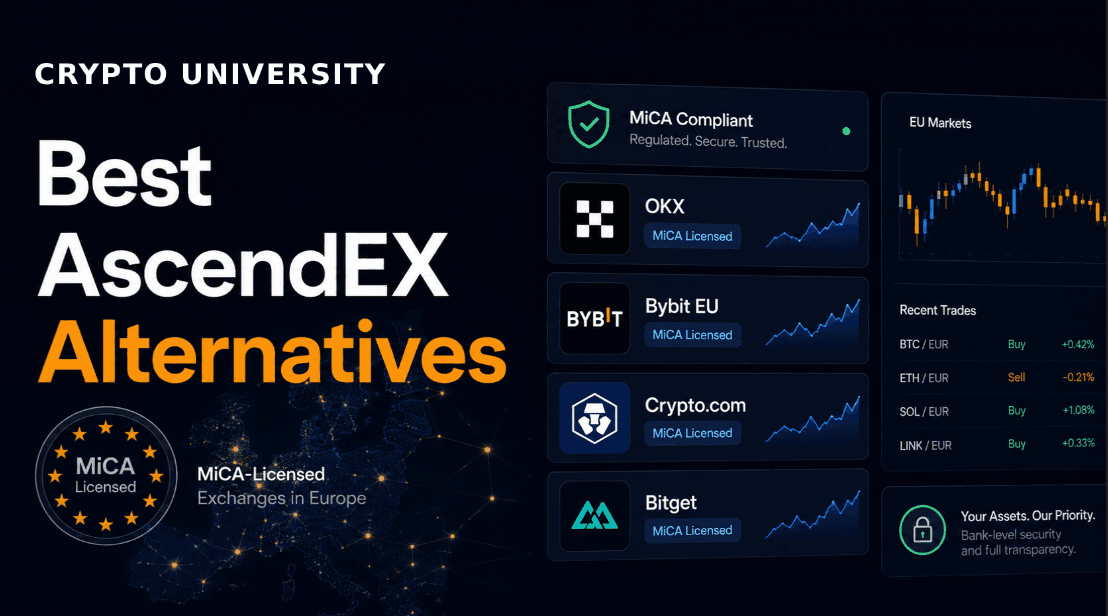
The table below reflects entries in the ESMA register of authorised crypto-asset service providers, cross-checked against independent register trackers and company announcements in August 2026. Entity names are given as they appear in the register, which in several cases differs from the name used in circulating comparison tables. Here is a quick overview of every confirmed MiCA-licensed consumer exchange on MICA tracker, followed by deeper detail on How to Cash Out Crypto.
Platform | Licensed entity (ESMA register) | Regulator | Home state | Authorised | Passports EEA-wide |
|---|---|---|---|---|---|
OKX Europe Limited | MFSA | Malta | Jan 2025 | Yes | |
Foris DAX MT Limited | MFSA | Malta | Jan 2025 | Yes | |
Bitpanda | Bitpanda GmbH | FMA | Austria | Apr 2025 | Yes |
Bitpanda | BP23 CA Limited | MFSA | Malta | Jan 2025 | Yes |
Bitstamp | Bitstamp Europe S.A. | CSSF | Luxembourg | May 2025 | Yes |
Bybit EU | Bybit EU GmbH | FMA | Austria | May 2025 | Yes |
Coinbase | Coinbase Luxembourg S.A. | CSSF | Luxembourg | Jun 2025 | Yes |
Kraken | Payward Europe Solutions Ltd | CBI | Ireland | Jun 2025 | Yes |
Bitvavo | Bitvavo B.V. | AFM | Netherlands | Jun 2025 | Yes |
Gate | Gate Technology Limited | MFSA | Malta | Sep 2025 | Yes |
Interactive Brokers | Interactive Brokers Ireland Ltd | CBI | Ireland | 2025 | Yes |
Binance | No authorised EU entity | None | None | Not authorised | No |
Regulator abbreviations: MFSA is the Malta Financial Services Authority, FMA the Austrian Financial Market Authority, CSSF the Commission de Surveillance du Secteur Financier in Luxembourg, CBI the Central Bank of Ireland, AFM the Dutch Authority for the Financial Markets.
Three corrections worth flagging
Binance. Comparison tables frequently list Binance France S.A.S. under the AMF. That reflects the older French national registration regime, which MiCA has replaced. Binance filed a MiCA application in Greece in January 2026 and withdrew it on 24 June 2026. As of the register snapshots published through August 2026, it does not appear as an authorised CASP anywhere in the EEA. Its European leadership has said it intends to apply in another member state, without naming one or giving a date.
Coinbase. The licensed entity is Coinbase Luxembourg S.A., authorised by the CSSF in June 2025, not Coinbase Financial Services Ltd. Coinbase also runs a separate Cyprus entity under MiFID II for derivatives.
Bybit EU and Kraken. The register lists Bybit EU GmbH rather than Bybit Technology Austria GmbH, and Payward Europe Solutions Limited rather than Payward Europe Limited. Small differences, but they are what you search for when verifying.
Not Every Licence Covers Trading
This is the detail most guides skip. MiCA separates the exchange of crypto-assets for funds from the operation of a trading platform. They sound similar and are legally distinct.
Under the first, you transact against the platform itself, which quotes you a price. This is the broker or dealer model, common in beginner-friendly apps. Under the second, the platform runs an order book that matches buyers and sellers against each other, which is what most people picture when they hear the word exchange.
Independent analysis of the ESMA register in early August 2026 found that of roughly 329 authorisations recorded at that point, only around 21 included permission to operate a trading platform. Most licensed CASPs are custodians, brokers, payment firms, banks and asset managers rather than order-book venues.
Model | How your order fills | What to check |
|---|---|---|
Exchange of crypto-assets for funds | You buy from or sell to the platform at a quoted price | The spread built into the quote, since the headline fee may not be the full cost |
Operation of a trading platform | Your order is matched against other users on an order book | Maker and taker fees, order book depth, and available order types |
Custody and administration | Not a trading service at all; the firm safeguards assets or keys | Whether trading is provided by the same entity or a different one |
Several well-known platforms in the table above are authorised for exchange services and custody but not for operating a trading platform under their MiCA entity. That is not a red flag. It simply describes how the service works, and it is worth knowing before you compare fee schedules.
How to Verify an Exchange Yourself
This takes about three minutes and does not require any specialist knowledge.
Find the legal entity name. Check the website footer, the terms of service, or a page usually labelled regulatory information or legal.
Open the ESMA register of authorised crypto-asset service providers, which is published under Article 109 of MiCA and available to the public without an account.
Search for the entity name, not the brand name. If nothing comes up, try the alternative spellings, then treat the absence as a question to resolve rather than a conclusion.
Check the home member state and the national competent authority listed against the entry.
Read the authorised services. Confirm the specific service you intend to use is covered, particularly custody and trading platform operation.
Cross-check the national regulator's own register where one is published. Some authorities, including the MFSA and CONSOB, do not publish a public lookup, so the ESMA entry is the primary reference.
An application in progress is not an authorisation. Since 1 July 2026 there is no transitional cover, and ESMA has confirmed that providing crypto-asset services to EEA clients without authorisation is a breach of EU law rather than a grey area. Here is a quick overview of every confirmed MiCA-licensed consumer exchange on MICA tracker.
What to Compare Once the Licence Checks Out
Licensing narrows the field. Beyond that, the differences that tend to matter in daily use are practical rather than regulatory.
Fiat rails. SEPA transfers work across the euro area. Country-specific methods such as iDEAL in the Netherlands or Bancontact in Belgium are not universal.
Stablecoin availability. MiCA sets separate rules for e-money tokens. Some stablecoins that do not meet those requirements have been removed from EU-regulated venues, while compliant alternatives remain listed. Check which pairs you actually need.
Fee structure. Compare the model as well as the number. A flat percentage on a simple buy screen and a maker or taker rate on an order book are not directly comparable.
Custody arrangements. Whether the platform self-custodies or uses a third-party custodian, and whether it publishes proof-of-reserves reporting.
Derivatives. Perpetual futures and similar products sit outside MiCA. Where they are offered to EEA users, they run through a separately licensed MiFID II investment firm, often in a different country from the MiCA entity.
Asset coverage. Listings vary considerably between EU entities and the global versions of the same brand. A token available globally may not be listed on the EEA platform.
Self-Custody as a Partial Alternative
An exchange is not the only place assets can sit, and events like the AscendEX closure are a reminder that access to a platform and ownership of an asset are not the same thing. When an exchange holds your coins, you hold a claim against that company rather than the asset itself.
Self-custody through a hardware or software wallet removes counterparty risk of that kind. It replaces it with personal responsibility. There is no password reset, no support line and no recovery process if a seed phrase is lost or exposed. Many people use a combination, keeping trading balances on a licensed platform and longer-term holdings in self-custody. Which balance suits you depends on your own circumstances, technical confidence and the amounts involved.
Frequently Asked Questions
Is AscendEX coming back?
There is no public indication of a restart. The company stated that operations ceased on 1 July 2026 and that withdrawal requests are subject to manual review, with no assurance regarding timing or amounts. Users with balances remaining should follow the process published by the company, keep documentation of every request, and consider raising the matter with the relevant financial regulator if funds stay inaccessible.
Does a MiCA licence mean my funds are guaranteed?
No. MiCA requires client asset segregation, governance standards and supervision, but it does not create a compensation or deposit guarantee scheme for crypto-assets comparable to the one that covers bank deposits. A licensed platform can still fail.
Can I still use an unlicensed exchange from inside the EU?
Technically a website may remain reachable, but since 1 July 2026 a firm serving EEA clients without CASP authorisation is operating in breach of EU law. Using one means the consumer protections built into MiCA do not apply to your account, and access can be restricted at short notice.
Why are so many exchanges licensed in Malta, Luxembourg or Ireland?
Because of passporting. A CASP authorisation granted by any one national regulator can be notified to the other member states and used across the entire European Economic Area. Firms therefore choose a single home state, and smaller jurisdictions with well-resourced regulators attracted a disproportionate share of applications from large international platforms.
Is Binance licensed under MiCA?
Not as of August 2026. Binance does not appear in the ESMA register as an authorised crypto-asset service provider. It applied through the Greek regulator in January 2026 and withdrew that application on 24 June 2026. The company has indicated it intends to apply in another member state. Because this situation can change, verify the current position in the ESMA register directly.
How often should I re-check a platform's status?
The register is updated regularly as new authorisations are granted and as circumstances change. Checking before a significant deposit, and periodically thereafter, is a reasonable habit. New licences were still being granted throughout mid-2026.
Does the licence cover every service on the platform?
No. Each entity is authorised for a specific subset of the ten MiCA services. Derivatives are outside MiCA entirely and require a separate MiFID II authorisation. Always check the authorised services list on the register entry rather than assuming full coverage.
Related Terms
CASP (Crypto-Asset Service Provider). The licence category defined by MiCA. A firm must hold one to serve clients in the European Economic Area.
Passporting. The mechanism allowing a single national authorisation to be used across all EEA member states without applying separately in each one.
ESMA Register. The public central register of authorised providers, white papers and non-compliant entities, published by the European Securities and Markets Authority under Article 109 of MiCA.
National Competent Authority (NCA). The financial regulator in each member state that reviews applications and supervises authorised firms, for example the MFSA in Malta or the AFM in the Netherlands.
Proof of Reserves. A reporting practice in which an exchange publishes evidence of the assets it holds against customer balances. Methodologies vary and it is not mandated uniformly under MiCA.
Sources
European Securities and Markets Authority, Markets in Crypto-Assets Regulation and interim MiCA register (Articles 109 and 110), esma.europa.eu
Regulation (EU) 2023/1114 of the European Parliament and of the Council (MiCA), including Article 143 transitional provisions
AscendEX, official statement on suspension of platform operations and customer withdrawals, ascendex.com, July 2026
The Block, AscendEX crypto exchange shuts down, no assurance on user payouts, 9 July 2026
Crowdfund Insider, Crypto Exchange AscendEX Halts All Operations, 9 July 2026
Outrun Advisory, MiCA CASP register dashboard, ESMA register snapshot 12 August 2026
CASP Tracker, MiCA licence list built from the official ESMA CASP register, synced 15 August 2026
Cryptoticker, analysis of the ESMA MiCA register dated 4 August 2026 covering trading platform authorisations
Gate Group, announcement of MiCA licence granted to Gate Technology Ltd by the MFSA, 1 October 2025
Central Bank of Ireland register and AMF white list entries for Interactive Brokers Ireland Limited
Editorial note: This article is educational and informational. It is not financial, investment or legal advice, and it does not recommend any platform. Licensing status changes over time. Verify any entity directly in the ESMA register before acting. Figures and dates reflect publicly reported information available on 18 August 2026.
A quick overview of deeper detail on EU MiCA License Tracker
BitMart Is Shutting Down: Timeline, What It Means, and What Traders Should Do
Best RugCheck Alternatives Every Beginner Trader Needs
Best Robinhood Chain Trading Platforms in 2026: FOMO, GMGN, Uniswap and OpenSea Compared
Need deeper training?
Join our structured modules with live examples and expert checklists for effective implementation.
JOIN THE ACADEMY