Key Takeaways
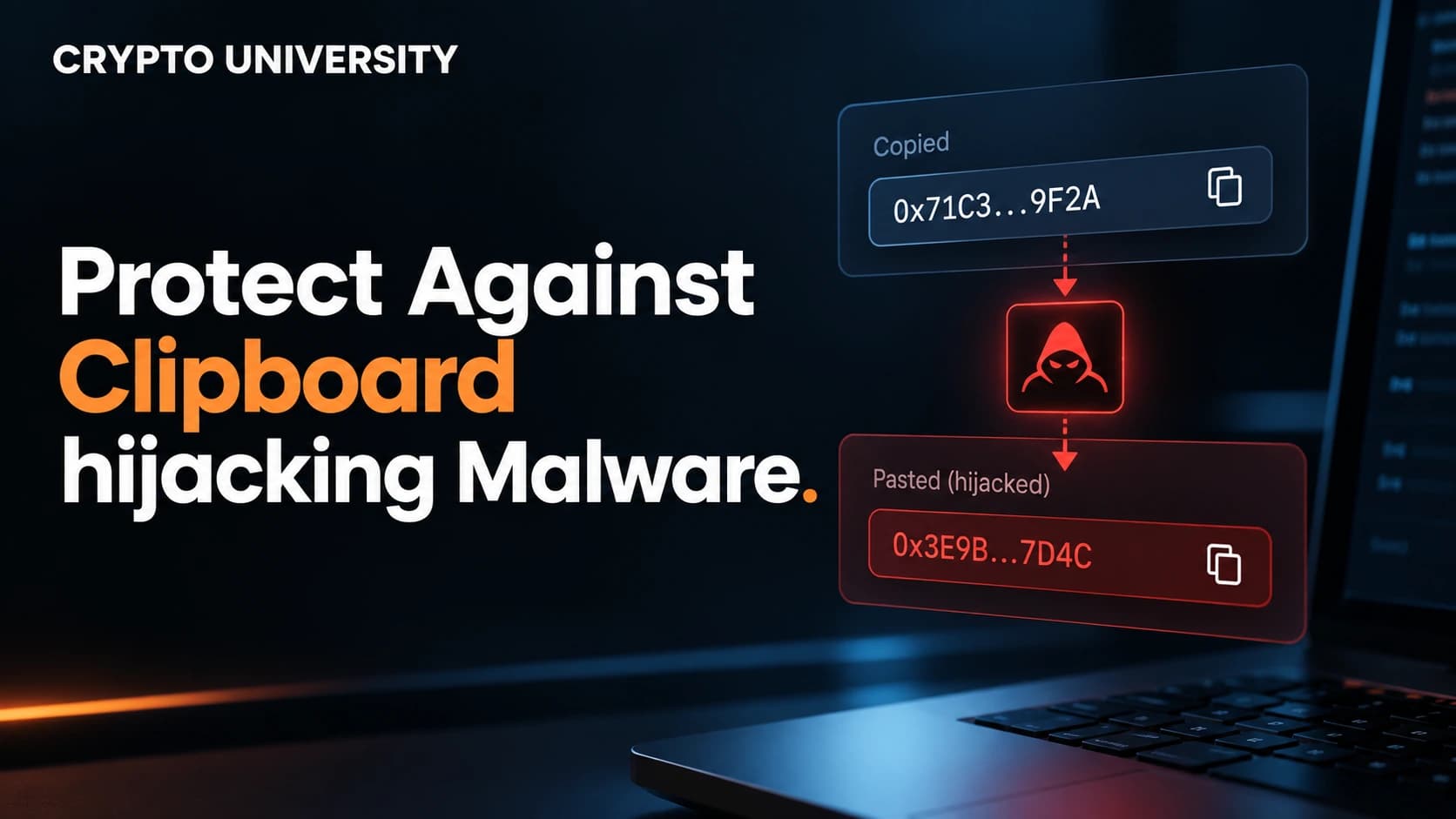
- Clipboard hijacking malware, often called a clipper, silently replaces a crypto wallet address after you copy it. The address you paste is technically valid, your wallet accepts it, and the transaction cannot be reversed once confirmed.
- Verification beats detection. Checking the first and last few characters is no longer enough, because modern clippers substitute lookalike addresses. Verifying the full address on a hardware wallet screen or through a small test transaction is the check that actually works.
- Most infections start with an action you take. Pirated software, fake installers, malicious browser extensions, and pasted terminal commands are the dominant delivery routes, which makes software hygiene the strongest preventive layer.
What Clipboard Hijacking Malware Is
Clipboard hijacking malware is a program that watches the copy and paste buffer on your device and edits what it finds there. In crypto, the target is almost always a wallet address.
The clipboard is a shared system resource. Any application with the right access can read from it and write to it. That is what makes copy and paste work across programs, and it is also what makes the clipboard a soft target. Security researchers call this malware family a clipper, and Microsoft has used the broader term cryware for malware built specifically to steal on-chain assets.
The attack has been documented since around 2017 and has since appeared on Windows, macOS, Android, and Linux. It does not break encryption, guess passwords, or open your wallet file. It exploits the one moment when an address leaves your wallet as plain text and travels through the operating system.
How the Attack Works, Step by Step
| Stage | What Happens |
|---|---|
| 1. Infection | Malware reaches the device through a download, extension, script, or compromised software package. |
| 2. Monitoring | The program runs quietly in the background and polls the clipboard. One Windows campaign analysed by Microsoft in 2026 checked roughly every 500 milliseconds. |
| 3. Pattern matching | It compares copied text against known address formats using regular expressions, covering Bitcoin, Ethereum, Solana, Litecoin, XRP, and others. |
| 4. Substitution | On a match, it writes an attacker-controlled address into the clipboard in place of yours. |
| 5. Execution | You paste, review briefly, and confirm. The funds go to the attacker. |
Advanced variants go further. Some capture screenshots, some scan the clipboard for 12 and 24 word seed phrases and private keys, and some browser extension versions rewrite the deposit address displayed on a web page rather than touching the clipboard at all.
How Clippers Reach Your Device
| Delivery Route | How It Works | Typical Warning Sign |
|---|---|---|
| Pirated software and cracks | Installers from warez sites bundle a loader. The MassJacker campaign documented by CyberArk in 2025 spread this way. | Free copy of paid software, disabled antivirus required |
| Fake installers and search ads | Sponsored results lead to lookalike download pages for wallets, node tools, or trading apps. | Domain does not match the official project |
| Malicious browser extensions | Extensions request broad permissions, then rewrite addresses in the page or clipboard. | Extension asks to read and change data on all sites |
| ClickFix and fake CAPTCHA prompts | A page instructs you to paste a command into Terminal or the Run box to "verify" yourself. | Any prompt asking you to run a command manually |
| Supply chain compromise | Attackers publish malicious versions of trusted libraries. In September 2025, a phishing attack on an npm maintainer pushed a crypto clipper into packages with billions of weekly downloads. | Not visible to end users, which is why habits matter |
| Malicious mobile apps | ESET documented the first clipper on Google Play in 2019, impersonating a well known wallet app. | App from outside official stores, or a clone listing |
The common thread is that the user usually initiates the infection. Very little of this involves an exploit against a patched, up to date system.
Why "Check the First and Last Few Characters" Stopped Working
For years the standard advice was to compare a handful of characters at each end of the address. Attackers adapted.
The Laplas Clipper family generates substitute addresses that closely resemble the copied one. Researchers testing it were able to generate a similar-looking address in as little as five seconds. The npm supply chain payload from 2025 used a string-similarity algorithm to pick the visually closest address from a large list.
Two further points make casual checking unreliable:
- Checksums do not help. The substituted address is a real, correctly formatted address. Your wallet has no reason to reject it.
- Explorers can be hidden. A browser extension campaign analysed by McAfee in 2026 deliberately switched itself off on blockchain explorer sites, so a victim inspecting the address on a block explorer would see the correct one.
Layer 1: Verification Habits That Actually Work
These are free, take seconds, and are the single highest-value defence.
- Verify on a hardware wallet screen. A hardware wallet displays the destination address on its own display, outside the reach of software on your computer. Compare it against the address you intended, then approve.
- Send a small test transaction first. Send a minimal amount, confirm it arrived at the correct destination, then send the rest. This costs a network fee and removes most of the risk on large transfers.
- Check the full string, not the ends. If you must check visually, read the whole address in segments, including the middle.
- Use saved address books and withdrawal whitelists. Most exchanges let you save and lock verified withdrawal addresses. A whitelist entry cannot be overwritten by clipboard malware.
- Prefer QR codes for in-person transfers, but be aware that a compromised browser can also alter a QR code rendered on a web page.
- Never copy a seed phrase or private key to the clipboard. Ever. Several clipper families specifically look for them.
Layer 2: Device and Software Hygiene
| Practice | Why It Matters |
|---|---|
| Install only from official sources | Removes the top delivery route in one step |
| Never run pasted terminal or Run box commands | ClickFix attacks depend entirely on the user executing the command |
| Audit browser extensions monthly | Remove anything unused; check permissions on the rest |
| Keep the OS and browser patched | Closes secondary escalation paths |
| Run reputable endpoint protection and scan periodically | Catches known families such as those flagged as clipper trojans |
| Use a dedicated device or user profile for high-value transfers | A clean machine with no downloads, extensions, or games |
| Treat unexpected admin password prompts as hostile | The 2026 macOS ClickFix stealer harvested credentials via a fake system dialog |
Layer 3: Platform Specific Settings
| Platform | What You Can Do |
|---|---|
| Windows | Turn off Clipboard History and cloud clipboard sync in Settings. Review startup programs and scheduled tasks. |
| macOS | Keep Gatekeeper enabled. Be suspicious of any file that asks you to bypass a security warning. Review Login Items. |
| Android | Android 10 and later blocks background apps from reading the clipboard unless the app is in focus or is your default keyboard. Android 12 and later shows a notification when an app reads clipboard data from another app. Android 13 clears the clipboard automatically after a period. Keep the OS current and install only from official stores. |
| iOS | Since iOS 14, the system alerts you when an app pastes from another app. Avoid jailbreaking, which removes the sandbox protections this depends on. |
| Linux | No longer a safe assumption. Clipper activity on Linux systems has been reported as of 2026. |
Warning Signs Worth Investigating
Clippers are designed to be quiet, so signals are subtle:
- A pasted address does not match what you copied, even once
- Clipboard content changes without you copying anything
- Unfamiliar processes running at startup or unexplained network activity
- A browser extension you do not remember installing
- Antivirus alerts referencing clipper, cryware, or trojan detections
What to Do If You Suspect an Infection
- Disconnect from the internet. This stops exfiltration and cuts contact with the command server.
- Do not send any further transactions from that device.
- Assume seed phrases and private keys touched by that device are compromised. If you have ever copied, screenshotted, or typed them on the machine, treat them as exposed.
- Move funds using a different, clean device, ideally with a hardware wallet.
- Run a full scan with reputable security software, then consider a clean operating system reinstall rather than a repair.
- Create a new wallet and migrate funds. Do not restore the old seed phrase onto the same machine.
- Report it. Notify your exchange and, where applicable, your national cybercrime reporting body.
Clipboard Hijacking vs Address Poisoning
These two attacks are often confused. They are different problems with different defences.
| Aspect | Clipboard Hijacking | Address Poisoning |
|---|---|---|
| Where it happens | On your device | On the blockchain |
| Mechanism | Malware edits the clipboard | Attacker sends dust from a lookalike address so it appears in your history |
| Requires malware | Yes | No |
| Main defence | Device hygiene plus verification | Never copy addresses from transaction history |
The Practical Summary
Clipboard hijacking is a low-sophistication attack that survives because of a very human habit: trusting that what we copied is what we pasted. The technical fix is not complicated. It is a verification step, performed every time, on a screen the malware cannot reach.
Treat the moment before you press confirm as the most important part of any transfer. Everything else is insurance.
This article is educational and does not constitute financial or legal advice. Security practices should be adapted to your own situation and risk tolerance.
Frequently Asked Questions
Can antivirus software alone stop clipboard hijacking malware? It helps but is not sufficient. Clippers have very small functional footprints, which makes them harder to flag than larger malware families. Some also use process injection to hide inside legitimate Windows utilities. Treat antivirus as one layer, not the whole defence.
Does using a hardware wallet make me immune? It removes the main risk if you use it correctly. A hardware wallet shows the destination address on its own screen, which is outside the reach of software on your computer. That protection only works if you actually read that screen before approving. If you approve without checking, the hardware wallet will sign a transaction to the attacker's address.
Can clipboard hijacking steal my seed phrase? Yes, if you put it on the clipboard. Several documented families scan clipboard content for 12 and 24 word recovery phrases and private key formats. This is why a seed phrase should never be copied, screenshotted, or stored in a password manager entry you paste from.
Can funds be recovered after a clipper attack? Almost never. Blockchain transactions are final once confirmed. Reporting to an exchange can occasionally help if the funds move to a centralised platform that freezes the account, but recovery should not be expected.
Is mobile safer than desktop for crypto transfers? Modern mobile operating systems restrict clipboard access more tightly than desktop systems, so the background monitoring route is harder. However, malicious apps installed from outside official stores still pose a real risk, and mobile users are more likely to skip full address verification on a small screen.
5 Related Terms
- Clipper malware
- The common industry name for software that swaps clipboard contents to redirect crypto payments.
- Cryware
- Microsoft's term for malware designed specifically to steal cryptocurrency assets and wallet data.
- ClickFix
- A social engineering technique that tricks users into pasting attacker-supplied commands into a terminal or run box.
- Address poisoning
- A scam that plants lookalike addresses into your transaction history so you copy the wrong one.
- Withdrawal whitelist
- An exchange security setting that restricts withdrawals to a pre-approved list of addresses.
Sources
- Microsoft Security Blog, "Crypto Clipper uses Tor and worm-like propagation for persistence and control", June 2026
- Microsoft Security Blog, "Protecting Android clipboard content from unintended exposure"
- CyberArk research on MassJacker, reported by BleepingComputer and The Hacker News, March 2025
- BleepingComputer, "New clipboard hijacker replaces crypto wallet addresses with lookalikes" (Laplas Clipper)
- McAfee Labs, "Silent Swap: A Crypto Clipper Extension Campaign", July 2026
- Huntress research on macOS ClickFix infostealer, reported by BleepingComputer and Infosecurity Magazine, August 2026
- Android Developers, "Secure Clipboard Handling"
- Halborn and Merkle Science research notes on clipper malware behaviour
Figures relating to stolen amounts and wallet counts are researcher estimates at the time of analysis and may change.
3 More Readings
- Microsoft Security Blog: Crypto Clipper technical analysis
- A detailed breakdown of how a modern clipper operates, including its clipboard polling behaviour and command and control design.
- Android Developers: Secure Clipboard Handling
- The official documentation on clipboard restrictions across Android versions, useful for understanding what your phone does and does not protect.
- BleepingComputer: MassJacker malware uses 778,000 wallets to steal cryptocurrency
- A well-sourced case study on the scale a single clipper operation can reach.
Disclaimer: This article is educational and is not financial, legal or investment advice. Regulatory rules and register locations change, so verify details with the relevant authority before acting.
Not sure which problem you have?
Use the Fixing Crypto Mistakes hub to identify the transaction, wallet, network, or exchange issue before taking another action.
OPEN TROUBLESHOOTING HUB