Key Takeaways
|
The Problem with Base Blockchains
Bitcoin can process roughly 7 transactions per second. Ethereum Layer 1 handles about 15 to 30 transactions per second under normal conditions. Visa, by comparison, handles tens of thousands of transactions per second.
That gap is not a bug in the original design. It is a deliberate tradeoff. Early blockchain designers prioritized security and decentralization above all else. Scalability came third. This is the core of what the industry calls the blockchain trilemma.
The Blockchain Trilemma Any blockchain must balance three competing properties:
The trilemma states you can optimize for two, but the third will suffer. Ethereum chose security and decentralization. Speed was the cost. |
What Is a Layer 1 Blockchain?
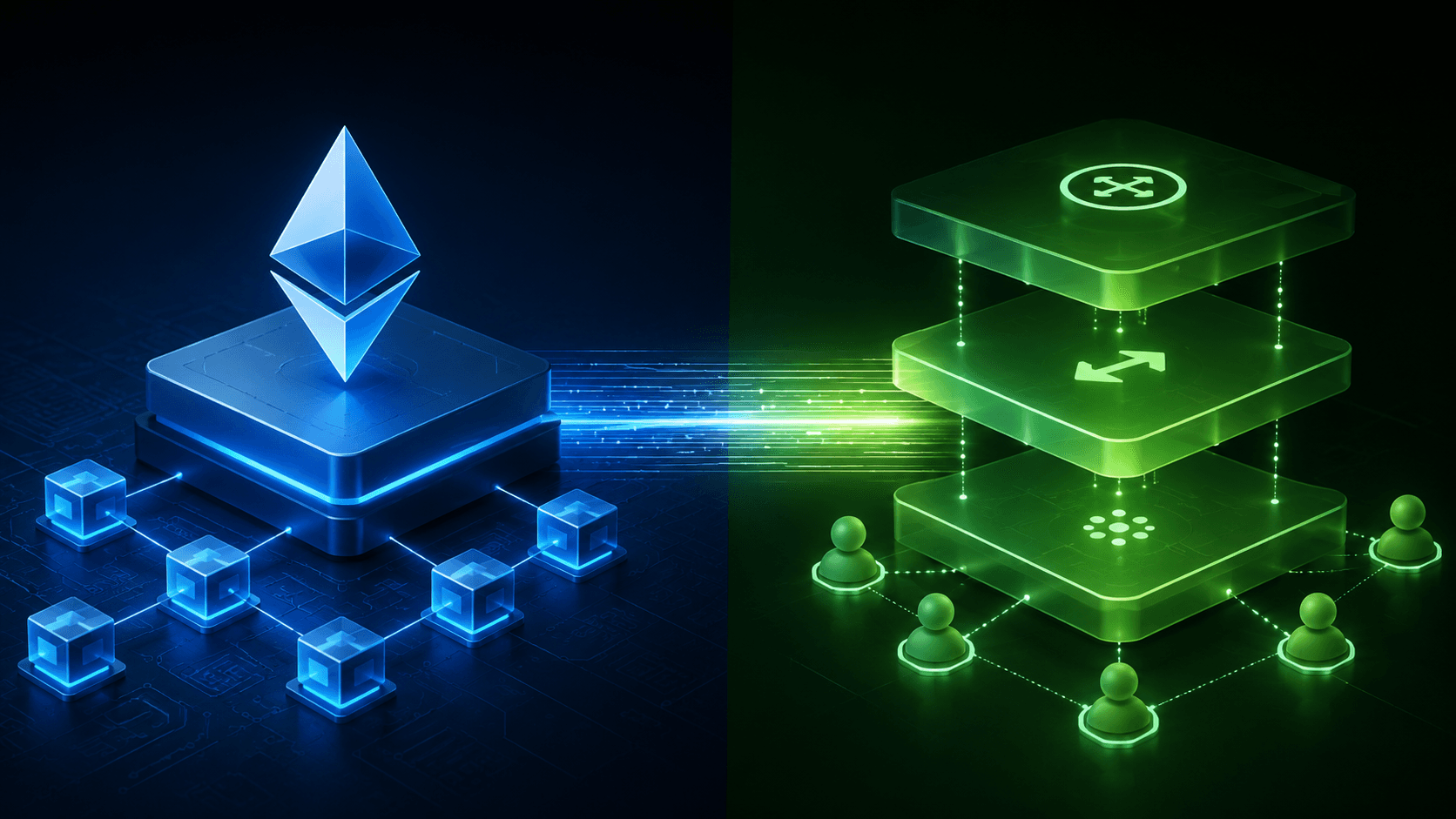
Layer 1 is the base layer. It is the original blockchain protocol that handles its own consensus, data storage, and transaction finality. It does not rely on any other chain to function.
Examples include: Bitcoin, Ethereum, Solana, Avalanche, and Cardano.
A Layer 1 chain contains everything inside itself: a consensus mechanism (how nodes agree on the correct chain state), a data availability layer (where all transaction data lives), and an execution layer (where smart contracts run).
Improving a Layer 1 directly is hard. It typically requires a hard fork, meaning a change to the core protocol that all network participants must agree to. Ethereum's move from proof-of-work to proof-of-stake in 2022 was a Layer 1 change. It took years of coordination.
What Is a Layer 2 Blockchain?
Layer 2 is a secondary network built on top of a Layer 1. Its job is to process transactions faster and more cheaply, then periodically report the results back to the base chain. The Layer 1 still provides the final security guarantee.
True Layer 2 solutions inherit the security of the Layer 1 they sit on. They do not have independent validator sets or separate consensus mechanisms.
The key distinction: a Layer 2 solution derives its trust from the Layer 1 beneath it. If a Layer 2 produces an invalid result, the Layer 1 can reject it. This is the core of how rollups work.
Quick Comparison: Layer 1 vs Layer 2
Feature | Layer 1 | Layer 2 |
Role | Base chain (settlement + security) | Built on top of L1 (execution + speed) |
Security | Self-contained consensus | Inherits from Layer 1 (for true L2s) |
Speed | 15-30 TPS (Ethereum L1) | Hundreds to thousands of TPS |
Cost | Can spike to $20-40 per tx | Often $0.01-$0.10 per tx |
Examples | Ethereum, Bitcoin, Solana | Arbitrum, Base, zkSync, Lightning |
Upgrades | Hard forks, major coordination | Deployed independently, faster iteration |
The Main Layer 2 Architectures
Not all Layer 2 solutions work the same way. There are four main categories, each with different security assumptions, use cases, and tradeoffs.
Type | How It Works | Security Level | Examples |
Optimistic Rollups | Assumes txns valid; fraud proofs used to challenge | High (L1-backed) | Arbitrum, Optimism, Base |
ZK Rollups | Cryptographic validity proofs submitted to L1 | Very High (math-verified) | zkSync Era, Starknet, Scroll |
State Channels | Two parties transact off-chain, settle on L1 | High (L1-backed) | Lightning Network, Raiden |
Sidechains | Separate chain with own validators; bridges to L1 | Lower (own security) | Polygon PoS, Gnosis Chain |
Plasma | Child chains anchored to L1 (largely superseded) | Medium | OMG Network (legacy) |
Rollups: The Dominant Approach
Rollups bundle hundreds or thousands of transactions, process them off-chain, and post the compressed results back to Layer 1. The base chain does not re-execute every transaction. It trusts (or verifies) the summary.
There are two types of rollups. Understanding the difference between them is the most important technical distinction in the current Layer 2 landscape.
Factor | Optimistic Rollups | ZK Rollups |
Validation method | Fraud proofs (challenge period) | Validity proofs (cryptographic math) |
Withdrawal time (to L1) | ~7 days (native bridge) | 15-45 minutes |
EVM compatibility | High (deploy Solidity directly) | Improving (zkEVMs closing the gap) |
Complexity to build for | Lower | Higher |
Current TVL dominance | Yes (Arbitrum, Base lead) | Growing but smaller |
Best for | DeFi, mature dApps | Payments, privacy, high-frequency apps |
State Channels: Fast, But Limited
State channels allow two or more parties to open a direct off-chain channel, transact many times, and then close the channel by posting the final balance to Layer 1. Only the opening and closing transactions touch the base chain.
Bitcoin's Lightning Network is the most established example. It works well for repeated transactions between known parties, like micropayments or gaming moves. It is less suited to open-ended, multi-party applications.
Sidechains: Related, But Different
Sidechains are often described as Layer 2, but the label is misleading. A sidechain is a separate blockchain that runs its own consensus and validator set. It connects to a Layer 1 via a bridge, but it does not inherit the Layer 1's security.
Important: If a sidechain's validators collude or the network fails, users may lose funds. There is no cryptographic fallback to the Layer 1 in the way rollups provide. Polygon PoS and Gnosis Chain are commonly cited examples.
How Transactions Settle Between Layers
Understanding the lifecycle of a transaction helps clarify why Layer 2 is useful and what the tradeoffs actually are.
When a user sends a transaction on an optimistic rollup like Arbitrum:
The transaction is broadcast to the rollup's sequencer
The sequencer orders and processes it off-chain
Periodically, batches of transactions are posted to Ethereum L1 as compressed data
A challenge window of approximately 7 days begins during which fraud proofs can be submitted
After the window, the state is finalized on Ethereum
With a ZK rollup like zkSync Era:
Transactions are processed off-chain by the sequencer
A cryptographic validity proof is generated for the batch
Both the compressed data and the proof are submitted to Ethereum L1
Ethereum verifies the proof mathematically, typically within minutes
Finality is near-instant once the proof is accepted
The tradeoff is complexity vs speed. ZK rollups are harder to build for but offer faster finality. Optimistic rollups are easier to develop on but introduce a withdrawal delay when moving funds back to Layer 1.
Why This Matters for Builders and Users
For users, the practical impact is straightforward. Transacting on a Layer 2 network is significantly cheaper than transacting on Ethereum Layer 1. Fees that might cost $20 to $40 on mainnet can cost fractions of a cent on well-designed rollups.
As of early 2025, following Ethereum's Dencun and Pectra upgrades, the cost of posting data from rollups to Ethereum dropped further. Layer 2 networks have become the primary place where most user activity on Ethereum now occurs.
For builders, the choice of Layer 2 matters for tooling, liquidity, and user reach. Optimistic rollups like Arbitrum and Base have larger developer ecosystems and deeper DeFi liquidity today. ZK rollups are technically superior in some dimensions but have smaller ecosystems and more complex tooling.
Summary
Layer 1 blockchains are the foundation. They are secure and decentralized but limited in throughput. Layer 2 networks sit on top to extend capacity while inheriting the security properties of the base chain.
Rollups, the dominant Layer 2 design, process transactions off-chain and post compressed proofs or data to Layer 1. Optimistic rollups are widely adopted and developer-friendly. ZK rollups offer stronger mathematical guarantees and faster finality but are more complex to build for.
Understanding this architecture helps explain why fees vary across networks, why withdrawal times differ, and what it means when a protocol describes itself as a Layer 2.
Frequently Asked Questions
What is the difference between Layer 1 and Layer 2?
Layer 1 is the base blockchain (such as Ethereum or Bitcoin). Layer 2 is built on top of it to improve speed and lower costs, while relying on Layer 1 for security.
Is Polygon a Layer 2?
Polygon has multiple products. Polygon PoS, its most widely used network, is technically a sidechain with its own validators, not a true Layer 2. However, Polygon zkEVM is a genuine ZK rollup that inherits Ethereum's security.
Why do Layer 2 withdrawals take 7 days?
Optimistic rollups assume transactions are valid and use a challenge period during which anyone can submit a fraud proof to dispute incorrect state. The 7-day window is the standard length for this challenge period on networks like Arbitrum and Optimism.
Are ZK rollups better than optimistic rollups?
ZK rollups offer faster finality and cryptographic certainty, while optimistic rollups have larger ecosystems and simpler tooling today. Neither is universally better. The right choice depends on the use case and maturity requirements.
What is a sequencer in a Layer 2?
A sequencer is the node or service that orders and processes transactions on a Layer 2 network. In many current rollups, the sequencer is operated by a single entity (the development team), which introduces some centralization risk. Decentralizing sequencers is an active area of development.
Can you lose money on a Layer 2?
Smart contract bugs, bridge vulnerabilities, and sequencer failures can all result in losses on Layer 2 networks. The Layer 2 security model reduces but does not eliminate risk. Users should evaluate each network's audit history and maturity before depositing large amounts.
Disclaimer: This content is for educational and informational purposes only and is not financial advice. Nothing here is a recommendation to buy or sell any asset or use any platform. Do your own research and manage your risk.
Need deeper training?
Join our structured modules with live examples and expert checklists for effective implementation.
JOIN THE ACADEMY