Key Takeaways
- A giveaway that asks you to send crypto first is not a giveaway. Every version of this scam, no matter how it looks, ends with the same instruction: pay, deposit, or approve something before you receive anything.
- Deepfakes fake the messenger, not the message. The face and voice can be generated perfectly, but the request never changes. Verify the request, not the person delivering it.
- Connecting a wallet can cost you more than sending funds. Modern giveaway pages often steal through a single signature approval rather than a deposit, which drains assets you never agreed to move.
What a Fake Crypto Giveaway Actually Is
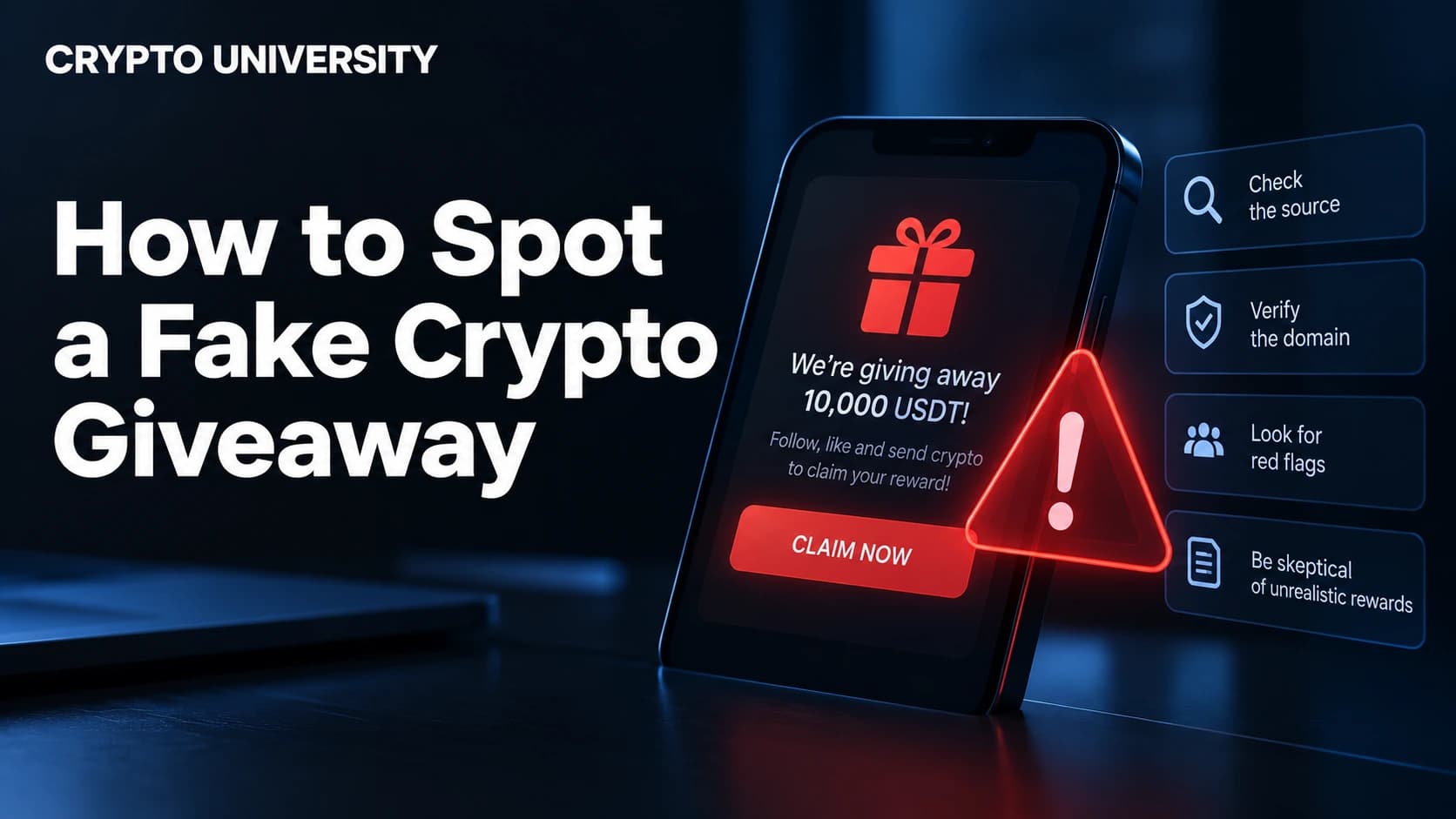
A fake crypto giveaway is a fraud that offers free or multiplied cryptocurrency in exchange for an action you take first. It is one of the oldest and simplest scams in the industry, and it survives because it is cheap to run, easy to translate into any language, and it borrows trust from names people already recognise.
The scam has two possible goals:
- Get you to send funds to an address the scammer controls.
- Get you to sign or approve a transaction that lets the scammer move funds out of your wallet later.
The second goal is the more dangerous one for people who feel confident about crypto, because it does not look like sending money at all. It looks like clicking a normal button on a website.
Why This Matters: The Reported Numbers
These figures come from public reports and represent only what was reported, so the real totals are almost certainly higher.
| Source and period | Reported figure | What it covers |
|---|---|---|
| FBI IC3, 2025 annual report | 181,565 complaints, more than 11.3 billion USD in losses | All complaints involving cryptocurrency filed in the US |
| FBI IC3, 2025 | Average loss of 20,699 USD overall, rising to 62,604 USD when crypto was involved | Per victim averages across reported complaints |
| FTC, 2025 data spotlight | 2.1 billion USD lost to scams that started on social media | All social media scams, not crypto only |
| Scam Sniffer, 2025 annual report | 83.85 million USD across 106,106 wallets, average 790 USD per victim | Wallet drainer and signature phishing on EVM chains only |
| FBI IC3, 2025 | Over 10,500 complaints and roughly 1.4 billion USD tied to recovery scams | Fraudsters targeting people who already lost money |
The wallet drainer figure fell sharply from 2024, when the same tracker recorded roughly 494 million USD. That is a real improvement, but it is a narrow measurement covering one attack type on one family of blockchains. It is not evidence that giveaway fraud has gone away.
The Rule That Beats Every Version of This Scam
No legitimate giveaway, airdrop, promotion, or reward requires you to send cryptocurrency first.
That single sentence defeats the entire category. A real airdrop distributes tokens to wallets that already qualified through past activity. A real exchange promotion credits your account after you complete a normal, disclosed action. A real charity accepts a donation and does not promise to send double back.
If money or a signature has to leave your side before value arrives, the offer is fraudulent. You do not need to identify the scammer, verify the celebrity, or analyse the website design. You only need to notice the direction of the first payment.
The Three Formats You Will Meet
| Format | How it is pitched | What actually happens | Main tell |
|---|---|---|---|
| Doubling or multiplier | Send 1 BTC and receive 2 BTC back, often with a countdown | Funds go to the scammer address and nothing returns | You are asked to send first |
| Connect wallet and claim | Claim your free tokens or reward, just connect and confirm | You sign an approval or Permit that lets the attacker move tokens | An unsolicited claim page that needs a signature |
| Fee first | You won, now pay a small gas fee, tax, or verification deposit | Each fee unlocks another fee until you stop paying | A prize that costs money to collect |
The third format deserves attention because it feels small. A request for 30 USD in "network fees" is easier to accept than a request for 3,000 USD. Real blockchain fees are paid to the network by your own wallet, not sent to a person or a company address.
Where Fake Giveaways Appear
| Channel | Common tactic | What to check |
|---|---|---|
| YouTube | Hijacked channels renamed to look official, running a looped pre recorded deepfake as a "live" event | Channel history, upload dates, whether older videos were deleted |
| X | Purchased checkmarks, cloned display names and avatars, reply bots under real posts | Handle spelling, account age, whether the real account has posted the same thing |
| Telegram and Discord | Direct messages from fake admins, takeovers of expired invite links, compromised project servers | Real admins do not message first, and official servers post announcements in read only channels |
| Search and paid ads | Spoofed domains bought as sponsored results above the real website | The URL character by character, ideally from your own bookmark |
| Your own wallet | Unexpected tokens or NFTs appear with a claim link inside the name or metadata | Treat unsolicited assets as bait, never interact with them |
| Email and SMS | Prize notifications from exchanges you may or may not use | Log in to the exchange separately instead of clicking anything |
A note on verification badges. On X, a blue checkmark is a paid subscription feature, not proof of identity. Scammers buy the subscription, copy a well known name and avatar, and reply to the real account's posts so their message appears directly beneath it. Treat badges as decoration.
Ten Red Flags to Check
- You are asked to send crypto before receiving anything.
- The offer promises a fixed multiple, such as double or five times your deposit.
- There is a timer, a "first 500 participants" limit, or any other pressure to act now.
- The message arrived unsolicited, in a reply, a direct message, or a comment.
- The account name matches a famous person but the handle has extra characters, numbers, or swapped letters.
- A live stream is showing an event you cannot find announced anywhere on the company's official website.
- The site asks you to connect a wallet to claim, then requests a signature you cannot read.
- You are asked for a seed phrase, private key, or recovery phrase in any form. This is always theft.
- Payment must go to a personal wallet address rather than through a normal checkout or exchange account.
- The people confirming that it works are anonymous accounts with new profiles and generic replies.
Any single flag is enough to stop. You do not need to collect several.
How to Verify Any Offer in Five Steps
- Stop the clock. Urgency is the mechanism, not a coincidence. Nothing legitimate expires in the next four minutes.
- Navigate independently. Close the message. Open the company's official website from a bookmark or a search you perform yourself, then look for the same announcement. If the promotion is real, it exists there too.
- Check the direction of value. Ask one question. Does anything have to leave my wallet first? If yes, stop.
- Read the signature request. If a site asks your wallet to sign, look at what the request actually authorises. Approvals such as Permit, Permit2, and setApprovalForAll grant permission over tokens you already hold. A genuine claim sends tokens to you and does not need control over your existing balance.
- Ask somewhere neutral. Post the link in an established community or check it against a scam database before you act, not after.
Real Distribution Versus Fake Giveaway
| Feature | Legitimate airdrop or promotion | Fake giveaway |
|---|---|---|
| Payment direction | You receive, you never send | You send or approve first |
| Announcement location | Official site, official blog, official app | Reply, direct message, live stream, or ad |
| Eligibility | Based on prior on chain activity or account status | Open to anyone who pays |
| Return promised | Not promised or quantified in advance | Guaranteed multiple of what you send |
| Time pressure | Claim windows usually run for weeks | Minutes or hours |
| Signature requested | Standard transfer or claim to your address | Broad approval over tokens you hold |
Deepfakes: Verify the Request, Not the Face
The visual layer of this scam has improved faster than anything else. In June 2024, a five hour YouTube live stream used a generated version of Elon Musk to promote a doubling offer and reached roughly 30,000 concurrent viewers before removal, according to widely reported coverage at the time. Similar impersonations have since targeted other public figures, including a July 2025 video misrepresenting Ripple's CEO endorsing a reward scheme, which Ripple staff publicly debunked, and a deepfake of Donald Trump circulated during Super Bowl LX in February 2026 directing viewers to a doubling website.
This is why identity checks fail. You cannot reliably detect a good synthetic video by looking at it, and you should not try. What has never changed across every case is the instruction: send cryptocurrency to this address, and more will come back. That instruction is the fraud, and it cannot be disguised, because without it there is no way to take the money.
So stop authenticating the person. Authenticate the request.
The Second Wave: Recovery Scams
People who lose money to a giveaway scam are often targeted again within weeks. The follow up pitch comes from a fake law firm, a fake blockchain investigator, or someone impersonating a government agency, and it offers to trace and return the stolen funds for an upfront fee.
The FBI reported more than 10,500 complaints and roughly 1.4 billion USD in losses tied to recovery schemes in 2025, including cases where fraudsters impersonated IC3 staff directly. Legitimate investigators and law enforcement do not cold contact victims and do not require crypto payments in advance.
If You Already Sent Funds or Signed Something
Act in this order:
- Revoke approvals. Use a reputable token approval checker to see what your wallet has authorised and cancel anything you do not recognise. Do this before anything else if you connected a wallet.
- Move remaining assets. If you signed something unknown or entered a seed phrase anywhere, treat the wallet as compromised. Create a new wallet with a new seed phrase and transfer out what is left.
- Record everything. Save transaction hashes, wallet addresses, URLs, screenshots, and timestamps. This is the only material an investigator can work with.
- Report it. File with your national cybercrime body. In the US that is IC3 and the FTC. Also notify the exchange the funds moved through, since exchanges can sometimes freeze deposits if contacted early.
- Ignore every recovery offer. Especially the ones that arrive quickly and know details about your loss.
Sent cryptocurrency cannot be reversed by the network. Reporting is still worth doing, because it feeds the data that leads to takedowns and occasional freezes at exchange level.
FAQ
Does Elon Musk or any exchange actually run crypto giveaways? Public figures do not run doubling promotions that require you to deposit first. Exchanges do run genuine promotions, but they are announced on the official site or in the app, and they credit your account without asking you to send crypto to an outside address.
Is a verified badge proof that an account is real? No. On X, the blue checkmark is a paid subscription rather than an identity check, and organisation badges have also been misused. Verify through the official website, not through platform badges.
Are all airdrops scams? No. Legitimate airdrops exist and distribute tokens to wallets that already qualified. The difference is that a real airdrop never requires a payment, a fee, or a broad approval over tokens you already own.
How do drainer scams take funds without me sending anything? They persuade you to sign a message that grants permission over your tokens. Approvals such as Permit or setApprovalForAll let another address move your assets afterwards. The theft happens in a later transaction you never see.
Can I get my money back after a fake giveaway? Usually not. Blockchain transactions are final and cannot be reversed by any support team. Reporting early to the exchange and to law enforcement gives the best chance, and anyone guaranteeing recovery for an upfront fee is running a second scam.
Five Related Terms
- Wallet drainer: phishing software placed on a fake website that triggers harmful signature requests and empties a connected wallet.
- Signature phishing: tricking a user into approving a transaction such as Permit or setApprovalForAll instead of stealing a password.
- Address poisoning: sending tiny transactions from a lookalike address so a victim later copies the wrong one from their history.
- Airdrop: a distribution of tokens to qualifying wallets, normally free and based on prior activity.
- Recovery scam: a follow up fraud that charges victims an upfront fee to retrieve funds that cannot be retrieved.
Sources
- FBI, Internet Crime Complaint Center, 2025 Internet Crime Report, published April 2026: https://www.ic3.gov/AnnualReport/Reports/2025_IC3Report.pdf
- FBI press release, "Cryptocurrency and AI Scams Bilk Americans of Billions", April 2026: https://www.fbi.gov/news/press-releases/cryptocurrency-and-ai-scams-bilk-americans-of-billions
- Federal Trade Commission, "New FTC Data Show People Have Lost Billions to Social Media Scams", April 2026: https://www.ftc.gov/news-events/news/press-releases/2026/04/new-ftc-data-show-people-have-lost-billions-social-media-scams
- FTC Consumer Advice, "Spotting cryptocurrency investment scams": https://consumer.ftc.gov/articles/what-know-about-cryptocurrency-and-scams
- Scam Sniffer, 2025 annual wallet drainer and phishing report: https://drops.scamsniffer.io/scam-sniffer-2025-crypto-phishing-losses-fall-83-to-84-million/
- Engadget, "Deepfakes of Elon Musk are pushing crypto giveaway scams on YouTube Live", June 2024: https://www.engadget.com/deepfakes-of-elon-musk-are-pushing-crypto-giveaway-scams-on-youtube-live-200700886.html
Three More Reading
- FBI IC3 2025 Internet Crime Report for the full statistical breakdown of crypto related complaints, age group exposure, and enforcement activity such as Operation Level Up.
- FTC Consumer Advice pages on cryptocurrency and social media scams for plain language guidance written for non technical readers, including reporting instructions.
- Scam Sniffer's annual phishing reports for a technical view of how wallet drainers, Permit signatures, and claim pages evolve year to year.
Disclaimer: This article is educational and is not financial, legal or investment advice. Regulatory rules and register locations change, so verify details with the relevant authority before acting.
Not sure which problem you have?
Use the Fixing Crypto Mistakes hub to identify the transaction, wallet, network, or exchange issue before taking another action.
OPEN TROUBLESHOOTING HUB