Key Takeaways
- Fake investment platforms rarely look fake. They copy real brands, publish polished dashboards, and show fabricated account balances that were never backed by real assets.
- The single most reliable test is regulatory verification. Check the platform name, domain, and contact details against official registers and warning lists before sending money, not after.
- If a platform asks you to pay a tax, fee, or unlock charge before releasing your own funds, treat it as fraud. Regulators describe this pattern as advance fee fraud, and paying more almost never releases anything.
Why This Matters Now
Fraudulent investment platforms are the largest single source of reported financial loss in online crime. In its 2025 Internet Crime Report, the FBI's Internet Crime Complaint Center recorded 181,565 complaints involving cryptocurrency with more than $11.36 billion in reported losses, a 22 percent rise on the previous year. Crypto investment fraud alone accounted for about $7.2 billion across roughly 61,600 complaints, with an average reported loss above $62,000.
Blockchain analytics firm Chainalysis reported at least $14 billion in on-chain scam inflows during 2025, and expects the final figure to pass $17 billion as more addresses are identified. Two details stand out. The average scam payment rose from $782 in 2024 to $2,764 in 2025, and impersonation scams grew by roughly 1,400 percent year over year.
These are widely reported estimates rather than exact totals, since most fraud goes unreported. The direction is still clear, and many victims do not realise anything is wrong until they try to withdraw.
What a Fake Investment Platform Actually Is
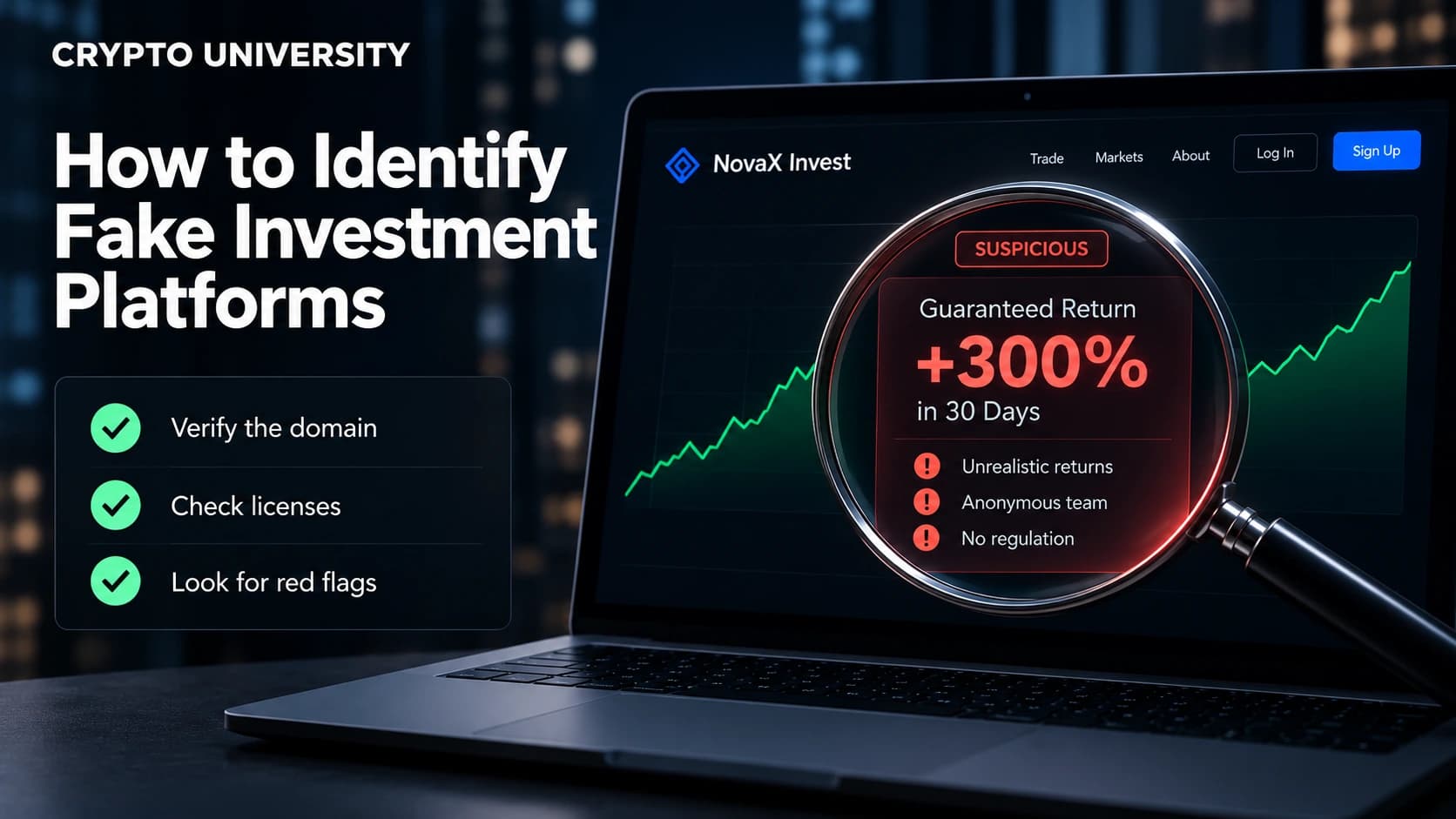
A fake investment platform is a website or app that presents itself as a broker, exchange, trading desk, mining service, or asset manager, but does not hold or trade client assets as claimed. The interface is the product. The numbers on the screen are entries in a database controlled by the operator.
Three common variants:
| Variant | How it presents itself | What is actually happening |
|---|---|---|
| Fake exchange or broker | Full trading interface, order books, live charts | Deposits go to operator-controlled wallets or bank accounts. Balances are display only. |
| Clone firm | Uses the name, logo, and licence number of a genuine regulated company | The real firm is uninvolved. Contact details and domain are different. |
| Fake yield or mining product | Fixed daily or monthly returns from staking, arbitrage bots, or mining | Returns are paid from new deposits or not paid at all. |
The SEC and CFTC have jointly warned that fraudulent digital asset websites typically promise high guaranteed returns in the range of 20 to 50 percent with little or no stated risk, and that operators sometimes stop communicating entirely once funds arrive.
The Standard Six Stage Pattern
Most fake platforms follow the same sequence. Recognising the stage you are in is more useful than memorising a list of warning signs.
| Stage | What happens | What to notice |
|---|---|---|
| 1. Contact | Unsolicited message on social media, dating apps, messaging groups, or an online ad | You did not go looking for this platform |
| 2. Trust building | Friendly conversation over days or weeks, screenshots of profits, mentorship framing | Emotional rapport is built before any financial detail |
| 3. Small deposit | You are guided to a specific site or app and asked to start small | The platform is chosen for you, not by you |
| 4. Visible profit | Dashboard shows fast gains. A small withdrawal may even succeed | The early withdrawal is bait, funded by your own deposit |
| 5. Escalation | Pressure to add more, often with borrowed money or retirement savings | Urgency, limited time offers, group encouragement |
| 6. Exit block | Withdrawal is frozen. A tax, commission, or compliance fee is demanded | This is the confirmation stage of the fraud |
The FBI's Operation Level Up notified 3,780 people in 2025 that they were being defrauded. Around 78 percent of them did not know.
Red Flags You Can Check Quickly
Commercial red flags
- Guaranteed or fixed returns. No real market produces guaranteed daily percentages. Returns and risk move together.
- Unsolicited approach. A stranger who contacts you first and later mentions an investment platform is the most common entry point in reported cases.
- Pressure and deadlines. Legitimate platforms do not need you to fund an account within the hour.
- Payment in crypto to an address given in chat. Transfers are fast and effectively irreversible.
- New payment demands at withdrawal. Regulators note that fraudsters direct victims to pay purported taxes to release fake profits. The CFTC has stated plainly that brokers do not collect or withhold taxes from trading accounts, and that you should never pay more money to withdraw from your own account.
Structural red flags
- No named legal entity, company registration number, or physical address.
- Support available only through Telegram, WhatsApp, or a chat widget, with no verifiable corporate email or phone.
- Terms and conditions copied from another site, or missing entirely.
- Reviews that all appeared within a short window and repeat the same phrasing.
- A domain registered recently despite claims of many years in business.
- Spelling and grammar errors in legal or fee documentation. The SEC and CFTC list this as a recognised warning sign.
The Verification Checklist
Work through these steps before depositing. Each one is free and takes minutes.
Step 1: Identify the legal entity. Find the exact registered company name, jurisdiction, and registration number. If the site will not tell you who you are contracting with, stop there.
Step 2: Search the official register, not the website. Look up the entity on the regulator's own register. Then compare the website domain, email domain, and phone number against the ones listed on the register. Clone firms copy real names and licence numbers, so matching the name alone proves nothing.
Step 3: Search the warning lists.
| Authority | Tool | What it covers |
|---|---|---|
| SEC (US) | Investor.gov search and the PAUSE list | Registration status, plus entities falsely claiming US registration, impersonators, and fake regulators |
| FINRA (US) | BrokerCheck | Licensed brokers and firms, with disciplinary history |
| CFTC (US) | RED List | Entities appearing to require registration but not registered |
| FCA (UK) | Financial Services Register and Warning List | Authorised firms plus firms known to be operating without permission |
| IOSCO (global) | Investor Alerts Portal | Aggregated alerts from member regulators worldwide |
| Local regulator | National register or alert list | Most jurisdictions publish an equivalent, including ASIC, MAS, and SFC |
The FCA notes an important limitation. If a firm is not on a warning list, that does not make it safe. Operators change names constantly and regulators cannot list them all.
Step 4: Check the domain. Run a public WHOIS or domain age lookup. A site claiming a decade of operation on a domain registered three months ago is misrepresenting itself. Check for near-miss spellings of a well known brand.
Step 5: Check the app carefully. Fake apps reach official stores. In April 2026, Kaspersky reported 26 fraudulent applications on the Apple App Store impersonating wallets including MetaMask, Ledger, Trust Wallet, Coinbase, TokenPocket, imToken, and Bitpie, using cloned icons and small name misspellings. Some redirected users to a fake App Store page and asked them to install an enterprise profile to sideload a compromised version. Apple has said it terminated 193,000 developer accounts and rejected more than 371,000 copycat submissions in 2025.
Practical rules: reach the app through a link on the official website you typed yourself, check the developer name and publication history, and never install a profile or certificate sent to you in a chat.
Step 6: Test a withdrawal early. Deposit a small amount, then withdraw most of it before adding anything more. A platform that processes deposits instantly but delays or conditions withdrawals is signalling its business model.
Step 7: Check custody and disclosure. Ask who holds the assets, under what licence, and whether client funds are segregated. Real platforms answer this in writing. Fake ones deflect or send marketing material.
Two Traps That Catch Careful People
Fake recovery services. After a loss, victims are often contacted by supposed law firms, blockchain investigators, or government officials who offer to retrieve funds for an upfront fee. The IC3 logged more than 10,500 recovery scam complaints in 2025 with an estimated $1.4 billion in losses, including cases where fraudsters impersonated IC3 staff. Assume any unsolicited recovery offer is a second attempt on the same victim.
AI generated credibility. Deepfaked video endorsements, cloned voices, fabricated news pages, and AI written support scripts now make fake platforms look established. Chainalysis found that scam operations with links to AI service providers earned several times more than those without. Treat a video endorsement as marketing, never as verification.
If You Have Already Deposited
- Stop sending money immediately, including any fee described as necessary to unlock a withdrawal.
- Preserve evidence: transaction IDs, wallet addresses, screenshots, chat logs, the domain, and app details.
- Notify your bank or the exchange you sent funds from. Speed matters, since some transfers can still be flagged.
- Report to your national police cybercrime unit and financial regulator. In the US that includes IC3, the SEC, and the CFTC.
- Decline all recovery offers that arrive afterwards.
This article is educational and is not financial, legal, or investment advice.
FAQ
Can a fake investment platform appear in Google search or app stores? Yes. Paid advertising, search optimisation, and app store submissions are all used by fraudulent operators. Presence on a mainstream platform is not verification.
Is a licence number on a website enough proof? No. Clone firms copy genuine licence numbers. Verification only counts when you look up the number on the regulator's own register and confirm that the contact details match.
Why did my first small withdrawal succeed? Early withdrawals are often paid from your own deposit to build confidence before a larger deposit is requested. A successful small withdrawal is not evidence of solvency.
Is being asked to pay tax before withdrawal ever legitimate? Regulators say no. Brokers do not collect taxes from trading accounts, and demands for a release fee, AML charge, or unlock payment are described by the CFTC and FBI as advance fee fraud.
What if the platform is not on any warning list? Absence from a list means nothing on its own. New entities appear faster than regulators can catalogue them, so rely on positive verification in an official register instead.
Related Terms
- Advance fee fraud: A scheme where a victim is asked to pay upfront charges to release money that does not exist.
- Clone firm: A fraudulent operation using the name, branding, and licence details of a genuine regulated business.
- Pig butchering: A long-form scam that builds a personal relationship before directing the victim to a fake investment platform.
- Warning list: A regulator-published register of firms believed to be operating without authorisation.
- Proof of reserves: A published attestation intended to show that a platform holds assets matching customer balances.
Sources
- FBI, 2025 Internet Crime Report and IC3 press release, April 2026
- Chainalysis, 2026 Crypto Crime Report: Scams
- SEC and CFTC staff, Investor Alert: Watch Out for Fraudulent Digital Asset and Crypto Trading Websites
- CFTC, Customer Advisory on fee scams and unregistered brokers
- FCA, Warning List of unauthorised firms
- SEC, Public Alert: Unregistered Soliciting Entities (PAUSE)
- Kaspersky, press release on fraudulent crypto wallet applications, April 2026
More Reading
- FBI IC3 Annual Report page for the full statistical breakdown of investment fraud complaints.
- FCA guidance on clone firms and how to check the Financial Services Register correctly.
- IOSCO Investor Alerts Portal for cross-border warnings issued by member regulators.
- How to Identify a Fake Hardware Wallet Website (/guides/how-to-identify-fake-hardware-wallet-website) ---
Disclaimer: This article is educational and is not financial, legal or investment advice. Regulatory rules and register locations change, so verify details with the relevant authority before acting.
Not sure which problem you have?
Use the Fixing Crypto Mistakes hub to identify the transaction, wallet, network, or exchange issue before taking another action.
OPEN TROUBLESHOOTING HUB