Key Takeaways
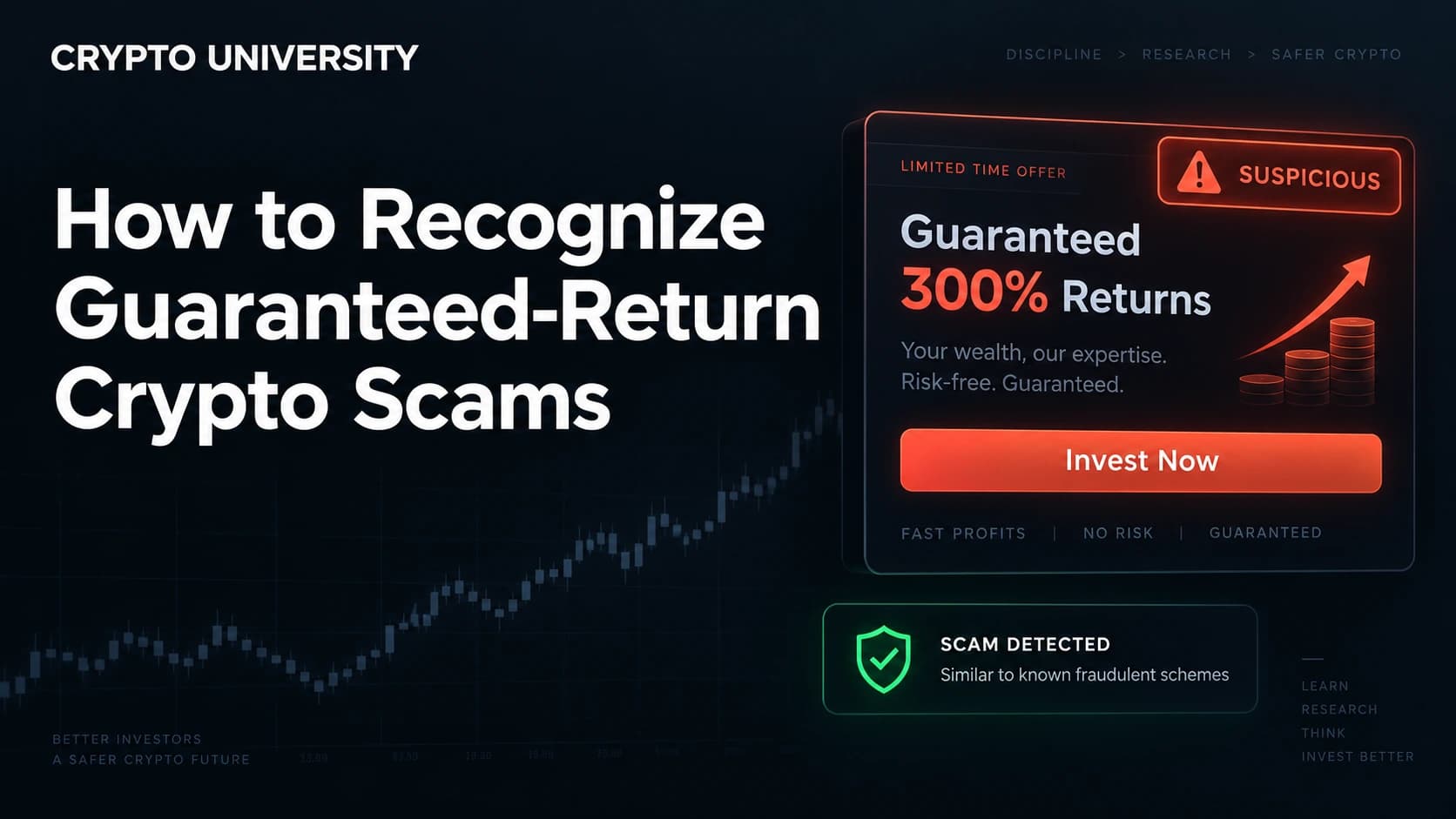
- A guaranteed return is not a feature, it is a warning. No investment that carries market risk can promise a fixed payout, and regulators treat the words "guaranteed" and "risk free" as core evidence of fraud in crypto cases.
- The pitch barely changes between a small scam and a billion-dollar one. Enforcement filings against schemes ranging from roughly 198 million dollars to more than 1.7 billion dollars used almost identical language: membership packages, daily passive rewards, and referral bonuses.
- Verification takes about ten minutes and works better than intuition. Free public registries let you check whether a firm is registered and whether regulators have already flagged it, before any money moves.
Crypto investment fraud is now the single largest category of reported financial crime in the United States. According to the FBI Internet Crime Complaint Center annual report for 2025, complaints involving cryptocurrency totaled 181,565 and accounted for more than 11.3 billion dollars in reported losses, roughly a 22 percent increase over the previous year. Investment fraud overall drove about 8.6 billion dollars of that total, and crypto investment scams alone accounted for around 7.2 billion dollars.
Almost all of these schemes share one sales line. They promise a return that cannot lose.
Why "Guaranteed" Is the Strongest Signal
Every real investment return is payment for taking a risk. If the outcome were certain, there would be no reason to pay you a high rate for it. That is why the promise of a guaranteed return is not a bonus feature. It is a contradiction, and it is the most reliable single indicator that something is wrong.
There is a narrow exception worth understanding. Some products genuinely do have fixed rates, such as an insured bank deposit or a government bond held to maturity. Those returns are low, they are backed by a named institution, and they are covered by a legal framework you can look up. A crypto platform offering 1 percent per day is not in that category, and it is not comparable to it, no matter how the marketing is worded.
Be alert to the softer versions of the same claim. "Risk free," "capital protected," "fixed daily rewards," "insured by our reserve fund," and "we cover any losses" all make the same promise while avoiding the word guaranteed.
Learn Where Real Yield Comes From
The best defence is understanding how honest returns are produced. If a platform cannot explain its revenue source in plain language, or if the explanation does not survive a follow-up question, that is the answer.
| Yield source | How it actually works | Is the rate fixed? |
|---|---|---|
| Staking | You lock tokens to help secure a proof-of-stake network and earn newly issued tokens plus fees | No. It varies with network activity and the total amount staked |
| Lending | Borrowers pay interest on assets you supply to a lending market | No. Rates float with borrowing demand, and borrowers can default |
| Market making | Providing liquidity to a trading venue earns fees on volume | No. Fees vary and can be offset by losses from price movement |
| Mining | Hardware secures a proof-of-work network in exchange for block rewards | No. It depends on price, difficulty, and electricity cost |
| Ponzi payout | New deposits are recycled to pay earlier participants | Yes, until deposits slow and the scheme collapses |
Notice the pattern. Every legitimate source produces a variable rate. Only fraud produces a fixed one, because a fraud is not generating anything, so nothing constrains the number it advertises.
Run the Arithmetic
Scam returns are usually quoted per day, because daily figures sound small. Converting them exposes the claim.
A promise of 1 percent per day is roughly 365 percent per year without compounding. With daily compounding, it is more than 3,000 percent. Applied to a modest 10,000 dollar deposit, a scheme paying that rate would need to produce returns that would make it one of the most profitable enterprises on earth within a few years. It never explains how.
The HyperFund scheme is the clearest documented example. The SEC alleged in January 2024 that the operation promised investors 0.5 percent to 1 percent per day in passive rewards, with the prospect of tripling an initial investment within 600 days, supposedly funded by large-scale crypto mining operations. Regulators alleged those mining operations did not exist and that the scheme had no revenue other than investor deposits. It raised more than 1.7 billion dollars before it collapsed.
Eight Warning Signs
| # | Warning sign | Why it matters |
|---|---|---|
| 1 | Fixed or guaranteed daily, weekly, or monthly returns | No real yield source produces a constant rate |
| 2 | Referral or recruitment bonuses | Paying for recruitment is the structural signature of a pyramid |
| 3 | "Membership packages" or tiered plans | Sells access to a promise rather than a described asset |
| 4 | Vague revenue story involving AI bots, arbitrage, or mining | Complexity is used to discourage follow-up questions |
| 5 | Pressure to act quickly or before a bonus window closes | Urgency prevents you from verifying anything |
| 6 | Screenshots of profits, luxury cars, and lifestyle posts | Proof of spending is not proof of trading |
| 7 | A fee required before you can withdraw | Common tactic to extract a second payment after the first |
| 8 | No named, verifiable regulated entity behind the offer | Removes accountability and legal recourse |
How the Pitch Usually Unfolds
Most of these operations follow the same sequence, described repeatedly in FBI and SEC materials.
- Contact. An approach arrives through social media, a messaging app, a dating platform, or a community group. It is often friendly and unhurried for days or weeks.
- Credibility. You are shown a polished website, a dashboard, testimonials, or an introduction to a supposed insider or fund manager.
- A small test deposit. You invest a small amount and are allowed to withdraw successfully. This single step converts most of the remaining doubt.
- Escalation. With trust established, you are encouraged to deposit far more, sometimes to borrow, and often to recruit family or colleagues.
- The block. Withdrawals stop. New reasons appear: a tax payment, a compliance fee, an account upgrade, an unlock charge.
The dashboard number is not your money. It is a figure on a web page that the operator controls. In many documented cases the deposits were never traded at all.
The Same Script at Every Scale
| Case | Alleged size | Language used | Structure |
|---|---|---|---|
| HyperFund (SEC, Jan 2024) | Over 1.7 billion dollars | Guaranteed high returns of 0.5 to 1 percent daily from crypto mining | Pyramid and Ponzi with referral rewards |
| CryptoFX (SEC, Mar 2024) | About 300 million dollars | "Risk free" and "guaranteed" crypto and forex returns | Ponzi targeting more than 40,000 mostly Latino investors |
| PGI Global (SEC, Apr 2025) | About 198 million dollars | Membership packages guaranteeing high returns from crypto and forex trading | Ponzi-like payouts with MLM referral incentives |
Read across that table and the lesson becomes obvious. The dollar amounts differ enormously. The vocabulary does not. In the PGI Global matter, the SEC alleged that more than 57 million dollars of investor funds went to Lamborghinis, luxury goods, and personal expenses rather than any trading activity.
Note the pattern in the third case as well. CryptoFX targeted a specific community. This is called affinity fraud, and it works because trust is inherited from the group rather than earned by the operator.
A Ten Minute Verification Checklist
Do this before money moves, not after.
- Check the registries. Investor.gov and FINRA BrokerCheck cover registration in the United States. The CFTC operates SmartCheck and a Registration Deficient list. Outside the US, use the FCA Financial Services Register and Warning List in the UK, the MAS Investor Alert List in Singapore, and ASIC resources in Australia. The IOSCO Investor Alerts Portal aggregates warnings globally.
- Search the name plus the word scam, warning, or complaint. Also search for the platform name alongside the word withdrawal.
- Identify the legal entity. A real firm has a registered company name, a jurisdiction, and a physical address. "Our team is global" is not an answer.
- Reverse image search the staff photos. Fabricated teams are common and are usually caught in seconds.
- Test one specific question. Ask exactly how the yield is produced and what happens in a losing month. Evasion or a change of subject is a result.
- Treat any withdrawal fee as the end of the process. Legitimate platforms deduct fees from a withdrawal. They do not require a separate incoming payment to release your own funds.
A striking figure underlines why this checklist matters. Through its Operation Level Up initiative, the FBI reported notifying 3,780 crypto investment fraud victims during 2025, and 78 percent of them did not know they were being defrauded at the time they were contacted. Confidence is not evidence.
The Second Scam That Follows the First
Anyone who loses money to a crypto scheme should expect to be targeted again. The IC3 recorded more than 10,500 complaints about recovery scams in 2025, with roughly 1.4 billion dollars in reported losses. These operations pose as law firms, blockchain forensics specialists, or government officials, and in at least one documented case impersonated IC3 staff. Victim lists circulate among criminal groups, which is why the second approach often arrives soon after the first loss and appears to know the details.
No private company can reverse a blockchain transaction. Any promise to recover funds for an upfront fee should be treated as a fresh scam.
If You Have Already Sent Funds
Stop sending money immediately, including any payment described as a fee, a tax, or a final unlock charge. Record everything: wallet addresses, transaction hashes, usernames, screenshots, and dates. Report the matter to the relevant national authority, such as the IC3 in the United States or Action Fraud in the UK, and notify the exchange you used, since exchanges can sometimes freeze funds that have not yet moved onward. Losing money to a well-built scheme is not a sign of poor judgement, and reporting it improves the data regulators use to disrupt these operations.
Frequently Asked Questions
Is any guaranteed return in crypto legitimate? No return tied to crypto trading, mining, lending, or arbitrage can be guaranteed, because all of those activities carry variable outcomes. A fixed advertised rate on a crypto investment product should always trigger verification before anything else.
Are staking rewards guaranteed? No. Staking rewards vary with network conditions, validator performance, and the total amount staked. Some networks also apply penalties for validator downtime or misbehaviour. Published rates are estimates, not promises.
Why did my first small withdrawal work? Allowing an early withdrawal is a standard step in these schemes. It is paid from other people's deposits and exists to build the confidence needed for a much larger second deposit. A successful small withdrawal proves nothing about solvency.
How can I check whether a crypto platform is registered? Use the free public registers maintained by financial regulators, including Investor.gov and FINRA BrokerCheck in the United States, the FCA register in the UK, and the IOSCO Investor Alerts Portal for global warnings. Confirm the exact legal entity name, since scams often mimic the name of a genuine firm.
Can stolen crypto be recovered? Recovery is difficult and usually depends on law enforcement action or an exchange freezing funds before they move on. Blockchain transactions cannot be reversed by a private company, so any service demanding an upfront fee to recover losses should be treated as a further scam.
Related Terms
- Ponzi scheme: An operation that pays existing participants using money from new participants rather than genuine profit.
- Pyramid scheme: A structure where earnings depend mainly on recruiting new members rather than selling a real product or service.
- Affinity fraud: Fraud aimed at a specific community, using shared identity or membership to borrow trust.
- Pig butchering: A long-form scam in which a relationship is built over weeks before the victim is directed to a fake investment platform.
- APY (Annual Percentage Yield): A rate showing the yearly return including compounding. In crypto it is almost always a variable estimate, not a fixed commitment.
Sources
- FBI Internet Crime Complaint Center, 2025 Internet Crime Report, ic3.gov
- FBI press release, "Cryptocurrency and AI Scams Bilk Americans of Billions," fbi.gov
- SEC Press Release 2024-11, "SEC Charges Founder of $1.7 Billion HyperFund Crypto Pyramid Scheme and Top Promoter with Fraud," sec.gov
- SEC Press Release 2024-35, "SEC Charges 17 Individuals in $300 Million Crypto Asset Ponzi Scheme Targeting the Latino Community," sec.gov
- SEC Press Release 2025-69, "SEC Charges PGI Global Founder with $198 Million Crypto Asset and Foreign Exchange Fraud Scheme," sec.gov
- CFTC, "Digital Asset Frauds," cftc.gov
More Reading
- CFTC, Digital Asset Frauds: A plain-language breakdown of the main fraud categories in digital assets, including Ponzi schemes, fake exchanges, and pump and dump activity.
- SEC Investor.gov, Crypto Asset Investor Alerts: Official investor bulletins covering fraudulent offerings, relationship investment scams, and how to check registration status.
- FBI IC3 Annual Report: The most detailed public dataset on reported losses by scam category, useful for understanding which tactics are growing and who they target.
- How to Protect Yourself From QR Code Crypto Scams: /guides/how-to-protect-yourself-from-qr-code-crypto-scams
--- Disclaimer: This article is educational and is not financial, legal or investment advice. Regulatory rules and register locations change, so verify details with the relevant authority before acting.
Not sure which problem you have?
Use the Fixing Crypto Mistakes hub to identify the transaction, wallet, network, or exchange issue before taking another action.
OPEN TROUBLESHOOTING HUB