Key Takeaways
- A blockchain shows you the sending address, not the sending person. Real identity almost always comes from off-chain records held by exchanges, brokers, and other regulated businesses.
- Anyone can do the first layer of work for free. A block explorer plus public entity labels will often tell you whether a payment came from an exchange, a smart contract, a bridge, or a private wallet. The final step, connecting an address to a legal name, normally requires a subpoena, court order, or law enforcement request.
- Attribution is probabilistic, not certain. Labels can be stale, clustering heuristics can be wrong, and scams such as address poisoning are designed to make a fake sender look real.
What "Sender" Actually Means on a Blockchain
Public blockchains are pseudonymous rather than anonymous. Every transfer permanently records a source address, a destination address, an amount, a timestamp, and a fee. None of that data contains a name, an email address, or a document number.
So when someone asks how to identify the sender of a crypto transaction, they are really asking two very different questions:
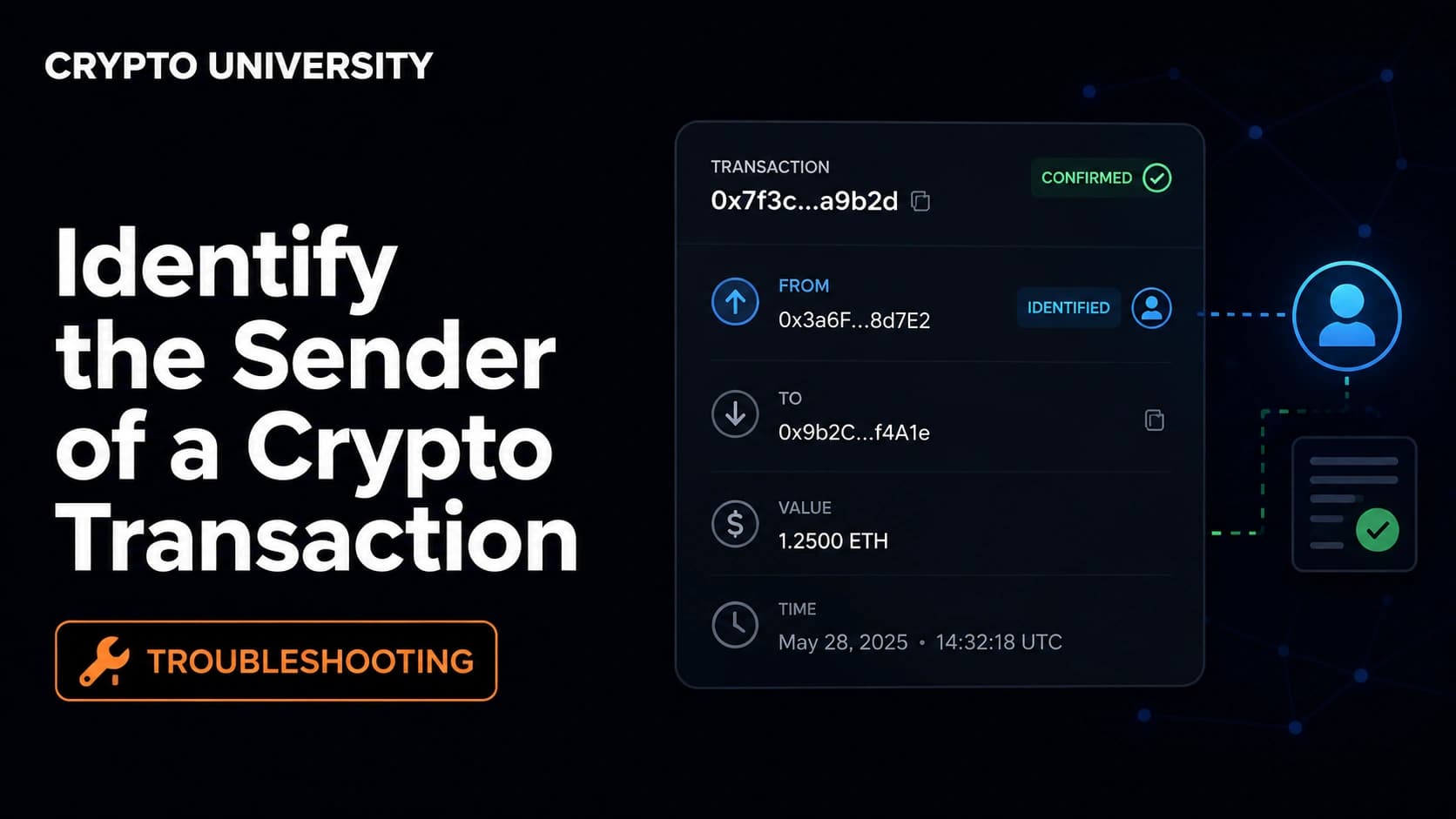
- Which address sent this? Public, free, and answerable in seconds.
- Who controls that address? Private, slow, and usually restricted to regulated firms and investigators.
The first question is data retrieval. The second is attribution, and attribution is where most of the difficulty sits.
How the sender appears on different types of blockchain
| Blockchain model | Examples | How the sender is displayed | What to watch out for |
|---|---|---|---|
| UTXO model | Bitcoin, Litecoin, Bitcoin Cash | One or more input addresses | A single payment can draw on many inputs, and analysts usually assume they share one owner |
| Account model | Ethereum, BNB Chain, Solana, Tron | A single "from" address | A smart contract can be the technical sender, which hides the human who triggered it |
| Privacy focused | Monero, Zcash shielded transactions | Hidden or deliberately ambiguous | Stealth addresses, decoy sets, and zero-knowledge proofs are designed to break the link |
One nuance trips up almost every beginner. If the sending address belongs to an exchange hot wallet, the blockchain is telling you which company processed the withdrawal, not which customer requested it. That customer record exists, but it sits in the exchange database, not on the chain.
Step by Step: What You Can Find on Your Own
Step 1: Get the transaction hash
The transaction hash, also called the TXID, is the unique identifier for a single transfer. Your wallet, your exchange withdrawal history, or the person who paid you should be able to provide it. Without a hash you can still search by address, but the hash is faster and removes ambiguity.
Step 2: Open the right block explorer
Each network has its own explorers. Using the wrong one returns nothing.
| Network | Common explorers | Useful for |
|---|---|---|
| Bitcoin | mempool.space, Blockchair, Blockchain.com | Inputs, outputs, fee behaviour, address history |
| Ethereum and EVM chains | Etherscan, BscScan, Arbiscan, Blockscout | The "from" field, token transfers, internal transactions, contract calls |
| Solana | Solscan, Solana Explorer | Signers, program interactions, token accounts |
| Tron | Tronscan | USDT transfers, which are heavily used for payments and scams |
| Multi-chain | Blockchair, Arkham, Breadcrumbs, MetaSleuth | Cross-chain views and visual tracing |
Step 3: Read the sender field carefully
On an account-based chain, look at the "from" address and check whether it is a wallet or a contract. On Bitcoin, look at every input address rather than only the first one.
Step 4: Check public entity labels
Explorers and analytics platforms tag known addresses. A label such as "Binance 14" or "Coinbase Hot Wallet" tells you the funds moved through a regulated business. That matters, because regulated businesses hold identity records. Treat labels as leads rather than proof. Labels are produced by heuristics and crowdsourced submissions, and they age badly.
Step 5: Trace back one or two hops
Look at where the sending address was funded from. A wallet funded directly by a large exchange is a very different investigative picture from a wallet funded by a mixer or a chain of freshly created addresses.
Step 6: Search for off-chain footprints
Addresses leak identity when people publish them. Search the address string on the open web, on social platforms, on GitHub, and on forums. Check whether an Ethereum address has a linked ENS name. Public donation pages, tip jars, and old marketplace posts have identified more wallets than any advanced technique.
How Professionals Link an Address to a Real Identity
Blockchain analytics firms such as Chainalysis, TRM Labs, Elliptic, and Arkham combine on-chain patterns with off-chain intelligence. The core methods are well documented in academic research.
| Technique | What it does | Main weakness |
|---|---|---|
| Common input ownership heuristic | Assumes all input addresses in one Bitcoin transaction share a single owner, because each input must be signed | Broken by CoinJoin and other collaborative transactions |
| Change address detection | Identifies which output returned funds to the sender, extending the cluster | Modern wallets that vary address types and amounts reduce accuracy |
| Behavioural analysis | Studies timing, time zones, fee choices, round-number amounts, and reuse habits | Circumstantial and easy to misread |
| Entity labelling and OSINT | Matches addresses to exchanges, merchants, ransomware wallets, and published addresses | Labels can be outdated, incomplete, or simply wrong |
| Off-chain records | KYC files, IP logs, device data, and Travel Rule messages | Only obtainable through legal process |
Two important limits. First, clustering identifies an entity, not a person. Second, the identity itself never comes from the chain. It comes from a company that verified a customer.
The Identity Layer: KYC and the Travel Rule
The reason attribution works at all is that most people eventually touch a regulated service. When they do, identity documents are collected.
The Travel Rule, based on Recommendation 16 from the Financial Action Task Force, requires regulated crypto businesses to collect and pass on sender and recipient information when value moves between them. Requirements differ by country.
| Jurisdiction | Threshold for sharing sender data | Status |
|---|---|---|
| FATF baseline recommendation | USD or EUR 1,000 | Global standard, applied differently by each member |
| European Union (Transfer of Funds Regulation) | Zero threshold for transfers between crypto-asset service providers | Applies from 30 December 2024 |
| United States (31 CFR 1010.410) | USD 3,000 | A proposal to lower cross-border transfers to USD 250 has not been finalised as of mid-2026 |
| United Kingdom | GBP 1,000 domestic, zero threshold cross-border | In force under the amended Money Laundering Regulations |
Industry trackers widely report that roughly 85 of 117 assessed jurisdictions have now passed Travel Rule legislation, although supervision and technical implementation remain uneven. These figures are estimates published by compliance vendors rather than audited counts.
For an ordinary user the practical meaning is simple. That sender data exists somewhere. You just do not have a right to see it.
Who Can Realistically Identify a Sender
| Party | What they can see | What they can obtain |
|---|---|---|
| Individual user | Addresses, amounts, timing, public labels | Nothing private, unless the sender voluntarily reveals it |
| Exchange compliance team | Everything above, plus their own customer records and Travel Rule messages | Customer identity for their own users only |
| Analytics firm | Large label databases, clustering across many chains | Entity-level attribution, sold to clients under contract |
| Law enforcement or a court | All of the above | Subpoenas, production orders, seizure warrants, mutual legal assistance requests |
This table is the honest answer to the underlying question. A private individual cannot lawfully unmask a stranger. What a private individual can do is build a clear evidence package and hand it to someone who can.
Where Tracing Gets Difficult
- Mixers and pooled transactions. Services that pool deposits break the direct link between input and output. The legal position around them is unsettled. The United States Treasury removed Tornado Cash from its sanctions list in March 2025 after an appeals court ruled that immutable smart contracts are not sanctionable property, but criminal proceedings against individual developers continued after that decision.
- Privacy coins. Monero hides amounts, uses one-time stealth addresses, and conceals the true spend inside a decoy set. Historically the decoy set was 16 members per input, and the project has been moving to full-chain membership proofs that widen it dramatically. Investigators generally attack the conversion points where privacy coins are bought or sold, not the cryptography.
- Cross-chain bridges. Value that moves between networks changes representation, so a naive trace stops at the bridge contract.
- Self-custody with no regulated touchpoint. If a wallet has never interacted with a service that performs identity checks, there may be no identity record to request.
Common Traps That Lead to the Wrong Sender
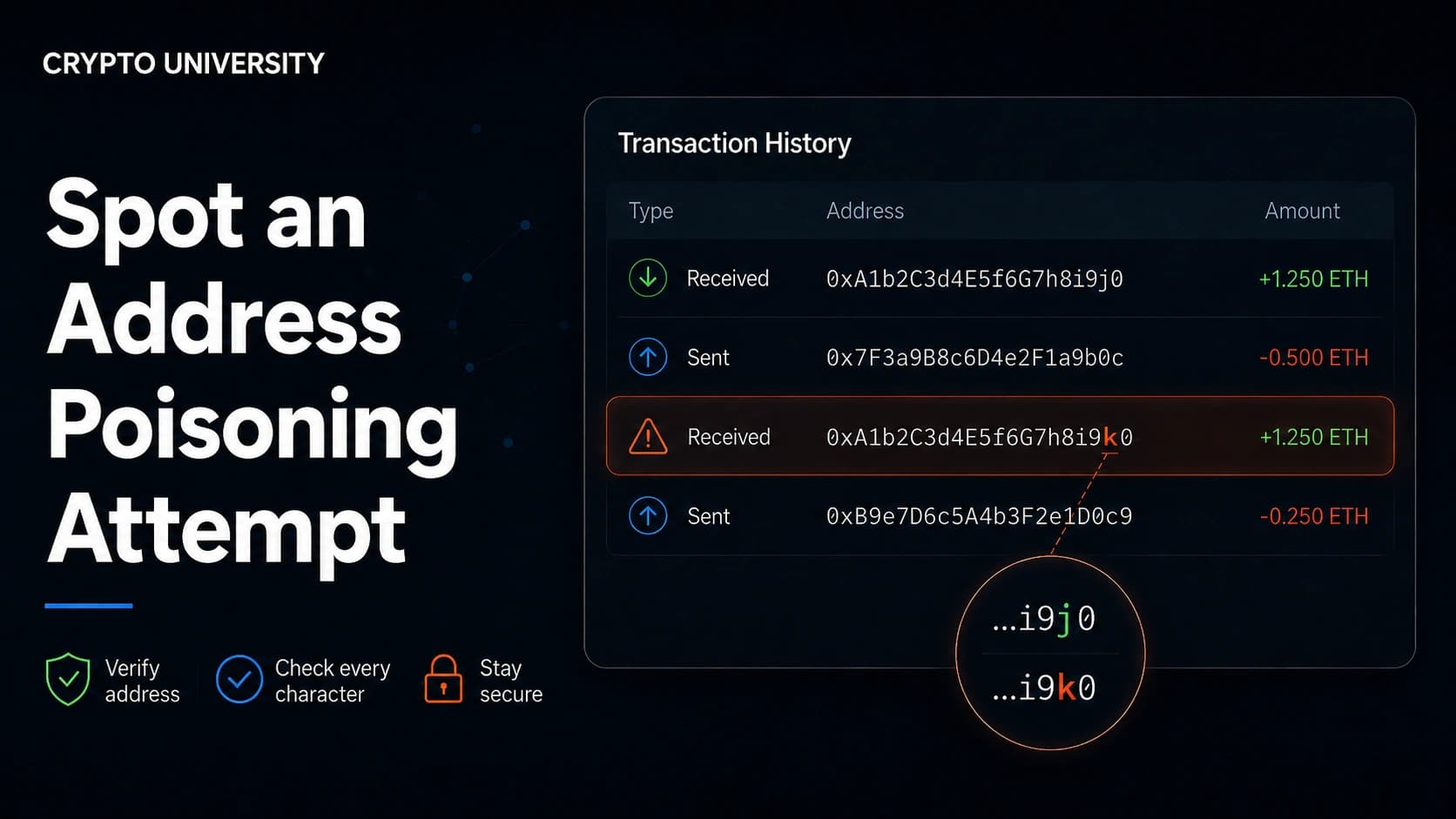
Address poisoning. Attackers generate a lookalike address that matches the first and last characters of one you trust, then push a zero-value or dust transfer into your history so the fake address appears alongside real ones. Security vendors and academic measurements report losses in the hundreds of millions of dollars from users copying an address out of their transaction history. Never treat a history entry as proof of who sent something, and never copy an address from it.
Contracts and routers. On EVM chains the "from" field may show a router, an aggregator, or a bridge. The initiating account is often visible in the internal transactions instead.
Assuming a label is a person. "Exchange hot wallet" means a company, not a customer.
Recovery scams. Anyone who contacts you promising to identify a thief and return your funds for an upfront fee should be treated as a second scam attempt. This pattern is one of the most consistently reported follow-on frauds.
If You Have Received or Lost Funds
- Record everything. Save transaction hashes, addresses, dates, screenshots, and any messages.
- Contact the exchange. If the funds passed through a regulated platform, its compliance team can flag or freeze internally and will act faster when law enforcement is already engaged.
- File an official report. In the United States that is the FBI Internet Crime Complaint Center at ic3.gov. Other countries have equivalent national channels. Filing creates the case reference that later legal steps depend on.
- Consider professional help for larger amounts. Licensed investigators and lawyers can request records through legal channels that individuals cannot use.
- Do not attempt to confront or dox anyone. Publishing an accusation based on a probabilistic label is both unreliable and legally risky.
Legal and Ethical Boundaries
Blockchain data is public, but combining it with personal data creates a privacy question. In many jurisdictions a wallet address that can be linked to a person is treated as personal data. Using on-chain analysis to harass, expose, or pressure someone can create legal exposure regardless of how the data was obtained.
This article is educational and is not legal advice. If you are dealing with theft, fraud, or a compliance obligation, speak to a qualified professional in your jurisdiction.
Frequently Asked Questions
Can I find out who sent me crypto using only a block explorer? You can find the sending address and often the service it belongs to. You cannot get a name. Explorers publish chain data, not customer records.
Are Bitcoin transactions anonymous? No. They are pseudonymous. The full history of every address is permanent and public, which is why analysis techniques developed over the past decade work so well.
Will an exchange tell me who sent a transaction? No. Exchanges are bound by data protection and financial privacy rules. They disclose customer identity to law enforcement and courts through formal legal process.
How accurate are wallet labels on analytics platforms? They are useful but imperfect. Labels come from heuristics, public sources, and user submissions, and they can be outdated or incorrect. Treat a label as a starting point for investigation.
Can stolen crypto be traced and recovered? Tracing is often possible. Recovery depends on whether the funds reach a cooperative regulated platform while there is still a balance to freeze, which is why reporting quickly matters.
Five Related Terms
- Pseudonymity
- identity is hidden behind a persistent identifier rather than removed entirely.
- Address clustering
- grouping addresses that appear to be controlled by the same entity.
- Travel Rule
- the requirement for regulated crypto firms to share sender and recipient details.
- UTXO
- the unspent output model used by Bitcoin, where inputs and outputs replace account balances.
- Attribution
- linking on-chain activity to a real-world entity or person.
Sources
- Financial Action Task Force, Recommendation 16 and virtual asset guidance, fatf-gafi.org
- European Union Regulation 2023/1113 (Transfer of Funds Regulation) and European Banking Authority Travel Rule Guidelines
- United States Code of Federal Regulations, 31 CFR 1010.410; FinCEN and Federal Reserve joint notice of proposed rulemaking, October 2020
- United States Court of Appeals for the Fifth Circuit, Van Loon v. Department of the Treasury, November 2024; OFAC delisting notice, March 2025
- He et al., "Bitcoin address clustering method based on multiple heuristic conditions", IET Blockchain, 2022
- FBI Internet Crime Complaint Center, guidance for cryptocurrency scam victims, ic3.gov
- Ledger Academy and MetaMask support documentation on address poisoning attacks
Three More Reading
- TRM Labs, "The Fundamentals of Cryptocurrency Transaction Tracing"
- a clear vendor-neutral overview of how tracing workflows are structured.
- Meiklejohn et al., "A Fistful of Bitcoins"
- the foundational academic paper on clustering and identifying entities from Bitcoin transaction data.
- FATF, "Targeted Update on Implementation of the FATF Standards on Virtual Assets and VASPs"
- the annual report tracking how far Travel Rule enforcement has actually spread.
Disclaimer: This article is educational content. It is not financial, investment, tax, or legal advice. Network behaviour, fees, and explorer interfaces change over time, so verify current details against official documentation before relying on them.
Not sure which problem you have?
Use the Fixing Crypto Mistakes hub to identify the transaction, wallet, network, or exchange issue before taking another action.
OPEN TROUBLESHOOTING HUB