Key Takeaways
The standard route is simple: transfer crypto to a South African exchange that is licensed by the FSCA, sell it for Rand, then withdraw the Rand to a bank account in your own name.
Fees are usually small, but the details matter. Withdrawal costs, network fees for sending crypto and processing times differ between platforms, and banking with Standard Bank often speeds things up.
Cashing out is a taxable event. SARS treats crypto as an asset, and from March 2026 exchanges report user data to SARS automatically under the CARF rules. Keep records and declare your gains.
Turning crypto into Rand, explained
“Cashing out” means converting a cryptocurrency such as Bitcoin, Ethereum or a stablecoin into South African Rand that you can spend or keep in a normal bank account. In 2026 this is a routine, well-supported process. South Africa has one of the most active crypto markets in Africa, with regulators reporting millions of users across the largest local exchanges, and the main platforms are now formally licensed.
This guide walks through the basic process, compares the three main local options, explains which crypto is cheapest to move, and covers large amounts, P2P and OTC desks, and tax. It is educational information, not financial or tax advice. Rules and fees change, so confirm current figures on the official platform and government sites before you act.
The basic process, step by step
Almost every cash-out in South Africa follows the same four stages, whichever platform you use.
Open and verify an account on a licensed South African exchange. You will complete identity verification (KYC), also called FICA verification, by uploading an ID document and proof of address. Higher verification levels raise your deposit and withdrawal limits.
Send your crypto to the exchange. Copy the exchange’s receiving address for the exact coin and network, then send from your external wallet. Always confirm the network matches on both sides.
Sell the crypto for Rand. Use a simple “buy/sell” screen for convenience, or the exchange’s order book for a better price on larger trades. Your Rand appears in a ZAR wallet on the platform.
Withdraw Rand to your bank account. Link a South African bank account in your own name, request a withdrawal, and confirm with a one-time PIN or two-factor code.
If you bought the crypto on the same exchange in the first place, you can skip straight to selling. The transfer step only applies when the coins sit in an external wallet.
Comparing your main options
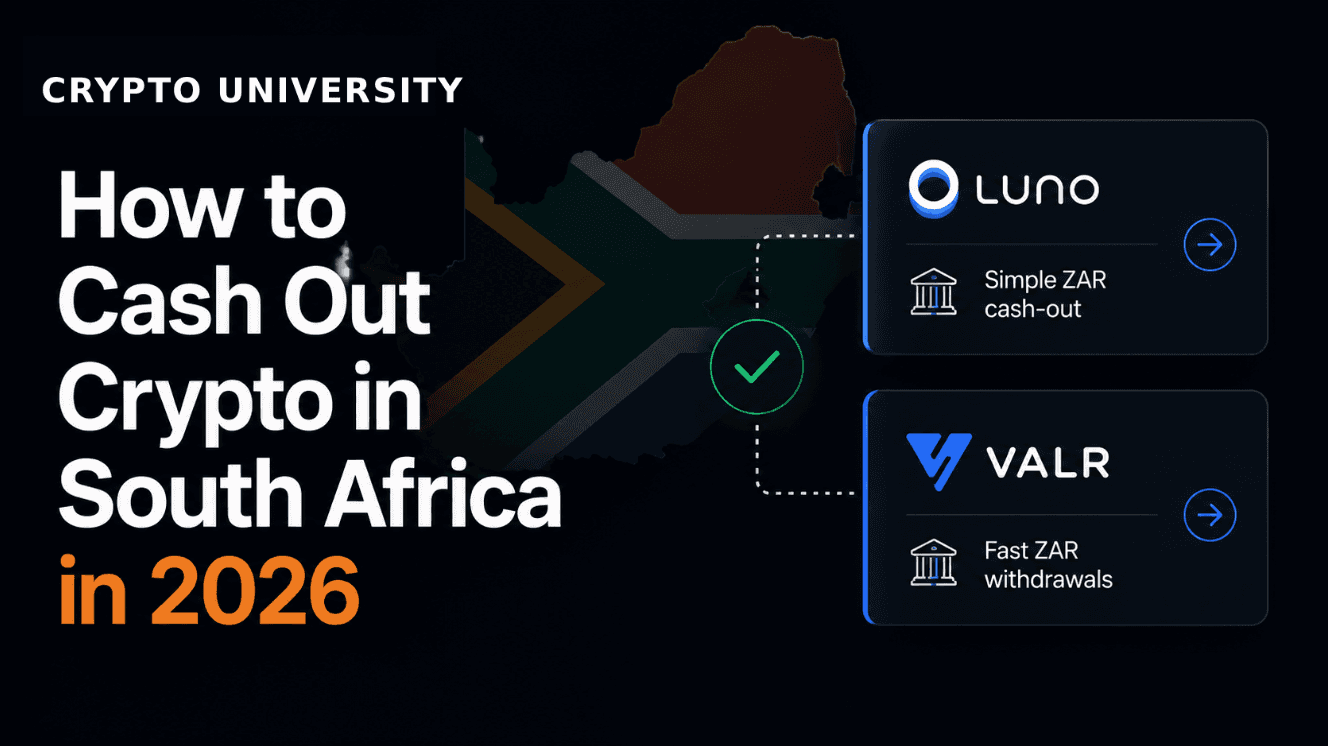
Three exchanges dominate local ZAR cash-outs, and all three hold Crypto Asset Service Provider (CASP) licences from the Financial Sector Conduct Authority (FSCA), granted from 2024 onwards. Being licensed does not remove market risk, but it means the provider is supervised for conduct and anti-money-laundering compliance.
Option 1: Luno (simple ZAR cash-out)
Luno is the most beginner-friendly option and has operated in South Africa for over a decade. Selling and withdrawing are straightforward from the app. Standard bank transfers (EFT) can take up to two business days to reflect. Luno also offers an express withdrawal: according to Luno’s help centre the fee is R20 to real-time-clearing (RTC) banks and R80 to other supported banks, with express amounts below R250,000 processed 24/7. Because Luno banks with Standard Bank, withdrawals to a Standard Bank account typically reflect within about 15 minutes during listed hours at no express fee.
Option 2: VALR (fast ZAR withdrawals)
VALR is popular with intermediate and active users and offers deeper markets and more assets. VALR gives individual clients 30 free normal ZAR withdrawals per calendar month. Its “Blitz Processing” system routes withdrawals over the RTC network for near-instant payment where the receiving bank supports it. VALR states that amounts under R250,000 are processed near-instantly 24/7 except Sundays and public holidays. A “fast withdrawal” adds a bank premium fee that is shown on screen before you confirm. Note VALR only pays out to a bank account in your own name.
At-a-glance comparison (confirm live figures before withdrawing):
Feature | ||
|---|---|---|
Best suited to | Beginners | Intermediate / active users |
FSCA CASP licence | Yes | Yes |
ZAR deposit | Free EFT (bank fees may apply) | Free EFT |
Free ZAR withdrawals | No set free allowance | 30 free normal / month (individuals) |
Fast withdrawal option | Express: R20 RTC / R80 other | Fast withdrawal with bank premium fee |
Speed to Standard Bank | Often ~15 min in listed hours | Near-instant 24/7 (with limits) |
Bank account name rule | Own name | Own name only |
Fees, limits and processing windows above are drawn from each provider’s public help documentation and can change at any time.
A word on P2P and OTC desks
Two other routes exist. Peer-to-peer (P2P) means selling directly to another person, often through a marketplace that holds the crypto in escrow while the buyer pays Rand into your bank. P2P can offer flexibility, but it carries higher fraud risk: reversed payments, fake proof of transfer and chargeback scams are common. If you use P2P, stick to platforms with escrow, never release crypto before cleared funds arrive, and be cautious of deals that look too good.
OTC (over-the-counter) desks handle large trades privately, away from the public order book, to avoid moving the market price. Several licensed South African providers run OTC services. For sizeable amounts an OTC desk can give a cleaner single price and dedicated support, usually with strict verification. For most everyday users, a standard exchange cash-out is simpler and cheaper.
South Africa (ZAR) via P2P
General Process (All Platforms)
Hold crypto (preferably USDT) in the platform’s funding/spot wallet.
Go to P2P → Sell.
Select ZAR + preferred payment method (mainly Bank Transfer / EFT).
Choose a high-rated buyer (completion rate ≥98–99%, many completed orders).
Platform locks your crypto in escrow.
Buyer sends ZAR to your South African bank account.
Confirm the funds have cleared in your banking app, then release the crypto.
Platform fees: Usually 0% for the seller (taker). You pay via the rate spread.
Key safety rule: Only release after actual bank credit (not SMS/email). Use platform chat only. Start with small amounts.
Requirements: Full KYC on all three.
Common methods in SA: Bank Transfer (Capitec, FNB, Standard Bank, Absa, Nedbank, etc.). Some cash-in-person or other options appear depending on the advertiser.
Quick Comparison
Platform | Liquidity (ZAR) | Ease of Use | Payment Flexibility | Best For |
Highest | High | Good (mainly banks) | Volume & reliability | |
Medium | High | Highest | Variety & local options | |
Good | High | Good | Zero fees & clean UX |
Practical tips for SA users
Compare live rates across the three before selling.
Prefer advertisers who accept your specific bank.
Watch for bank daily limits or temporary freezes on crypto-related transfers.
Crypto disposals are taxable in South Africa (SARS treats them as assets for CGT). Keep records.
Always verify current availability and terms directly on the platforms, as payment methods and liquidity can change.
Which crypto should you send?
When you move coins into an exchange, you pay a network fee (also called a miner or gas fee) that goes to the blockchain, not the exchange. This fee depends on the coin and network you choose, not the Rand value you are moving. Picking a cheaper network can save meaningfully on small and medium transfers.
Stablecoins on low-cost networks are usually cheapest. For example, USDT on Tron (TRC-20) or Solana, and USDC on Solana or Base, typically carry very low fees. Luno supports USDT on Ethereum and Tron; VALR supports USDT on Solana, Tron and Ethereum, and USDC on several networks including Solana and Base.
Bitcoin and Ethereum work but can cost more. Bitcoin fees vary with congestion; Ethereum (ERC-20) transfers are often the most expensive option during busy periods.
Match the network on both ends. Sending USDT on Tron to an address that only accepts USDT on Ethereum can cause permanent loss. Always confirm the exact coin and network before sending, and send a small test amount first if you are unsure.
A practical rule for many people: if you are already holding a stablecoin, move it on a low-fee network. If you are holding Bitcoin, weigh the network fee against simply selling where the coins already are.
Cashing out large amounts
There is no single “limit” on cashing out, but large transactions attract more checks. Exchanges are accountable institutions under the Financial Intelligence Centre Act (FICA), so for bigger withdrawals they may ask for source-of-funds documents and take longer to process. Both Luno and VALR handle very large amounts, but timing rules tighten above certain thresholds. VALR, for instance, describes near-instant RTC processing up to R5 million during weekday business hours, with smaller limits after hours and on Saturdays, and heavier amounts routed through the slower RTGS system.
Practical steps for large cash-outs:
Raise your verification level in advance so your limits are high enough.
Have proof of the origin of the funds ready, such as trade records or purchase history.
Consider splitting a very large sale across the order book or using an OTC desk to reduce price impact.
Expect large withdrawals to occasionally be reviewed; build in time rather than assuming instant payout.
A separate legal question is exchange control. Cashing out on a local licensed exchange to your own South African bank account is a domestic transaction. Sending crypto to an offshore exchange or foreign wallet is different. In the 2025 Standard Bank v SARB case a High Court found that crypto did not fall within the existing exchange-control definitions of “money” or “capital,” but the South African Reserve Bank is appealing, and in the February 2026 Budget the government said it will publish draft rules to bring crypto into the cross-border capital-flow framework. In short, the rules for moving crypto across borders are being tightened. If you are moving large value offshore, get professional advice.
Here is a quick overview of deeper detail on How to Cash Out Crypto.
What about taxes?
Cashing out is a taxable event in South Africa. SARS treats crypto as an intangible asset, not as currency. When you sell, swap or spend crypto, any profit is taxed. How it is taxed depends on your situation:
Treatment | Who it usually applies to | Rate (widely reported) |
|---|---|---|
Capital Gains Tax (CGT) | Long-term investors | Effective maximum around 18% for individuals, after the annual exclusion |
Income Tax | Frequent traders / crypto earned as income | Marginal rates up to 45% |
For the tax year starting 1 March 2026, the annual capital gains exclusion for individuals was reported as raised to about R50,000 (from R40,000 previously). Mining, staking and airdrop rewards are generally treated as income at the Rand value when received. Simply buying crypto or moving it between your own wallets does not trigger tax; selling, swapping, spending or earning does.
The big change in 2026 is the Crypto-Asset Reporting Framework (CARF). From 1 March 2026, South African exchanges report user transaction data to SARS automatically. The assumption that crypto activity is invisible to the tax authority no longer holds. Keep detailed records (trade histories, dates, Rand values and fees) for at least five years, declare gains in your annual return, and consider a registered tax practitioner for anything complex. Penalties for non-compliance have been widely reported as severe. This is general information, not tax advice.
The bottom line
Cashing out crypto in South Africa in 2026 is a mature, low-friction process for ordinary amounts. Choose a licensed local exchange, move your crypto on a low-fee network, sell for Rand and withdraw to a bank account in your own name. Luno is the easiest starting point, VALR suits users who value fast, low-cost withdrawals. For large or cross-border amounts, expect more checks and consider professional advice. Whatever route you take, keep records and plan for tax, because the reporting environment has tightened significantly.
Frequently asked questions
How long does it take to cash out crypto in South Africa?
Selling crypto for Rand is instant on the exchange. The bank withdrawal is what takes time. Fast or express withdrawals to supported banks can arrive within minutes, while standard EFT withdrawals may take up to two business days. Payments to a Standard Bank account are often the quickest because the major exchanges bank there.
What is the cheapest way to cash out crypto?
Costs come from three places: the network fee to send crypto, the trading fee to sell, and the withdrawal fee to your bank. Moving a stablecoin on a low-fee network such as Tron or Solana, using a maker order where possible, and taking a free or standard withdrawal usually keeps total costs lowest.
Do I have to pay tax when I cash out crypto?
Yes. SARS treats crypto as an asset, so selling it for a profit is taxable, either as a capital gain or as income depending on your activity. From March 2026, exchanges report your data to SARS automatically, so declaring your gains is essential.
Can I withdraw Rand to someone else’s bank account?
No. Licensed exchanges require the linked bank account to be in your own name. VALR states plainly that it will not withdraw Rand to an account that is not yours, and other platforms apply similar rules for anti-money-laundering reasons.
Is it legal to cash out crypto in South Africa?
Yes. Buying, holding and selling crypto is legal. Crypto is not legal tender, but the FSCA licenses and supervises crypto exchanges as financial service providers, and there are tax and reporting obligations you must meet.
What about very large withdrawals?
Large withdrawals are allowed but attract more scrutiny. Exchanges may request source-of-funds documents and process big amounts more slowly. Moving large value offshore raises separate exchange-control questions that are being tightened, so professional advice is sensible for high-value cash-outs.
Research notes and sources
Luno Help Centre – Express withdrawals, fees and limits for South African customers (guide.luno.com).
Luno Help Centre – Supported cryptocurrencies and USDT transfer networks (Ethereum and Tron).
VALR Help Centre – ZAR withdrawals, Blitz Processing, Fast Withdrawals, and 30 free ZAR withdrawals per month (support.valr.com).
VALR Help Centre – USDT and USDC deposits and withdrawals across Tron, Solana, Ethereum, Base and other networks.
SARS crypto tax references – Koinly, TaxTim, TokenTax, Memeburn and MEXC guides on CGT vs income tax, the annual exclusion, and CARF reporting from 1 March 2026; SARS Draft Guide to the Taxation of Crypto Assets (1 July 2026).
Exchange control – Werksmans and Polity coverage of Standard Bank v SARB (2025) and the February 2026 Budget announcement on crypto and cross-border capital-flow rules; SARB financial stability commentary on crypto and stablecoins.
Disclaimer: This content is for educational and informational purposes only and is not financial advice. Nothing here is a recommendation to buy or sell any asset or use any platform. Do your own research and manage your risk.
How to Cash Out Crypto in Dubai in 2026
Best Crypto Trading Competitions in 2026: OKX vs Bybit
How RugCheck Works: A Beginner's Guide to Checking Solana Tokens
Best Crypto Off-Ramps in the UAE: OKX, BitOasis and Fasset Compared
Need deeper training?
Join our structured modules with live examples and expert checklists for effective implementation.
JOIN THE ACADEMY