Key Takeaways
# | Takeaway |
|---|---|
1 | Tokenized stock tax is unsettled almost everywhere, so treat confident online answers with a healthy dose of caution. |
2 | The biggest open question is whether your country taxes these products like shares or like crypto, and that single choice changes almost everything. |
3 | Keep detailed records from day one and work with a local tax professional for anything beyond small amounts. |
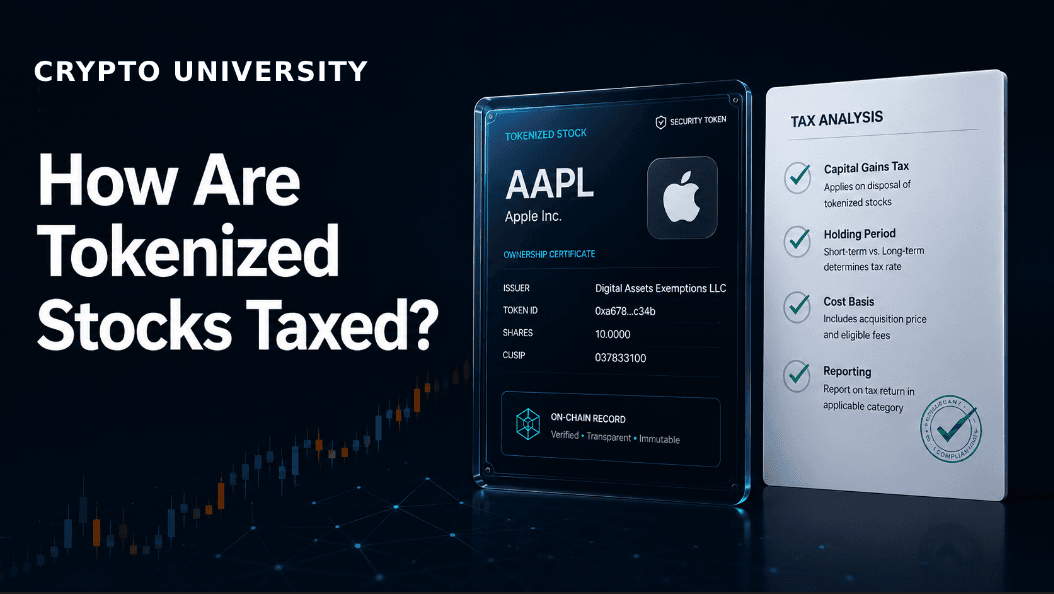
If you've bought a tokenized version of a stock like Tesla or Apple, or you're just thinking about it, one question tends to pop up fast: what happens at tax time? The honest answer is that nobody has fully figured this out yet, and that isn't a cop out. Tax authorities in most countries simply haven't published clear rules for these products. What follows is a plain-language look at what's generally true, where the grey areas are, and what you can do right now to protect yourself.
Read This First
This article is general information, not tax advice. Tokenized stock taxation is genuinely unsettled in most of the world, so anything involving real money belongs with a qualified tax professional in your own country. Keep that in the back of your mind as you read everything below.
Golden rule: when in doubt, write it down and ask a local professional. Good records and one good conversation will save you far more stress than any blog post. |
Why Tokenized Stock Tax Is So Confusing
A tokenized stock sits awkwardly between two tax systems your country probably already has. One system handles stocks (securities), and the other handles crypto (tokens). A tokenized stock is basically a share wrapped inside a token, so which set of rules applies?
Most tax offices haven't answered that question yet, and that silence is the single biggest fact about this whole topic. No clear rules also means no clear safe harbour, which is exactly why careful record-keeping matters more, not less. Here are the three directions your country might take.
Possible treatment | What it means | Likely tax effect |
|---|---|---|
As a security | It's taxed based on what it really is underneath: a share. | Gains are taxed like normal stock gains, and dividends like dividend income. |
As a crypto asset | It's taxed based on its technical form: a token. | Whatever your country's crypto rules are, they get applied to the token. |
As an undefined instrument | The reality in many places right now, where no clear label exists. | You and your adviser reason by analogy and document your thinking. |
The Moments That Usually Trigger Tax
Whatever label your country lands on, a handful of moments tend to be taxable almost everywhere. A safe habit is to treat each one as reportable unless a professional tells you otherwise.
Event | What happens | Watch out for |
|---|---|---|
Selling or swapping | Selling a tokenized stock for cash, stablecoins or another token usually creates a gain or loss. | In countries that tax crypto-to-crypto trades, swapping something like TSLAx for USDC counts even though no real cash moved. |
Dividend rebases | When your balance grows from a dividend, it may count as income now, or as something to sort out when you sell. | Treatment is unsettled, so log every rebase with the date and value, and note any tax already withheld upstream. |
Funding a buy with crypto | If you sold appreciated ETH to buy a tokenized stock, that sale was likely taxable on its own. | The taxable event can happen before your stock exposure even begins. |
Moving between your own wallets | Usually not taxable, because you haven't actually sold anything. | Still record it, so you don't later mistake a simple transfer for a sale. |
The Hidden Currency Trap
Most tokenized US stocks are priced in US dollars. If your home currency isn't the dollar, every position quietly carries currency gains and losses on top of the stock's own movement.
Some tax systems make you calculate your gain in your home currency using the exchange rate at each transaction. That means you could owe tax on currency movement even if the stock itself went nowhere. It surprises a lot of people, and it's exactly the kind of detail a local professional handles all the time.
The Records to Keep From Day One
Records are the one part of this whole topic that you fully control. Self-custody or a closed exchange account can wipe out your history overnight, so it pays to start logging early. Aim to capture the following for every transaction.
What to record | Why it matters |
|---|---|
Date and time | Fixes the exchange rate and the tax year the event belongs to. |
Asset and token | Identifies exactly what you traded when classifications differ. |
Quantity | The basic building block of any gain or loss calculation. |
Price and total value in your home currency | Lets you compute gains the way most tax systems expect. |
Fees | Often reduce your taxable gain, so they're worth keeping. |
What you paid with | Shows whether a swap itself was a taxable disposal. |
Wallet addresses and venue | Helps you trace and prove the history of each position. |
Dividend rebases (running log) | Captures value that may be income or basis later on. |
A couple of extra habits help too. Export your exchange statements regularly rather than trusting them to stay available. And while crypto tax software is getting better at importing token trades, the unclear classification of tokenized stocks means you should always sanity-check its assumptions with a real person.
A Simple Step-by-Step Approach
If all of this feels like a lot, here's a calm order of operations you can follow.
# | Step | What to do |
|---|---|---|
1 | Identify the structure | Find out whether your product is a certificate, note, dShare or derivative, since it shapes the security-versus-crypto argument. |
2 | Check your country's position | Look for official guidance on tokenized securities specifically. If there's none, that in itself is useful to know. |
3 | Bring in a local professional | For anything beyond tiny amounts, this is the step you really shouldn't skip. |
4 | Document your reasoning | Where the rules are silent, being consistent and defensible beats confident guessing. |
5 | Review every year | This area is being written in real time, so revisit your approach annually as the rules evolve. |
FAQ
Are tokenized stocks taxable?
In nearly all countries, selling them for a gain is taxable, and dividend value likely is too. The unsettled part is which set of rules applies (securities or crypto), not whether tax exists at all.
Is swapping a tokenized stock for a stablecoin a taxable event?
Usually yes, because it's treated as a disposal. In countries that tax crypto-to-crypto trades, swapping something like TSLAx for USDC is taxable even when no real cash is involved.
How are dividend rebases taxed?
It's unsettled. It might be income when you receive it, or basis that you deal with at sale. Log every rebase, ask a local professional, and remember that tax may already have been withheld upstream.
Do I owe tax if I just hold and my currency isn't the US dollar?
Holding alone usually isn't taxed. But when you sell, many systems make you calculate the gain in your home currency, which can capture US dollar and local currency movement on top of the stock's own move.
Can I rely on crypto tax software?
It's genuinely helpful for pulling in your data, but the unclear classification of tokenized stocks means its default treatment may be wrong for your country. Always verify with a professional.
Disclaimer: This content is for educational and informational purposes only and is not financial advice. Nothing here is a recommendation to buy or sell any asset or use any platform. Do your own research and manage your risk.
Explore the Crypto University Tokenized Stocks Directory.
Tokenized Stocks Explained: A Simple Guide for Beginner Traders
How to Buy Tokenized Stocks: A Step by Step Guide for Beginners
Can Tokenized Stocks Depeg From Real Shares? Premiums, Discounts and Tracking Error
Best Platforms for Tokenized Stocks: Exchanges, Brokers and Onchain Apps
Need deeper training?
Join our structured modules with live examples and expert checklists for effective implementation.
JOIN THE ACADEMY