Key Takeaways
Key Takeaway | |
|---|---|
1. | The share behind the token is held by the issuer either way, so the real choice is between platform risk (an exchange) and key-loss risk (you). |
2. | Exchanges are easier and more forgiving, with password recovery, tax statements, and instant cash-outs. Wallets give you 24/7 trading, DeFi access, and safety from exchange failures. |
3. | You don't have to pick a side. Most people are best off splitting their holdings: trade on the exchange, and keep long-term positions in a wallet. |
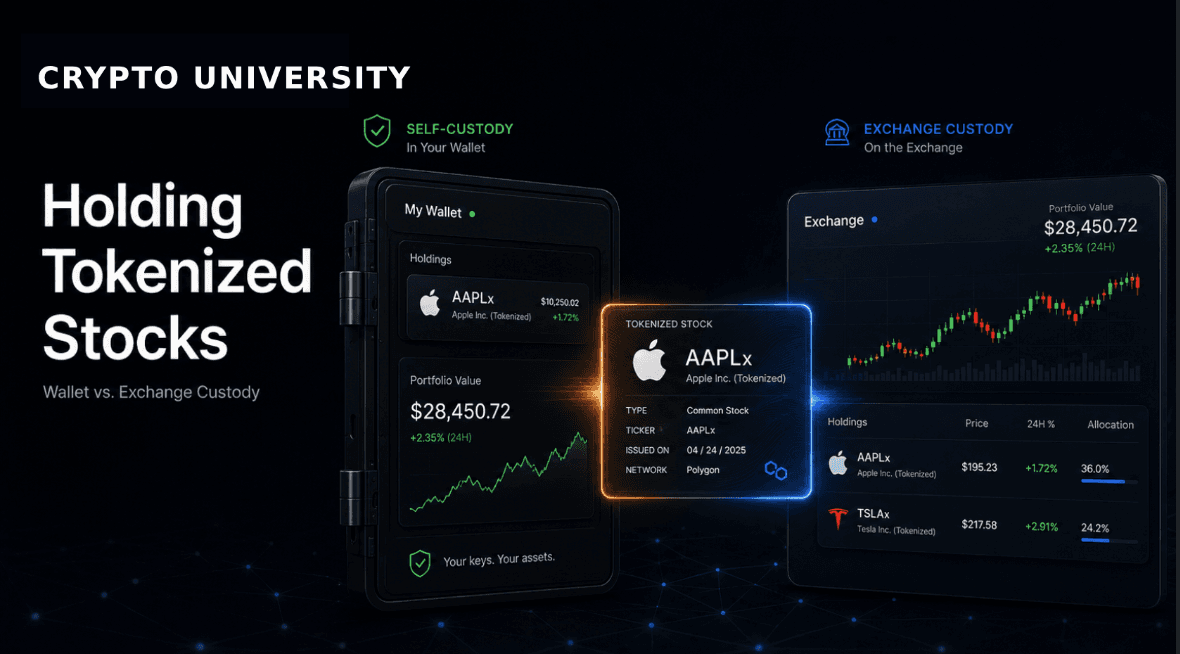
Crypto has an old saying: “not your keys, not your coins.” Now that you can buy tokenized versions of real stocks like Tesla, that same question shows up in a brand new place. Should you leave your tokenized stocks on the exchange where you bought them, or move them into your own wallet?
This is a real decision, not a hypothetical. Kraken already lets you withdraw xStocks to a Solana wallet, and some tokens live directly on Ethereum. The good news is that the answer is far more practical than the internet makes it sound. Let's walk through it together, step by step.
What You're Actually Deciding
Before anything else, it helps to know what this choice does and doesn't affect. It only concerns the token in your hands. The actual shares that back the token stay with the issuer no matter what you do, so the issuer risk is exactly the same either way.
What you're really deciding is simpler than it sounds: who could lose, freeze, or misuse the token itself? A company (the exchange), or you.
Exchange vs Wallet at a Glance
Here is the honest trade-off, side by side.
What matters | On the exchange | In your own wallet |
|---|---|---|
Platform failure | You're a creditor if the exchange collapses (the FTX lesson) | None. Exchange failures can't touch you |
Losing your keys | No risk. Account recovery exists | Total risk. Lose the keys, lose the tokens |
Trading hours | Exchange hours (often 24/5), deep order books | 24/7 on decentralized exchanges, thinner liquidity |
Dividends | Handled for you, with clean statements | Also automatic onchain, but you track the records |
Cashing out | Instant into cash or stablecoins | Swap to a stablecoin, then off-ramp separately |
DeFi use | Not available | Yes: pools, collateral, and transfers |
Account freezes | The platform can restrict your account | No platform layer to freeze you |
Estate planning | Account processes exist | You have to set this up yourself |
Best for | Active trading, income simplicity, beginners | Long-term holds, DeFi users, platform-risk minimizers |
A quick note before you act: withdrawal support varies by exchange and by asset, so always check each specific token before assuming you can move it.
Why You Might Keep Them on the Exchange
Exchanges are built for convenience and second chances. Everything happens in one place: trading, dividends, statements, and cashing out. Forgot your password? You can reset it. Need your tax history? You can usually export it in a click. And if you trade often, the deep order books on a big exchange matter more to you than round-the-clock access.
There's a catch, though. If the exchange collapses, you become one of many people waiting in line to get your money back, and the industry learned that lesson the hard way. Your account can also be frozen or restricted if the rules change, and if the platform goes down, you simply can't sell until it comes back up.
Why You Might Move Them to a Wallet
A personal wallet is about survival and freedom. If an exchange fails, freezes accounts, or changes its rules, none of that can reach tokens sitting in your own wallet. You can trade any time, day or night, and your tokens can plug into other DeFi apps. For people living somewhere with shaky banks or an unstable government, “no company can lock me out” isn't a marketing line, it's the entire point.
The trade-off is responsibility. If you lose your keys, your tokens are gone for good, with no reset button. Prices on decentralized exchanges can be thinner, cashing out means sending tokens back to an exchange eventually, and keeping your own records at tax time is entirely on you.
One myth is worth clearing up. Holding tokens in your own wallet does not make you invisible to the rules or to the tax office. The same restrictions follow the token, and your tax authority does not care where you stored it.
How It Works in Practice (xStocks Example)
If you decide to try self-custody, here's what the round trip actually looks like.
Step | What happens |
|---|---|
Withdrawing | On Kraken, xStocks come out as SPL tokens to any Solana address. Send a tiny test amount first, confirm it arrives, then move the rest. |
Holding | Dividends arrive automatically as onchain rebases, so your balance updates on its own with no action needed. |
Trading | Jupiter pulls together most of Solana's trading liquidity in one convenient place. |
Returning | To cash out, deposit the tokens back to a supporting exchange and sell them into regular money. |
The real cost | Solana fees are tiny. The true cost is simply staying careful and paying attention. |
The Simple, Sensible Answer: Do Both
For most people, the smartest move isn't picking a side, it's finding a balance. A common approach is to keep your trading money on the exchange, where buying, selling, and cashing out are fast, and keep your long-term holdings in a wallet, safe from platform problems.
Lean more toward the exchange if you trade actively and trust the platforms in your country. Lean more toward the wallet if you're holding for the long haul, use DeFi, or worry about being locked out. Then revisit the balance whenever something changes, like exchange news, your comfort with managing keys, or a move to a new country.
Frequently Asked Questions
Can I withdraw tokenized stocks to my own wallet?
Where it's supported, yes. Kraken lets you withdraw xStocks to Solana wallets, and Ondo tokens live natively onchain. Support varies by exchange and asset, so confirm it before buying if self-custody is your goal.
Do I still get dividends in self-custody?
Yes. Dividends apply at the token level onchain as rebases, so your wallet balance updates automatically. Just remember to keep your own records for taxes.
Is self-custody safer than an exchange?
It removes platform risk but adds key risk. Which one is safer depends on whether you're more likely to face an exchange failure or to lose your own keys. Be honest with yourself about the second one.
What happens to wallet-held tokens if the exchange I bought on fails?
Nothing. They sit outside the failure entirely. You'd simply sell them on a decentralized exchange or another supporting venue. This is the core argument for self-custody.
Can a frozen exchange or issuer touch my wallet-held tokens?
An exchange can't. Issuers of regulated tokenized equities do keep some token-level compliance powers under legal compulsion. It's rarely used, but never quite zero.
Disclaimer: This content is for educational and informational purposes only and is not financial advice. Nothing here is a recommendation to buy or sell any asset or use any platform. Do your own research and manage your risk.
Explore the Crypto University Tokenized Stocks Directory.
Tokenized Stocks Explained: A Simple Guide for Beginner Traders
How to Buy Tokenized Stocks: A Step by Step Guide for Beginners
Best Platforms for Tokenized Stocks: Exchanges, Brokers and Onchain Apps
Need deeper training?
Join our structured modules with live examples and expert checklists for effective implementation.
JOIN THE ACADEMY