Key Takeaways
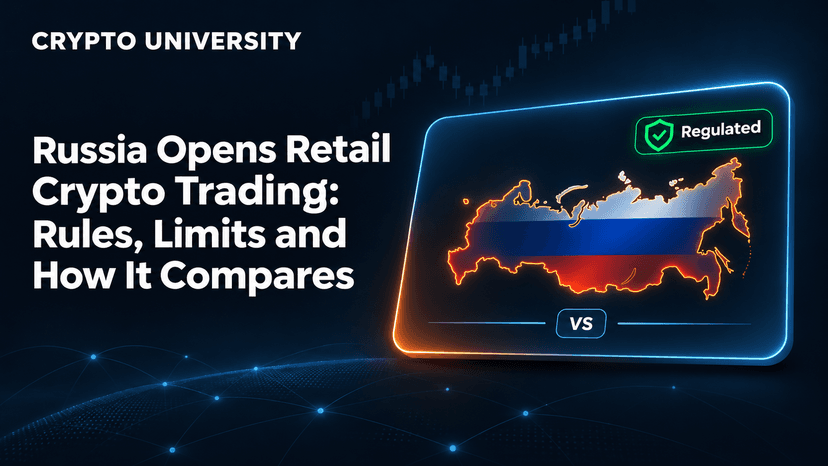
From November 17, 2026, licensed brokers, trust managers and crypto exchange offices in Russia can sell Bitcoin, Ether and USDT to ordinary retail investors.
"Non-qualified" investors can buy up to 300,000 rubles (about $3,700) of crypto per year through each intermediary, and every investor must pass a test first.
Russia is one example of a wider pattern. Countries limit who can buy crypto through investor categories, tests, caps, cooling-off periods, real-name accounts or outright bans.
What Changed in Russia
For years, Russia sat in a gray zone. Many Russians held crypto, but there was no clear legal path for an ordinary person to buy it through a regulated domestic company.
That changed in 2026. President Vladimir Putin signed the law "On Digital Currencies and Digital Rights" (Federal Law No. 282-FZ) on August 4, and most of it took effect on September 1. The law gives the Bank of Russia the power to decide which digital currencies can be traded on organized markets and to set the rules around that trading.
On November 6, the central bank used that power. It approved three assets for retail buyers: Bitcoin (BTC), Ether (ETH) and Tether's USDT. The ordinance takes effect on November 17, 2026.
Crypto is treated as a currency asset in Russia. People can buy and sell it, but it still cannot be used to pay for goods or services inside the country.
Timeline of Key Dates
Date | What happens |
|---|---|
August 4, 2026 | Crypto law signed by President Putin |
September 1, 2026 | Most of the law takes effect |
November 6, 2026 | Bank of Russia approves BTC, ETH and USDT for non-qualified investors |
November 17, 2026 | Approved asset list and retail purchase rules take effect |
November 22, 2026 | Exchanges may start organized crypto trading, once the central bank approves their trading rules |
December 1, 2026 | Moscow Exchange and Sberbank plan their first crypto launches |
July 1, 2027 | End of the transition period for market participants to get licences and comply |
November 17 or November 22? Two Dates Explained
You may see two different start dates in the news. Both are correct, because they cover different things.
November 17 is when the approved asset list takes effect. From this date, licensed intermediaries such as brokers, trust managers and crypto exchange offices can sell BTC, ETH and USDT to retail investors, both on exchanges and over the counter.
November 22 applies to exchanges that run organized trading. A separate central bank directive on organized crypto trading, registered by the Justice Ministry, takes effect on this date. Even then, each exchange can only start once the Bank of Russia approves its own trading rules.
Before they launch, exchanges must:
Register market participants
Keep separate records of orders and completed trades
Calculate price indicators, such as weighted average and closing prices
Report trading activity to the central bank, using the same process as for other financial instruments
So November 22 is the earliest possible date for exchange trading, not a guaranteed one. Moscow Exchange has said it is aiming for December 1.
Who Can Buy What
Russian law splits investors into two groups. The rules are very different for each.
Feature | Non-qualified investor | Qualified investor |
|---|---|---|
Who it covers | Most ordinary people | People who meet asset, experience or education criteria |
Assets allowed | BTC, ETH and USDT only | Any crypto, except anonymous (privacy) tokens |
Purchase limit | 300,000 rubles per year, per intermediary | No limit |
Knowledge test required | Yes | Yes |
Risk disclosure required | Yes | Yes |
Qualified status is based on the size of a person's assets, professional trading experience, or a certified financial qualification. Most Russians do not qualify. The Moscow Times reported that roughly 98% of Russian investors fall into the non-qualified group.
How the 300,000 Ruble Cap Works
The cap is set at 300,000 rubles per calendar year, per intermediary. At recent exchange rates, that is widely reported as about $3,700.
The phrase "per intermediary" matters. The limit applies to each broker or other licensed provider separately, not to the person as a whole.
Example: Anna uses two licensed brokers. She can buy up to 300,000 rubles of crypto through Broker A and another 300,000 rubles through Broker B in the same year. The cap does not combine across providers.
Reports on the new rules have not explained in detail what happens if someone tries to go past the cap. In practice, the intermediary is expected to block purchases above the limit.
Why Only Bitcoin, Ether and USDT?
The central bank picked assets using three criteria set out in the law:
Market capitalization, meaning the total value of the asset
Average daily trading volume, which shows how easily it can be bought and sold
At least five years of price history on foreign exchanges
The goal is to keep non-qualified investors away from the riskiest and least liquid parts of the market. Newer or smaller tokens do not meet these tests yet.
What Russians Still Cannot Do
The new rules open a door, but they come with clear limits.
No payments. Crypto still cannot be used to pay for goods or services in Russia.
No transfers to self-custody from regulated accounts. The law bars moving crypto from a regulated account to a personal wallet.
Peer-to-peer trading is being phased out. The central bank has said direct peer-to-peer trades will end in July 2027.
No privacy coins. Even qualified investors cannot trade anonymous tokens that hide transfer details.
How Other Countries Limit Who Can Buy Crypto
Russia's approach is strict, but the idea behind it is common. Most regulators try to protect retail investors while still allowing some access. They use different tools to do it.
Country or region | Main approach | Example of the rule |
|---|---|---|
Russia | Investor categories plus caps | 300,000 ruble yearly cap per intermediary for non-qualified investors, test for all |
United Kingdom | Friction before buying | 24-hour cooling-off period for first-time investors with a firm, plus an appropriateness test |
South Korea | Identity checks | Exchange accounts must link to a real-name bank account in the user's own name |
European Union | Rules on providers, not buyers | MiCA licenses crypto service providers but does not cap how much retail investors can buy |
China (mainland) | Outright ban | Crypto trading has been treated as illegal financial activity since 2021 |
The Common Tools Regulators Use
Investor categories. Separate rules for ordinary and professional or wealthy investors, as in Russia.
Knowledge or appropriateness tests. Checks that a buyer understands the risks, used in Russia and the UK.
Purchase caps. Hard limits on how much a person can buy. Russia's cap is one of the clearest examples.
Cooling-off periods. A forced wait before a first purchase, as in the UK.
Real-name and identity rules. Linking crypto accounts to verified bank accounts, as in South Korea.
Full bans. Blocking retail trading entirely, as in mainland China.
The UK cooling-off rule applies firm by firm. A person who already trades on one platform still has to wait 24 hours before their first purchase on a new one.
A quick overview of deeper detail on Compare Places to Buy Stablecoins Worldwide.
What This Means for Beginners
If you are learning how crypto rules work around the world, Russia is a useful case study. It shows a government moving from near-ban to tightly controlled access.
If you live in any country and want to buy crypto, the same questions apply:
Is the provider licensed or registered with your local regulator?
Are there limits on what you can buy, or how much?
Will you need to pass a test or wait before your first purchase?
Can you withdraw to your own wallet, or must assets stay with the provider?
How is crypto taxed where you live?
Rules change often. Always check your local regulator's official website before acting on news reports.
FAQ
When does retail crypto trading start in Russia?
The approved asset list takes effect on November 17, 2026, so licensed intermediaries can start selling to retail investors from then. Organized trading on exchanges can start from November 22, but only after the Bank of Russia approves each exchange's trading rules.
Which cryptocurrencies can ordinary Russians buy?
Non-qualified investors can buy only Bitcoin, Ether and Tether's USDT. Qualified investors can buy any cryptocurrency except anonymous privacy tokens.
Is the 300,000 ruble limit per person or per broker?
It applies per intermediary. A non-qualified investor can buy up to 300,000 rubles a year through each licensed broker or provider they use.
Do qualified investors have to take a test?
Yes. All investors, qualified or not, must pass a test and review the risks of crypto investing before they can trade.
Can Russians pay for things with crypto now?
No. Crypto can be bought and sold as an asset, but using it to pay for goods or services inside Russia remains banned.
Related Terms
Qualified Investor: A person who meets legal criteria for wealth, experience or education and is allowed to buy riskier financial products.
Stablecoin: A cryptocurrency designed to keep a steady value, usually by tracking a currency such as the US dollar.
Crypto Regulation: The laws and rules that governments set for how crypto can be issued, traded, held and taxed.
Disclaimer
This article is for educational purposes only. It is not financial, legal or tax advice. Crypto rules change often and differ by country. Check official sources and speak to a qualified professional before making any decisions.
Sources
Bank of Russia approval of BTC, ETH and USDT for retail and purchase cap details: CoinMarketCap Academy
Exchange trading from Nov 22 and exchange obligations: crypto.news
Exchanges need trading rules approved before launch: Bitcoin Magazine
Law passed by the State Duma, cap via one intermediary and transition to July 2027: Bank of Russia
Test requirement for all investors: Interfax
Share of non-qualified investors: The Moscow Times
UK 24-hour cooling-off and appropriateness rules: Reed Smith
South Korea real-name account rules: Crypto Briefing