Key Takeaways
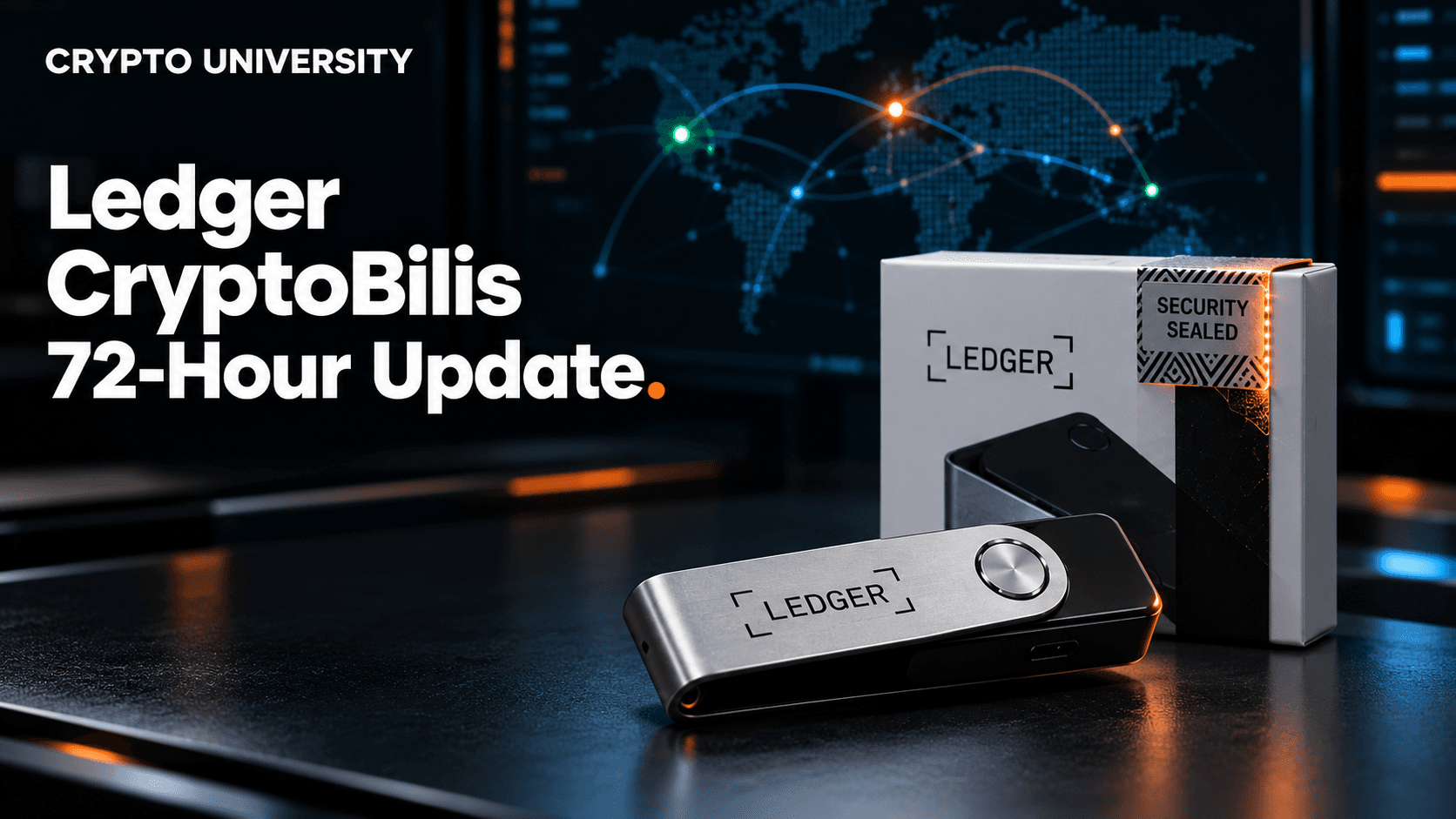
A supply chain attack targets the device before it reaches you. In the 2026 Ledger case, Ledger confirmed that at least one affected customer's device contained an unauthorized hardware implant, and the reported cases trace to devices sold by Southeast Asian reseller CryptoBilis.
Authenticity checks do not check everything. Ledger's Genuine Check proves the secure chip is real. Researchers say an implant that leaves the chip alone and reads the screen instead can still pass it.
Where you buy matters as much as what you buy. Buying direct, avoiding secondhand units, treating any seed shown on a suspect device as exposed, and spreading risk across devices all reduce the damage one tampered unit can do.
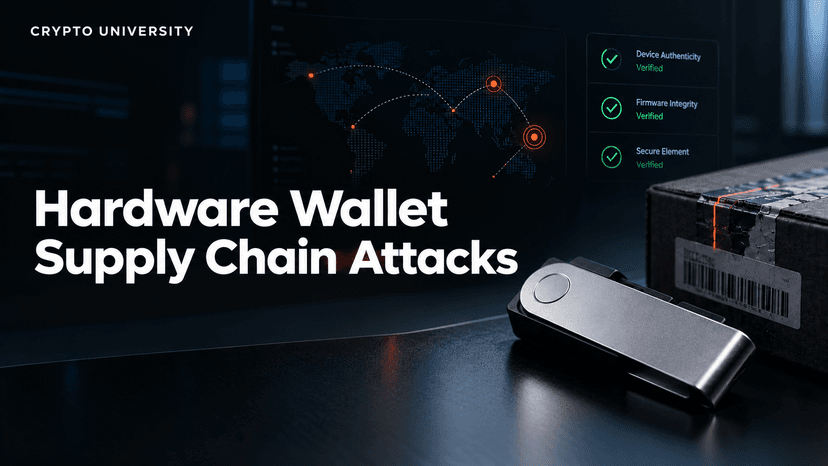
What Is a Hardware Wallet Supply Chain Attack?
A hardware wallet is a small device that stores the private keys to your crypto offline. Its main promise is simple: the secret that controls your funds, your seed phrase (also called a recovery phrase), never touches an internet-connected computer.
A supply chain attack goes around that promise. Instead of hacking the device after you own it, the attacker changes it somewhere between the factory and your hands. That could happen at a distributor, a reseller, a warehouse, during shipping, or in the secondhand market.
The device then looks normal and works normally. It simply has one extra job you do not know about: sending your secret to someone else.
The 2026 Ledger Implant Case: What Is Known
The facts are still developing. The table below separates what Ledger itself has said from what researchers and analysts have reported.
Claim | Source | Status |
|---|---|---|
Users who bought from reseller CryptoBilis lost funds | Ledger, October 9, 2026 | Confirmed by Ledger as under investigation |
CryptoBilis was told to pause all sales and shipments | Ledger | Confirmed |
One affected user's device contained an unauthorized hardware implant | Ledger, October 10, 2026 | Confirmed by Ledger for one device |
Ledger's own systems and direct sales were not compromised | Ledger | Ledger's position |
Losses of roughly $72 million to $93 million across about 311 to 315 wallets | On-chain analysts | Estimate, not confirmed by Ledger |
About $70 million of losses were USDT on TRON; Tether froze about $10 million | Media reports | Widely reported, not confirmed by Ledger |
A Nano X from Malaysia held an LTE modem, antenna, eSIM and microcontroller | Mark Karpelès | Researcher's findings |
A Nano X reportedly bought in Europe also held an implant | A user on X | Unverified; Ledger says confirmed cases involve CryptoBilis |
Timeline
Earlier in 2026: Hardware security researcher Joe Grand presented a teardown of an implant found in a secondhand Nano X bought online in Thailand. The owner noticed a smaller battery and a small green circuit board with an antenna.
October 9: Ledger said it was investigating losses among Southeast Asian users who bought from CryptoBilis, an authorized reseller listed for Indonesia, Malaysia, and the Philippines. It told buyers from the past 90 days not to set up their devices, and told those who already had to move assets to a new Ledger device with a new seed.
October 9: Mark Karpelès, the former head of Mt. Gox, posted photos of a tampered Nano X from Malaysia. Reports note it was not established that this unit came from CryptoBilis.
October 10: Ledger confirmed that one impacted user's device contained an unauthorized hardware implant. It said it was working with authorities and the security group SEAL 911. It has not named the model or said how many devices are affected.
October 11: A user reported an implant in a Nano X reportedly bought from MediaMarkt in Europe about two weeks earlier. The user said no funds were taken. Karpelès said the antenna carried a "Eurasian version" label, which may point to versions built for different mobile frequency bands. Ledger said all confirmed cases so far involve CryptoBilis and that it is reviewing authorized reseller controls.
Important: Ledger has not said the implant caused every reported loss. Some losses could have other causes, such as phishing. Treat the totals above as estimates.
How the Reported Implant Works
According to Karpelès and Grand, the attack does not break the secure chip at all. It watches what the chip sends to the screen.
The implant is hidden inside the case. In the Malaysian unit it sat where the screen's padding should be. In the Thailand unit, the battery was replaced with a smaller one to make room.
It taps the display connection. On the Nano X, the secure chip talks to the OLED screen over a wired link called the SPI bus. The implant's microcontroller listens to that link.
It captures the seed phrase. When you set up the device, it shows your 24 words on screen one by one. The implant reads them as they are drawn.
It sends the words out over a mobile network. The implant carries its own 4G modem and eSIM, so it does not need your phone, computer, Wi-Fi, or Bluetooth.
The attacker waits. With the seed in hand, the attacker can empty the wallet at any time, and can choose which wallets are worth the risk.
Why the Genuine Check Still Passed
Ledger's Genuine Check is a cryptographic test. The secure chip, called the secure element, proves it holds a secret key that only Ledger could have installed. This reliably detects a fake chip or modified firmware.
What it does not do is inspect every other part of the circuit board. An extra board that only listens to the screen leaves the secure element untouched, so the test passes.
What the Genuine Check verifies | What it cannot see |
|---|---|
The secure element is a real Ledger chip | Extra boards added inside the case |
The firmware is signed by Ledger | A listener on the display connection |
The device can sign transactions correctly | A swapped battery or added antenna |
What About Sealed Packaging?
Sealed packaging is not strong proof. Ledger has long said its devices are not shipped with tamper-evident seals and that security relies on the secure element instead. As reporting on this case points out, every pair of hands in the supply chain is a chance to open, modify, and reseal a box.
Past Ledger Supply Chain Incidents
This is not the first attempt to tamper with Ledger devices. It is, by most accounts, the first confirmed implant tied to an authorized reseller.
Year | Incident | Method |
|---|---|---|
2021 | Fake "replacement" Nano X units mailed to victims of Ledger's 2020 customer data leak | A USB thumb drive soldered inside to deliver malware |
2023 | Ledger Connect Kit software library compromised | Malicious code pushed to web apps, not to devices |
Early 2026 | Secondhand Nano X bought online in Thailand | Hidden board with antenna and smaller battery |
October 2026 | Devices sold via reseller CryptoBilis | Hardware implant confirmed by Ledger in one device |
How to Lower Your Risk
These are general safety steps for education, not financial or security advice.
Buy direct from the manufacturer when you can. In this case, Ledger said it had no reports involving devices bought directly from it. An authorized reseller is still a separate link in the chain.
Never buy secondhand or from marketplaces. A used or "open box" device is the easiest one to tamper with.
Follow official notices. If your device came from an affected channel, do not set it up. If you already did, treat the seed as exposed and move funds to a new device with a new seed.
Treat any seed shown on a suspect device as exposed. This includes a seed you restored by typing it into that device.
Look for physical warning signs. Unusual weight, loose casing, glue marks, or a battery that looks different from official photos all deserve a closer look. Opening a device may affect its warranty, so weigh that against the value you plan to store.
Spread the risk. A multisig setup needs signatures from several keys, ideally on devices from different makers and bought from different channels. One tampered device then cannot move funds on its own.
Report problems. Contact the manufacturer through its official support site and file a report with local law enforcement.
What This Means for Self-Custody
Some commentators now argue that hardware wallets can no longer be trusted. A more measured view is that the risk has moved. The secure chip still did its job; the weak point was the path the device took to reach the buyer.
That means buyers now need to think about trust in the supply chain, not just trust in the chip. Exchanges, software wallets, and hardware wallets all ask you to trust someone. The practical goal is to reduce how much you depend on any single party.
FAQ
Are all Ledger devices tampered with? No evidence shows that. Ledger says the confirmed cases involve devices sold through CryptoBilis, and that its own systems and direct sales were not compromised. A separate report from Europe has not been confirmed by Ledger.
Can a firmware update fix a hardware implant? No. The implant is extra physical hardware. Firmware runs on the secure element and cannot see or remove a separate board inside the case.
Does a sealed box prove my hardware wallet is safe? No. Packaging can be opened and resealed, and Ledger does not rely on tamper-evident seals. Buying from a trusted channel matters more.
I bought from CryptoBilis. What should I do? Ledger's public guidance is not to set up an unused device, and to move assets to a new Ledger device with a new seed if you already did. Contact Ledger Support only through its official website.
Is a hardware wallet still safer than leaving crypto on an exchange? It depends on your situation. Each option carries different risks. Hardware wallets remove exchange risk but add supply chain and personal storage risk.
Related Terms
Hardware Wallet: A physical device that stores the private keys to crypto offline and signs transactions without exposing them to the internet.
Supply Chain Attack: An attack that compromises a product somewhere between its maker and its user, such as at a distributor, reseller, or shipper.
Seed Phrase: A list of 12 to 24 words that can restore a crypto wallet and every key it controls.
Secure Element: A tamper-resistant chip designed to store secret keys and perform cryptographic operations safely.
Multisig: A wallet setup that requires signatures from more than one key before funds can move.
Sources
The Block, "Ledger investigates wallet drains involving CryptoBilis buyers; estimate tops $86 million in losses" (2026): https://theblock.co/news/business/2026-10-09-ledger-cryptobilis-fund-losses-418163
Decrypt, Ledger investigating CryptoBilis reseller losses (2026): https://decrypt.co/380582
Crypto Briefing, "Ledger users warned of potential implant in Malaysian devices" (2026): https://cryptobriefing.com/ledger-malaysia-hidden-implant-cryptobilis/
Crypto Briefing, "Ledger confirms draining cases linked to CryptoBilis-sold devices" (2026): https://cryptobriefing.com/ledger-cryptobilis-hardware-implant-draining/
Gizmodo, Ledger wallets reportedly backdoored, $71 million moved (2026): https://gizmodo.com/ledgers-crypto-wallets-reportedly-backdoored-71-million-in-crypto-already-moved-2000824372
Bitcoin.com News, "Ledger Confirms Hidden Hardware Implant in Affected User's Wallet" (2026): https://news.bitcoin.com/security/ledger-confirms-hidden-hardware-implant-in-affected-users-wallet/
Bitcoin.com News, "User Exposes Hidden Hardware Implant in European Ledger Wallet" (2026): https://news.bitcoin.com/security/user-exposes-hidden-hardware-implant-in-european-ledger-wallet/
GN Crypto, "Ledger Finds Hardware Implant in CryptoBilis Wallet, Warns Buyers" (2026): https://www.gncrypto.news/news/ledger-finds-hardware-implant-in-cryptobilis-wallet/
Joe Grand, Grand Idea Studio, "Reverse Engineering a Ledger Nano X Hardware Implant" (slides, 2026): https://grandideastudio.com/media/ledger_hardware_implant_slides.pdf
72 hour update on reseller CryptoBilis incident https://x.com/Ledger/status/2109331538072494364
Disclaimer: This article is for educational purposes only and does not constitute financial, legal or tax advice. Always verify details with official sources. All the information is based on the date of publication.