Key Takeaways
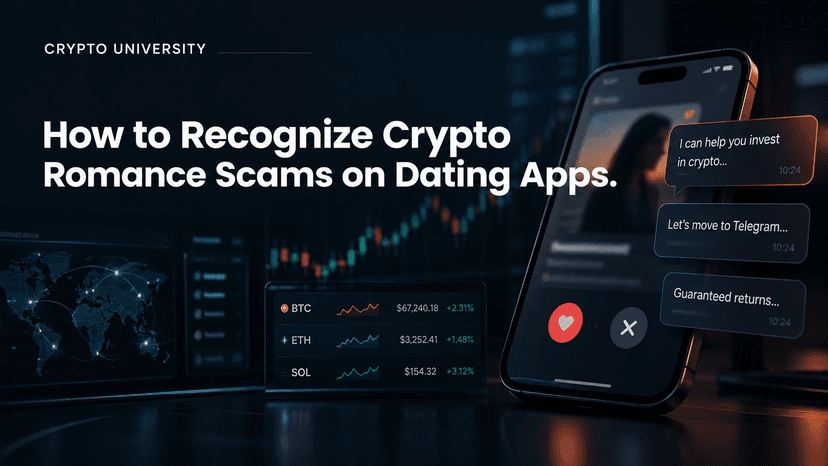
A crypto romance scam mixes a fake relationship with a fake investment. The scammer builds trust over weeks, then steers the victim toward a trading app or website that they control.
The warning signs follow a pattern. Moving the chat off the dating app, refusing video calls, talking about a "mentor" or "uncle" who trades crypto, and showing big profits on a platform you have never heard of are all common signals.
Act fast if you are targeted. Stop sending money, save every message and wallet address, and report it to your exchange, your bank, and official agencies such as the FBI's IC3 or the FTC. Be careful of "recovery" services that promise to get your money back.
What Is a Crypto Romance Scam?
A crypto romance scam is a type of fraud where a criminal pretends to be a romantic partner or close friend online, then uses that trust to get the victim to "invest" in cryptocurrency. The money does not go into a real investment. It goes straight to the scammer.
These scams are often called pig butchering, a translation of a Chinese phrase (sha zhu pan). The name refers to how scammers "fatten up" a victim with attention and fake profits before taking as much money as possible.
Dating apps are a common starting point because people there expect to talk with strangers and share personal details. But the same approach also appears on social media, messaging apps, and even through "wrong number" text messages.
Why this matters now
The FBI’s 2025 Internet Crime Report records substantial cryptocurrency-related losses. These figures describe complaints received by IC3, not the full scale of fraud or a count of dating-app scams.
Data point | Figure | Source |
|---|---|---|
Total losses reported to IC3 in 2025 | About $20.9 billion | FBI IC3 2025 report |
Losses involving cryptocurrency in 2025 | About $11.4 billion | FBI IC3 2025 report |
Crypto investment fraud losses in 2025 | About $7.28 billion | FBI IC3 2025 report |
Confidence/romance fraud losses in 2025, all payment methods | About $929 million | FBI IC3 2025 report |
These are reported losses only. Many victims never report, so the real totals are likely higher. Cryptocurrency is a descriptor that overlaps crime categories. The figures are not additive, and crypto investment fraud can involve a fabricated relationship even when classified as investment fraud. Read the FBI report.
How a Crypto Romance Scam Works: Step by Step
Most cases follow a similar script. Knowing the stages makes it easier to notice when a conversation is drifting into danger.
Step 1: The match or "accidental" contact
The scammer creates an attractive, polished profile. Photos are often stolen from real people or generated with AI. The profile may describe a successful career in finance, tech, medicine, or international business.
Step 2: Moving off the app
Within days, the scammer asks to continue the chat on WhatsApp, Telegram, WeChat, LINE, or Signal. The usual excuse is that they "rarely use the app." The real reason is that dating apps can detect and ban scam accounts, while private chats are harder to monitor.
Step 3: Building trust
The scammer messages daily, sometimes for weeks. They ask about your family, your job, and your goals. They share stories about their own life. This stage is about emotional connection, not money.
Step 4: The crypto introduction
Eventually, the scammer mentions that they make money trading crypto, often with help from a relative or "mentor" with inside knowledge. They do not ask for money directly. Instead, they offer to "teach" you.
Step 5: The fake platform
You are guided to download an app or visit a website that looks like a real exchange. You buy crypto on a legitimate exchange, then send it to a wallet address on the fake platform. The dashboard shows fast, impressive gains.
Step 6: Small withdrawal, bigger deposits
Some scammers let you withdraw a small amount early so the platform feels real. Then they push you to deposit more, sometimes by borrowing, using retirement savings, or selling property.
Step 7: The trap closes
When you try to withdraw a larger sum, the platform demands "taxes," "unlock fees," or "verification deposits." Paying these does not release your funds. Eventually the scammer and the platform disappear.
Red Flags to Watch For
The table below groups the most common warning signs by stage.
Stage | Red flag | Why it matters |
|---|---|---|
Profile | Photos look like a model shoot, or the person seems "too perfect" | Images are often stolen or AI generated |
Early chat | Pushes to move to WhatsApp or Telegram quickly | Avoids dating app safety systems |
Identity | Avoids live video calls or always has an excuse | Hides that the person is not who they claim |
Story | Works abroad, on an oil rig, in the military, or travels constantly | Explains why they can never meet |
Money talk | Mentions a crypto mentor, insider tips, or "guaranteed" returns | No legitimate trader can guarantee profits |
Platform | Asks you to use an unknown app or a link they send | Fake platforms show made-up balances |
Pressure | Creates urgency, such as a "limited window" to invest | Rushing stops you from checking facts |
Withdrawal | Requires fees or taxes before you can withdraw | A demand for a separate deposit to unlock purported profits is a strong scam warning |
Secrecy | Tells you not to tell family or your bank | Isolation keeps you from getting outside advice |
Keep dating and investment decisions separate: do not send money or use a trading platform on the recommendation of an online love interest.
How to Check If a Profile or Platform Is Real
You do not need technical skills to run a few basic checks.
Reverse image search their photos. Upload profile pictures to Google Images, Bing Visual Search, or TinEye. If the same photos show up under different names, that is a strong warning sign.
Ask for a live video call. A refusal can be a warning sign, but deepfake video and hired impersonators mean even an apparently convincing call is not proof.
Look up the trading platform. Search the platform name with words like "scam" or "fraud." Check whether it appears on regulator warning lists, such as state securities regulator alerts or the UK FCA Warning List. Absence from a warning list does not establish safety.
Check how you found the app. Be cautious if the app was shared through a direct link instead of an official app store, or if the website domain was registered very recently. App-store availability, a familiar logo, or a registration number does not prove the operator is genuine.
Talk to someone you trust. A friend or family member who is not emotionally involved can often see warning signs more clearly.
Legitimate exchange vs. fake platform
Feature | Legitimate exchange | Fake scam platform |
|---|---|---|
How you find it | Independently verified official website and app publisher | Link sent by an online contact or an impersonation app |
Regulation | Relevant permissions independently checked for the service and jurisdiction | Missing, irrelevant, copied, or fabricated registration details |
Withdrawals | Standard network fees, clear limits | Surprise "taxes" or "unlock fees" |
Customer support | Official help center | Support chat that pressures you to deposit more |
Returns | No promises of profit | Steady, unrealistic gains |
What to Do If You Think You Are Being Scammed
If any of this sounds familiar, take these steps right away.
Stop sending money to the suspected scam. Do not make additional deposits for supposed taxes or withdrawal-unlock fees.
Do not confront the scammer in a way that alerts them before you save your evidence.
Save everything. Take screenshots of chats, profiles, the platform, and transactions. Record wallet addresses and transaction IDs (also called hashes).
Contact your exchange and bank. Tell them which addresses received your funds. They may be able to flag the activity.
Report the scam. In the US, report to the FBI's Internet Crime Complaint Center (ic3.gov) and the FTC (ReportFraud.ftc.gov). In other countries, contact local police or your national fraud reporting center.
Report the profile to the dating app so it can be removed.
Watch for recovery scams. Scammers often return pretending to be lawyers, hackers, or government agents who can recover your crypto for a fee. The FBI warns that recovery-scam complaints may include losses from the earlier scam as well, so their loss totals should not be interpreted as additional recovery fees alone.
Recovery is not guaranteed, but early reports help. Through its Operation Level Up program, the FBI said it notified 3,780 victims in 2025, and most of them did not realize they were being scammed.
Who Is Behind These Scams?
Many crypto romance scams are run by organized criminal groups, not lone individuals. Investigations by governments and journalists have linked large operations to scam compounds in parts of Southeast Asia, where some workers are reportedly trafficked and forced to run scams.
In October 2025, the US Department of Justice announced charges against Chen Zhi, chairman of Cambodia's Prince Group, and a forfeiture action covering about 127,271 bitcoin, valued at roughly $15 billion at the time. Prosecutors alleged the bitcoin was linked to scam operations that used forced labor. These are allegations, not a criminal conviction; a civil forfeiture filing is not a final finding of ownership or a guarantee of repayment. DOJ’s October 14, 2025 announcement describes the charges.
FAQ
What is the difference between a romance scam and a crypto romance scam?
A traditional romance scam usually involves a direct request for money, such as for a medical emergency or travel costs. A crypto romance scam frames the request as an investment opportunity, which can feel less like giving money away and more like building wealth together.
Can I get my crypto back after a romance scam?
Recovery is sometimes possible, but no outcome is guaranteed. Confirmed blockchain transfers generally cannot be reversed by the sender. Prompt reports may help an exchange or investigators identify, freeze, or pursue funds through legal processes.
Are dating apps doing anything to stop these scams?
Many dating apps use automated systems and moderation teams to remove fake accounts, and they encourage users to report suspicious profiles. However, scammers try to move conversations off the app quickly to avoid these protections.
Is it a scam if they let me withdraw money once?
No. A successful small withdrawal does not establish safety. Allowing a small early withdrawal is a common tactic to build trust before encouraging much larger deposits.
Who should I report a crypto romance scam to?
In the US, report to the FBI IC3 and the FTC. Also contact your exchange, your bank, and the dating app. Outside the US, report to local police or your national fraud center.
Related Terms
Pig Butchering: A long-term scam where criminals build trust with a victim before stealing as much money as possible through fake investments.
Social Engineering: The use of psychological manipulation to trick people into giving up money, access, or information.
Crypto Wallet Address: A string of characters that identifies where cryptocurrency can be sent on a blockchain.
Transaction Hash: A unique ID that records a specific transaction on a blockchain and can be used to trace funds.
Recovery Scam: A follow-up fraud where scammers falsely promise to recover a victim's lost funds in exchange for a fee.
Sources
FBI IC3, 2025 Internet Crime Report, especially pages 8, 11–12, 20, and 53–55
FinCEN, Virtual Currency Investment Scam Alert, September 8, 2023
DOJ, Prince Group Chairman Indictment and Bitcoin Forfeiture Complaint, October 14, 2025
For general education, not individualized financial or legal advice.