Key Takeaways
- A crypto pump and dump is price manipulation. Insiders buy a cheap token, create hype or fake activity to push the price up, then sell to the late buyers who arrive.
- Small, thinly traded tokens are the usual targets. It takes little money to move their price, and fake volume can make them look popular.
- Late buyers face a serious risk of losses. Organizers aim to sell into the demand they create, leaving later buyers exposed when the price falls. A sharp rise alone does not prove manipulation.
What Is a Crypto Pump and Dump?
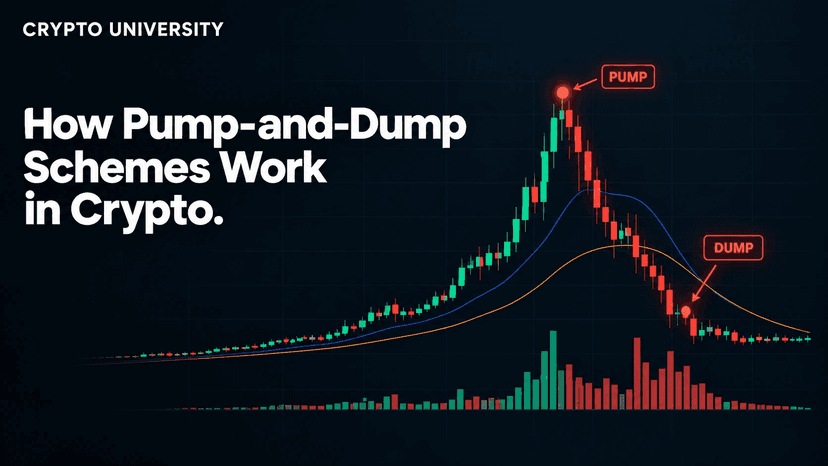
A crypto pump and dump is a scheme where a group buys a token at a low price, artificially pushes the price up (the "pump"), and then sells its holdings at the higher price (the "dump"). The scheme uses deceptive promotion, coordinated trading, or fake activity to create a misleading impression of demand. Genuine buyers may join in, but they are responding to a manipulated picture of the market.
Pump and dumps are older than crypto. In traditional markets they often involved cheap "penny stocks" promoted through cold calls, newsletters, or online forums. Crypto offers the same opportunity with fewer barriers:
- Anyone can create a new token in minutes and at low cost.
- Thousands of small tokens trade with very little daily volume.
- Social media, Telegram, and Discord make it easy to reach large audiences quickly.
- Permissionless exchanges can allow a token trading pool to be created without a centralized listing review.
- Real crypto success stories make sudden price jumps look believable.
Deceptive promotion and manipulative trading can lead to fraud or market-manipulation charges. The applicable law depends on the jurisdiction, conduct, and asset. In the US, the Department of Justice (DOJ) brings criminal cases, while the SEC and CFTC bring civil enforcement actions within their respective authority. The cases below illustrate those distinctions.
How a Pump and Dump Works, Step by Step
Most schemes follow a similar path, whether they are run by a single influencer or an organized group.
- Pick a target. Organizers look for tokens whose trading price can be moved relatively easily, often because liquidity and genuine trading activity are low. A low price per token alone does not mean a small market value.
- Accumulate quietly. Insiders buy large amounts before any promotion begins. In newly created tokens, the creators may already hold most of the supply.
- Create the appearance of demand. Some schemes use wash trading, where the same party buys and sells to itself to make volume look high. High volume can help a token appear on ranking sites and attract attention.
- Promote heavily. Promoters post about the token on social media, in chat groups, or through paid influencers. Messages often mention a big partnership, a coming exchange listing, or a "gem" that is about to take off.
- The pump. New buyers rush in. The price rises quickly, sometimes several times over in minutes or hours.
- The dump. Insiders sell into the buying wave. Because the token has little real demand, the selling crushes the price.
- The aftermath. The price falls far below the peak. Late buyers are left with losses, and the promoters often move on to the next token.
Why the Organizers Win and Late Buyers Lose
Organizers have an information and timing advantage. They know the target before the promotion, can acquire tokens earlier, and plan when to sell. Later buyers do not know when that selling will begin. Trading fees and price slippage add to the risk; a displayed gain is not the same as a gain that can be realized by selling.
| Participant | When they buy | When they sell | Typical result |
|---|---|---|---|
| Organizers and insiders | Before the promotion | Aim to sell during the price spike | Positioned to profit at later buyers' expense |
| Early followers | At the start of the pump | Try to sell shortly after | Uncertain; the price can reverse before they exit |
| Late buyers | Near the peak | After the crash, if at all | Losses |
Common Types of Crypto Pump and Dumps
The basic idea stays the same, but the delivery method changes.
| Type | How it works | Key feature |
|---|---|---|
| Pump groups | Organizers in Telegram or Discord announce a token at a set time and members buy together | Countdown to a "pump signal" |
| Influencer pumps | A well-known person promotes a token they already own, then sells | Hidden conflict of interest |
| Wash-trading-assisted pumps | Related accounts or coordinated traders create artificial trading activity to support the promotion | Fake volume can make demand look stronger than it is |
| New token launches | Creators hold most of the supply and sell after a hype-driven launch | Highly concentrated ownership |
Pump Groups on Telegram
A 2019 paper by Jiahua Xu and Benjamin Livshits, presented at the USENIX Security Symposium, analyzed 412 pump-and-dump events organized through Telegram between June 17, 2018 and February 26, 2019. It is evidence of how those groups operated during the study period, not a measurement of all crypto trading today. USENIX research paper
A timed buying signal does not give ordinary members the same position as an organizer who has already accumulated the token. The CFTC warns that these schemes can unfold within minutes and advises against buying solely on social-media tips or sudden price spikes. CFTC customer advisory
Pump and Dump vs Rug Pull
The two are related but not identical.
| Feature | Pump and dump | Rug pull |
|---|---|---|
| Main method | Hype and coordinated selling | Creators drain liquidity or block selling |
| Who can run it | Anyone who holds enough of a token | Usually the project's own developers |
| Token after the event | Still trades, at a much lower price | Often becomes untradable or worthless |
The mechanisms can overlap. Creators might promote a token, sell a large allocation into the resulting demand, and remove liquidity. A chart showing a high price does not establish that holders can sell their full position at that price. Selling restrictions and shallow liquidity can make the apparent gains impossible to realize.
Lessons From Real Cases
Case information was checked on October 16, 2026. An allegation, a civil settlement, and a criminal conviction are different outcomes.
John McAfee and Jimmy Gale Watson: Undisclosed Holdings
In March 2021, the CFTC charged John McAfee and his former employee Jimmy Gale Watson over an alleged pump-and-dump scheme. The complaint alleged that they accumulated tokens including verge (XVG), dogecoin (DOGE), and reddcoin (RDD), promoted them as longer-term investments, then sold into the resulting demand. It put the scheme's profits above $2 million. CFTC charging announcement
In July 2022, a court entered a consent order against Watson requiring more than $146,000 in disgorgement of gains and a separate, equal civil monetary penalty, along with trading and registration bans. This was a civil resolution, not a criminal conviction. CFTC judgment announcement
After McAfee's death, the SEC's separate claims against him were dismissed in July 2022. The allegations against him should not be described as a conviction. SEC litigation update
Lesson: When someone promotes a token, consider both compensation and existing holdings. Fame does not resolve a conflict of interest.
Operation Token Mirrors: Fake Volume for Hire
In October 2024, the DOJ announced charges against 18 individuals and entities in an investigation called Operation Token Mirrors. The FBI created a token called NexFundAI as part of its undercover work. Prosecutors described alleged manipulation involving token issuers and firms including Gotbit, ZM Quant, CLS Global, and MyTrade. The announcement reported more than $25 million in crypto seized and manipulation bots affecting about 60 cryptocurrencies disabled. The defendants' conduct and legal outcomes must be assessed separately. DOJ operation announcement
A later outcome was Gotbit's criminal resolution. After pleading guilty, founder Aleksei Andriunin was sentenced in June 2025 to eight months in prison. Gotbit was ordered to forfeit approximately $23 million in seized crypto and received five years of probation, during which it was to cease operating. The firm admitted manipulative trading involving clients including Saitama and Robo Inu. This forfeiture was not a statement that $23 million had been paid to victims. DOJ sentencing announcement
Related enforcement continued beyond those cases. In March 2026, federal prosecutors in Northern California announced separate cases against ten executives and employees connected to Gotbit, Vortex, Antier, and Contrarian. The DOJ reported that two defendants had pleaded guilty and been sentenced; the charges against the remaining defendants were allegations. DOJ's March 2026 announcement
Lesson: High reported volume is not proof of independent buyers or healthy liquidity. Some volume can be manufactured.
Common Red Flags
| Red flag | What it looks like | Why it matters |
|---|---|---|
| Sudden price spike without a clear explanation | A sharp rise accompanied by unverifiable claims | A reason to investigate, though volatility alone does not prove fraud |
| Urgency | "Buy now before it moons" | Rushed buyers skip basic checks |
| Undisclosed or coordinated promotion | Many accounts repeat the same claims without explaining their incentives | The apparent enthusiasm may be a paid campaign |
| Concentrated ownership | A few related holders appear to control much of the available supply | Large sellers may move the price; exchange, pool, and burn addresses need separate interpretation |
| Low liquidity | Small trading pools on one exchange | A few sales can move the price sharply |
| Unusual volume | Huge volume on a token with few holders | Possible wash trading |
| Countdown "signals" | "Coin announced at 8:00 PM UTC" | Classic pump-group format |
How to Protect Yourself
These are general research steps for education, not financial advice.
- Ask why the price is moving. Look for a verifiable reason, such as an official announcement. If there is none, be cautious.
- Check token holders. Use a public block explorer to examine large holders, while distinguishing exchange, liquidity-pool, vesting, and burn addresses. One person can also split holdings across many wallets.
- Check liquidity and markets. A token that trades on only one small pool can be hard to sell.
- Treat promoters as salespeople. Ask about payments and token holdings. FTC guidance calls for clear disclosure of material brand connections. Where the promoted asset is a security, securities-law anti-touting rules require disclosure of the nature, source, and amount of compensation. FTC disclosure guidance, SEC endorsement guidance
- Avoid pump groups entirely. A public signal does not remove organizers' head start or tell you when they will sell.
- Never chase a spike. By the time a pump is widely visible, insiders are often already selling.
What Happens After a Pump and Dump
Recovery is uncertain. A token may continue trading after manipulation, and a prosecution or civil judgment does not guarantee compensation. Investigations and court cases can take years. Seized assets, forfeiture orders, disgorgement, and penalties are different measures; none should automatically be described as money returned to victims.
As with other crypto frauds, victims are often targeted again by recovery scams that promise to retrieve lost funds for an upfront fee. Verify any recovery process through official law-enforcement, court, or regulator channels. Keep transaction IDs, wallet addresses, messages, and payment records. In the US, suspected internet fraud can be reported to the FBI Internet Crime Complaint Center; the CFTC also accepts tips about suspected manipulation. Elsewhere, contact the relevant local regulator or law-enforcement agency.
FAQ
What is a crypto pump and dump in simple terms? It is a scheme where insiders push up the price of a token with hype or fake trading, then sell their tokens to late buyers at the higher price.
Are crypto pump and dumps illegal? Deceptive promotion and manipulative trading can violate fraud and market-manipulation laws. The legal analysis depends on the country, the asset, and the conduct. US authorities have brought both criminal and civil cases against crypto promoters and trading-service providers.
How can I spot a pump and dump? Watch for sudden price spikes with no news, heavy promotion, urgency, a few wallets holding most of the supply, and unusually high volume on a small token. Several signs together are a strong warning.
Can you make money joining a pump group? Some traders may profit, but an organizer can buy before the public signal and sell into members' demand. You cannot reliably know when the selling will start, and participating can also create legal risks. A pump group is not a dependable investment strategy.
What is the difference between a pump and dump and a rug pull? A pump and dump uses hype and selling to crash a token's price. A rug pull usually involves developers draining liquidity or blocking sales, which can leave a token untradable.
Related Terms
- Pump and Dump: A scheme where a group artificially raises an asset's price and then sells it to later buyers at the inflated price.
- Wash Trading: Trades between commonly controlled accounts or coordinated parties that create a false appearance of genuine market activity.
- Market Manipulation: Any deliberate attempt to interfere with the fair price or volume of an asset.
- Liquidity: How easily an asset can be bought or sold without causing a large change in its price.
- Rug Pull: A scam where project creators suddenly withdraw funds or liquidity and abandon the project.
Sources
- CFTC: McAfee and Watson charging announcement (March 5, 2021)
- CFTC: Watson consent order (July 18, 2022)
- SEC: Watson judgment and dismissal of claims against McAfee (July 15, 2022)
- DOJ: Operation Token Mirrors charges (October 9, 2024)
- DOJ: Gotbit and Andriunin sentencing (June 13, 2025)
- DOJ: Separate market-manipulation cases (March 30, 2026; updated April 9, 2026)
- Xu and Livshits: The Anatomy of a Cryptocurrency Pump-and-Dump Scheme, USENIX Security (2019)
- CFTC: Pump-and-dump customer advisory (February 15, 2018)
- FTC: Disclosures 101 for Social Media Influencers
- SEC: Caution around celebrity-backed ICOs (November 1, 2017)