Key Takeaways
- A crypto Ponzi scheme pays earlier investors with newer investors' money. The promised returns are not supported by the investment profits the operator claims to earn.
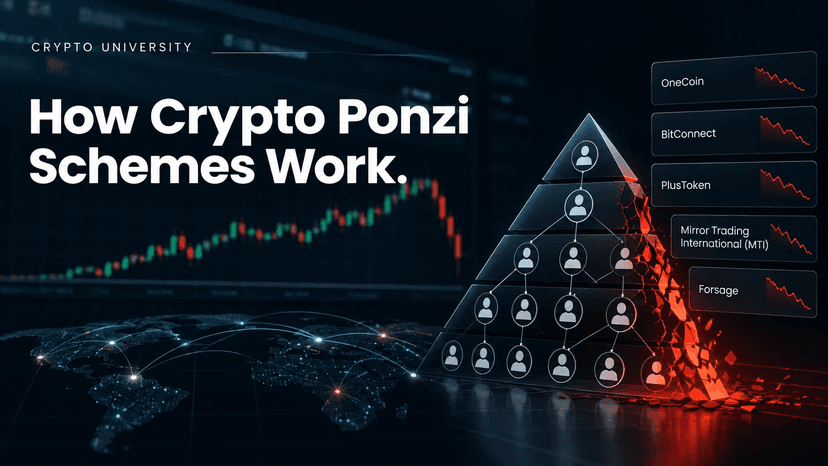
- Different frauds use similar sales tactics. BitConnect, OneCoin, PlusToken, Mirror Trading International, and Forsage illustrate combinations of false investment claims, recruitment incentives, and misleading uses of crypto technology. Some are better described as pyramid schemes, or as alleged combinations of the two.
- Payments funded by new deposits are unsustainable. When incoming funds and remaining assets cannot cover withdrawals, the scheme fails. Early payouts do not prove an investment is legitimate.
What Is a Crypto Ponzi Scheme?
A crypto Ponzi scheme is an investment fraud that pays earlier investors with money taken from newer investors, while claiming the returns come from trading, mining, lending, or some other crypto activity. The defining problem is the source of the payouts: new investor money is passed off as investment profit. An operator may conduct some real business, but that does not make deposit-funded returns legitimate. The scheme fails when new money and remaining assets cannot cover withdrawals.
The name comes from Charles Ponzi, who ran a similar fraud in Boston in 1920. Crypto versions use the same basic math but add modern packaging: trading bots, staking pools, smart contracts, and private tokens that the operators can create and price themselves.
Crypto is attractive to fraudsters for a few reasons:
- Many people do not yet understand how crypto yields are produced.
- Funds can move across borders quickly.
- Operators can launch a token or "platform" with little cost.
- Real crypto success stories make unrealistic promises sound possible.
How a Crypto Ponzi Scheme Works, Step by Step
Most schemes move through the same stages.
- The pitch. The platform promises steady, high returns, often daily or monthly. The source is described in vague terms such as "AI trading," "arbitrage," or "proprietary software."
- Early payouts. The first investors are paid on time. This builds trust and creates real testimonials.
- Recruitment. Investors earn bonuses for bringing in friends and family. Promoters post screenshots of earnings on social media and hold seminars or online events.
- Internal balances. Investors watch their balance grow on a dashboard. The figures may be fabricated database entries or denominated in an illiquid token. A displayed balance does not prove that withdrawable assets exist.
- Withdrawal friction. As money gets tight, the platform adds fees, lockup periods, withdrawal limits, or forced conversion into its own token.
- Collapse. Withdrawals stop. Operators blame hackers, regulators, or "maintenance," and often disappear with the remaining funds.
Why the Math Always Fails
Consider a platform that promises 10% per month. With compounding, $1,000 would need to become about $3,138 after one year. To fund that growth entirely from investment gains, the operator would need an annual return of about 214% before costs. A promise to deliver that consistently, without investment risk, is a major warning sign.
Without sufficient investment profits, payouts depend on attracting more deposits or consuming the money already collected. Reinvested balances can delay withdrawals, but they also increase what investors expect to receive. This does not create a sustainable business.
Ponzi Scheme vs Pyramid Scheme
The two terms are often used together, and many crypto frauds are both at once.
| Feature | Ponzi scheme | Pyramid scheme |
|---|---|---|
| Main promise | Passive returns from an investment | Income from recruiting others |
| Who pays you | The operator, using new deposits | Your recruits and their recruits |
| Role of recruiting | Not essential to the investment pitch | Recruiting and downline payments drive the compensation model |
| What hides the fraud | Fake trading results or balances | A product or "membership" with little real value |
| Crypto example | BitConnect | OneCoin; Forsage as alleged by US authorities |
Lessons From Real Cases
The cases below include criminal convictions, civil judgments, and unresolved allegations. Those are different legal outcomes. The figures describe different measures and time periods, so they should not be treated as a ranking of investor losses. Case information was checked on October 16, 2026.
| Case | Relevant period | Claimed activity | Reported scale | Documented legal milestone |
|---|---|---|---|---|
| OneCoin | Began in 2014 | Its own purported cryptocurrency and recruitment-based package sales | More than $4 billion invested, according to US prosecutors | Co-founder Karl Sebastian Greenwood sentenced to 20 years in 2023 |
| BitConnect | Lending program: early 2017 to January 2018 | A proprietary trading bot | About $2 billion alleged in the SEC's 2021 case | US promoter Glenn Arcaro sentenced to 38 months in 2022 |
| PlusToken | May 2018 to June 2019, according to Chinese prosecutors | A crypto platform with recruitment rewards | More than 2 million members reported by Chinese prosecutors | Prosecutor report described 16 first-instance convictions in September 2020 |
| Mirror Trading International (MTI) | May 2018 to March 2021, the period covered by the US order | A bitcoin-funded forex trading pool | At least 29,421 BTC, valued above $1.7 billion at the end of that period | MTI ordered to pay more than $1.7 billion in restitution in 2023 |
| Forsage | Launched in January 2020 | Smart-contract-based investment programs | More than $300 million alleged by the SEC; approximately $340 million alleged by DOJ | SEC charged 11 people in 2022; four founders criminally charged in 2023 |
OneCoin: A Coin With No Verifiable Blockchain
OneCoin was founded in Bulgaria in 2014 by Ruja Ignatova and Karl Sebastian Greenwood. It sold cryptocurrency packages through a multilevel-marketing network, with commissions for recruitment. US prosecutors said it lacked a genuine, verifiable blockchain and set its coin's price internally rather than through a market. Greenwood was sentenced to 20 years in prison in September 2023 and ordered to forfeit approximately $300 million. Forfeiture is distinct from a fine or an order compensating victims. DOJ sentencing announcement
Ignatova was added to the FBI's Ten Most Wanted Fugitives list in 2022. Her FBI wanted notice remained active when this article was checked. That notice concerns allegations against her, not a criminal conviction. FBI wanted notice
Lesson: An issuer-controlled price is not evidence that you can sell at that price. Check both what the asset represents and whether an independent market actually exists.
BitConnect: The Trading Bot Pitch
BitConnect's lending program ran from early 2017 through January 2018. The SEC alleged that its supposedly proprietary trading bot was a cover for diverting investors' money into wallets controlled by its founder and promoters. Its 2021 case alleged approximately $2 billion in fraud. SEC complaint announcement
Top US promoter Glenn Arcaro pleaded guilty to conspiracy to commit wire fraud and was sentenced to 38 months in prison in September 2022. The DOJ's sentencing announcement described payouts to earlier investors coming from later investors' deposits. DOJ sentencing announcement
Lesson: A secret trading system and impressive testimonials do not establish where investment returns come from.
PlusToken: Scale Through Layers of Recruits
PlusToken used crypto and blockchain language to market a recruitment-based platform. According to a September 2020 report published by China's Supreme People's Procuratorate, it developed more than 2 million members across over 3,000 recruitment levels between May 2018 and June 2019. Investigators said much of the crypto collected funded recruitment rewards, while some was converted for the organizers' personal spending.
The report described first-instance prison sentences of two to eleven years for 16 defendants for organizing or leading pyramid-selling activities, along with fines and confiscation of criminal assets. These figures describe that specific reported proceeding. Chinese prosecutor report, in Chinese
Lesson: A crypto app can be a front for a recruitment scheme. Ask where payments come from, not just what the app appears to do.
Mirror Trading International: False Trading Claims, Real Bitcoin
MTI solicited bitcoin for a pool that purportedly traded foreign exchange using proprietary software. A 2023 US court order found that it and founder Cornelius Johannes Steynberg had misappropriated the bitcoin collected. The order covered at least 29,421 BTC, valued above $1.7 billion at the end of the relevant period in March 2021.
In September 2023, the court ordered MTI to pay more than $1.7 billion in restitution. An earlier default judgment against Steynberg ordered more than $1.7 billion in restitution and a separate civil monetary penalty of more than $1.7 billion. These orders do not establish that victims received those amounts. CFTC account of the court orders
Lesson: A statement or dashboard is not independent verification. Even a visible wallet balance does not establish a business's profits, liabilities, or ability to repay everyone.
Forsage: Smart Contracts Can Automate a Scheme
Forsage used smart contracts on Ethereum, Tron, and what was then called Binance Smart Chain. In August 2022, the SEC charged 11 founders and promoters, alleging a Ponzi and pyramid scheme that raised more than $300 million. It alleged that new investors' assets were used to pay earlier investors and that recruitment drove rewards. SEC charging announcement
In February 2023, US prosecutors separately charged four founders with conspiracy to commit wire fraud in an alleged scheme involving approximately $340 million. The indictment alleged that one contract also diverted funds to founder-controlled accounts. Those criminal charges are allegations; an indictment is not a conviction. DOJ indictment announcement
Lesson: Public code can reveal how funds move, but it cannot make an unsustainable payment model sustainable. Being on a blockchain is not a safety label.
Common Red Flags
| Red flag | What it looks like | Why it matters |
|---|---|---|
| Guaranteed returns | "1% daily" or "10% monthly, no risk" | Real investments carry risk and returns vary |
| Vague strategy | "AI bot," "arbitrage," "secret algorithm" | Nothing can be checked or audited |
| Recruitment rewards | Referral bonuses, ranks, "levels" | Income depends on new money, not profit |
| Own token payouts | Rewards paid in a thinly traded platform token | A displayed token value may not be realizable in an independent market |
| Missing required registration | The operator cannot show authorization for the activity it offers | Requirements vary by product and country; a company registration alone is not an investment license |
| Withdrawal limits | New fees, lockups, delays | Often a sign of a cash shortage |
| Pressure and urgency | "Join before the price rises" | Rushed decisions skip basic checks |
How to Check a Platform Before Depositing
These are general research steps for education, not financial advice.
- Ask where the return comes from. If the answer is unclear, treat that as a serious warning.
- Check regulator registers and warning lists. Use the relevant regulator for your country and the activity offered. In the US, investment-adviser, broker, and derivatives registrations are different checks. Verify the exact legal entity and website, since scammers can impersonate registered firms. Registration is not a guarantee against loss.
- Verify assets independently. Look up the token on a public block explorer and examine its independent markets. A token's existence, an exchange listing, or a wallet balance alone does not prove a platform is solvent or profitable.
- Look for real company details. Named executives, a registered address, and audited financial statements.
- Be skeptical of promoters. People who earn referral commissions are not neutral sources.
- Remember that early payouts prove nothing. Paying early investors is how Ponzi schemes build trust.
What Happens After a Collapse
Recovery can take years and may be partial or impossible. A court order is not the same as money returned: defendants may lack sufficient assets. In January 2023, a US court ordered more than $17 million distributed to approximately 800 BitConnect victims. That was a specific recovery process, not reimbursement of everyone affected. DOJ restitution announcement
In the PlusToken proceeding described above, the prosecutor report said criminal assets were confiscated for the national treasury. Seizure and forfeiture therefore should not be assumed to mean compensation for participants.
After a collapse, victims are often targeted again by recovery scams that promise to retrieve lost funds for an upfront fee. Use official law-enforcement, court, or appointed-receiver channels to check any claimed recovery process. Save transaction IDs, wallet addresses, messages, and payment records. Do not pay an additional fee or supposed tax to unlock funds. SEC and CFTC investor alert
FAQ
What is a crypto Ponzi scheme in simple terms? It is a fake crypto investment that pays existing investors with money from new investors, instead of from real profits.
How can I tell if a crypto platform is a Ponzi scheme? Common signs include guaranteed high returns, a vague strategy, rewards for recruiting, payouts in the platform's own token, and missing authorization where it is required. No single sign proves fraud, but several together are a strong warning.
Is every high-yield crypto product a Ponzi scheme? No. Some yields come from real activity such as lending or staking. The key questions are where the yield comes from, whether it can be verified, and what risks exist.
What was the largest crypto Ponzi scheme? There is no single reliable ranking. OneCoin is a major crypto-branded pyramid fraud: US prosecutors reported more than $4 billion invested. Comparisons can be misleading because reports mix deposits, losses, and seized assets valued at different dates.
Can victims get their money back? Sometimes, through an official recovery or compensation process. Recovery depends on available assets and the applicable proceedings; it is never guaranteed. Be wary of anyone promising to retrieve funds for an upfront payment.
Related Terms
- Ponzi Scheme: An investment fraud that pays earlier investors using money from newer investors instead of real profits.
- Pyramid Scheme: A business model where participants earn mainly by recruiting others rather than by selling a real product or service.
- Smart Contract: A program on a blockchain that runs automatically when set conditions are met.
- Rug Pull: A scam where project creators suddenly withdraw funds or liquidity and abandon the project.
- Due Diligence: The research and checks a person does to verify an investment before committing money.
Sources
- SEC: BitConnect enforcement allegations (September 1, 2021)
- DOJ: Glenn Arcaro sentencing (September 16, 2022)
- DOJ: BitConnect restitution order (January 12, 2023)
- DOJ: OneCoin co-founder Greenwood sentencing (September 12, 2023)
- FBI: Ruja Ignatova wanted notice
- Supreme People's Procuratorate of China: PlusToken prosecution report (September 29, 2020; Chinese)
- CFTC: MTI restitution and related Steynberg judgment (September 7, 2023)
- SEC: Forsage civil charges (August 1, 2022)
- DOJ: Forsage founders' indictment (February 22, 2023)
- SEC and CFTC: Fraudulent crypto trading website investor alert