Key Takeaways
- Anyone who contacts you out of the blue promising to recover lost crypto for an upfront fee is almost certainly running a second scam. The FBI and FTC both warn about this pattern.
- A private recovery company cannot issue seizure orders. A lawyer can advise on civil remedies, but cannot promise repayment. US law enforcement does not charge victims to investigate crimes.
- The safest first steps are free: stop sending money, secure your accounts, save your evidence, and report to official channels such as IC3, the FTC, or your national police.
What Is a Crypto Recovery Scam?
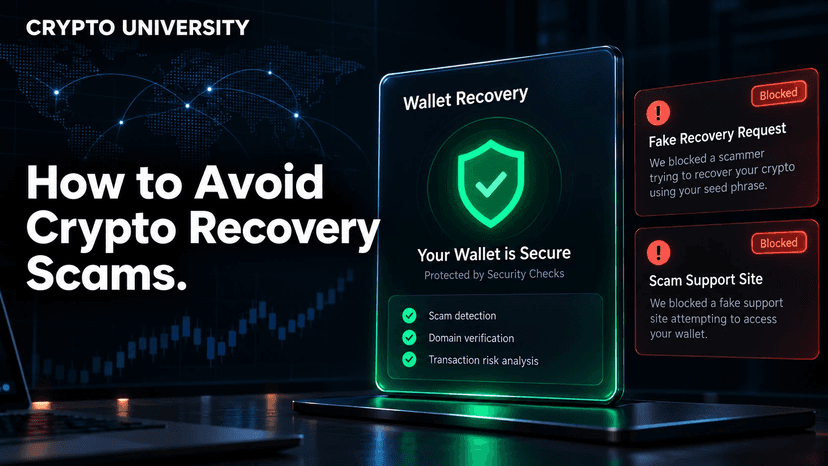
A crypto recovery scam is a follow-up fraud that targets people who have already lost money. The scammer poses as a recovery firm, a lawyer, a blockchain investigator, or a government official. They promise to trace and return your lost crypto. Then they ask you to pay a fee first.
The fee is the whole point. Once you pay, the "recovery agent" either disappears or invents a new charge. Victims can lose money twice: once to the original scam and again to the people claiming they will fix it.
This type of fraud is sometimes called a recovery room scam or a refund and recovery scam. It is a form of advance-fee fraud, where you are asked to pay money upfront for a benefit that never arrives.
Why This Matters Now
Crypto fraud has grown into one of the largest categories of reported online crime. That creates a large pool of victims for recovery scammers to target.
| Reported figure (FBI IC3) | Amount |
|---|---|
| All losses reported to IC3 in 2025 | About $20.9 billion |
| Crypto-related losses reported in 2025 | About $11.4 billion (a record) |
| Crypto investment fraud losses in 2025 | About $7.28 billion |
| Crypto losses reported by people aged 60 and over in 2025 | About $4.4 billion |
| Losses to fake law firms posing as recovery services (Feb 2023 to Feb 2024) | Over $9.9 million |
These are complaint figures from the FBI’s 2025 report and its June 2024 alert. The categories overlap and cover different periods; do not add them together. Real losses are likely higher, since many victims never file a report.
How Crypto Recovery Scams Work
Most recovery scams follow a similar path. Knowing the pattern makes it easier to spot.
Step 1: They Find You
Scammers reach victims in two main ways.
- They contact you directly. The FTC warns that scammers buy and share lists of people who have already been defrauded. These lists can include your name, contact details, the original scam, and how much you lost.
- You find them. The FBI has warned that fake recovery services advertise in search results, on social media, and in the comment sections of news articles and videos about crypto. When you post publicly that you were scammed, accounts may reply recommending a supposed "trusted recovery expert."
Step 2: They Build Trust
To look legitimate, scammers may:
- Claim to work with the FBI, the Consumer Financial Protection Bureau (CFPB), or another real agency
- Invent official sounding bodies, such as the fictitious "International Financial Trading Commission" named in an FBI alert
- Impersonate real lawyers and use fake documents with copied letterheads
- Quote the exact dates and amounts of your earlier transfers, which they may have obtained from victim lists or the original scammers
- Show polished websites, fake case numbers, and fake blockchain tracing reports
Step 3: They Ask for Money or Data
This is where the second loss happens. Common requests include:
- An upfront "retainer," "processing fee," or "tax" before funds can be released
- Payment in crypto, gift cards, or wire transfers
- Your bank details, ID documents, or Social Security number to "verify" your identity
- Your wallet seed phrase or remote access to your computer
- Registration with a foreign bank that supposedly holds your recovered funds
Step 4: The Fees Keep Coming
After the first payment, there is usually another obstacle. A compliance check, an unlock fee, or a "foreign bank charge" appears. The cycle continues until the victim stops paying.
Red Flags of a Fake Crypto Recovery Service
Use this table as a quick checklist. If you see even one of these signs, stop and verify independently.
| Red flag | Why it matters |
|---|---|
| They contacted you first | Unexpected outreach requires independent verification, even when the caller knows your case |
| They ask for an upfront fee | An unsolicited demand for money to release recovered funds is a classic warning; independently hired lawyers may charge disclosed fees |
| They guarantee results | No one can guarantee the return of stolen crypto |
| They want payment in crypto or gift cards | These methods are hard to reverse and are common scam requests |
| They claim a government partnership | A claim to be an FBI-authorized recovery partner is not proof of authority; verify it with the agency directly |
| They ask for your seed phrase | Anyone with your seed phrase can take everything in your wallet |
| They refuse video calls or will not show a license | Check identity and licensing independently; photos, documents, and video calls can be faked |
| They name an agency you cannot find | Fictitious regulators are a known tactic |
| They pressure you to act fast or keep it secret | Urgency and secrecy stop you from checking with others |
What Legitimate Help Actually Looks Like
It helps to understand what real recovery can and cannot do.
Private recovery firms have no power to issue seizure orders. The FBI explains that exchanges may freeze accounts through internal processes or in response to legal process. Victims can also seek legal advice about civil litigation. A court order still does not guarantee that assets will be available or returned.
Blockchain tracing is real, but it is not recovery. Analytics firms can follow funds across public blockchains. Tracing can provide leads, but attribution and cross-chain movements can be uncertain. It cannot reverse a confirmed transfer. Any recovery depends on the facts, accessible assets, service-provider cooperation, and applicable legal processes.
| Feature | Legitimate channel | Recovery scammer |
|---|---|---|
| Who starts contact | You initiate contact or independently verify official outreach | An unsolicited offer demands trust or payment |
| Cost to report | Free | Upfront fee required |
| Promises | No guarantees | "Guaranteed" or "100%" recovery |
| Identity | Verifiable through official websites | Hard to verify, avoids video |
| Payment method | No payment needed to report | Crypto, gift cards, wire transfers |
| Requests for seed phrase | Never | Often |
If you want legal help, choose a lawyer yourself. Look them up through your local or national bar association, and contact the firm using details you found independently. Do not use the phone number or link the caller gave you.
What to Do If You've Been Scammed: A Safe Step-by-Step Plan
Filing official reports is free and does not require a recovery service. Some security steps, such as moving crypto or revoking approvals, may incur network fees.
- Stop all payments. Do not send more money to anyone connected to the original scam, including people who later offer help.
- Secure your accounts. Use a clean device to change compromised passwords and enable strong two-factor authentication. If wallet keys were exposed, stop using that wallet and consult the wallet provider’s official guidance on securing remaining assets in a newly generated wallet. Do not import the old seed phrase into a new app and assume that makes it safe. Avoid adding gas blindly if an automated theft script may be watching the wallet.
- Save your evidence. Keep wallet addresses, transaction IDs (hashes), dates, amounts, screenshots, emails, and chat logs.
- Report to official channels. In the US, file at ic3.gov and ReportFraud.ftc.gov, and consider your state attorney general. Outside the US, report to your national police or fraud reporting center.
- Contact the exchange you used. If you sent funds from an exchange, tell its support team through the official app or website.
- Warn your contacts and stay alert. Expect follow-up contact from scammers. Treat any unsolicited recovery offer as suspicious.
- Get emotional support. Being scammed is stressful. Talking to trusted people helps you make calmer decisions.
When you report to IC3, the FBI also asks you to include details about anyone who contacted you offering recovery services. That information can help investigators.
How to Verify Anyone Who Offers Help
Before you share anything, run these checks:
- Look up the organization yourself. Search its name with words like "scam" or "complaint."
- Call the agency directly. If someone claims to be from the FBI, contact your local FBI field office using its official number.
- Verify professional credentials independently. Check the bar register and call the firm using independently sourced contact details. A license image or video call alone can be faked.
- Never share your seed phrase or private keys. No legitimate person needs them.
- Talk to someone you trust before paying. A second opinion often breaks the scammer's spell.
Frequently Asked Questions
Can stolen crypto be recovered?
Sometimes. An exchange may freeze identifiable assets, law enforcement may pursue them, or a victim may seek a civil remedy. Blockchain tracing alone does not return funds, and outcomes are never guaranteed.
Are all crypto recovery companies scams?
Not every firm that offers blockchain tracing is a scam. Guarantees and unsolicited demands for release fees are serious warning signs. A lawyer or tracing firm you independently hire may charge for genuine work, but cannot issue seizure orders or guarantee recovery.
Does the FBI or FTC charge fees to recover money?
US law enforcement does not charge victims to investigate, and official FTC refunds do not require a release fee. Verify any payment demand directly with the agency using its official website.
Why do scammers know details about my case?
Scammers may buy or share lists of past victims, or they may be linked to the original scam. Knowing your details does not make them legitimate.
Where should I report a crypto recovery scam?
In the US, report to IC3 at ic3.gov and to the FTC at ReportFraud.ftc.gov. Outside the US, contact your national police or fraud reporting center.
Related Terms
- Advance-Fee Fraud: A scam in which the victim pays money upfront for a promised benefit, such as a refund or prize, that never arrives.
- Pig Butchering: A long-running investment scam where fraudsters build a relationship with a victim before steering them into a fake crypto platform.
- Blockchain Analysis: The process of studying public blockchain data to trace how funds move between addresses.
- Social Engineering: Manipulating people through trust, fear, or urgency to get them to reveal information or send money.
- Seed Phrase: A list of words that can restore a crypto wallet and must never be shared with anyone.
Sources
- FBI IC3, Fraudulent Cryptocurrency Recovery Services, August 11, 2023
- FBI IC3, Fictitious Law Firms Targeting Cryptocurrency Scam Victims, June 24, 2024
- FBI IC3, Updated Fictitious Law Firm Warning, August 13, 2025
- FTC, Refund and Recovery Scams
- FBI IC3, 2025 Internet Crime Report, pages 8 and 52–55
This article is for educational purposes only and is not legal or financial advice.