What is the FOMO app?
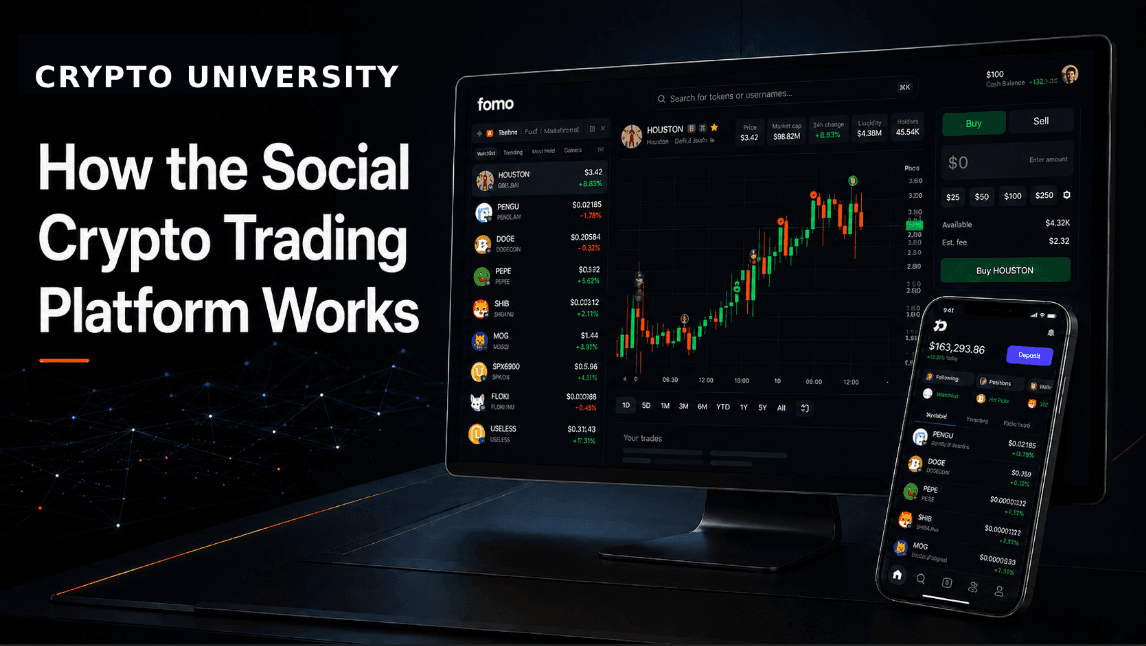
FOMO is a mobile-first social trading application for cryptocurrency, launched in May 2025 by Fomo Labs. It combines two things that used to live in separate apps: trading tokens and watching what other traders are doing. A memecoin, one of the asset types fomo is best known for, is a cryptocurrency whose value comes mainly from community attention and internet culture rather than from a product or revenue. The app runs on iOS, Android, and the web at fomo.family, and it reported more than 120,000 users within its first six months (a figure widely cited by the company and in press coverage).
The core idea is to reduce friction. Instead of juggling separate wallets, moving assets between blockchains, and paying a network fee (“gas”) on every action, fomo gives each user a single balance and handles much of that in the background. Social tools sit on top: a live feed of trades, public trader profiles, leaderboards, and the option to follow or copy other users.
Supported networks
fomo is built for cross-chain trading, which means a user can hold one balance and trade assets that live on different blockchains without manually moving funds between them. Based on company materials and press coverage, supported networks include:
Solana, the chain fomo launched on and still central to its memecoin activity
Base, an Ethereum layer-2 network
Ethereum
Bitcoin
Networks and listings change over time, so the current list on fomo.family is the authoritative source.
Main features
Social feed and profiles: Trades from people you follow appear as they happen, and trader profiles are public, so activity is observable rather than hidden.
Copy and “tail” trading: Follow selected traders for alerts, or mirror their trades automatically, with rules such as a minimum trade size. Note a key limit: seeing an entry is not the same as seeing an exit, so a copied position can leave you holding a token the original trader has already sold.
Leaderboards: Rankings highlight top-performing wallets. Useful for discovery, but they can be noisy or misleading, for example when large wallets move in a coordinated way.
Portfolio tools: Track performance over time, view equity curves, and review profit or loss by token and by trade.
Send and receive: Transfer tokens or USDC (a US-dollar stablecoin) to other users inside the app.
Referral program: Users can earn a share of fees from people they refer, and referred users usually get a fee discount.
How to set up a fomo account
Download the FOMO app from the App Store or Google Play, or open fomo.family in a browser.
Sign up with an Apple or Google account. There is no 12-word seed phrase to store, which removes one common way beginners lose access to funds.
Turn on two-factor authentication (2FA) before depositing. Because security rests on your login rather than a seed phrase, 2FA matters.
Add funds. fomo supports card payments including Apple Pay, alongside crypto deposits.
Explore the feed and follow a few traders. If you choose to trade, start with small amounts while you learn the interface.
Fees
fomo charges a flat 0.5% fee per transaction on buys and sells, according to the company and multiple reviews. The key points:
The 0.5% is generally described as covering blockchain and validator costs, rather than billing gas separately.
A minimum fee of roughly $1 per trade is widely reported, which makes very small trades proportionally more expensive.
Referral codes commonly advertise a 10% fee discount, which would lower the rate to about 0.45%. Treat referral offers as marketing and confirm current terms in the app.
Understanding the risks
Memecoin trading is high risk. This section is educational and is not financial advice.
Tokens can go to zero. Many memecoins lose most or all of their value, and some are outright scams, including “rug pulls” where creators drain the liquidity that lets people sell.
Social signals are not guarantees. A leaderboard rank or a track record describes the past and says nothing about the next trade.
Copying has blind spots. You may not see when a trader exits, so you can be left holding a position they have already closed.
Custody and access. Convenience features like social login mean you depend on that login and on the app's infrastructure. Understand how funds are held before depositing meaningfully.
Early-stage platform. fomo launched in 2025 and has raised roughly $19M, including a $17M Series A led by Benchmark, with several well-known backers. Even so, newer platforms carry more uncertainty than long-established ones.
Rather than reacting to a fast-moving price, cautious users tend to slow down and ask plain questions: What is this token, and who created it? How much would I be comfortable losing entirely? Am I copying an entry without knowing the exit? These are risk-awareness prompts, not signals to buy.
Pros and cons
Pros | Cons |
|---|---|
Fast, beginner-friendly mobile interface with social login and no seed phrase to manage. | Memecoin focus means very high volatility and real risk of total loss. |
Cross-chain balance removes manual bridging and per-action gas handling. | Copy trading shows entries but not always exits; leaderboards can be noisy or misleading. |
Transparency features (public profiles, live feed, portfolio tracking) make trader behaviour observable. | Early-stage platform; convenience relies on your login security and the app's infrastructure. |
Fees at a glance
Trading fee: flat 0.5% per transaction (buy or sell)
Minimum fee: about $1 per trade (widely reported)
Gas: no separate gas billing; the 0.5% is said to cover network and validator costs
Referral discount: commonly advertised at 10% off fees (about 0.45%); verify in-app
FAQ
Is the fomo app free to use?
The app is free to download and set up. You pay a fee per trade (a flat 0.5%, with a minimum of about $1), so there is no cost until you actually trade.
Which blockchains does fomo support?
It is cross-chain, with reported support for Solana, Base, Ethereum, and Bitcoin from a single balance. Check fomo.family for the current list.
Do I need a seed phrase?
No. You sign up with an Apple or Google account, so there is no 12-word phrase to store. Security then depends on your login, so enabling two-factor authentication is important.
What is copy trading, and is it safe?
Copy trading lets you mirror another user's trades automatically. It is not a safety guarantee: past results do not predict future trades, and you may not see when the original trader exits a position.
Can I lose money on fomo?
Yes. Memecoins and other volatile tokens can lose most or all of their value. Only trade what you can afford to lose, and treat this article as education, not financial advice.
Disclaimer: This content is for educational and informational purposes only and is not financial advice. Nothing here is a recommendation to buy or sell any asset or use any platform. Do your own research and manage your risk.
Revoke.cash: How to Check and Revoke Token Approvals to Protect Your Wallet
Chainlist: How to Find Chain IDs and Add EVM Networks to Your Wallet
Cryptocurrency Payment Gateways for Beginners: BTCPay Server Explained
What is DEXTools? How Crypto Traders Use It
Rugcheck Explained: How to Spot Scam Tokens on Solana in 2 Minutes