Key Takeaways
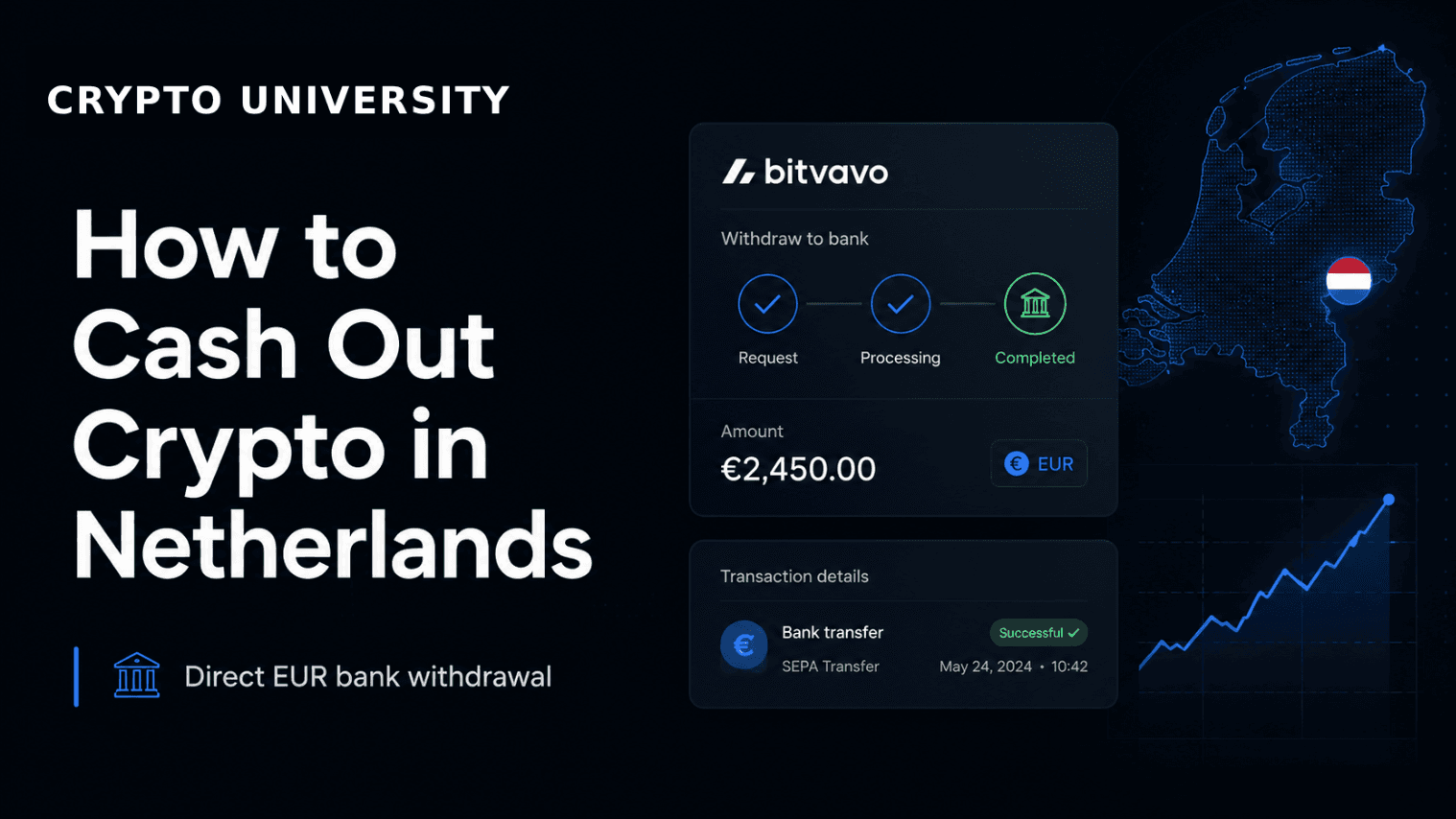
Use a licensed exchange. The most direct way to turn crypto into euros is through a MiCA-licensed platform such as Bitvavo, which lets you sell crypto and withdraw euros straight to a Dutch bank account by SEPA transfer, usually with no withdrawal fee.
Selling is not the taxable event. The Netherlands taxes crypto under the Box 3 wealth tax, based on the value of your holdings on 1 January, not on the profit from any single sale.
Large amounts trigger extra checks. Licensed exchanges are legally required to confirm your identity and the source of your funds under anti-money-laundering rules, so keep records ready.
Turning crypto back into spendable euros is one of the most common questions for people in the Netherlands, and in 2026 the process is more standardised than it used to be. The European MiCA regulation (Markets in Crypto-Assets) now sets a single rulebook for crypto platforms across the EU, and Dutch users have several licensed options to choose from. This guide explains the basic steps, compares the main ways to cash out, and covers fees, limits, large withdrawals, and how Dutch tax treats crypto. None of this is financial or tax advice. It is background to help you understand how the system works. Here is a quick overview of every confirmed MiCA-licensed consumer exchange on MICA tracker.
The Basic Process, Step by Step
At a high level, cashing out means converting a digital asset into euros and then moving those euros into your bank account. The steps are broadly the same whether you hold Bitcoin, Ethereum, or a stablecoin.
Choose a licensed exchange. Since MiCA became fully enforceable across the EU, any platform serving EU customers must hold a CASP (Crypto-Asset Service Provider) licence. Bitvavo is authorised by the Dutch regulator, the AFM.
Verify your identity. You complete a KYC (Know Your Customer) check with an ID document. This is a legal requirement, not an optional step.
Move your crypto to the exchange. If your coins sit in a self-custody wallet, send them to your exchange deposit address. If you already bought on the exchange, you can skip this step.
Sell the crypto for euros. Place a sell order. Once it fills, you hold a euro balance on the platform.
Withdraw euros to your bank. Link a bank account held in your own name, then request a SEPA withdrawal. The euros land in your account within one to a few business days.
Roughly how long each stage takes:
Stage | What happens | Typical time |
|---|---|---|
Account and KYC | Register and verify your identity once | Minutes to a day |
Crypto deposit | Send coins from a wallet to the exchange | Minutes to about an hour |
Selling | Market or limit order fills | Seconds to minutes |
Euro withdrawal | SEPA transfer to a Dutch bank account | 1 to 2 business days |
Times are typical and can vary with network congestion, weekends, and public holidays. Banks generally do not process transfers on weekends, so a Friday withdrawal may only arrive the following week.
Comparing Your Main Options
There is more than one way to convert crypto to euros in the Netherlands. Most people are best served by a single regulated exchange, but it helps to understand the alternatives.
Option 1: Bitvavo (Best Option for Most People)
Bitvavo is an Amsterdam-based exchange founded in 2018 and holds a MiCA licence from the AFM. It is widely reported as the largest retail crypto platform in the Netherlands. For cashing out, its main advantage is a direct euro bank withdrawal over SEPA. You sell your crypto for euros on the platform, then withdraw those euros to a linked Dutch (or European) bank account.
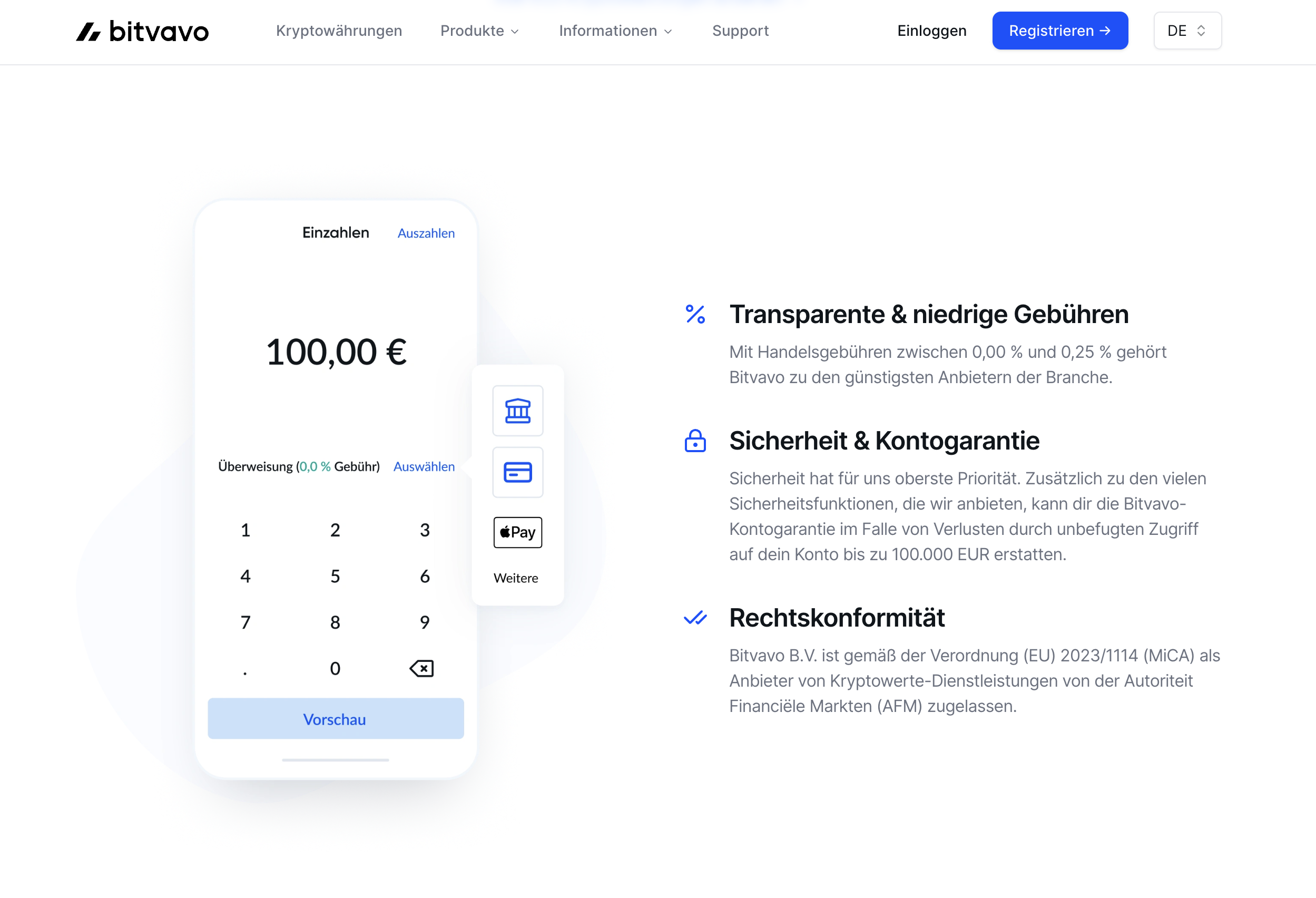
Trading fee: around 0.25% per trade for standard users, with a fee-free allowance on early trades for new accounts.
Euro deposits and withdrawals: free of charge.
Withdrawal speed: about one to two business days to a Dutch bank account.
Payout method: bank account only. You cannot withdraw euros to PayPal or a credit card, and the bank account must be in your own name.
Other Routes
These can make sense in specific situations, but they usually add cost, complexity, or risk compared with a direct exchange withdrawal.
Option | How it works | Typical speed | Best for |
|---|---|---|---|
Other licensed EU exchanges (Kraken, Coinbase, Coinmerce, Finst) | Sell for euros, then SEPA withdraw. Some are licensed via other EU regulators but can serve Dutch users under MiCA passporting. | 1 to 3 business days | People already using one of these platforms |
Crypto debit cards / broker apps | Spend a crypto-linked balance directly, or sell inside a broker app. Fees and spreads are often higher. | Instant to a few days | Small, everyday spending rather than large cash-outs |
Peer-to-peer (P2P) | Sell directly to another person for a bank transfer or cash. | Varies | Niche cases, higher personal risk |
OTC desks | A dealer arranges a private trade for large amounts at a negotiated price. | Same day to a few days | Very large amounts (see below) |
Which Crypto Should You Send?
If your coins are in a self-custody wallet, the asset and network you use to move them to the exchange affects both the fee and the arrival time. A few practical points:
Match the network the exchange expects. Sending an asset on the wrong network (for example, a token on a chain the exchange does not credit for that deposit) can lead to lost funds. Always copy the exact deposit address and select the correct network.
Network fees differ widely. Moving Bitcoin on its main network can cost more than moving a stablecoin on a low-fee chain. If you hold the same value in different forms, the cheaper-to-transfer asset can save on fees.
Stablecoins can simplify things. Some users convert volatile crypto to a euro or dollar stablecoin first, then transfer that. This locks in a value before the transfer, but you still sell it for euros on the exchange and it does not change your tax position.
Send a small test first. For a large transfer, many people send a small test amount, confirm it arrives, then send the rest.
There is no single "best coin" to send. The goal is simply low fees, a supported network, and a correct address. When in doubt, selling on the platform where the crypto already sits avoids transfers entirely.
Cashing Out Large Amounts
Larger cash-outs work the same way but run into daily limits and compliance checks. On Bitvavo, for example, the standard limit is a cumulative maximum for combined euro and crypto withdrawals within a 24-hour window, and higher amounts require documentation. Here is a quick overview of deeper detail on How to Cash Out Crypto.
Daily limit: Bitvavo lists a standard cap of around 25,000 EUR per 24 hours, counting euro and crypto withdrawals together.
Source-of-funds checks: to withdraw above the standard limit, you may need to provide evidence of where your funds came from. This is required under the Dutch anti-money-laundering law (the Wwft).
Spreading withdrawals: balances below a certain threshold can often be withdrawn in stages over a few days without extra paperwork, while very large balances trigger mandatory documentation.
Plan ahead: if you need a large sum by a certain date, start early. Verification and bank processing both take time.
Exact limits and thresholds change and vary by platform. Always check the provider's own current help pages before assuming a figure.
A Word on P2P and OTC Desks
Peer-to-peer (P2P) means selling your crypto directly to another individual, who pays you by bank transfer or, in some cases, cash. It can feel flexible, but it carries real risks: chargeback fraud, fake payment confirmations, and no regulated intermediary to help if something goes wrong. For most people, the small convenience is not worth the exposure.
OTC (over-the-counter) desks serve the opposite end of the market. An OTC desk arranges a private trade for a large amount at a negotiated price, which avoids moving the market on a public order book. Reputable desks are run by licensed firms and still apply full identity and source-of-funds checks. They are aimed at high-value sellers, not everyday users, and are not a shortcut around compliance.
Whichever route you consider, confirm the counterparty is legitimate. You can check whether a platform holds a valid CASP licence on the ESMA register or the AFM's own register.
What About Taxes?
Dutch crypto tax works differently from many other countries, and it surprises a lot of newcomers. This section is general information, not tax advice. For your own situation, check the Belastingdienst (Dutch Tax Administration) or a qualified adviser.
In the Netherlands, private individuals are generally taxed on crypto under Box 3, the wealth tax on savings and investments. The key point is that you are not taxed at the moment you sell. Instead, the value of your crypto on 1 January is counted as part of your total assets, and tax is calculated on a presumed (deemed) return over your assets above a tax-free allowance.
What is taxed | How it works | Notes |
|---|---|---|
Holding crypto as a private investor | Value on 1 January falls under Box 3. A presumed return is taxed, not your actual sale profit. | Deemed return for investments is roughly 6% (provisional and set yearly), taxed at 36% |
Tax-free allowance | A portion of your total assets is exempt each year. | Widely reported around 57,000 to 59,000 EUR per person for recent years |
Real return lower than assumed | Since a 2024 Supreme Court ruling, you can file an actual-return declaration (Opgaaf Werkelijk Rendement). | Can reduce the bill if your true return was lower or negative |
Mining or staking as a business | May be treated as income under Box 1 rather than Box 3. | Box 1 uses progressive income-tax rates |
Put simply, a private holder pays a small effective percentage on the value of their crypto each year, regardless of whether they sold. On a holding worth 50,000 EUR, the deemed-return method works out to a widely reported figure of roughly 1,000 to 1,100 EUR of tax for the year, not tax on the sale itself. Figures are provisional, change annually, and depend on your total assets, so treat these as widely reported estimates rather than fixed numbers.
A separate point worth knowing: from January 2026, crypto service providers in the EU report customer data to tax authorities under new reporting rules. In practice, this means the Belastingdienst increasingly receives information about holdings, so accurate self-reporting matters.
The Bottom Line
For most people in the Netherlands in 2026, cashing out crypto is straightforward: use a MiCA-licensed exchange, sell for euros, and withdraw to your own bank account by SEPA. Bitvavo is the most common choice because it offers direct, fee-free euro withdrawals to Dutch bank accounts and is regulated by the AFM.
Keep three things in mind. First, expect identity and source-of-funds checks, especially for large amounts. Second, remember that Dutch tax is based on the value of your holdings on 1 January under Box 3, not on the moment you sell. Third, be cautious with P2P trades and confirm any platform holds a valid licence before you send funds. Do those things and the process is predictable and low-stress.
Frequently Asked Questions
Is it legal to cash out crypto in the Netherlands?
Yes. Buying, holding, and selling crypto is legal. Platforms serving Dutch users must hold a MiCA CASP licence, and you are expected to report holdings for tax.
What is the cheapest way to convert crypto to euros?
Selling on a low-fee, regulated exchange and using a free SEPA withdrawal is usually cheapest. Bitvavo charges around 0.25% per trade and no euro withdrawal fee. Broker apps and crypto cards often cost more.
How long does a euro withdrawal take?
To a Dutch bank account, typically one to two business days. Weekends and public holidays can add delay because banks do not process transfers on those days.
Do I pay tax when I sell my crypto?
Not directly. The Netherlands taxes crypto under the Box 3 wealth tax, based on the value of your holdings on 1 January, not on the profit from a specific sale. Business activity like professional mining may fall under Box 1.
Can I withdraw a large amount at once?
There are daily limits (Bitvavo lists around 25,000 EUR per 24 hours across euro and crypto), and larger sums require source-of-funds documentation under anti-money-laundering rules. Plan ahead for big cash-outs.
Is P2P safe for cashing out?
It carries more risk than a regulated exchange, including payment fraud and no intermediary to help in a dispute. Most users are better served by a licensed platform.
How do I check if an exchange is licensed?
Look for the platform on the ESMA CASP register or the AFM's register. A valid MiCA licence lets a platform serve customers across the EU.
Sources
The following public sources informed this guide. Figures such as tax rates and withdrawal limits change over time, so confirm current details on the official pages before acting.
Bitvavo Help Center, euro deposits and withdrawals, withdrawal limits, and SEPA transfer pages (support.bitvavo.com).
Bitvavo press release, MiCA licence from the AFM (bitvavo.com).
AFM and ESMA registers of authorised Crypto-Asset Service Providers (CASPs) under MiCA.
Belastingdienst guidance on Box 3 (income from savings and investments), plus widely reported 2025 and 2026 figures from Dutch tax guides.
Public reporting on the 2024 Dutch Supreme Court ruling and the actual-return declaration (Opgaaf Werkelijk Rendement).
Public reporting on MiCA enforcement timelines in the Netherlands and the EU.
Disclaimer: This content is for educational and informational purposes only and is not financial advice. Nothing here is a recommendation to buy or sell any asset or use any platform. Do your own research and manage your risk.
How to Cash Out Crypto in UK in 2026
How RugCheck Works: A Beginner's Guide to Checking Solana Tokens
Best Crypto Off-Ramps in the UAE: OKX, BitOasis and Fasset Compared
Need deeper training?
Join our structured modules with live examples and expert checklists for effective implementation.
JOIN THE ACADEMY