Key Takeaways
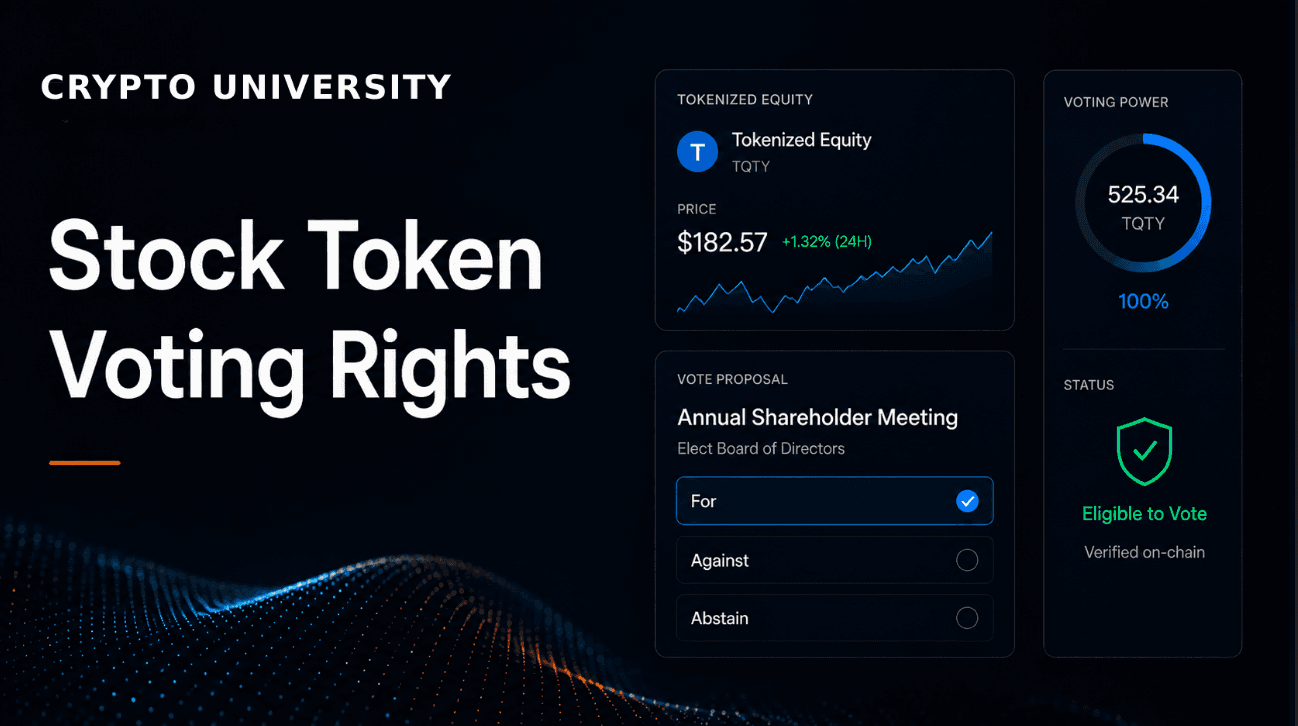
No mainstream tokenized stock gives you voting rights or puts your name on a company's shareholder register. This is by design, not a catch hidden in the fine print.
What you actually own is economic exposure — a certificate, note, or derivative that tracks the share price and often the dividends. The custody chain behind the product holds and votes the real shares.
For most small, passive investors this changes nothing. But if you care about voting, activist situations, dual-class shares, or legal standing, buy real shares through a broker instead.
The Short Answer
Here is the short version: no. The tokenized stocks you can buy today do not give you voting rights, and they do not make you a registered owner of the company's shares. That holds across every major product, whether it is xStocks, Robinhood's stock tokens, or Ondo's notes. US regulators drafting rules for tokenized equities have even floated leaving voting out on purpose.
So the real questions worth your attention are simple ones: what do you actually get, who votes the shares sitting behind your token, and when does that difference actually matter to you? Let's walk through each.
Why Tokens Don't Carry Votes
Voting rights belong to whoever's name sits on a company's shareholder register, or to someone whose broker passes the vote through to them. A tokenized stock puts a company (the issuer) in the middle. That issuer holds the real shares and hands you a token that tracks their value. So the registered owner is the custody chain, not you. Your token is a claim on how the stock performs, and that is all it is meant to be.
This is not a sneaky detail buried in a disclosure. It is the very thing that makes these products work. Passing votes through thousands of anonymous token holders across different blockchains and countries would need exactly the kind of shareholder-registry paperwork that tokenization is built to skip.
What You Own Instead, Product by Product
Here is how the four main products stack up. Every one of them gives you the price movement, but none of them gives you a vote or a spot on the register.
Product | What your token actually is | Price / dividends | Voting or register entry |
|---|---|---|---|
xStocks | A tracker certificate (a bearer debt instrument) from a Jersey company, backed one-to-one by the real share | Yes | No |
Ondo Global Markets | A note secured by shares held at US broker-dealers, built for total return | Yes | No |
Dinari dShares | Tokenized shares on regulated broker-dealer rails that keep dividends and corporate actions | Yes | No |
Robinhood stock tokens | A derivative or debt security that simply references the stock price | Yes | No |
So who actually votes? The shares sit in custody accounts, and whoever holds them decides how (or whether) to vote, based on the product's arrangements. In practice they are often voted conservatively or not at all. As more money flows into these products, a growing pile of dormant voting power builds up with custodians and issuers. That is an interesting governance question for the industry's future, but it changes nothing about your position today.
Want to compare what each token legally represents? The Crypto University Tokenized Stocks Directory tracks it asset by asset.
Does It Actually Matter for You?
Be honest about whether you would ever vote in the first place. Most small shareholders never do. Turnout among retail holders at annual meetings is famously low, and a 30-share position sways nothing. If that describes you, losing a right you would never use costs you close to nothing, and the phrase "no voting rights" may sound scarier than it really is.
That said, it genuinely matters in a few specific cases:
Situation | Why real ownership matters here |
|---|---|
Activist fights and contested votes | Proxy battles, merger approvals, and board fights all need registered shares if you want a say. These dramas play out without token holders. |
Dual-class shares | GOOGL and GOOG differ by voting power. Once tokenized, that difference disappears, so don't pay a premium for a vote the token strips away. |
Ownership as a principle | Some people want to own the actual thing, not a claim on it. That is a fair preference a token can't meet, but a brokerage can. |
Legal standing | Registered shareholders can get appraisal rights, class-action standing, and books-and-records access. Certificate holders sit in a different position. Rarely relevant, but never truly zero. |
Real Share Ownership: The Precise Version
When people ask "are these real shares?", three separate questions are hiding inside, and each has its own answer.
The question | The answer |
|---|---|
Do real shares exist behind the token? | Yes, for backed products. They are held one-to-one in custody and can be verified. |
Do you own those shares? | No. You own an instrument that references them. |
Does it matter? | For price and dividends, mostly no. For voting, legal standing, and bankruptcy situations, yes. |
The takeaway: be skeptical of any article, influencer, or listing that answers the first question ("yes, real shares exist") and quietly implies it means the second ("so you own them"). Those are not the same thing.
The Bottom Line
In every mainstream tokenized stock, there is no vote and no register entry, and that is on purpose. You are holding economic exposure through a certificate, note, dShare, or derivative, while the custody chain holds the real shares. For a passive small investor, the rights you give up are mostly theoretical. For activists, principle-driven owners, and dual-class buyers, they can be decisive. If voting is what you are after, buy shares through a broker, because no token is a substitute.
Frequently Asked Questions
Can I vote at a company's annual meeting with tokenized stocks?
No. Token holders are not registered shareholders, so you receive no proxy materials and get no voting access in any current mainstream product.
Who votes the shares backing my tokens?
The custody structure holding them does, based on its own arrangements. In practice they are often voted conservatively or not at all, and retail token holders have no input.
Are Dinari dShares real share ownership?
They are the closest structure available: tokenized shares on US broker-dealer rails with dividends preserved. But retail voting still doesn't pass through, and you are not the registered holder.
Do tokenized GOOGL tokens have more rights than GOOG tokens?
No. The underlying share classes differ in voting, but tokenization strips voting either way. You end up with two tokens that carry identical holder rights and simply track slightly different prices.
Could tokenized stocks ever include voting?
It is technically possible, with onchain identity plus registrar integration, and regulated rails like Dinari's are the likely path. But nothing mainstream offers it as of July 2026, and the SEC's sketched US framework openly contemplates tokens without voting rights.
Sources
Source | Link |
|---|---|
xStocks product legal overview | docs.xstocks.fi/docs/product-legal-overview |
Kraken xStocks FAQ | kraken.com/xstocks |
Ondo Global Markets documentation | docs.ondo.finance/ondo-global-markets |
Robinhood EU token disclosures | robinhood.com/eu/en/invest/ |
SEC innovation-exemption coverage | Tokens excluding shareholder rights (SEC proposed framework) |
Disclaimer: This content is for educational and informational purposes only and is not financial advice. Nothing here is a recommendation to buy or sell any asset or use any platform. Do your own research and manage your risk.
Explore the Crypto University Tokenized Stocks Directory.
Tokenized Stocks Explained: A Simple Guide for Beginner Traders
How to Buy Tokenized Stocks: A Step by Step Guide for Beginners
Can Tokenized Stocks Depeg From Real Shares? Premiums, Discounts and Tracking Error
How Tokenized Stocks Are Backed: Shares, Custody, Reserves and Synthetic Exposure
Best Platforms for Tokenized Stocks: Exchanges, Brokers and Onchain Apps
Need deeper training?
Join our structured modules with live examples and expert checklists for effective implementation.
JOIN THE ACADEMY